Showing posts with label animal welfare. Show all posts

July 22, 2011

Uplift fears: Scientists warn of 'Planet of the Apes' scenario

Wow, animal uplift just got a little bit more real: a recent report from the Academy of Medical Science suggests that action is needed now to prevent nightmarish "Planet Of The Apes" science ever turning from fiction to fact. The report calls for a new rules to supervise sensitive research that involves humanising animals:
One area of concern is "Category Three" experiments which may raise "very strong ethical concerns" and should be banned. An example given is the creation of primates with distinctly human characteristics, such as speech. Exactly the same scenario is portrayed in the new movie Rise Of The Planet Of The Apes, in which scientists searching for an Alzheimer's cure create a new breed of ape with human-like intelligence. The report also acknowledges the "Frankenstein fear" that humanising animals might lead to the creation of "monsters".

Currently research involving great apes, such as chimpanzees, is outlawed in the UK. But it continues in many other countries including the US, and British scientists are permitted to experiment on monkeys. Professor Thomas Baldwin, a member of the Academy of Medical Sciences working group that produced the report, said the possibility of humanised apes should be taken seriously.

"The fear is that if you start putting very large numbers of human brain cells into the brains of primates suddenly you might transform the primate into something that has some of the capacities that we regard as distinctively human.. speech, or other ways of being able to manipulate or relate to us," he told a news briefing in London.

"These possibilities that are at the moment largely explored in fiction we need to start thinking about now."

Prof Baldwin, professor of philosophy at the University of York, recommended applying the "Great Ape Test". If modified monkeys began to acquire abilities similar to those of chimpanzees, it was time to "hold off".

"If it's heading in that direction, red lights start flashing," said Prof Baldwin. "You really do not want to go down that road."
Okay,  I'm just as concerned as anyone about the potential for abuse, particularly when animals are used in scientific experiments. But setting that aside, and assuming that cognitive enhancement could be done safely on non-human primates, there's no reason why we should fear this. In fact, I take virtually the opposite stance to this report. I feel that humanity is obligated to uplift non-human animals as we simultaneously work to uplift ourselves (i.e. transhumanism).

Reading this report, I can't help but feel that human egocentricity is driving the discussion. I sincerely believe that animal welfare is not the real issue here, but rather, ensuring human dominance on the planet.

Ultimately, we have to ask ourselves, why wouldn't we wish to endow our primate cousins with the same cognitive gifts that we have? Human intelligence and complex language skills are our most prized attributes. The time is coming when we'll be ale to share these capacities with other animals.

February 19, 2011

Putting an end to dolphin exploitation at aquatic theme parks


A number of years ago I visited Sea World in Orlando, Florida. The experience proved to be a formative one, as it would mark the last time I would ever visit an aquatic theme park. What I saw there at the dolphin show that day shattered all illusions I had about the treatment of dolphins at these parks, while at the same time demonstrating to me the obvious ways in which they can express their individuality and intentions—and how this is conveniently ignored by us in ways that are completely self-serving.

The show got off to a rocky start. As the cheesy performance music blared through the loudspeakers, the trainers enthusiastically marched to the stage and assumed their positions. They blew their high-pitched whistles and waited for the dolphins to do their part.

But the dolphins ignored the cue. They swam nervously in their holding tank, circling and circling.

The trainers tried again, but the dolphins remained steadfast. They weren't going anywhere.

So, the trainers stopped the show and addressed the audience. We were told that, as a hierarchical species, the leaders of the troop were preventing the rest of the dolphins from partaking in the show. The reason, they suspected, was on account of a looming storm.

Indeed, hurricane Ernesto was slated to hit the region in the next 24 hours, and it's likely that the dolphins, sensing the low pressure system, were in a state of agitation. The last thing they wanted to do at that moment was to follow commands and perform tricks.

Unfazed, the trainers said they weren't about to let the dolphins have their way and that they were going to try and try again until they performed the show as expected.

Once again, the trainers marched to their stations and the cheesy music began anew. After another short delay, the dolphins finally decided to take part. But I have to say, it was the most half-assed effort I've ever seen put on by dolphins. They consistently missed their cues and went about their jumps and tricks as if they were just going through the motions.

What was happening was blatantly obvious to anyone paying attention: Their hearts were simply not into it.

As I sat there watching this spectacle, I started to feel ill, and I suddenly regretted coming to the park. I was hit hit with a glaringly obvious realization.

These dolphins are slaves.

Indeed, we are making these highly intelligent and emotional animals perform tricks against their will. They are confined to ridiculously small tanks and expected to perform on cue—and should they refuse, they're beaten back to submission by an unrelenting crew of trainers who simply won't take no for an answer—even if it's in front of a live audience.

Now, I realize that the dolphin show brings a lot of money to these parks—but the dolphin tank has got to go. It's cruelty through and through. As nonhuman persons, dolphins need to be protected from these kinds of abuses. They are not ours to play with.

We have no right to compel dolphins to entertain us. They deserve better than that. Moreover, we have no right to contain them in this way. Dolphins need to swim. In fact, in the wild, dolphins swim an average of 65 to 85 kilometers per day. The tanks at these theme parks must feel intensely claustrophobic to them. It's torturous.

And as I learned on that day at Sea World, dolphins are also capable of expressing their discontent. They can show us when they're not happy and they can express their will. We need to start paying attention and put aside our petty desire to watch dolphins jump through hoops.

It's time to stop this kind of animal exploitation.

Check out the IEET's Rights of Non-Human Persons program to learn more.

November 9, 2010

Lawrence Hansen: Animal researchers and animal rights advocates guilty of groupthink

Thomas Peter, Retuers
There's an interesting and thought-provoking article by Lawrence A. Hansen over at The Chronicle: Animal Research: Groupthink in Both Camps. Hansen, who is an animal researcher himself, makes the case that both animal researchers and defenders of animals are guilty of groupthink, a mode of thought that people engage in when they are profoundly involved in a cohesive in-group. This typically happens when members of a group strive for unanimity and override their motivations to realistically appraise alternative courses of action:
We faculty members with deep concerns for animal welfare are often viewed by our groupthink scientific colleagues as untrustworthy or even treasonous agents provocateurs, since we are inclined to raise both ethical and scientific objections to invasive and lethal animal experimentation, especially when it involves primates and companion animals—that is, dogs and cats.
Meanwhile, our animal-rights associates suspect us of insufficient ardor for animal welfare, since we acknowledge that not all research involving animals is torture, and many of us do not object when transgenic mice are painlessly euthanized after being well cared for during their short lives.
Groupthink among animal advocates, unless it leads to violence, is harmless enough, but it's self-defeating when the goal is to rally public opposition to vivisection (a term that encompasses both the dissection of living animals for teaching, and performing invasive, intentionally mutilating or maiming surgeries on living animals as a way to do research). A huge reservoir of empathy for our fellow primates and for companion animals goes untapped when PETA demonstrators protest biomedical research on mice or trivia like presidential fly swatting. It may well be that a Gandhi-like respect for all animal life represents the ultimate in human ethical evolution, but until that "consummation devoutly to be wished" is realized, apes and monkeys and dogs and cats are being confined, vivisected, and killed while animal advocates are ignored as a lunatic fringe.
But when it comes to animal vivisection in particular, Hansen paints a particularly grim picture of what goes on behind the scenes and the attitudes that perpetuate unethical research practices:
One especially disturbing example of primate vivisection repeatedly approved by many university animal-care-and-use committees is a decades-long series of highly invasive experiments performed on rhesus monkeys to learn more about the neuronal circuitry of visual tracking in the brain. The luckless monkeys undergo multiple surgeries to have coils implanted in both eyes; holes drilled in their skulls to allow researchers to selectively destroy some parts of their brains and put recording electrodes in others; and head-immobilization surgeries in which screws, bolts, and plates are directly attached to their skulls. The monkeys are anesthetized during these surgeries. After a recovery period, they are intentionally dehydrated to produce a water-deprivation "work ethic" so that they will visually track moving objects for the reward of a sip of water.

First impressions are usually correct in questions of cruelty to animals, and most of us cannot bear to even look at pictures of these monkeys, with their electrode-implanted brains and bolted heads, being put through their paces in a desperate attempt to get a life-sustaining sip of water. Such treatment is justified in the corresponding grant application by invoking the possibility that the resulting data may allow us to find the cause and cure for human diseases such as Alzheimer's.

But those of us who have spent decades in research on Alzheimer's disease recognize that such a justification is an ethical bait and switch, since the neural pathway being investigated in these experiments is not even involved in Alzheimer's disease. These experiments in the basic neuroscience of visual tracking are so thoroughly unrelated to the neuropathology of Alzheimer's disease that in more than 28 years of research in the neuroscience of the disease, I have never come across a single reference to them in any scientific literature on neurodegenerative disease.
Since most invasive monkey research is not directly linked to alleviating human suffering, argues Hansen, what is the real motivation of scientists doing such things to our cousin primates? "The investigators are not sadists, although they may seem to be from the monkey's point of view," he writes, "Researchers simply see themselves as doing neuroscience, reasoning that if you want to learn about how brains are wired, the easiest and most direct way is to selectively damage a living brain and see what happens."

Hansen's analysis is both fair and tempered; he concludes on a rather encouraging and enlightened note:
All these efforts reflect a growing awareness that neuroscientists wedded to primate vivisection as a way to conduct research are simply too biased by their own training, research agendas, and career considerations to objectively perform the kind of ethical cost-benefit analysis required before permitting primate vivisection. The trend toward outside supervision of animal vivisection parallels the point made by Georges Clemenceau, a French statesman and physician, who said, "War is too important to be left to the generals." Ethically aware citizens are increasingly concluding that primate vivisection is too important to be left to the researchers who dominate their university animal-care-and-use committees.

September 17, 2010

Peter Singer: Animal personhood by 2020

One of the many things I like about Peter Singer is his patient and pragmatic approach to animal rights. He realizes that major change doesn't happen overnight. So, instead of just hoping for a miraculous shift in public perception, Singer has methodically worked to see his vision for animal welfare and rights come to fruition. And in the grander scheme of things, that doesn't mean he can't dream big.

Writing in the Forbes article, 2020: Animal Advocates Surpass NRA In Political Influence, he speculates about what things might be like in ten years:
Perhaps even more significant has been the change in the legal status of animals, and the way we think about them. That movement began in Europe. Already in 2009 the European Union recognized it was wrong to think of animals merely as "property" and instead gave them a legal status that recognized them for what they are: "sentient beings." That opened the floodgates for court challenges against the confinement and mistreatment of animals.

In the United States the argument focused on our nearest relatives: chimpanzees, bonobos, gorillas and orangutans. Supported by expert evidence that great apes are self-aware, rational beings with close personal relationships and rich emotional lives, courts began to recognize them as having rights, and appointed guardians to protect those rights, in much the same way as they appoint guardians to protect the rights of people with intellectual disabilities. In 2019 the U.S. Supreme court effectively ended research on great apes by requiring consent to each experiment from a guardian concerned with the welfare of each experimental subject. The court left open for further argument the extension of this principle to other animals.
Fingers are crossed.

Link.

June 8, 2010

Singer: Religion's regressive hold on animal rights issues

Peter Singer wonders how we can promote the need for improved animal welfare when battling ancient religious views.
The chief minister's [Mohamad Ali Rustam of Malacca] comment is yet another illustration of the generally regressive influence that religion has on ethical issues – whether they are concerned with the status of women, with sexuality, with end-of-life decisions in medicine, with the environment, or with animals. Although religions do change, they change slowly, and tend to preserve attitudes that have become obsolete and often are positively harmful.

"Go forth and multiply" was a reasonable idea when the world had a few million humans in it. Now, unrestricted multiplication of our species has become a grave risk to the environment of our planet, and a significant cause of infant mortality and poverty. Yet some religious leaders continue to condemn not only abortion, but also contraception, and their condemnation of homosexuality also has the same roots in the non-reproductive nature of same-sex relationships.

In the same way, there has been great progress, worldwide, in attitudes to animals over the past century, but some religious believers, such as Mohamad Ali Rustam, remain stuck with attitudes that were formed many centuries ago.

Independently of the problems of reactionary religious belief, the trend to establish animal testing facilities in countries with weak or no regulations is an extremely worrying one. As regulations improve in Europe, North America, Australia and other countries, it seems that unscrupulous entrepreneurs are engaged in a race to the bottom.

If we are concerned about the exploitation of human workers in countries with low standards of worker protection, we should also be concerned about the treatment of even more defenceless non-human animals. At present, the only hope of reversing this trend seems to be pressure on companies not to test their products in countries without good animal welfare regulations, and pressure on research institutions not to have links with such countries. But to unravel the connections and make them clear to consumers is, unfortunately, going to be a difficult task.

June 6, 2010

Time: The quest for fake meat

Time Magazine on the potential for artificial meat.

Excerpt:
What has confounded fake-meat producers for years is the texture problem. Before an animal is killed, its flesh essentially marinates, for all the years that the animal lives, in the rich biological stew that we call blood: a fecund bath of oxygen, hormones, sugars and plasma. Vegan foods like tofu, tempeh (fermented soy) and seitan (wheat gluten) don't have the benefit of sloshing around in something so complex as blood before they go onto your plate. So how do you create fleshy, muscley texture without blood?

November 1, 2009

Elephant prosthetic

Elephant Prosthetic


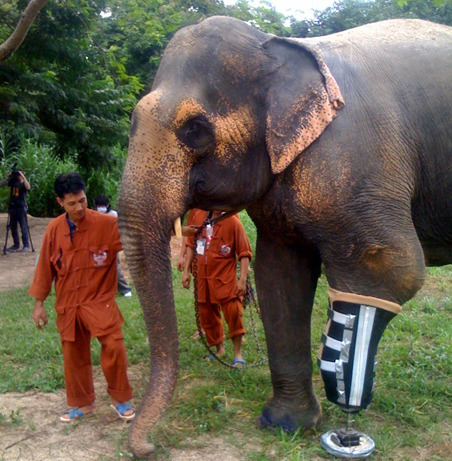
Several years ago, Motala, a 48-year old former working elephant from Thailand (she moved trees for a living), wandered into the forest to look for food and accidently stepped on a land mine left over from the Burmese-Thai War. The blast destroyed her left front leg and had to be amputated below the knee. In 2006, Motala got a temporary prothesis to help her learn to walk on what would be a more permanent artificial leg.

This past summer she was finally fitted for that leg in Thailand. It's a state-of-the-art upgrade to the artificial leg she's had for the last three years.

Accordingly to early reports Motala is taking to it quite well.

June 15, 2009

TED: Susan Savage-Rumbaugh on primate intelligence and culture [video]


From TED:
Into the great debate over intelligence and instinct -- over what makes us human -- Susan Savage-Rumbaugh has thrown a monkey wrench. Her work with apes has forced a new way of looking at what traits are truly and distinctly human, and new questions about whether some abilities we attribute to "species" are in fact due to an animal's social environment. She believes culture and tradition, in many cases more than biology, can account for differences between humans and other primates.

Her bonobo apes, including a superstar named Kanzi, understand spoken English, interact, and have learned to execute tasks once believed limited to humans -- such as starting and controlling a fire. They aren't trained in classic human-animal fashion. Like human children, the apes learn by watching. "Parents really don't know how they teach their children language," she has said. "Why should I have to know how I teach Kanzi language? I just act normal around him, and he learns it."
More: Sue Savage-Rumbaugh on the welfare of apes in captivity.

May 27, 2009

David Pearce: Post-Darwinian Ethics?

British philosopher David Pearce, who guest blogged here in April, has written a fascinating piece for H+ Magazine about post-Darwinian ethics and the principles of morals and legislation. Pearce writes:
Recent decades have witnessed a slowly expanding "circle of compassion". But it is a circle with one species at its absolute centre. Can Ethics ever aspire to be a rigorous academic discipline that delivers an impartial perspective embracing the interests of all sentient life: the well being of posthuman, human and non-human animals; hypothetical extra-terrestrial life, future "cyborgs", and artificial life alike? Or will Ethics always serve to rationalize the self-interest of the world's most powerful lifeforms?...

...Unfortunately, no such moral clarity was on display in the European Parliament earlier this month. An initial vote passed by EC legislators on May 5, 2009 sets guidelines on the "upper" limit of suffering that humans can lawfully inflict on non-human animals used in scientific experiments. Every year around 12 million non-human animals are used in scientific research in EU nations in the course of commercial product-testing, biomedical research, or open-ended scientific inquiry. Legally permissible levels of suffering inflicted can range from "up to mild" to "moderate" to "severe." Non-human animals are "reusable" if the testing entails up to "moderate" pain. The new EC regulations also cover our closest living relatives, non-human primates. Each year around 10,000 non-human primates are killed in European laboratories. The new parliamentary directive recommends phasing out wild-caught animals in favor of laboratory-bred animals over a 10-year period; and calls for an unspecified overall reduction in the number of non-human primates experimented on.
Be sure to read the entire article.

April 27, 2009

What is a person?

A number of Sentient Developments readers have asked what I mean when I refer to non-human persons and the personhood spectrum. It's a fair question, and to be honest, I have yet to see a satisfying personhood taxonomy with an attendant list of traits that fully circumscribe the personhood continuum. I consider this an incredibly important issue as we move into a 'transhuman condition' and as we work to give non-human animals greater moral consideration. If I ever go back to school I think this will be a likely topic for a thesis.

A big question I would like to answer is, should personhood status be described as a spectrum or as a definitive, fixed state. In other words, are dolphins and bonobos as much persons as a genetically modified and cyborgized transhuman? And is such a distinction even necessary? Should persons, regardless of where they are situated in the personhood spectrum, all have the same moral and legal considerations? More philosophically, given the space of all possible minds, how can we begin to identify the space of all possible persons within that gigantic spectrum?

As for defining and circumscribing personhood, a number of thinkers have tried to give it a shot. First out the gates was Joseph Fletcher, an Episcopalian theologian and bioethicist, who argued for a list of fifteen “positive propositions” of personhood. These attributes are:
  • minimum intelligence
  • self-awareness
  • self-control
  • a sense of time
  • a sense of futurity
  • a sense of the past
  • the capability of relating to others
  • concern for others
  • communication
  • control of existence
  • curiosity
  • change and changeability
  • balance of rationality and feeling
  • idiosyncrasy
  • neocortical functioning
Many of Fletcher's traits are fairly subjective, open to argument (e.g. how do you measure intelligence, and how intelligent is intelligent enough?) and difficult to test scientifically (at least by today's standards). But what's interesting about this list is that not all human beings qualify as persons, and not all persons qualify as human. Moreover, individuals, at one time or another, are not persons. Fletcher argued that some severely developmentally challenged humans were not persons, and that chimeras and cyborgs might someday qualify as persons (what he called "parahumans").

Further, as Linda MacDonald Glenn noted in her paper, "When Pigs Fly? Legal and Ethical Issues in Transgenics and the Creation of Chimeras," Fletcher's list is more of a continuum (which is not necessarily a problem -- an idea I'm rather partial to) than a description of a definitive and fixed state -- the advantage being that it would serve as a better model for application to legal theory and practice.

Looking to the future, and as we move forward with NBIC technologies, we run the risk of denying essential basic liberties to intelligent and sentient beings should we fail to better elucidate what it means to be a person (whether they be non-human animals or artificially intelligent agents). As Glenn notes, we need to be prepared to ask, "How can we preserve our human rights and dignity despite the fact that our 'humanness' may no longer be the exclusive possession of Homo sapiens?"

Thankfully there appears to be a trend in favor of widening the circle of moral consideration to some non-human animals. We obviously have laws against animal abuse, some animal experimentation, and unacceptably constrained levels of confinement. More significantly, however, a number of countries are looking to see highly sapient and emotional non-human animals like the great apes be given proper personhood status along with all the attendant legal protections.

Ultimately, what a lot of people need to realize is that their status as persons will not be diminished should "lesser" animals be granted personhood status. This is a common concern -- that it would be undignified for humans to have to recognize the presence of other persons who are not human.

There are two things I'll say to that: First, it's our humaneness and sense of social justice that's important -- not that we're "human," and second, as we work to develop greater-than-human artificial intelligence, we are poised to lose our exalted status as the the most "highly evolved" creature on the planet. We better position our laws and social mechanisms in such a way that all persons will be protected when the time comes (the caveat being that we'll actually have a say in the matter once we hit that Singularity point).

Support the Great Ape Project.

April 25, 2009

Special glasses to prevent eye-contact with gorillas at zoos [FAIL]

The Rotterdam Zoo is providing cardboard glasses to make it appear that visitors are looking off to one side. These are meant to prevent incidents in which gorillas attack visitors for making eye contact. The introduction of these glasses follows an attack on a woman by an escaped gorilla and are sponsored by a local health-insurance company.

This is just insanity. Gorillas simply do not belong in zoos where people get to gawk at them day after day. It's time for some serious animal welfare reform and the removal of all non-human animals from zoos who fall within the personhood spectrum.

April 15, 2009

Do you hate this ad?

PETA ran this ad campaign several years ago, and needless to say it was met with extreme negative reaction. You can read more about PETA and the use of Holocaust imagery over at Wikipedia.

For the record, I made a similar analogy a number of years ago.

So, what do you think? Did PETA go too far, or is it fair to compare?

February 28, 2009

Drug use among pets increasing

A recent National Geographic article addresses the increasing tendency of some pet owners to medicate their pets with anti-depressants and other psycho-pharmaceuticals that have been explicitly developed for humans.

The issue made headlines earlier this month after a pet chimp attacked a woman in Connecticut leaving her in critical condition. The chimp may have been given the anti-anxiety medication Xanax because he was agitated -- a claim that his owner later retracted.

According to NG:

Demand for anti-anxiety medications for pets is growing, in part because of increased public awareness of the drugs' potential benefits, said animal-behavior expert Bonnie Beaver of Texas A&M University's College of Veterinary Medicine.

It's not known, however, exactly how many pets are taking such drugs, Beaver said.

Common side effects of anti-anxiety medications in pets include drowsiness or sedation, said veterinary behaviorist Melissa Bain of the University of California, Davis.

But in dogs, drugs such as Xanax can reduce inhibition, worsening aggression problems, Bain said. Dogs that are both fearful and aggressive, for example, may lose their fear and lash out.

"We use [anti-anxiety medications] with caution in aggressive animals, by all means," she said.

Other side effects of Xanax, noticed in dogs and cats, include excitement, irritability, and increased affection.

I could write a tome about this topic. This trend raises a number of issues:
  • Should pet owners be allowed to medicate their pets (yes, in some circumstances)
  • Should pet owners medicate their pets with drugs intended for humans (probably not)
  • Should drug companies develop drugs specifically intended for pets? And if so, what psychological issues would these drugs address? Why? (probably yes -- all pets by definition have already been highly modified and domesticated; as for what psychological traits to address, that's an open question -- but perhaps human psychology may provide a clue)
  • Should people be allowed to have chimps (and other highly intelligent species) as pets? (definitely not)
  • Should people even be allowed to have pets (Peter Singer would say no)
I would be interested to hear what you think. Please feel free to share your thoughts on the matter.

January 27, 2009

The myth of our exalted human place - A SentDev Classic


I'm still stewing about Spiked Online and their misguided mission to malign the animal rights movement. In particular, I'm upset at Chris Pile's assertion that animal rights activists are acting misanthropically by putting the welfare of animals on par with those of humans.

It's similar to Wesley Smith's argument that transhumanists, like animal rights advocates, are demeaning humans by ascribing personhood characteristics to non-humans.

In the case of transhumanists, they're anticipating existence outside of the evolved human form and the rise of artificial intelligence and machine minds, whereas animal rights folks are acknowledging the personhood of gorillas, elephants, whales and dolphins. Ultimately, however, transhumanists and animal rights advocates are on the same wavelength in that they support the idea of non-anthropocentric personhood.

In his article, “The Transhumanists: The Next Great Threat to Human Dignity,” Smith declares that humans “are not just another animal in the forest,” and that “human life has ultimate value simply and merely because it is human.”

Of course, the argument that humans have value because they're human is not really an argument at all. Rather, it's a rhetorical tautology devoid of any substance – except for what it reveals about the person making the argument.

Like Pile, Smith believes that humans occupy a special metaphysical or exalted space somewhere between the beasts and gods. Even when framed in secular language, the allusion to religious sensibilities is inescapable and one that informs an indelible part of this ideology. Along similar lines, the whole idea of 'dignity' itself arose during the time of aristocracy, a period when the nobility accredited their 'blue blood' as the essence which separated them from the lesser members of humanity.

Consequently, those arguments that bemoan the demise of human dignity are conspicuously promoted by those who steadfastly cling to these notions as they have been reconstituted and manifested by 21st century concerns. I'm speaking, of course, of inhibitions against ascribing personhood to non-humans. This speciesism, or what James Hughes refers to as human-racism, is one of the worst prejudices of our time.

Today, our gods and kings have been replaced by reason and liberal democracies. As a society, we have grown increasingly tolerant and accommodating of minority groups and those without power. We no longer enslave the 'other' and relegate our women to second class citizenry for fear of undermining human dignity. Similarly, as we are coming to recognize the psychological and emotional workings of non-human animals, we stand to take our morality and ethical commitments to the next level.

At the very core, though, what the speciests cannot bear is when an animal's life is 'put ahead' of a human's. More accurately, what they find repugnant is the thought of a human death when a cure could have been developed through animal experimentation -- the underlying assumption being that an animal's life does not have the same value as a human's. To the speciest, the animal's suffering is either not really happening (i.e. the misconception that animals don't really feel things the way people do), or that its suffering is a justifiable sacrifice in the name of science or in helping more 'worthy' human lives.

These rationalizations are the result of human arrogance and a mass hallucination among those who condone and perform the work; they operate in total denial, deliberately choosing to ignore the overwhelming evidence that animals get frightened and can experience pain the same way we do. There's also the 'blame the victim' mentality. In 2004, for example, PETA recorded the conversations of Covance technicians as they were restraining monkeys: "Goddamn...I'm gonna knock you out...you little bitch...you little hateful ass, you."

There is no doubt that much scientific and medical advancement has occurred as a result of animal experimentation. But this is tainted knowledge, much like the tainted knowledge acquired by the Nazi doctors who tested on human subjects. Nazi doctors weren't so much sadistic as they felt their work was justified. Much like we have devalued the life and well-being of non-human animals, the Nazis de-valued an entire race of people.

Without a doubt many lives could be saved today if we allowed the inhumane testing of human subjects. But what a repulsive and abhorrent idea! It for this exact same sense of repulsion and abhorrence that we cannot continue to allow cruel experimentation on animals deserving of personhood status and moral consideration. Denying the psychological experience of each and every animal that is experimented upon is a gross breach of our reason and moral sensibilities.

And contrary to what Spiked Online, Chris Pile and Wesley Smith believe, animal rights activists are not misanthropic. In fact, they're quite the opposite. It's not just animals whose well-being they consider, it's a concern for all creatures capable of conscious experience and complex emotion.

Consequently, it is when we consider the well-being of both human and non-human animals that we become truly humane.

This article was originally published on April 25, 2006.

December 17, 2008

Cows are people, too - A SentDev Classic

This article was originally published on March 5, 2005.


As someone concerned with and supportive of non-anthropocentric personhood ethics, I've long insisted that any agent capable of subjective and emotional experience--no matter how subtle or simple--deserves moral consideration. Consequently, even the most "lowly" non-human animals IMO qualify for personhood status of varying degrees; it's been long known that many animals have their own personalities and emotional life. Moreover, most of them are capable of suffering, so as animal rights activist Peter Singer has bravely and cogently argued, we need to look out for their welfare.

Reinforcing this notion, recent studies have shown that farm animals do in fact exhibit human-like qualities in terms of their emotional life and in their relations with other animals. Cows in particular, who are often used as an example to showcase mindless docility in animals, do in fact have a complex internal psychological life in which they bear grudges, nurture friendships and become excited over intellectual challenges. They're also capable of feeling strong emotions such as happiness, pain, fear and even anxiety.

And very importantly, it's now suspected that they are even capable of worrying about the future--a psychological attribute that is often considered a critical threshold in personhood determination (i.e. a person should be capable of making plans and having intentions over time). If cows are worrying about the future, that means that i) they have a sense of self, ii) they are concerned about their welfare (which is intention), and iii) they can imagine themselves in the future (which it can be argued is a type of planning, in that they "plan" or expect themselves to exist in the future). Sounds like a person to me.

Many of these characteristics have been observed in other farm animals, including pigs, goats, and chickens. Consequently, animal rights advocates are urging that animal welfare laws need to be significatnly rethought and reconsidered. Christine Nicol, professor of animal welfare at Bristol University, believes that because remarkable cognitive abilities and cultural innovations have been revealed, "[o]ur challenge is to teach others that every animal we intend to eat or use is a complex individual, and to adjust our farming culture accordingly.” She argues that even chickens should be treated as individuals with needs and problems.

Other observations about farm animal behaviour include:
  • cows within a herd form smaller friendship groups of between two and four animals with whom they spend most of their time, often grooming and licking each other
  • cows will also dislike other cows and can bear grudges for months or years
  • dairy cow herds have a complex and intense sex life
  • cows become excited when they solve intellectual challenges; when solving problems, their heartbeats go up and some even hump into the air in excitment
  • sheep can remember 50 ovine faces (even in profile) and they can recognise another sheep after as much as a year apart
John Webster, a professor of animal husbandry at Bristol, has just published a book on the topic, Animal Welfare: Limping Towards Eden. “People have assumed that intelligence is linked to the ability to suffer and that because animals have smaller brains they suffer less than humans. That is a pathetic piece of logic,” he said.

February 13, 2008

Worst livestock route in North America exposed

The Handle with Care Coalition -- a World Federation for the Protection of Animals led global coalition representing leading national and international animal welfare organizations -- recently completed a two-year-long investigation to expose the brutality of long distance transport for slaughter.

What they discovered is that Canada is responsible for one of the harshest transportation ordeals for livestock in the entire world.

According to their release:
One of the longest, cruellest, most gruelling journeys ever faced by pigs, actually begins right here in Canada. Every year 10,000 - 15,000 pigs from Hutterite farms in Alberta are forced to endure a seven to nine day trip by land and by sea from Alberta to Hawaii. These unfortunate pigs are never once unloaded to the ground for rest during their entire ordeal. Confined to cramped, filthy containers, they are forced to lie in their own faeces, urine and vomit and may go long periods of time without food or water. Shortly after their arrival, the pigs are slaughtered and the meat is sold to unsuspecting locals and tourists as "Island Produced" pork.
Read more here. If you live in Canada you can do something about it by clicking here.

August 13, 2007

The struggle to make vegetarianism the new normal

Wow.

In my wildest dreams I would have never imagined the kind of negative response I got to my vegetarian rant. My attempt to stir debate was set aflame on account of my tone, which as Martin Striz correctly noted, "psychologically primed [my] readers for a certain kind of response by framing the discourse in a disparaging tone to begin with."

Clearly, I misjudged the severity of this 'disparaging tone,' while my efforts to infuse humour and levity into the piece clearly failed; I obviously need to work on that.

But one thing I certainly learned from this exercise is that people are hypersensitive to rather forceful attacks on their dietary habits and their choice to eat meat. I clearly hit a soft-spot in a way that enraged a number of my readers. I even lost a number of regulars -- a consequence I find most fascinating. While I'm sure that many of these individuals were upset at my attitude and my over-the-top effort to proselytize, I have to think that the subject matter had a lot to do with it as well.

As I learned from writing this article, one cannot yet stand on a soapbox and make the declaration that eating meat is wrong without the fear of severe reprisal (particularly in the way that I did!). This exercise was a very clear reminder to me that vegetarianism is still very fringe, as is the broader effort to advocate for animal rights.

In other words, the debate hasn't yet been normalized in our society. Arguing for an end to livestock today would be tantamount to arguing for same-sex marriage in the 19th Century.

Now, I've pissed off my share of readers over the years. I'm a polemicist and I wear that label like a badge. I'm used to all the negative feedback and ad hominem attacks. In fact, I consider a polemical article a failure if I get very little response; it means I didn't say anything of import, I didn't push any buttons.

But this last article, jeez did I ever hit a nerve.

And over what?

Meat.

It wasn't like I was saying we should abandon democracy or throw away the Charter of Rights and Freedoms. I wasn't suggesting that we bomb Iraq or that we should be forced to wear clown suits from now on.

Nope, it was about meat.

I told my readers in very blunt terms that the practice of eating meat is unethical and that they should consider converting to a vegetarian diet. That message earned me the most abuse of any post I have ever written about anything.

Meat.

Yes, I used a big stick approach, but that was very deliberate. It was an effort to get attention.

One commenter suggested that I should have written a very polite article in which I carefully made my points. Sure, I could have done that -- but no one would have read it. Instead, with my sensationalistic approach I brought thousands of people to the article.

Did I change any minds? Well, maybe -- I know that at least one couple has converted to vegetarianism on account of my article. But my intention to change minds was indirect; what I really wanted to do was pass on the message that eating meat is very uncool -- and I think that accounts for a lot of the anger.

The in-your-face nature of the post was intended to upset and cajole. I wanted meat eaters to know what I think of their habits. I wanted them to know that there are people in our society who look at their eating choices with disgust and disdain. This is a very serious issue -- about as serious as it gets because we are talking about the welfare of living, breathing creatures (not to mention the environment).

Another reason for all the negative feedback is that a significant portion of my readership could care less about animal rights. They visit my site to read about transhumanism, science, futuristic technologies, the search for extraterrestrial life, and so on. The sudden shift to animal welfare and vegetarianism must have certainly seemed like a huge disconnect and a real turn-off.

But there is good reason for this; much of my transhumanist methodology is derived from non-anthropocentric personhood ethics. At its very core transhumanism is about the acknowledgment of worthwhile and morally valuable personhood space outside of Homo sapiens -- whether it be the personhood of advanced humans or more 'primitive' non-human animals.

Consequently, this ties directly into my futurist activism; I want to help create a future in which animals do not have to suffer to the degree that they do today. Sure, technology can and will help to make that happen, but today we have to use common sense food choices.

Now, in regards to the accusation that I'm a 'bigot' or intolerant of meat eaters, that's an interesting point. Bigotry, I suppose, is relative. Let's imagine for a moment that I had written an article titled 'Racists are bad people,' or 'Homophobes are bad people.' Do you think I would have received the same kind of negative response? Hardly. Aside from a few anachronistic and unenlightened perspectives I'd get a slew of comments saying, 'right on, brother.'

But the fact that I didn't get these sorts of supportive comments, aside from a small minority, indicates to me that our transition to a mostly meat-free society is a process still in its infancy.

And yes, this is not just my vision for the future, it's also an imperative and a prediction.

The ultimate goal is an end to livestock and to make vegetarianism the new normal (eventually we'll have lab grown meat at our disposal, but until then vegetarianism is a good short-term fix). How do we achieve this goal? Well, we can continue to pussy-foot around the issues and act like everything is okay, or we can raise a stink much like I did. I don't tolerate racism, homophobia, religious prejudice and sexual discrimination, nor do I tolerate speciesist meat-eating culture.

Yes, I realize that this perspective will turn off many of my readers, but for that I make no apologies.

And I don't believe I'm out of line with these sorts of comparisons. I assign high-moral worth to non-human animals. They are not our property to do with as we please. This is a crucial social issue as millions upon millions of animals suffer needlessly every year.

In closing, to those of you were offended by my rude and belligerent tone, please accept my apologies. For those readers who were angered by my message itself, please ask yourself what it is you're getting so upset about and contrast that with what I'm so upset about.

I would like to see less animal suffering, improvements to human health and a reduction in environmental degradation.

You want to eat meat.

Does this not seem disproportionate to you?

August 9, 2007

Meat eaters are bad people

That's right -- you heard me, bitch.

If you eat meat you're a bad person.

And you’re probably deluded too, desperately clinging to quasi-sensical rationalizations that are supposed to justify your cruel and filthy habit.

Yup, you guessed it -- I'm through being Mr. Nice Guy when it comes to dealing with meat eaters. I’ve passed a personal tipping point, so to speak, mostly on account of my having to suffer through far too many dinner conservations in which I'm exposed to ridiculous and unfounded arguments intended to support the practice of eating flesh.

Ultimately, when it comes right down to it there is no excuse for eating meat.

Let me repeat that.

There is no excuse for eating meat.

All justifications for doing so – including those rare arguments that actually manage to make sense – are weak to the core. There’s no possible excuse that outweighs the damage and suffering caused by consuming meat.

I would now like to take the time to debunk some of the more common fallacies I’m forced to listen to (and supposedly tolerate) on a regular basis:

Fallacy #1: “Humans evolved the capacity to eat meat, so it’s justified”

When a person tells me this I get the urge to smash tofu in their face.

This is the oft used appeal to nature. Advocates of this view – whether they realize it or not – are essentially suggesting that ‘might makes right’ – that because humans sit atop the food chain they can pretty much kill and eat whatever they want. I’ve even heard guys use this argument to uphold their sense of masculinity – as if eating defenseless animals who were killed by machines that dip them in electrified pools of water somehow affirms their manliness.

Funny, I have a different measure of what makes a man.

Looking at this argument another way, the appeal to nature asserts that evolved traits are inherently good. The line of thinking goes like this: Evolution is natural, and what is natural is good; and because humans evolved the capacity to eat and digest meat, the practice of eating meat must also be natural and subsequently good.

This is the naturalistic fallacy and it leads to all sorts of problems. Given this line of thinking we should also condone other human traits that came about through evolution, namely rape, murder, pedophilia and cannibalism. Obviously we’re not about to do this any time soon. We know very well that many people cannot be left to their own hard-wired devices; this is why we have self-corrective memes (i.e. ethics, laws, etc.) and why we need to have police and penal systems.

More to the point, however, is the acknowledgment that overriding our evolutionary baggage is part of the human mission. Having Darwinian processes guide our moral compass is sheer lunacy. Where is the morality in ‘survival of the fittest?’ Evolution may have helped us describe how we got here, but it most certainly won’t help us move forward as a compassionate species.

Fallacy #2: “Humans evolved the capacity to eat meat, so it’s a necessary part of a healthy diet”

Yeah, right.

That’s why heart disease is the leading cause of death; hundreds of thousands of people die prematurely each year because of too much saturated fat from meat and dairy products. It's no secret that meat consumption promotes heart disease, cancer, diabetes, osteoporosis, and every other major degenerative disease. The Western meat-obsessed diet is a major contributor to the host of health problems currently endemic in our society.

Meanwhile back at the tempeh ranch, not only do humans fare very well without meat, they actually thrive without it.

A number of dietitians are now claiming that human physical performance peaks when people go off meat and other animal bi-products. Carl Lewis said his best years as a sprinter came after he transitioned to a vegan diet. Word of this is slowly getting out and an entire sub-culture has emerged around this revelation.

Philosopher Peter Singer hit the nail on the head when he said that if alternative means of survival exist, one ought to choose the option that does not cause unnecessary harm to animals. And as Charles Eisenstein has said, “It is just plain wrong to take another animal's life unnecessarily; it is bloody, brutal, and barbaric.”

Makes sense to me. We don't need meat to survive or to remain healthy. Consequently, we have no business raising and killing animals for food. The ongoing practice of doing so is pure extravagance.

Fallacy #3: “Being a vegetarian is too difficult and I’d never find anything to eat”

In other words, you’re lazy, unimaginative and you have the taste buds of a 5-year old.

Get over it. A chunk of meat does not reside at the center of the Universe. There are plenty of other options.

Which brings to mind another infuriating but common misconception – the twisted notion that vegetarians only eat vegetables. What nonsense. How about a good old fashioned plate of pasta and thick tomato sauce? Or a pizza covered in mushrooms and hot peppers? A plate of nachos and refried beans, anyone? How about meatless lasagne, stir-fries, curries, chillies and casseroles? Pancakes covered in syrup, sweet potato soup, and a fresh blueberry pie...

In fact, I’ve never eaten better since becoming a vegetarian five years ago. I now eat a diverse array of foods and I’m much more competent and knowledgeable in the kitchen.

Moreover, even the most meat-centric of us (my old self included) can find worthy substitutes. I often enjoy fake ham sandwich for lunch. For dinner I like to throw a veggie patty on the barbecue and slather it with HP and Tabasco sauce. I also enjoy burritos stuffed with simulated ground meat. Add the right spicing, condiments and marinade to this stuff and you're practically there.

Fallacy #4: “Taking the life of an animal isn’t cruel because they’re worthless, stupid and probably not even self-aware”

Again, patent nonsense. These are the lies that people tell themselves as they bite into a sirloin steak – the kind of re-assurance they need to convince themselves that what they’re doing is not evil.

It’s also a sign of our speciest tendencies. As humans, we don’t kill each other because we know that other humans do not want to die. The same should hold true for our relationship with non-human animals. They don't want to die either, but they're given no choice and no protection.

Indeed, the de-valuing of animals is a lie. Farm animals are remarkably intelligent and emotional. As professor of animal husbandry John Webster has said,
"People have assumed that intelligence is linked to the ability to suffer and that because animals have smaller brains they suffer less than humans. That is a pathetic piece of logic, sentient animals have the capacity to experience pleasure and are motivated to seek it, you only have to watch how cows and lambs both seek and enjoy pleasure when they lie with their heads raised to the sun on a perfect English summer's day. Just like humans."
Yes, animals deserve an experiential life free from suffering and torment. We, as the dominant species on the planet, have to pay particular attention to their needs.

Biologist Marc Bekoff has noted, "When animals are seen as automatons with no emotions, it is easy to treat them as mere property with which humans can do as they please." Exactly -- and we need to move away from this sort of parochial thinking as quickly as possible.

Along these lines I highly recommend the book, The Pig Who Sang to the Moon: The Emotional World of Farm Animals by Jeffrey Moussaieff Masson.

Fallacy #5: “Livestock aren’t treated poorly”

People who make this claim are either terribly misinformed or just plain ignorant. The reality is that modern farming practices are an absolute travesty.

Pigs are typically kept in stalls so small and narrow that they can never turn around or rest properly. Many develop respiratory problems and neurotic coping behaviors such as repetitive bar biting and sham chewing (chewing nothing). Chickens and turkeys are often packed twenty to a cage and pumped with antibiotics. Their beaks have to be clipped to prevent them from pecking at one another. And as for cows, well, read this excerpt from an April 2001 Washington Post article which describes typical slaughterplant conditions:

The cattle were supposed to be dead before they got to Moreno. But too often they weren't.

They blink. They make noises, he said softly. The head moves, the eyes are wide and looking around. Still Moreno would cut. On bad days, he says, dozens of animals reached his station clearly alive and conscious. Some would survive as far as the tail cutter, the belly ripper, the hide puller. They die, said Moreno, piece by piece...

"In plants all over the United States, this happens on a daily basis," said Lester Friedlander, a veterinarian and formerly chief government inspector at a Pennsylvania hamburger plant. "I've seen it happen. And I've talked to other veterinarians. They feel it's out of control."

I could go on and on, but I'm sure you're getting the point and you'd probably get more by reading other accounts of how pigs, cows, chickens and other farm animals are mistreated. I also recommend the book, Slaughterhouse: The Shocking Story of Greed, Neglect, And Inhumane Treatment Inside the U.S. Meat Industry by Gail A. Eisnitz.

Fallacy #6: “Eating meat isn’t that bad for the environment”

Guess again. Raising meat is environmentally nasty and an inconvenient truth.

Given the climate change hysteria currently gripping the planet, one would think that maintaining hordes of livestock would be a hot-button social and political issue. But it’s not. That would be too inconvenient. The ongoing practice of raising animals for food is being ignored as a subset to the larger environmental catastrophe currently in effect.

Animal protein, for example, requires tremendous expenditures of fossil-fuel energy—eight times as much as for the same amount of plant protein. The average meat consuming diet burns the equivalent of a gallon of gas per day. All the livestock in the U.S. consumes five times as much grain as its human population. Americans are outnumbered by their farm animals by a ratio of 25 to 1.

In terms of land use, one-sixth an acre of land can feed a vegetarian for a year, while three acres are required to provide the grain needed to raise a year's worth of meat for the average meat-eater.

The toll on water resources is just as bad. Grain-fed livestock consume 100,000 liters of water for every kilogram of food they produce; this compares to 2,000 liters required for soybeans. The meat industry accounts for nearly half of the water consumption in the U.S. – 2,500 gallons per pound of beef compared to 25 gallons per pound of wheat.

And what goes in must come out; 1.6 million tons of manure gets sent back into the environment every year in the U.S. In addition to this, residues of antibiotics and synthetic hormones are increasingly showing up in municipal water supplies.

And I have only scratched the surface.

So, as you’re heading off in your hybrid car to get solar panels for your home, just remember that as a meat eater you’re only being partly environmentally conscious.

Fallacy #7: “Eating meat is my personal choice, and since I respect your desire not to eat animals, I would appreciate your respecting my preference”

Sorry, I will do no such thing.

As Colleen Patrick-Goudreau has retorted, "The problem with this justification is that it assumes there is no victim, no other. It implies that the meat-eater’s desires, traditions, culture, or taste buds are superior to anything — or anyone — else and that because of this, he or she is absolved from the harm eating meat causes."

Remember, this is not about you.

The truth hurts

As for me personally, I do not profess to have achieved any semblance of moral perfection. You don’t need to remind me of my hypocrisies and inconsistencies; I am very much aware of them and I am my own worst critic. I am not vegan, for example, but I hope to transition to that diet eventually.

But at least I’m trying; I'm making an effort to live a life in which I mete out as little suffering as possible to other living creatures. I'm also trying to reduce my global footprint. And if that means giving up meat, which I used to eat with great delight, then so be it.

And yes, I’m on my high-horse now -- but I’m sincerely trying to make a difference. If my tone pissed you off then I succeeded in my goal. I’m deliberately trying to cajole you so you'll reconsider your eating habits.

And in my own naive way I’m hoping that some of you will now actually consider a vegetarian diet.