Showing posts with label assistive devices. Show all posts

September 4, 2010

Artificial hand of the 19th Century


From the Science Museum:
Made from steel and brass, this unusual prosthetic arm articulates in a number of ways. The elbow joint can be moved by releasing a spring, whereas the top joint of the wrist allows a degree of rotation and an up-and-down motion. The fingers can also curl up and straighten out. The leather upper arm piece is used to fix the prosthesis to the remaining upper arm. The rather sinister appearance of the hand suggests the wearer may have disguised it with a glove. Among the most common causes of amputation throughout the 1800s were injuries received as a result of warfare.
Disguise it with a glove?! Bah, it looks seriously badass.

November 1, 2009

Dog gets osseointegrated prosthetic


Osseointegrated prosthetics, artificial limbs that fuse to the bone, have been touted as the future of prosthetics -- and rightly so. There are a number of possible benefits, both for humans and animals, including prosthetic limbs that attach without chafing or irritation and limbs with more natural ranges of motion.

Pictured is a male German Shepherd mix named Cassidy -- the first canine to receive the pioneering surgery. Cassidy was born with a defect in his left hind leg. Much of this work is being performed by the Carolina State University's School of Veterinary Medicine.

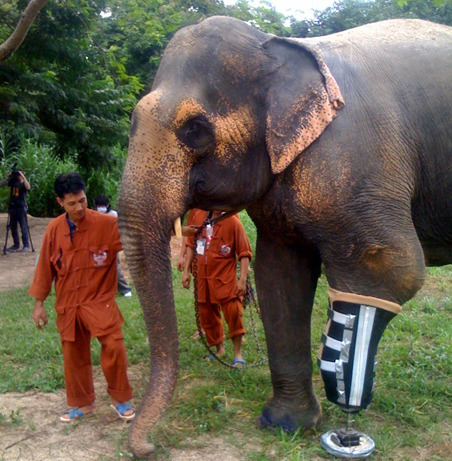
Elephant prosthetic

Elephant Prosthetic


Several years ago, Motala, a 48-year old former working elephant from Thailand (she moved trees for a living), wandered into the forest to look for food and accidently stepped on a land mine left over from the Burmese-Thai War. The blast destroyed her left front leg and had to be amputated below the knee. In 2006, Motala got a temporary prothesis to help her learn to walk on what would be a more permanent artificial leg.

This past summer she was finally fitted for that leg in Thailand. It's a state-of-the-art upgrade to the artificial leg she's had for the last three years.

Accordingly to early reports Motala is taking to it quite well.

September 12, 2009

HAL: New assistive walking device


So get this: there's actually a Cyberdyne Corporation out there working on a device called HAL. But it's probably not what you think.

In this case, Cyberdyne of Japan, along with Professor Sankai of Tsukuba University, have developed the Hybrid Assistive Limb -- a device intended to help people walk or carry heavy loads.

The suit makes mobility easier and increases user strength to carry heavy objects. The 10-kilogram (22-pound) machine belts at the waist and has a battery and computer system at the back. The system also has sensors that pick up weak electric signals that are sent along the skin's surface to the brain. This allows HAL to help wearers move in the way they are thinking. The average walking speed with the assist of the suit is 1.8 kilometers per hour. The company began renting out the suits last October -- but at a hefty USD$2,200 a month.

July 5, 2009

Toyota developing thought-controlled wheelchairs

The BSI-Toyota Collaboration Center (BTCC) is working on a wheelchair that can be navigated in real-time with brain waves. Users simply think of the direction they want to go in and the wheelchair does the rest.

Toyota is taking full advantage of recent technological developments in the area of brain machine interfaces (BMI). Such systems allow elderly or handicapped people to interact with the world through signals from their brains -- and all without having to give voice commands.

The wheelchair is currently under development by RIKEN, an independent administrative institution that's a collaborative project with the Toyota Motor Corporation.

The new system allows brain-wave analysis in as little as 125 ms, as compared to several seconds required by conventional methods. Brain-wave analysis results are displayed on a panel so quickly that drivers do not sense any delay.

The system also has the capacity to adjust itself to the characteristics of each individual user, thereby improving the efficiency with which it senses the driver's commands. That way, the driver is able to get the system to learn his/her commands (forward/right/left) quickly and efficiently; the system boasts an accuracy rate of 95% -- one of the highest in the world.

Here's a video of the thought-controlled wheelchair in action:

May 10, 2009

Digilegs


The Digilegs aren't really practical, but they're an interesting 'modification' from a cosmetic perspective.

March 27, 2009

The hazards of being a cyborg, or why heart patients should never be allowed to do their own home wiring

Being a cyborg is not all it's cracked up to be -- especially if the wiring in your house is not up to snuff. Case in point is a recent incident in Denmark involving a patient with an implantable cardioverter defibrillator, a shower, and an improperly grounded washing machine (you can see where this is going).

Soon after receiving the device the patient was taking a shower when he experienced a pair of electrical shocks. Obviously this is not supposed to happen, so he returned to the hospital. The physicians were stumped -- there was no apparent physical reason why the device, which delivers a shock to restore normal heart rhythm if an arrhythmia occurs, should have gone off.

But during the analysis the physicians started to suspect that electrical noise had caused an inappropriate ICD discharge. On this hunch the hospital sent an electrician to check the wiring of the patient's house.

Sure enough, the electrician discovered that the washing machine was not properly grounded (the patient had installed it himself) and it was emitting the problematic electrical noise.

Interestingly (or perhaps disturbingly), this is not an isolated case; there have been scattered reports of similar events with heart defibrillators. Back in 2002 cardiologists in Hong Kong reported two such cases -- one caused by electrical signals from a power drill, the other by signals from a washing machine. And German cardiologists described an instance of a defibrillator shock delivered because of electromagnetic signals from, yes, you guessed it, a washing machine (it's becoming clear that washing machines have it in for cyborgs).

It's worth noting that the ICD is a safe treatment provided that all regulations for electrical equipment is followed.

March 16, 2009

February 17, 2009

Aimee Mullins at TED: Give me beautiful legs

In my previous post I made the case for novel and non-traditional prostheses. I'm not implying, however, that this is for all people, nor am I suggesting that there's something wrong with a disabled person wanting to look like a "normal" human.

Case in point is cyber-athlete and double-amputee Aimee Mullins. When Aimee is not tearing up the track with her carbon-fibre blades, she wears artificial legs that look and feel exactly like normal legs -- hair follicles and all. She even likes to paint her nails and wear high heels.

Here's a video of Aimee Mullins at TED 1998 talking about running as a disabled athlete (very inspiring and I highly recommend you watch this) and her assortment of artificial limbs. It's a poignant example of how technologies can help people achieve self-actualization.

The Immaculate designer prosthesis

Something that's always bothered me about traditional prostheses is the constant attempt to mimic normal human morphology. Artificial legs are supposed to look like real legs and artificial arms are supposed to look like real arms, right?

Well, that shouldn't always have to be the case. Why not think outside the box? This is an opportunity, after all, for some disabled people to express themselves and change their bodies in novel and unexpected ways.

This is exactly the perspective of Hans Alexander Huseklepp who believes that prostheses should go beyond mere functionality and become objects of fashion and identity. To this end he has designed the "Immaculate" which explores new possibilities for assistive devices.

Immaculate is a neurological prosthetic that will be connected to a user's central nervous system. The exterior of the prosthetic is textile clad in Corian plates which, in principle, will allow embedded technology to be seamlessly integrated. This material will also give the prosthetic a clear graphical identity. In addition, each joint is a globe joint, allowing a larger freedom of movement than a normal human arm.

February 3, 2009

Para-athletes 'closing the gap' with sports technologies


The latest issue of Sports Technology (subscription required) spotlights recent developments that seek to close the gap between able-bodied athletes and para-athletes, with two published articles highlighting running prostheses.

The first article, entitled "Biomechanics of double transtibial amputee sprinting using dedicated sprinting prostheses" compares the sprinting mechanics data of able-bodied sprinters with that of a double transtibial amputee by examining the overall kinetics and the kinetics at the joints – while sprinting at maximum speed.

In this article, the authors conclude that the carbon blade used by the amputee sprinter has a significant advantage in both energy storage and return in fast sprinting, in comparison to the healthy human ankle joint. The blade allows the disabled sprinter to deliver the same level of performance as an able-bodied athlete – but at a lower metabolic cost.

If true, this discovery will have implications for those runners like Oscar Pistorius who hope to compete against able-bodied athletes.

The second article, "Lower Extremity Leg Amputation: an advantage in running?" describes the clinical view of fitting an amputee with a prosthetic leg.

The paper provides a general overview on prosthesis technology. It highlights the challenges and disadvantages of a prosthetic fitting – including the difficulties in selection, fitting and the alignment adaptation of the socket; as well as other issues such as the compensatory strategies of the amputee.

January 7, 2009

New Scientist: We Have the Technology to Rebuild Ourselves

Julian Smith has penned an excellent overview of prosthetic technologies for New Scientist. Smith describes the current state-of-the-union as far as assistive devices goes and looks at the potential for these devices to not just mimic normal human functioning, but to surpass it as well.


Smith writes,
After decades of amputees having to make do with designs that had changed little since the second world war, artificial limbs that predict their user's every movement and look like the real thing are finally breaking out of the lab. Yet convincing and comfortable synthetic limbs like McNaughton's are only the beginning of the bionic age.

Emerging prosthetic technologies promise not only greater power and flexibility but also pressure-sensitive artificial skin, and even limbs that are bonded to the body and controlled by the mind - and much of this within five years. Rebuilding amputees to be faster and stronger than before is rapidly becoming a realistic possibility. With experimental prosthetics increasingly able to integrate with flesh, bone and the nervous system, the very idea of "losing a limb" may one day become obsolete.
Examples of these cutting edge devices include the C-Leg from German orthopaedic company Otto Block and the Rheo Knee from the Icelandic company Össur, both of which use a combination of hydraulics and motors to make carrying the leg less tiring, plus carbon fibre to mimic the elastic properties of bones and tendons. As for arms, the smallest and most powerful yet is the i-Limb from British company Touch Bionics in Livingston, West Lothian. The i-Limb is a lightweight plastic hand in which each digit contains its own motor and can move independently in response to signals from two sensors attached to skin elsewhere on the user's body.

There are even devices that are able to mimic the sense of touch, what's known as 'artificial skin.' This is a rather complicated technical feat, but solutions have been proposed that involve a nanotube layer that measures changing resistance.

Of course, the ultimate next step is in directly connecting artificial limbs to the nervous system. This would require the tapping of brain signals, decoding them in real time and routing them to the prosthetic. Sensory input would then have to be relayed back from the prosthetic to the central nervous system. The New Scientist article goes over a number of ways this can be accomplished, including targeted muscle reinnervation.

The article also addresses the issue as it pertains to human augmentation:

With brain control seemingly not far off, prosthetic limbs could eventually be as easy to control as they are strong and light. They would then be stronger and faster than the real thing. So what happens when they surpass the limbs we were born with, and a prosthetic becomes an augmentation?

This issue hit the headlines in the case of South African sprinter Oscar Pistorius, a double amputee who runs on curved carbon-fibre "blades" and narrowly missed qualifying for the Beijing Olympics. Sports officials had earlier argued that his prosthetic feet gave him an unfair biomechanical advantage...

David Gow, inventor of the i-Limb hand, believes that artificial limbs may well give natural ones a run for their money, not just by being stronger and faster, but more aesthetically pleasing too. "Then we will have to evolve as a society a new morality, new ethics and codes of conduct, won't we?" says Gow.

Read the entire article.

For more on this topic, read my article, "Is the world ready for cyborg athletes?"

November 10, 2008

Imagining branded prosthetics of the future

In the future, will all the cool kids will be wearing Air Jordan prosthetics? Designer Colin Matsco certainly thinks so:
3D printing has become an incredibly powerful tool to customize one-off products for differing applications. This project was based on using this technology to design a customized prosthetic leg for a specific user- a young, urban, male athlete. Nike was chosen as an appropriate brand to bring form to the leg. It also required familiarizing oneself with the emotional, medical, lifestyle, and physical changes the user would encounter.