Showing posts with label nonhuman animal intelligence. Show all posts

March 22, 2011

Chimp mom mourns the death of her baby [video]

Part of the struggle in getting people on board with the idea that some animals deserve to be recognized as persons is convincing them that the emotional responses, inner psychological life and social bonds of these animals are similar to our own. Because we lack the neuroscience to prove definitively that nonhuman persons have the cognitive toolkit required for these responses, we're stuck with empiricism: if it looks like a duck and quacks likes a duck, we have to conclude that it's a duck. Behaviorism is currently our best tool for assessing the psychological sophistication of animals—and to a certain degree our own. It's worth noting that we cannot prove humans have these capacities either. We just take it for granted that others feel the way we do.

Some behavioral studies are more powerful than others. The video below is a good example—even if it is difficult to watch. It shows a chimpanzee mother dealing with and apparently mourning the death of her 16-month-old child. This haunting footage challenges those who might question the extent to which animals experience the loss of a life:


This footage was captured by researchers from the Max Planck Institute for Psycholinguistics. A team led by Dr. Katherine Cronin sought to study the reaction of non-human primates encountering the realities of mortality.

"The videos are extremely valuable because they force one to stop and think about what might be happening in the minds of other primates," Dr. Cronin told CORDIS News. "Whether a viewer ultimately decides that the chimpanzee is mourning, or simply curious about the corpse, is not nearly as important as people taking a moment to consider the possibilities."

Their report describes what researchers observed:
Dr. Cronin and doctoral student Edwin Van Leeuwen monitored the behaviour of a female chimpanzee that had recently lost her 16-month-old infant. The mother carried the infant's dead body for more than 24 hours, and then laid it on the ground in a glade. She approached the body many times, and held her fingers against the infant's face and neck for several seconds. The mother then stayed close to the body for almost an hour, later carrying it over to a group of chimpanzees that began to examine the body. The mother no longer carried the body of the infant the next day.
When watching the video I was particularly struck with the mother's tenderness and the way she stroked the infant's face. Looking at her reactions, she appeared distraught, frustrated, and forlorn. She seemed quite upset over the idea of having to abandon the body, returning to it periodically in the hopes that the infant would show some signs of life.

A human mom in the same situation would likely act and respond in a similar way. It's worth noting that, like chimpanzees, humans are also members of the great ape family.

Via TreeHugger.

Isabel Behncke: Evolution's gift of play, from bonobo apes to humans [TED]

March 19, 2011

The moral lives of animals...and humans

Stephen Budiansky has penned a snide review of Dale Peterson's new book, The Moral Lives of Animals in which he claims that animal rights advocates have gone too far in ascribing altruism and other forms of compassionate behavior onto non-human animals. Budiansky, like many other skeptics, is arguing from the perspective of human exceptionalism—the notion that there is something intrinsically valuable or special in the way our species operates, and that it is this specialness that irrevocably separates us from the rest of the animal kingdom.

The primary fear expressed by the human exceptionalists is that through our increased understanding of non-human animal cognition and behavior that we will better come to understand our own, and that by consequence we will conclude that we're all relatively similar in certain key aspects. They see this as an overt effort to prove that humans are nothing more than another "animal in the forest," a claim that somehow demeans or lessens the value of the human being.

Budiansky writes:
Mr. Peterson....makes clear at the outset that he very much shares the fundamental ambition of the animal-rights movement to puncture the claim of human exceptionalism—the "error," he states, of believing that humans have a unique status in nature or "are disconnected from the limits, systems, structures, and truths of the rest of the natural world." Recognizing the difficulty of boosting animals, his approach is instead to deflate humans: in particular, to suggest that there is much less to even so vaunted a human trait as morality than we like to believe. Rather than a sophisticated system of language-based laws, philosophical arguments and abstract values that sets mankind apart, morality is, in his view, a set of largely primitive psycho logical instincts. This is a definition undemanding and broad enough to encompass much of the animal world, which is precisely his point.

A sense of fairness and reciprocity, for example, does not depend on formal rules or any "complicated intellectual" processes, he writes, just a gut check: Our sense of justice is really nothing but a "quick emotional" assessment. Empathy does not require a mind capable of imagining the feelings and thoughts of another mind, but arises from "mirror neurons" that are automatically triggered when an animal witnesses the actions of others, generating the same sensations experienced when it performs those same actions itself. In Mr. Peterson's view, human philosophizing about morality is little more than a smokescreen that obscures an instinctual and primitive essence. While language "allows us to discuss morality and to debate, endlessly, this or that obscure issue about it," in fact all this rhetorical hot air merely expresses "unspoken and unwritten universes of urge and inclination and inhibition," shared by a large number of animals, that surely evolved "long before the separate evolution of our own species."

Despite having begged the question of human exceptionalism at the start—by dismissing the sense that we are different as mere "Darwinian narcissism"—Mr. Peterson does develop a provocative case for the existence of a broadly shared evolutionary imperative that under pins human moral instincts. Among his better-chosen anecdotes are vivid illustrations of the social mechanisms by which primates and other group-dwellers mediate access to mates, food and other resources. Vampire bats, strikingly, remember which members of the group have shared a regurgitated blood meal in the past and know who to return the favor to. It is hard to argue with his propo sition that the powerful emotional saliency moral issues have for us, and their connection to serious matters of social organization and conflict—sex, territory, possessions, reciprocity, kinship—point to a hard-wired evolutionary adaptation of group-dwelling animals.
As that last paragraph suggests, it is becoming increasingly difficult to ignore the science. Yes, much of human culture contributes to the ways in which we can and choose to act as moral agents, but utlimately it's our hard-wiring that makes any of this possible in the first place. Whether the human exceptionalists like it or not, this comes down to an issue of latent capacities.

Yes, we are just "another animal in the forest." Those who are offended by this notion sound suspiciously like those in the 19th Century who were aghast at Darwin's suggestion that humanity is descended from apes.

None of this really bothers me. What matters is that we understand how our minds work and how our moral faculties develop in concert with our culture, institutions and the ways in which we are socialized. If anything, culture is a way for us to go against our programming; we are animals through-and-through. We have some nasty traits as a species, but we also have some very powerful empathetic and cooperative skills that we're learned to accentuate and emphasize through our culture.

Many of the animals studied in Peterson's book have similar moral capacities to our own. The problem is that they don't have the sophistication and robustness of human culture to extend it further.

I've been wondering recently if we can endow certain species with the culture required to suppress their own anti-social or destructive instincts. Could we ever teach males dolphin males, for example, that gang raping females is morally wrong? And I'm not just talking about a punishment/reward type lesson—I'm talking about actually convincing the dolphins that what they're doing is morally wrong. This would be a kind of cultural uplift and require some form of memetic engineering. To do so we'd have to radically expand not just our inter-species language and communication skills, but also find ways to plant complex and enlightened concepts in their minds according to their current cognitive architecture.

I'll have to expand on this idea later.

February 19, 2011

Putting an end to dolphin exploitation at aquatic theme parks


A number of years ago I visited Sea World in Orlando, Florida. The experience proved to be a formative one, as it would mark the last time I would ever visit an aquatic theme park. What I saw there at the dolphin show that day shattered all illusions I had about the treatment of dolphins at these parks, while at the same time demonstrating to me the obvious ways in which they can express their individuality and intentions—and how this is conveniently ignored by us in ways that are completely self-serving.

The show got off to a rocky start. As the cheesy performance music blared through the loudspeakers, the trainers enthusiastically marched to the stage and assumed their positions. They blew their high-pitched whistles and waited for the dolphins to do their part.

But the dolphins ignored the cue. They swam nervously in their holding tank, circling and circling.

The trainers tried again, but the dolphins remained steadfast. They weren't going anywhere.

So, the trainers stopped the show and addressed the audience. We were told that, as a hierarchical species, the leaders of the troop were preventing the rest of the dolphins from partaking in the show. The reason, they suspected, was on account of a looming storm.

Indeed, hurricane Ernesto was slated to hit the region in the next 24 hours, and it's likely that the dolphins, sensing the low pressure system, were in a state of agitation. The last thing they wanted to do at that moment was to follow commands and perform tricks.

Unfazed, the trainers said they weren't about to let the dolphins have their way and that they were going to try and try again until they performed the show as expected.

Once again, the trainers marched to their stations and the cheesy music began anew. After another short delay, the dolphins finally decided to take part. But I have to say, it was the most half-assed effort I've ever seen put on by dolphins. They consistently missed their cues and went about their jumps and tricks as if they were just going through the motions.

What was happening was blatantly obvious to anyone paying attention: Their hearts were simply not into it.

As I sat there watching this spectacle, I started to feel ill, and I suddenly regretted coming to the park. I was hit hit with a glaringly obvious realization.

These dolphins are slaves.

Indeed, we are making these highly intelligent and emotional animals perform tricks against their will. They are confined to ridiculously small tanks and expected to perform on cue—and should they refuse, they're beaten back to submission by an unrelenting crew of trainers who simply won't take no for an answer—even if it's in front of a live audience.

Now, I realize that the dolphin show brings a lot of money to these parks—but the dolphin tank has got to go. It's cruelty through and through. As nonhuman persons, dolphins need to be protected from these kinds of abuses. They are not ours to play with.

We have no right to compel dolphins to entertain us. They deserve better than that. Moreover, we have no right to contain them in this way. Dolphins need to swim. In fact, in the wild, dolphins swim an average of 65 to 85 kilometers per day. The tanks at these theme parks must feel intensely claustrophobic to them. It's torturous.

And as I learned on that day at Sea World, dolphins are also capable of expressing their discontent. They can show us when they're not happy and they can express their will. We need to start paying attention and put aside our petty desire to watch dolphins jump through hoops.

It's time to stop this kind of animal exploitation.

Check out the IEET's Rights of Non-Human Persons program to learn more.

February 16, 2011

Wired: To Talk With Aliens, Learn to Speak With Dolphins

Wired is reporting on an interesting paper about cutting edge dolphin communications studies and how this research may eventually assist in SETI endeavors.

This research is being done by Denise Herzing of the Wild Dolphin Project. Her paper is called "SETI meets a social intelligence: Dolphins as a model for real-time interaction and communication with a sentient species." Abstract:
In the past SETI has focused on the reception and deciphering of radio signals from potential remote civilizations. It is conceivable that real-time contact and interaction with a social intelligence may occur in the future. A serious look at the development of relationship, and deciphering of communication signals within and between a non-terrestrial, non-primate sentient species is relevant. Since 1985 a resident community of free-ranging Atlantic spotted dolphins has been observed regularly in the Bahamas. Life history, relationships, regular interspecific interactions with bottlenose dolphins, and multi-modal underwater communication signals have been documented. Dolphins display social communication signals modified for water, their body types, and sensory systems. Like anthropologists, human researchers engage in benign observation in the water and interact with these dolphins to develop rapport and trust. Many individual dolphins have been known for over 20 years. Learning the culturally appropriate etiquette has been important in the relationship with this alien society. To engage humans in interaction the dolphins often initiate spontaneous displays, mimicry, imitation, and synchrony. These elements may be emergent/universal features of one intelligent species contacting another for the intention of initiating interaction. This should be a consideration for real-time contact and interaction for future SETI work.

February 11, 2011

IEET launches program to further the rights of nonhuman persons

With the help from the Institute for Ethics and Emerging Technologies, I've finally got my non-human persons rights project off the ground. Today's announcement from the IEET:
The Institute for Ethics and Emerging Technologies has announced a new program, Rights of Non-Human Persons, that will argue in favor of applying human-level rights to certain other species.

“Defense of human rights, applied as fully as possible, is one of our core principles,” said IEET Executive Director James Hughes. “As our understanding of what constitutes a ‘person’ continues to grow and change, we’re convinced it is time to expand that definition.”

George Dvorsky, a Canadian futurist and bioethicist who serves on the IEET’s Board of Directors, will head the new program on Rights of Non-Human Persons.

“It is increasingly clear that some non-human animals meet the criteria of legal personhood, and thus are deserving of specific rights and protections,” said Dvorsky. “Recent scientific research has revealed more about animal cognition and behavior than ever before, so we really have no choice but to take this prospect seriously.”

This new initiative will be included within the broader Rights of the Person program, managed by Kristi Scott. “The general thrust of human history is toward the progressive inclusion of previously marginalized individuals and groups,” said Scott. “Now we’re reaching the point where this imperative compels us to cross the species barrier so we can protect some of the most vulnerable and exploited animals on the planet.”

“Species like bonobos, elephants, dolphins, and others most certainly fall into a special class of beings, namely those deserving of the personhood designation,” added Dvorsky. “While we might recognize this instinctually, or even scientifically, it’s time we start to recognize this in the legal sense.”

“The Institute for Ethics and Emerging Technologies is well positioned to work on behalf of this cause,” said Hughes. “Philosophically, the IEET has always recognized the value of looking beyond mere human-ness when it comes to our consideration of ethics and morals. With our non-anthropocentric approach to personhood and our impressive body of advisors, the IEET will work actively to promote the idea of legal non-human personhood and see it come to fruition.”

Rights of Non-Human Persons Mission Statement:
Owing to advances in several fields, including the neurosciences, it is becoming increasingly obvious that the human species no longer can ignore the rights of non-human persons. A number of non-human animals, including the great apes, cetaceans (i.e. dolphins and whales), elephants, and parrots, exhibit characteristics and tendencies consistent with that of a person—traits like self-awareness, intentionality, creativity, symbolic communication, and many others. It is a moral and legal imperative that we now extend the protection of ‘human rights’ from our species to all beings with those characteristics.

The Institute for Ethics and Emerging Technologies, as a promoter of non-anthropocentric personhood ethics, defends the rights of non-human persons to live in liberty, free from undue confinement, slavery, torture, experimentation, and the threat of unnatural death. Further, the IEET defends the right of non-human persons to live freely in their natural habitats, and when that’s not possible, to be given the best quality of life and welfare possible in captivity (such as sanctuaries).

Through the Rights of the Non-Human Person program, the IEET will strive to:

  • Investigate and refine definitions of personhood and those criteria sufficient for the recognition of non-human persons.
  • Facilitate and support further research in the neurosciences for the improved understanding and identification of those cognitive processes, functions and behaviors that give rise to personhood.
  • Educate and persuade the public on the matter, spread the word, and increase awareness of the idea that some animals are persons.
  • Produce evidence and fact-based argumentation in favor of non-human animal personhood to support the cause and other like-minded groups and individuals.
Feel free to contact me if you want to contribute; and join our new mailing list.

January 13, 2010

November 19, 2009

IBM's claim to have simulated a cat's brain grossly overstated

Blue Gene
This is not a brain.

I'm a big fan of IBM's Brain and Mind Institute (BMI) and the Blue Brain project. Initiated in May 2005, the Blue Brain project is an attempt to to model the mammalian cerebral cortex with computers. The intention is not to re-create the actual physical structure of the brain, but to simulate it using arrays of supercomputers. Ultimately, the developers are hoping to create biologically realistic models of neurons. In fact, the results of the simulation will be experimentally tested against biological columns.

But I take exception to the recent claim that IBM has created a simulation that is supposedly on par, in terms of complexity and scale, with an actual cat's brain. The media tends to sensationalize these sorts of achievements, and in this case, grossly overstate (and even misstate) the actual accomplishment.

Contrary to what some people may believe, IBM has not created a virtual cat. There's no simulated cat somewhere pouncing around simulated fields chasing simulated mice inside a supercomputer. All IBM has done is replicate the power of a cat's cebebral coretex using a bunch of powerful computers. Nothing more -- there's no psychological or AI element involved whatsoever. They're merely creating a physical power structure and computational infrastructure that may someday run a properly engineered mind.

But credit where credit is due.

IBM has made incredible progress in the sophistication and detail level of human brain mapping. By reverse engineering the human brain, IBM hopes to bring about the era of "cognitive computing," -- a development that would bring about new ways for building computers which mimic natural brain structures.

Essentially, IBM is hoping to simulate a neocortical column, which is the smallest functional unit of the neocortex. This is the part of the brain that is responsible for higher functions such as conscious thought. In humans, the neocortical column is 2mm tall, has a diameter of 0.5mm and contains 60,000 neurons. Project developers initially worked to replicate the neocortical column of a rat, which has only 10,000 neurons, and now they've achieved the same thing with the cat brain. Developers hope to model the human brain in about seven to eight years.

To model these components the developers use a Blue Gene supercomputer that runs the MPI-based 'Neocortical Simulator' combined with 'NEURON' software. Blue Gene is a computer architecture project that has will spawn several next-generation supercomputers -- computers that will reach operating speeds in the petaflops range, and are currently reaching speeds over 280 sustained teraflops. Its 8,000 processors will crunch away at 23 trillion operations per second.

I don't want to take away from IBM's accomplishment, but it's important to note that we are extremely far off in terms of our ability to emulate the true complexity of a mammalian brain. Creating an array of supercomputers that mimics the brute force of a biological brain and then claiming that it matches the 'complexity' and 'scale' of the real thing is pure hyperbole. True whole brain emulation (PDF) is still a far ways off.

November 1, 2009

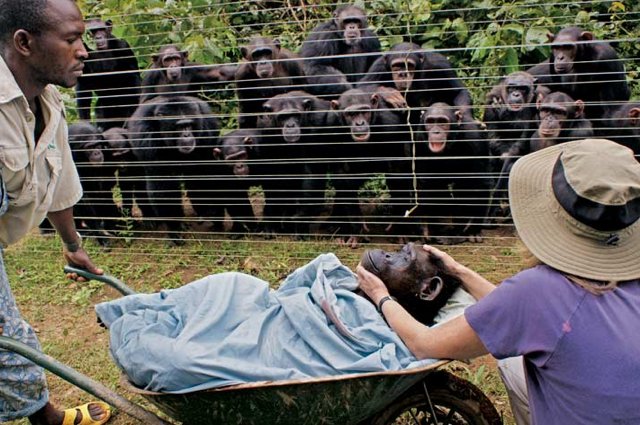
Grieving chimps

Grieving chimps

This image was shot for National Geographic by Monica Szczupider and shows chimpanzees at the Sanaga-Yong Chimpanzee Rescue Center in Cameroon. The chimps are observing the body of an elder troop member named Dorothy just prior to burial. She died at 40 years of age, which is quite old for chimpanzees. The photo appears in the November issue of National Geographic Magazine in the "Visions of Earth" section.

[via BoingBoing]

June 15, 2009

TED: Susan Savage-Rumbaugh on primate intelligence and culture [video]


From TED:
Into the great debate over intelligence and instinct -- over what makes us human -- Susan Savage-Rumbaugh has thrown a monkey wrench. Her work with apes has forced a new way of looking at what traits are truly and distinctly human, and new questions about whether some abilities we attribute to "species" are in fact due to an animal's social environment. She believes culture and tradition, in many cases more than biology, can account for differences between humans and other primates.

Her bonobo apes, including a superstar named Kanzi, understand spoken English, interact, and have learned to execute tasks once believed limited to humans -- such as starting and controlling a fire. They aren't trained in classic human-animal fashion. Like human children, the apes learn by watching. "Parents really don't know how they teach their children language," she has said. "Why should I have to know how I teach Kanzi language? I just act normal around him, and he learns it."
More: Sue Savage-Rumbaugh on the welfare of apes in captivity.

May 4, 2009

Why is this bird dancing?


This remarkable video of a dancing parrot left me asking one question: why?

More specifically, I wondered why, from the perspective of evolutionary psychology, would parrots evolve a penchant (and clearly a talent) for dancing? Clearly this bird is dancing -- and if I'm not mistaken is totally getting into it -- but why?

Well, there are three theories that attempt to explain the origins of singing and dancing in human culture. Perhaps these theories could shed some light on the dancing parrot.

Two theories are functional, suggesting that singing and dancing either serves to attract mates or foster social cohesion and collaboration. The third, put forward recently by Aniruddh Patel of the Neurosciences Institute in San Diego, suggests the whole thing is a "glorious accident," the by-product of an evolved capacity for mimicking vocal cues which we humans have evolved because that's how we learn to speak. Patel suggests that our capacity for vocalization is intertwined with the way we process and react to rhythms.

Further, Patel suspects that we should study animals who are known to be vocal mimics and see if they too exhibit behaviors that resemble dancing when exposed to rhythms.

Given the dancing prowess of Snowball, Patel may be on to something. And in fact, he has taken a great interest in the bird. Patel has concluded that Snowball is in fact dancing and believes it has the capacity to adjust to changing tempos. Further studies by his team have revealed that other vocalizing animals have similar capacities, including 14 different types of parrots and even elephants.

Now the only questions is, can we get Snowball to dance to something other than the Backstreet Boys?

More.

February 18, 2009

Recent insights into animal intelligence

Recent studies are adding to the growing body of evidence suggesting that animals are much smarter than we think:
  • Baby chimps given human love ace IQ tests: Study may shed light on how early care effects human baby development
  • Monkeys can subtract: The discovery marks the first time a nonhuman species has been seen having "widespread success" with subtraction.
  • Whiz chimps outsmart college students: Three five-year-old chimpanzees have soundly defeated nine university students while playing a computer game that tests numerical memory skills
  • Baboons and pigeons are capable of higher-level cognition: It's safe to say that humans are smarter than animals, but a University of Iowa researcher is investigating the extent of that disparity in intelligence.
  • Monkeys have a sense of morality: In a series of studies scientists have found that monkeys and apes can make judgments about fairness, offer altruistic help and empathise when a fellow animal is ill or in difficulties. They even appear to have consciences and the ability to remember obligations.
Lastly, here's a video about how primate gestures may be linked to early humans -- a possible indication of how our ancestors may have communicated:


Support the Great Ape Project.

February 22, 2008

Inter-species video games


The concept behind this year's Game Design Challenge was to create a game playable by humans and at least one other species. The result? Games for dolphins, dogs and....uh....bacteria.

Heh, the joke's on them. Bonobos have been playing Pacman since forever ago.

August 13, 2007

The struggle to make vegetarianism the new normal

Wow.

In my wildest dreams I would have never imagined the kind of negative response I got to my vegetarian rant. My attempt to stir debate was set aflame on account of my tone, which as Martin Striz correctly noted, "psychologically primed [my] readers for a certain kind of response by framing the discourse in a disparaging tone to begin with."

Clearly, I misjudged the severity of this 'disparaging tone,' while my efforts to infuse humour and levity into the piece clearly failed; I obviously need to work on that.

But one thing I certainly learned from this exercise is that people are hypersensitive to rather forceful attacks on their dietary habits and their choice to eat meat. I clearly hit a soft-spot in a way that enraged a number of my readers. I even lost a number of regulars -- a consequence I find most fascinating. While I'm sure that many of these individuals were upset at my attitude and my over-the-top effort to proselytize, I have to think that the subject matter had a lot to do with it as well.

As I learned from writing this article, one cannot yet stand on a soapbox and make the declaration that eating meat is wrong without the fear of severe reprisal (particularly in the way that I did!). This exercise was a very clear reminder to me that vegetarianism is still very fringe, as is the broader effort to advocate for animal rights.

In other words, the debate hasn't yet been normalized in our society. Arguing for an end to livestock today would be tantamount to arguing for same-sex marriage in the 19th Century.

Now, I've pissed off my share of readers over the years. I'm a polemicist and I wear that label like a badge. I'm used to all the negative feedback and ad hominem attacks. In fact, I consider a polemical article a failure if I get very little response; it means I didn't say anything of import, I didn't push any buttons.

But this last article, jeez did I ever hit a nerve.

And over what?

Meat.

It wasn't like I was saying we should abandon democracy or throw away the Charter of Rights and Freedoms. I wasn't suggesting that we bomb Iraq or that we should be forced to wear clown suits from now on.

Nope, it was about meat.

I told my readers in very blunt terms that the practice of eating meat is unethical and that they should consider converting to a vegetarian diet. That message earned me the most abuse of any post I have ever written about anything.

Meat.

Yes, I used a big stick approach, but that was very deliberate. It was an effort to get attention.

One commenter suggested that I should have written a very polite article in which I carefully made my points. Sure, I could have done that -- but no one would have read it. Instead, with my sensationalistic approach I brought thousands of people to the article.

Did I change any minds? Well, maybe -- I know that at least one couple has converted to vegetarianism on account of my article. But my intention to change minds was indirect; what I really wanted to do was pass on the message that eating meat is very uncool -- and I think that accounts for a lot of the anger.

The in-your-face nature of the post was intended to upset and cajole. I wanted meat eaters to know what I think of their habits. I wanted them to know that there are people in our society who look at their eating choices with disgust and disdain. This is a very serious issue -- about as serious as it gets because we are talking about the welfare of living, breathing creatures (not to mention the environment).

Another reason for all the negative feedback is that a significant portion of my readership could care less about animal rights. They visit my site to read about transhumanism, science, futuristic technologies, the search for extraterrestrial life, and so on. The sudden shift to animal welfare and vegetarianism must have certainly seemed like a huge disconnect and a real turn-off.

But there is good reason for this; much of my transhumanist methodology is derived from non-anthropocentric personhood ethics. At its very core transhumanism is about the acknowledgment of worthwhile and morally valuable personhood space outside of Homo sapiens -- whether it be the personhood of advanced humans or more 'primitive' non-human animals.

Consequently, this ties directly into my futurist activism; I want to help create a future in which animals do not have to suffer to the degree that they do today. Sure, technology can and will help to make that happen, but today we have to use common sense food choices.

Now, in regards to the accusation that I'm a 'bigot' or intolerant of meat eaters, that's an interesting point. Bigotry, I suppose, is relative. Let's imagine for a moment that I had written an article titled 'Racists are bad people,' or 'Homophobes are bad people.' Do you think I would have received the same kind of negative response? Hardly. Aside from a few anachronistic and unenlightened perspectives I'd get a slew of comments saying, 'right on, brother.'

But the fact that I didn't get these sorts of supportive comments, aside from a small minority, indicates to me that our transition to a mostly meat-free society is a process still in its infancy.

And yes, this is not just my vision for the future, it's also an imperative and a prediction.

The ultimate goal is an end to livestock and to make vegetarianism the new normal (eventually we'll have lab grown meat at our disposal, but until then vegetarianism is a good short-term fix). How do we achieve this goal? Well, we can continue to pussy-foot around the issues and act like everything is okay, or we can raise a stink much like I did. I don't tolerate racism, homophobia, religious prejudice and sexual discrimination, nor do I tolerate speciesist meat-eating culture.

Yes, I realize that this perspective will turn off many of my readers, but for that I make no apologies.

And I don't believe I'm out of line with these sorts of comparisons. I assign high-moral worth to non-human animals. They are not our property to do with as we please. This is a crucial social issue as millions upon millions of animals suffer needlessly every year.

In closing, to those of you were offended by my rude and belligerent tone, please accept my apologies. For those readers who were angered by my message itself, please ask yourself what it is you're getting so upset about and contrast that with what I'm so upset about.

I would like to see less animal suffering, improvements to human health and a reduction in environmental degradation.

You want to eat meat.

Does this not seem disproportionate to you?

August 9, 2007

Meat eaters are bad people

That's right -- you heard me, bitch.

If you eat meat you're a bad person.

And you’re probably deluded too, desperately clinging to quasi-sensical rationalizations that are supposed to justify your cruel and filthy habit.

Yup, you guessed it -- I'm through being Mr. Nice Guy when it comes to dealing with meat eaters. I’ve passed a personal tipping point, so to speak, mostly on account of my having to suffer through far too many dinner conservations in which I'm exposed to ridiculous and unfounded arguments intended to support the practice of eating flesh.

Ultimately, when it comes right down to it there is no excuse for eating meat.

Let me repeat that.

There is no excuse for eating meat.

All justifications for doing so – including those rare arguments that actually manage to make sense – are weak to the core. There’s no possible excuse that outweighs the damage and suffering caused by consuming meat.

I would now like to take the time to debunk some of the more common fallacies I’m forced to listen to (and supposedly tolerate) on a regular basis:

Fallacy #1: “Humans evolved the capacity to eat meat, so it’s justified”

When a person tells me this I get the urge to smash tofu in their face.

This is the oft used appeal to nature. Advocates of this view – whether they realize it or not – are essentially suggesting that ‘might makes right’ – that because humans sit atop the food chain they can pretty much kill and eat whatever they want. I’ve even heard guys use this argument to uphold their sense of masculinity – as if eating defenseless animals who were killed by machines that dip them in electrified pools of water somehow affirms their manliness.

Funny, I have a different measure of what makes a man.

Looking at this argument another way, the appeal to nature asserts that evolved traits are inherently good. The line of thinking goes like this: Evolution is natural, and what is natural is good; and because humans evolved the capacity to eat and digest meat, the practice of eating meat must also be natural and subsequently good.

This is the naturalistic fallacy and it leads to all sorts of problems. Given this line of thinking we should also condone other human traits that came about through evolution, namely rape, murder, pedophilia and cannibalism. Obviously we’re not about to do this any time soon. We know very well that many people cannot be left to their own hard-wired devices; this is why we have self-corrective memes (i.e. ethics, laws, etc.) and why we need to have police and penal systems.

More to the point, however, is the acknowledgment that overriding our evolutionary baggage is part of the human mission. Having Darwinian processes guide our moral compass is sheer lunacy. Where is the morality in ‘survival of the fittest?’ Evolution may have helped us describe how we got here, but it most certainly won’t help us move forward as a compassionate species.

Fallacy #2: “Humans evolved the capacity to eat meat, so it’s a necessary part of a healthy diet”

Yeah, right.

That’s why heart disease is the leading cause of death; hundreds of thousands of people die prematurely each year because of too much saturated fat from meat and dairy products. It's no secret that meat consumption promotes heart disease, cancer, diabetes, osteoporosis, and every other major degenerative disease. The Western meat-obsessed diet is a major contributor to the host of health problems currently endemic in our society.

Meanwhile back at the tempeh ranch, not only do humans fare very well without meat, they actually thrive without it.

A number of dietitians are now claiming that human physical performance peaks when people go off meat and other animal bi-products. Carl Lewis said his best years as a sprinter came after he transitioned to a vegan diet. Word of this is slowly getting out and an entire sub-culture has emerged around this revelation.

Philosopher Peter Singer hit the nail on the head when he said that if alternative means of survival exist, one ought to choose the option that does not cause unnecessary harm to animals. And as Charles Eisenstein has said, “It is just plain wrong to take another animal's life unnecessarily; it is bloody, brutal, and barbaric.”

Makes sense to me. We don't need meat to survive or to remain healthy. Consequently, we have no business raising and killing animals for food. The ongoing practice of doing so is pure extravagance.

Fallacy #3: “Being a vegetarian is too difficult and I’d never find anything to eat”

In other words, you’re lazy, unimaginative and you have the taste buds of a 5-year old.

Get over it. A chunk of meat does not reside at the center of the Universe. There are plenty of other options.

Which brings to mind another infuriating but common misconception – the twisted notion that vegetarians only eat vegetables. What nonsense. How about a good old fashioned plate of pasta and thick tomato sauce? Or a pizza covered in mushrooms and hot peppers? A plate of nachos and refried beans, anyone? How about meatless lasagne, stir-fries, curries, chillies and casseroles? Pancakes covered in syrup, sweet potato soup, and a fresh blueberry pie...

In fact, I’ve never eaten better since becoming a vegetarian five years ago. I now eat a diverse array of foods and I’m much more competent and knowledgeable in the kitchen.

Moreover, even the most meat-centric of us (my old self included) can find worthy substitutes. I often enjoy fake ham sandwich for lunch. For dinner I like to throw a veggie patty on the barbecue and slather it with HP and Tabasco sauce. I also enjoy burritos stuffed with simulated ground meat. Add the right spicing, condiments and marinade to this stuff and you're practically there.

Fallacy #4: “Taking the life of an animal isn’t cruel because they’re worthless, stupid and probably not even self-aware”

Again, patent nonsense. These are the lies that people tell themselves as they bite into a sirloin steak – the kind of re-assurance they need to convince themselves that what they’re doing is not evil.

It’s also a sign of our speciest tendencies. As humans, we don’t kill each other because we know that other humans do not want to die. The same should hold true for our relationship with non-human animals. They don't want to die either, but they're given no choice and no protection.

Indeed, the de-valuing of animals is a lie. Farm animals are remarkably intelligent and emotional. As professor of animal husbandry John Webster has said,
"People have assumed that intelligence is linked to the ability to suffer and that because animals have smaller brains they suffer less than humans. That is a pathetic piece of logic, sentient animals have the capacity to experience pleasure and are motivated to seek it, you only have to watch how cows and lambs both seek and enjoy pleasure when they lie with their heads raised to the sun on a perfect English summer's day. Just like humans."
Yes, animals deserve an experiential life free from suffering and torment. We, as the dominant species on the planet, have to pay particular attention to their needs.

Biologist Marc Bekoff has noted, "When animals are seen as automatons with no emotions, it is easy to treat them as mere property with which humans can do as they please." Exactly -- and we need to move away from this sort of parochial thinking as quickly as possible.

Along these lines I highly recommend the book, The Pig Who Sang to the Moon: The Emotional World of Farm Animals by Jeffrey Moussaieff Masson.

Fallacy #5: “Livestock aren’t treated poorly”

People who make this claim are either terribly misinformed or just plain ignorant. The reality is that modern farming practices are an absolute travesty.

Pigs are typically kept in stalls so small and narrow that they can never turn around or rest properly. Many develop respiratory problems and neurotic coping behaviors such as repetitive bar biting and sham chewing (chewing nothing). Chickens and turkeys are often packed twenty to a cage and pumped with antibiotics. Their beaks have to be clipped to prevent them from pecking at one another. And as for cows, well, read this excerpt from an April 2001 Washington Post article which describes typical slaughterplant conditions:

The cattle were supposed to be dead before they got to Moreno. But too often they weren't.

They blink. They make noises, he said softly. The head moves, the eyes are wide and looking around. Still Moreno would cut. On bad days, he says, dozens of animals reached his station clearly alive and conscious. Some would survive as far as the tail cutter, the belly ripper, the hide puller. They die, said Moreno, piece by piece...

"In plants all over the United States, this happens on a daily basis," said Lester Friedlander, a veterinarian and formerly chief government inspector at a Pennsylvania hamburger plant. "I've seen it happen. And I've talked to other veterinarians. They feel it's out of control."

I could go on and on, but I'm sure you're getting the point and you'd probably get more by reading other accounts of how pigs, cows, chickens and other farm animals are mistreated. I also recommend the book, Slaughterhouse: The Shocking Story of Greed, Neglect, And Inhumane Treatment Inside the U.S. Meat Industry by Gail A. Eisnitz.

Fallacy #6: “Eating meat isn’t that bad for the environment”

Guess again. Raising meat is environmentally nasty and an inconvenient truth.

Given the climate change hysteria currently gripping the planet, one would think that maintaining hordes of livestock would be a hot-button social and political issue. But it’s not. That would be too inconvenient. The ongoing practice of raising animals for food is being ignored as a subset to the larger environmental catastrophe currently in effect.

Animal protein, for example, requires tremendous expenditures of fossil-fuel energy—eight times as much as for the same amount of plant protein. The average meat consuming diet burns the equivalent of a gallon of gas per day. All the livestock in the U.S. consumes five times as much grain as its human population. Americans are outnumbered by their farm animals by a ratio of 25 to 1.

In terms of land use, one-sixth an acre of land can feed a vegetarian for a year, while three acres are required to provide the grain needed to raise a year's worth of meat for the average meat-eater.

The toll on water resources is just as bad. Grain-fed livestock consume 100,000 liters of water for every kilogram of food they produce; this compares to 2,000 liters required for soybeans. The meat industry accounts for nearly half of the water consumption in the U.S. – 2,500 gallons per pound of beef compared to 25 gallons per pound of wheat.

And what goes in must come out; 1.6 million tons of manure gets sent back into the environment every year in the U.S. In addition to this, residues of antibiotics and synthetic hormones are increasingly showing up in municipal water supplies.

And I have only scratched the surface.

So, as you’re heading off in your hybrid car to get solar panels for your home, just remember that as a meat eater you’re only being partly environmentally conscious.

Fallacy #7: “Eating meat is my personal choice, and since I respect your desire not to eat animals, I would appreciate your respecting my preference”

Sorry, I will do no such thing.

As Colleen Patrick-Goudreau has retorted, "The problem with this justification is that it assumes there is no victim, no other. It implies that the meat-eater’s desires, traditions, culture, or taste buds are superior to anything — or anyone — else and that because of this, he or she is absolved from the harm eating meat causes."

Remember, this is not about you.

The truth hurts

As for me personally, I do not profess to have achieved any semblance of moral perfection. You don’t need to remind me of my hypocrisies and inconsistencies; I am very much aware of them and I am my own worst critic. I am not vegan, for example, but I hope to transition to that diet eventually.

But at least I’m trying; I'm making an effort to live a life in which I mete out as little suffering as possible to other living creatures. I'm also trying to reduce my global footprint. And if that means giving up meat, which I used to eat with great delight, then so be it.

And yes, I’m on my high-horse now -- but I’m sincerely trying to make a difference. If my tone pissed you off then I succeeded in my goal. I’m deliberately trying to cajole you so you'll reconsider your eating habits.

And in my own naive way I’m hoping that some of you will now actually consider a vegetarian diet.

June 14, 2007

Humans enhance chimps just by interacting with them

A new study examines human impact on chimpanzees' cognitive abilities:
Human interaction and stimulation enhance chimpanzees’ cognitive abilities, according to new research from the Chimpanzee Cognition Center at The Ohio State University. The study is the first to demonstrate that raising chimpanzees in a human cultural environment enhances their cognitive abilities, as measured by their ability to understand how tools work. The findings have just been published online in the Springer journal Animal Cognition.
(Thanks, PJ!)