
Via riot rite right clit clip click.

 I was hoping to say something original and provocative about the Big Three’s recent attempt to get a government bailout, but I’m finding myself drawn to the ‘survival of the fittest’ camp. It sounds like they could use a shake-up; the North American auto sector has had this coming after years of mismanagement and ambivalence to customer needs.
 Earlier this year doctors in Toronto reported a strange incident involving a morbidly obese man who was undergoing deep brain stimulation (DBS).
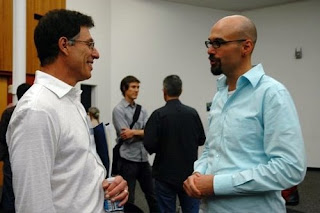 I had the pleasure of meeting Dr. Terry Grossman this past weekend at Convergence08.
 [*Note: See addendum at the end of this article]
Semi-autonomous robotic weapons systems, including cruise missiles and Predator drones, already exist. A few machine-gun-toting robots were sent to Iraq and photographed on a battlefield, though apparently were not deployed.Indeed, the primary problem is that if someone wants to create a band of marauding robots there's nothing really to stop them.However, military planners are very interested in the development of robotic soldiers, and see them as a means of reducing deaths of human soldiers during warfare.
While it is too late to stop the building of robot weapons, it may not be too late to restrict which weapons they carry, or the situations in which the weapons can be used.
The New Scientist article has been misread by some commentators, who believe that we propose moral machines can be built with these simple strategies and that the critiques of the strategies were written by Simonite. The strategies and evaluation of the strategies were written by us. The original article from which this material was drawn can be found below on my October 13th posting.Specifically, the New Scientist article's author, Tom Simonite, did not make it sufficiently clear as to who was responsible for the content and commentary. As Wallach noted to me in personal conversation, "90% of that article was written by me, including the strategies and the comments as to why the strategies were inadequate and simplistic. The piece was written as a tool to direct attention to the book, which is the first overview of the field of machine morality and a very serious and sophisticated look at the challenge."
 In addition to live blogging Convergence08, I used Twitter to send out microblog bursts to my followers during the course of the conference.

I was quite surprised that this concept had never been realized, and I scoured the net for several hours to ensure I was not duplicating another artists concept - and thankfully came up with nothing even close. It seems like an obvious solution given the growing emergence of transhumanist technologies and artificial inteligence augmentation, as an inevitable evolutionary step in human kind.By the way, the concept was partly inspired by a recent illustration they did for the latest cover of Scientific American:
We really enjoy working out our paintings using digital technology and then taking it back into the analogue world for somthing a bit more permenant as an Oil on Canvas painting. It allows us to quickly realize a piece, and work out all of the elements like colour, composition - which lays down a solid foundation for creating a painting quickly and efficiently.

"But now a growing number of social scientists are offering their expertise in behavioral decision making, risk analysis, and evolutionary influences on human behavior to explain our limited responses to global warming. Among the most significant factors they point to: The way we're psychologically wired and socially conditioned to respond to crises makes us ill-suited to react to the abstract and seemingly remote threat posed by global warming. Their insights are also leading to some intriguing recommendations about how to get people to take action-including the potentially dangerous prospect of playing on people's fears."-- Lisa BennettFrom Alternet.
 Tanya Jones of Alcor has opted for a Q&A format.
 Saffo is often asked, 'Are you a futurist or a forecaster?' A forecaster cannot slide into that advocacy role. The forecaster needs to be a bystander to events, whereas the futurist says, "this is the direction I think we should all go." Paul Saffo is saying that futurism should be a science, not a religion.
 How do you get to cheap energy? If you can get a penny per kilowatt hour you can get a dollar a gallon gasoline. The only way to get this is to draw solar power from space.


