Showing posts with label foresight. Show all posts

March 24, 2011

Paul Root Wolpe: It's time to question bio-engineering [TED]


At TEDxPeachtree, bioethicist Paul Root Wolpe describes an astonishing series of recent bio-engineering experiments, from hybrid pets to mice that grow human ears. He asks: isn't it time to set some ground rules?

I hate talks like this. Wolpe spends the first 17 minutes treading on painfully familiar (and tired) territory and the last two minutes asking the wrong questions. And worst of all, he offers absolutely no answers or directions in terms of next steps. Weak.

February 5, 2011

SAI in the material world

Mondolithic Studios
A meme that gets bandied about by Singularity denialists is the assertion that a rogue super-artificial intelligence (SAI) won't be able to act on its desires and make a real impact on the physical world. It's just a really sophisticated computer, goes the thinking; it couldn't actually reach out and touch someone.

This runs contrary to the concerns of those in the Singularity camp who are gravely concerned that an SAI will be both uncontainable and capable of manipulating physical space in a non-trivial way.

I'd like to present a pair of  arguments that will serve as a warning to those who would like to dismiss this possibility. The first is based on a recent technological breakthrough, the second being more of a thought experiment.

Robotic networking and self-replication

RoboEarth is a system that's allowing robots to build on and learn from the experiences of other robots. Think of it as an internet for robots. As it stands, robotics engineers have to teach their bots to navigate and function in the real world. RoboEarth, on the other hand, collects and centralizes information on objects and navigation, and in turn shares this information with other bots. What this means is that any new robot that's connected to this system will have immediate knowledge of its surroundings.

But it doesn't stop there. A recent breakthrough has endowed the TechUnited AMIGO robot with the ability to download all the information it needs for a specific task and then carry out that task. Check out the video below of AMIGO at work:


If this doesn't blow your mind then you're not paying attention. While the task was simple enough, that of autonomously picking up and serving a bottle of water to a person, the potential implications of this are huge. As Joris Peels of iMaterialize clarifies,
If you would combine Robo Earth, with genetic algorithms that automatically design robots and 3D printing you have a very powerful combination. It would be a system that could design a robot based on its experiences, then give that robot all the information it needed to navigate the world and carry out tasks. Anyone could then 3D print this robot anywhere around the world. And the system would be one of continuous learning and itteration with better robots being made every second. We’re still very far away from this but it is these kind of ongoing developments that make me think that I live in the future.

I think we should really consider the implications of this. I know, it sounds a bit sci fi and off piste. But, we will develop a Skynet at one point and we should consider the implications before we do so.
The scenario I'm imagining, as I'm sure are other Singularity-concerned futurists, would see an SAI co-opt this system (or create versions of its own) and begin to fulfill its intentions through a myriad of self-designed, recursively improving, and remotely controlled agents disbursed around the world.

Plenty of room at the bottom

Okay, so there's that example. The next consideration is something a bit more fantastical (relatively speaking): the potential for an SAI to reshape the planet (or significant portions of it) from the molecular scale upwards. Before you tune out, watch this video, Molecular Visualizations of DNA:


What you're seeing in this video is a very small sampling of the kinds of molecular machinery that's capable of arising through the processes of natural selection. What you're not seeing here, however, is the space of all possible molecular machinery that's capable of arising through intentional design. And what you're definitely not seeing here is the space of all possible molecular machinery that's capable of arising through intentional super-intelligent design.

The kinds of molecular machinery that we're familiar with has come about solely for the purpose of maintaining and propagating complex organisms. We're only beginning to imagine the kinds of molecular-scale processes and devices that might be designed to perform other kinds of functions; the design space is massive.

And this is where an SAI comes in. It's easy to imagine a system similar to RoboEarth in which an SAI can design and disburse both macro and micro scale devices. The only limitations facing such a system would be inherent energy and material constraints, other human or SAI-driven countermeasures, and the laws of physics itself.

Okay, what exactly am I imagining? Given free reign, an SAI could potentially re-arrange all matter on the planet. One possibility is that it could turn the Earth into computronium or anything else it wants. Or, it could remove all toxins and other pollutants from the surface and atmosphere. It could turn the planet into a Venusian hell, or a verdant Utopian paradise. Whatever. In all honestly, I can't even really begin to speculate without knowing the intentionality of a Singularity-surviving intelligence. But suffice to say the scope of its impact on the material world needn't be subtle.

For those of us engaged in foresight activities, the risk is in thinking too small on this matter—or in denying it altogether.

December 19, 2010

NIC: Making policy in the shadow of the future

Back in 2008, the National Intelligence Council (NIC) put out a report titled "Global Trends 2025: A Transformed World" where it made projections about what the world will look like in 2025 based on recent trends. Now, the NIC has followed-up by describing what the United States needs to do about it:
How should U.S. policy adapt now to account for these trends and the future that will result from them? This paper takes on that task. It focuses on important issues for which a long-term perspective leads to different immediate choices for U.S. policy than would result from only a short-term perspective. These include energy and climate change; defense policy, including the diffusion of nuclear weapons and the movement to abolish them; the reshaping of international law and institutions; the structure of the federal government; and the U.S. relationship with Mexico. For some other issues, long- and short-term thinking produce similar conclusions; yet for still others, the two perspectives seem difficult to reconcile.

Stuxnet: A serious global problem

Writing for both RAND and The Bulletin of the Atomic Scientists, Isaac Porche is raising the alarm on Stuxnet, claiming that it is now a global concern. He argues that the cyberworm may foreshadow the evolution of "bad seed cybercousins" that could threaten banking, commerce, and national defense and that it could breach boundaries between public and private sectors--a path US defenders cannot easily follow. The time is now, says Porche, for serious discussions on whether information laws should be reformed for the sake of national security:
The highly sophisticated Stuxnet computer worm suspected of sending Iran's nuclear centrifuges into self-destruction mode forces a difficult debate on whether longstanding firewalls in our country's democracy should be breached for the sake of national security.

Stuxnet is a malicious, complicated program, which has been detected on computers in Iran, India, Indonesia, and other countries. It allows an outside force to take control of a certain industrial computer system made by Siemens and "sabotages normal operations by speeding up industrial control processes," according to Eric Chien, a researcher at the Symantec computer security company. Stuxnet's embrace and destruction of computer codes can suddenly cause centrifuges to blow apart. That effect, as recently detected on computers in Iran's Natanz nuclear facility and Bushehr nuclear power plant, has terrifying implications for any country, including the US, whose gas pipelines, chemical plants, and nuclear centrifuges, among other important computerized platforms, depend on similar equipment.

Though Stuxnet may have been targeted to disrupt Iran's nuclear program, the fact that worms like Stuxnet now exist raises the specter of still other worms that could evolve and interfere with electrical grids, causing loss of power to millions; or interrupt transmissions from the Global Positioning System (GPS), affecting motorists, emergency responders, and the military's guidance of precision weapons; or foil electronic fund transfers, causing a banking meltdown.
More.

November 9, 2010

Clegg's 'Armageddon science'

Physicist Brian Clegg, author of "Armageddon Science: The Science of Mass Destruction", was recently interviewed by Salon. Among the various threats to humanity discussed—a list that includes nuclear weapons, global warming, particle accelerators, nanobots, and apparently autistics—Clegg also discusses the possibility of a technological singularity. But like so many other so-called experts, he gets this one completely wrong. Fair warning, as this next quote is full of fail:
The Singularity came from the ideas of science-fiction writer Vernor Vinge. It's like the Borg in "Star Trek": something that is a combination of living creature and machine. Followers of the Singularity believe the machine will become more and more intelligent, and that this new creature will be the next step. Homo sapiens will either be subjugated or wiped out.

Frankly, I think the time scales are unrealistic. There is no doubt that technology is going to be used to enhance human beings. We've been doing this for a long time. You could say that the dog enhanced human ability; we created dogs from the wolf and used them for our benefit. In the modern sense, we use technology inside our bodies. But technology always jumps in a different direction than you might expect. The people who talk about the Singularity look at computer technology and medical technology that puts stuff in our bodies and assume the technology will continue to progress in the exact same direction. I think we're much more likely to end up with technology that interacts with us rather than becoming a part of us.

The Singularity is a rather crude idea, and the 2040 prediction is ridiculous, especially if you look at how little cybertechnology has actually developed. Ray Kurzeil has this idea of wanting to live forever, and hoped to keep himself going until the technology developed, so the Singularity is a kind of wish fulfillment. Most of the scientific community, frankly, views him as an eccentric. He gives himself blood transfusions and eats vast numbers of supplements every day, and these are things that actually have very little scientific basis for prolonging life. The Singularity is popular because everyone wants to live forever. It's a very appealing idea.
Once again the cult of Ray Kurzweil is invoked, and as is frustratingly typical of these outside commentaries, transhumanism is conflated with the singularity (not to mention the use of ad hominen to dismiss Ray's predictions). Nowhere in this analysis does Clegg discuss the potential for a runaway superintelligence or an "intelligence explosion" outside of human enhancement. So needless to say, his assessment of the singularity risk is grossly understated.

September 4, 2010

Anissimov: Beware botulinum and EMP attacks

Michael Anissimov of Accelerating Future is feeling a bit doomy these days—and for good reason. He argues that we're collectively understating and underreporting non-conventional but thoroughly viable catastrophic risks, including the deliberate spread of botulinum toxin and an EMP attack.

On the latter risk, Anissimov writes:
If an EMP attack came, cars and trucks would just stop. Factories, controlled by computers, would stop. Molten steel on the assembly line would cool and solidify in place due to failure of the heating elements. The vast majority of tractors, combines, and other heavy machinery would become useless. Transformers and other electrical elements, large and small, would be fried. The largest transformers have to be ordered from China and are generally ordered with a year of lead time.

An effective EMP attack on the US would cause tens of trillions of dollars of damage. Cities would run out of food in a few days. The US grain stockpile only has about a million bushels of wheat. Wheat is the only common grain with enough nutrients to sustain someone on an all-grain diet. A bushel is only 60 pounds, and someone needs about a pound of wheat a day to avoid hunger pangs. Ideally two pounds if you are doing manual labor. 60 million man-days of food is not a lot. The population of the United States is 300 million. That means our grain stockpiles are enough food for everyone to eat a fifth of a pound and then they’re gone.
By the way, if you're particularly paranoid about this, you can always convert your house into a Faraday Cage. I'm just not sure how useful all your electronics will be given that everyone else's will be fried.

And in regards to the botulinum risk, he writes, "99.9% of the population will dismiss [it] as not a big deal, due to wishful thinking. It’s all just words on the page, until people start dying."

April 27, 2009

TED: P.W. Singer: Military robots and the future of war


For his TED talk, military robotics expert P.W. Singer shows how the widespread use of robots in war is changing the realities of combat. His talk is alarming and sobering -- but it needs to be said. In addition to this video, I suggest you read the article, "Towards a largely robotic battlefield."

Singer's bio:
Peter Warren Singer is the director of the 21st Century Defense Initiative at the Brookings Institution -- where his research and analysis offer an eye-opening take on what the 21st century holds for war and foreign policy. His latest book, Wired for War, examines how the U.S. military has been, in the words of a recent US Navy recruiting ad, "working hard to get soldiers off the front lines" and replacing humans with machines for bombing, flying and spying. He asks big questions: What will the rise of war machines mean to traditional notions of the battlefield, like honor? His 2003 book Corporate Warriors was a prescient look at private military forces. It's essential reading for anyone curious about what went on to happen in Iraq involving these quasi-armies.

Singer is a prolific writer and essayist (for Brookings, for newspapers, and for Wired.com’s great Threat Level), and is expert at linking popular culture with hard news on what’s coming next from the military-industrial complex. Recommended: his recent piece for Brookings called "A Look at the Pentagon's Five-Step Plan for Making Iron Man Real."
Via Theoretical Transhumanism.

March 17, 2009

Transcription: Risks posed by political extremism

Below is a transcription of the talk I gave last year at the IEET's symposium on Building a Resilient Civilization. The title of my presentation was: "Democracy in danger: Catastrophic threats and the rise of political extremism."

If you don't want to read the entire transcription you can always read my summarized version, "Future risks and the challenge to democracy," or just watch the video.

Many thanks to Jeriaska for putting this together.

The world’s democracies are set to face their gravest challenge yet as viable and ongoing political options. George Dvorsky—who serves on the Board of Directors for the Institute for Ethics and Emerging Technologies and Humanity+ while bloging at Sentient Developments—presents on how given these high stakes situations, democratic institutions may not be given the chance to prevent catastrophes or deal with actual crises.

Risks Posed by Political Extremism

dvorsky_01.png

We have had some great ideas today. Jamais, Mike, Martin and others have put together some concrete ways in which we can use the institutions that we have at our disposal and go about dealing with existential risks in a way where we can still live as civilized human beings and not have our lives diminished appreciably.

What I am going to be speaking about today though is another path that we could take. What if we do not set up a resilient civilization? Aside from the obvious result of there being a global-scale catastrophe or outright human extinction, there is the path down to political extremism, which might be a natural consequence of the emergence of existential risks in the first place. There is a double-edged sword here.

dvorsky_02.png

That is essentially the theme that will be at the base level of this discussion. Throughout the 20th century there was a lot of political perturbations and restructuring that happened, largely driven by the maturation of the nation-state and industrial economies. These states had to figure out very quickly how to manage a civilization and redistribute wealth. You had a number of ideological forces coming into play to argue this exact point. It explains a lot of the tensions that did occur in the 20th century, most dramatically in the form of totalitarianism. Meanwhile, the democratic nations, who resisted this radicalism, were working to develop the welfare state and put Keynesian economics into practice. Not everyone had to fall into these radical patterns.

Looking ahead into the 21st century, the politics and restructuring of our political institutions will be driven by the demands of mitigating existential risks. In particular, managing the impacts of disruptive technologies and the threats posed by apocalyptic-scale weapons and ongoing environmental degradation are subjects we absolutely do have to talk about.

This restructuring is already happening. We are living in a post-911 world. That was an example of “superterrorism,” where it was a rather devastating event that impacted not just those immediately involved but on our psychologies and societal sensibilities. We have seen what has happened in the seven years since then. A reaction is happening. Looking into the future, we can certainly anticipate that there will be more of this.

Even the term “existential risks” is slowly starting to seep its way into the popular vernacular. Some of you might have caught during the second debate between John McCain and Barack Obama, McCain actually used the term “existential risks” during the debate, which caught me by surprise. He was not speaking of course of humanwide extinction. He was speaking specifically about the state of Israel and its current situation as it is being confronted with what it perceives to be an existential risk in the form of a nuclear attack from a rather belligerent Iran right now. This I expect not only to enter into our parlance more frequently but to seep itself into public policy in a very real way in terms of our institutions and the ways in which we react to these threats.

dvorsky_03.png

This is a three-part presentation. Existential risks will change the political landscape. There is an ever-growing multiplicity of threats. The next generation of threats are on the horizon. Today, many of us have spoken about what exactly those are going to be. What is worse is that there is an increased chance that there is going to be an increased chance of unchecked development and proliferation. Given the nature of information technology today and the access to information, there is this increased threat that anybody, given the right information and the right resources, can put these threats together. Further compounding that is an increased sense of motivation among some groups, whether done at the individual level or state level, to put these weapons into practice.

dvorsky_04.png

We are collectively speaking here about global catastrophic risks. It does not result in humanwide extinction but it is an event of such devastation that each person on this planet will be impacted in some way. When that happens we will be overnight put into a reactive state. That will be an order of magnitude beyond anything that has happened since World War II, in terms of our entire structure having to be based around this reaction.

Another issue as we are dealing with these catastrophes, maybe politicians will lose faith in the kinds of remedies we are trying to articulate today. Perhaps they may think that we are naive and that a rather more heavy hand is required. They may lose faith in the ability of democracies to deal with these particular problems and look for more extreme measures and more draconian answers to these problems.

dvorsky_05.png

The future may unfortunately not be exactly what we had hoped for. At the end of the Cold War, you had this rather optimistic sense that things were finally going to change for the better. You had this feeling that Western liberal democracy was in the process of triumphing and that free market capitalism was about to envelope the world, you had all this talk about the end of history, and a new world order. However, this has not been the case. The last fifteen years have been replete with violence and has resulted arguably in a more unstable world from a geopolitical perspective. We have hardly reached the sense of a new world order or an end of history.

dvorsky_06.png

In the 21st century, with the introduction of apocalyptic threats, it will not be politics as usual. These times are going to call for more drastic measures. The mere presence of existential risks will result in there being more political extremism. This is a negative feedback loop. Those who feel persecuted will have an added impetus to use weapons of mass destruction.

What kind of challenge does this pose to democracy? Democracy is still the exception and not the rule. Right now, according to some surveys, as little as 45-48% of the world can be classified as being truly free. This was a figure that was down to around 35% as early as 1973. Speaking about cognitive biases today, we may actually be the victims of an ideological bias. We have this idea that democracy is here and here to stay. This may not in fact be the case.

We may actually be living in a rather extraordinary time in human history where the social and technological situation is such that we have reached an equilibrium where we can have the strong democracies and freedoms that we have. We may be entering into a period of social disequilibrium where democracies simply will not be able to withstand the pressure of the threat of existential risks. A big part of what I am speaking about today is the perceived need for extremism. There will be an unprecedented need for social control. That does not mean merely looking at people and wondering what they are doing, but getting them to do something or not to do something.

It can also be not only in anticipation of a disaster happening and getting individuals to work to prevent it from happening but it can be in response to an actual catastrophic event on the scale of World War II, where suddenly everyone in society is mobilized to participate in disaster recovery.

dvorsky_08.png

The second part is defining and anticipating political extremism. What do we mean by political extremism? It is a relative term with no fixed political baseline. It can be used to describe the actions or ideologies of individuals or groups that are outside of a perceived establishment. The views and actions of perceived extremists are typically contrasted with what we would consider moderate opinion. It is also used to describe those groups who violate the sense of there being a common moral standard. Again, it does not have to be a group of individuals outside society, but could be members of your own government.

dvorsky_09.png

Extremists can direct their angst either internally, within their own group, or outside of the confines of the state, or both. They will often be accused of advocating violence against the will of society and the actions are often considered beyond what is necessary. Some might consider the actions of the outgoing administration of the United States in the introduction of the Patriot Act and warrantless wiretapping are extreme measures beyond the call of what is necessary. The term is almost always used as a pejorative. No one declares themselves to be an “extremist.”

dvorsky_07.png

What will give rise to various forms of extremism? When times are good, you are not going to have agitation. You are not going to have calls for more radical political action. When you have economic, environmental and civil strife, that is when things get churned up. There is an old revolutionary credo that the worse things are, the better. That is the only time when people are going to be willing to do something about their situation. Reasons for extremism at the state level are when the ends are felt to justify the means. There is seen to be just cause to implement policies that reduce our civil liberties.

dvorsky_10.png

Radicalism begets radicalism. When you had the emergence of fascism in 1930’s Europe, arguably the reason for it was that it was a reaction to Bolshevism and the threat of Collectivism. You had radicalism establish itself in one spot, and others freaking out about it and deciding to embrace radicalism to counter it. Given prescriptions for the 21st century on how we will address existential risks, you could see the same bipolar stratification happening with different forms of radicalism. I cannot speak to them specifically right now, but perhaps later when I go over particular threats themselves. You could envision a radical progressive group countered by a radical luddite group, for example, as they gain political power.

dvorsky_11.png

There is the issue of future shock, as well. The idea that accelerating change will upset a lot of our psychological sensibilities is something that Émile Durkheim referred to as “anomie.” Because things are changing so quickly, the public does not really know what to grab onto. Their footing is lost, social norms are changing. Today, of course, we are feeling it through such things as gay marriage. Social changes are happening with greater rapidity than they have in the past. I look at things going on at Google with a certain degree of reverence because I simply cannot imagine how they are piecing things together.

How the Nazis took advantage of this in the 1930s was by appealing to people’s sensibility and nostalgia. While on the one hand they would tap into what technology had to offer, they would offer them comfort in values that they could relate to. Accelerating technological change can also give rise to a call for radical action. You also need a psychologically primed populace. A catastrophic event will create a populace that is hysterical or primed for a strong central authority figure to tell them what to do and how to do it. The regime will take advantage of that and scare the populace with threats in hopes of keeping them in control that way. This is a common political tactic. A psychologically primed populace will be both welcoming of and supportive of a regime that comes in and take away those civil liberties.

Despite the previous slide, where I went over conditions, there are drivers that will speak to 21st century politics. How are we going to restructure our politics such that we will avoid wisespread catastrophes and human extinction? We are going to need our political institutions deal with the managing of ongoing disasters. Right now what comes to mind are the environmental disasters that appear to be looming on the horizon. However, one could imagine a pandemic of some sort, a nano-disaster, not at an existential level. Meeting the demands of managing these disasters and dealing with disaster recovery are going to be cost prohibitive to say the least. As usual, the economy is going to be a huge issue in the 21st century.

There are some secondary drivers as well that may again lead to some more sense of instability. That is the emergence of disruptive technologies. That will have profound socio-economic effects that have been somewhat outside the bounds of this symposium. There is nanotechnology, for example, and what it will mean to the manufacturing sector. There is robotics and what it will mean to unemployment. Then there will be dealing with the restructuring of society that will be on the scale of the previous industrial revolution that will happen because of AI.

dvorsky_12.png

Another possibility, one that could be considered extreme, is do-nothingism. That is denial, underestimation and circumvention. Today we are seeing corporate interests interested in obfuscation and disinformation. For their own selfish interests they will see the world burn. Political self-preservation, scared politicians that are simply afraid to do anything, may only be interested in maintaining the status quo. It also might be an issue of human nature. We are victims often of our own psychologies, denial or our inability to grok probabilities, and so on. We may fail to realize a threat is on the horizon.

There is also the possibility of isolationism. Countries that do not want to deal with this will not follow the path of meeting this threat. Also, there is backwardness, simply not comprehending the issue at hand. Look at Africa over the past thirty years now largely being in denial of the AIDS epidemic. That is a massive disaster in its own right.

dvorsky_13.png

Moving on to assessing the various threats, I broke them down into authoritarianism, totalitarianism, paramilitary groups and radical social groups. What are the drivers for an iron-fisted government? I cannot stress enough both the positive and negative injunctions for making people act in a certain way. A state that distrusts and is fearful of its own citizens will pick quick, easy and lazy ways to deal with crisis situations, such as circumventing due process by tweaking the Constitution or putting it aside.

dvorsky_14.pngdvorsky_15.pngdvorsky_16.png

This type of regime can manifest itself through an existing democratic regime like the United States or Canada. It is just a matter of putting the right tools into action to make it happen. For instance, the Nazis were voted into power. It could be a coup, a junta, an occupying force through the establishment of police states and dictatorships. There was a coup d’etat in Pakistan in 1999 with Musharraf taking control of a nuclear-capable country. What can an authoritarian state do to deal with the threat of there being a disaster? It can declare a state of emergency, suspend elections, dissolve the government, ban all criticism and protests, reduce privacy and mobility rights, conduct illegal arrests and torture.

dvorsky_17.png

This would certainly be a threat in terms of the gross diminishment of our rights and civil liberties. It would provoke reactions internally and abroad, working to destabilize the situation even further. I think you could devote an entire symposium to the future of totalitarian threats. It is important to address, simply because it is an existential risk unto itself.

dvorsky_18.png

Why would an authoritarian threat want establish totalitarianism? It is the need for absolute social control, to mobilize the people and get them to think the way that is in the state’s best interest through the imposition of an ideological imperative. This could be a religious imperative, or it could be regime based on getting itself back on its feet after a global catastrophe. I think some of the same technologies that would work to enable totalitarianism in the 21st century would also work to undermine the instantiation of totalitarianism. Namely, communications technologies could be use to hack the system.

This could manifest itself through an existing regime. It might not be through the radical left or right as we know it. It could be the emergence of neo-totalitarianism under new conditions. The political tools would be the same as authoritarianism, but other things that they have at their disposal could be a monopoly on all political activity, on the ideology, on the means of coercion and the means of persuasion. All economic and professional activities of the state would become subject to the state.

January 6, 2009

Cozying up with Deep Blue: A SentDev Classic

"Advanced Chess" pitting computer-human teams against each other shows how humans can avoid obsolescence through symbiotic relationships with technology

Several weeks ago, while bored on a commuter train, I decided to pull out my Palm Pilot and play a game of chess. Seeing as I had no one to play against, I decided to try my hand against the computer. I was quite confident that I'd have little difficultly keeping up—it's hardly Deep Blue, after all.

I arbitrarily picked an average difficultly level and proceeded to get my ass kicked in frighteningly short order. Somewhat discouraged, I then tried at the easiest level. Once again, I suffered an embarrassing thrashing.

With my dignity soiled, I vowed to improve my chess skills. I wasn't going to let some puny Palm Pilot beat me at chess. I dusted off an old chess manual and practiced some standard openings and strategies. I can now proudly say that I can beat my handheld at level 5. My goal is to beat it at level 8, maximum difficulty.

Playing a computer at chess can be rather humbling. As you're waiting for it to make its move, watching the "thinking" progress bar move from left to right, it's daunting to consider how many moves it's evaluating. I'm happy if I can think three to four moves ahead. The computer can contemplate thousands every second.

I'm sure Garry Kasparov felt the same way back in 1996 when pitted against Deep Blue. Now that computer could crunch the numbers. Written in C and running under the AIX operating system, Deep Blue was a massively parallel, 30-node, RS/6000, SP-based computer system enhanced with 480 special purpose VLSI chess processors. Odds are those stats are meaningless to you, but this one shouldn't be: This mother could crunch 100,000,000 positions per second.

100,000,000 positions per second!

It's a wonder that Kasparov could play against it at all. Of course, there's more to chess than just raw computation. It's a game of subtlety, nuance and sophisticated psychology and strategy—elements that are far beyond the capabilities of even the most powerful computers. In fact, prior to Kasparov's defeat, some chess experts maintained that computers would never be capable of defeating grandmasters. But thanks to Deep Blue and its successors, we all know that this is in fact possible.

Kasparov's loss was indeed a deep shock to the chess world. It was a significant milestone in the history of chess, not just because a reigning world champion finally lost against a computer, but because of the ramifications to the game itself. Did Kasparov's loss signify the beginning of the end for meaningful human interaction in professional chess? Would future tournaments see humans as mere spectators to machines?

More broadly, did Deep Blue's intrusion into a previously sanctified human realm represent the beginning of a larger trend? If computers could now defeat even our grandmasters, what else might they be capable of? Indeed, the steady onslaught of Moore's Law and breakthroughs in parallel processing has some fearing the rise of AI and the subsequent delegation of human minds. Are Homo sapiens poised for obsolescence and even replacement?

Well, if Kasparov has his way, the answer is no—and not because he feels that humans can continue to compete with computers. Rather, Kasparov believes the future of chess can be advanced through the cooperation of computers with humans. Consequently, Kasparov's idea of Advanced Chess, where human-machine teams compete against other human-machine teams, offers an effective framework for how humanity as a whole should manage its ongoing relationship with its advancing technologies. To avoid replacement, we need to establish a symbiosis with our technologies and create something greater than the sum of its parts.

Computer chess vs. human chess

In all fairness to Kasparov and other expert chess players, computers still aren't able to consistently defeat their human counterparts. After losing to Deep Blue in the first game, Kasparov rebounded by winning three games and drawing two, defeating it by a final score of four to two. Kasparov lost the 1997 rematch, but managed a draw against its successor, X3D Fritz in 2003. Similarly, grandmaster Vladimir Kramnik tied Deep Fritz in an eight-game tournament a year earlier. As it currently stands, the tables are quite even in terms of what the best computers can do against the best players.

But what's interesting is not so much the parity; it's that humans and machines play chess so differently yet still come up even. Computers and humans have unique weaknesses that are clearly offset by their strengths.

It's generally acknowledged that computers are superior calculators, while humans are better at long-range planning. Computers cannot be psychologically intimidated (something Kasparov does very well against his human opponents), nor are they capable of suffering from fatigue or other physical problems (during the 1984 World Championships, for example, Anatoly Karpov lost 22 pounds and was hospitalized several times as he battled Kasparov in a protracted tournament that saw them play well over 30 games). Computers are also immune to making silly mistakes (Kramnik lost game five against Fritz after making a severe blunder).

Humans, on the other hand, can plan, bluff and, most importantly, adapt. Kasparov, in all his encounters with computers, tends to finish more strongly than he begins. Even in my own clashes against my Palm Pilot, I have noticed that my computer opponent gets quite messed-up when I open with the Queen's Gambit. Consequently, that's now my standard opening against it. The Palm, on the other hand, cannot learn from my mistakes, and has no idea that I fare very poorly in end game scenarios.

Computers are also quite poor at recognizing when something is irrelevant. During its first match against Kasparov, for example, Deep Blue eliminated an inconsequential pawn at a critical point in the game. It's thought that Deep Blue sensed no threat from Kasparov at the time and that the move wouldn't detract from the attack it was developing at the other side of the board. It was merely being mindlessly methodical by claiming the material.

Assistive devices

In consideration of these differences and unique strengths, it's safe to say that the best chess playing entity in existence today is neither a computer nor a human, but rather a computer and a human working together. As Albert Einstein once remarked, "Computers are incredibly fast, accurate and stupid; humans are incredibly slow, inaccurate and brilliant; together they are powerful beyond imagination."

Indeed, computers have changed the face of chess—not just because they have proven to be formidable opponents, but because they can also act as potent assistive devices. Grandmasters now use them extensively for planning and practice. Exhaustive hash tables have been generated by computers that map virtually all end game scenarios involving up to five pieces. Scenario analysis is now possible at an unprecedented scale, including backward analysis (starting from a position with a large edge and moving back to a starting position) to find new branches worth analyzing, and multi-variation analysis mode to examine alternate tries worthy of analysis.

Simply put, not using computers to assist in chess play would be as silly as not using calculators to help us do math. Further, when looked at as prostheses, computers clearly expand human capacities, helping us take our activities and disciplines to the next level. They enable us to partake in endeavors that were previously cognitively impossible.

Recognizing this, Kasparov proposed a new form of competition during the late 90s. Inspired by his matches against computers, Kasparov felt that humans and computers should cooperate instead of contending with each other. Called "Advanced Chess," the new style of play would see human players team-up with a computer and compete against another man-machine unit.

Kasparov got the ball rolling by organizing a six-game Advanced Chess match against Veselin Topalov in June of 1998, with Kasparov using Fritz 5 and Topalov using ChessBase 7.0. The match ended in a three-three draw. Kasparov commented afterward, "My prediction seems to be true that in Advanced Chess it's all over once someone gets a won position. This experiment was exciting and helped spectators understand what's going on. It was quite enjoyable and will take a very big and prestigious place in the history of chess."

Since this initial match, Advanced Chess tournaments have been scheduled annually in Leon, Spain. Grandmaster Viswanathan Anand, the winner of three titles, is currently considered the world's best Advance Chess player. After losing to Kramnik in 2002, Anand commented, "I think in general people tend to overestimate the importance of the computer in the competitions. You can do a lot of things with the computer but you still have to play good chess...I don't really feel that the computer alone can change the objective true to the position."

Expanding on Anand's point, advocates of Advanced Chess argue that the strength of a player does not come from any of the components of the human-computer team, but rather from the symbiosis of the two. The combination of man and machine results in a "player" that is endowed with the computer's extreme power and accuracy and the human's creativity and sagacity.

Ultimately, the combined skills of knowledgeable humans and computer chess engines can produce a result stronger than either alone. Advanced Chess has resulted in heights never before seen in chess. It has produced blunder-free games with the beauty and quality of both perfect tactical play and highly meaningful strategic plans, and it has offered chess aficionados remarkable insight into the thought processes of strong human chess players and strong chess computers.

Cooperation and merger, not obsolescence

With the rise in prominence of computers in the chess world, Kasparov refused to throw up his hands in despair and declare the end of human involvement in the game. Instead, he devised a new activity that would combine the best of what the digital world had to offer with that of the biological. The result was something greater than the sum of its individual parts.

The rest of society should learn from this example. Naturally, people are growing increasingly wary of supercomputers and the potential for AI; it's understandable that people fear a future in which humans are replaced by machines. But as the example of Advanced Chess shows, that's not necessarily what's going to happen. The development of AI and other information technologies will continue to advance based on how we choose to adapt to them and how they adapt to us. Further, human control over where and how advanced technologies develop will have a significant impact on the kinds of collaborative and symbiotic systems that emerge.

Thanks to human ingenuity, our disciplines, activities and goals will continue to change and evolve, taking the human experience to unprecedented places as we become capable of things never before possible.

Like beating my Palm Pilot at level 6.

The article was originally published on March 19, 2005.

December 22, 2008

Future risks and the challenge to democracy

As we prepare for the emergence of the next generation of apocalyptic weapons, it needs to be acknowledged that the world's democracies are set to face their gravest challenge yet as viable and ongoing political options.

The continuing presence and increased accessibility of Weapons of Mass Destruction (WMDs) are poised to put an abrupt end to politics as usual. Technologies that threaten our very existence will greatly upset current sensibilities about social control and civil liberties. And as a consequence, those institutions that have worked for centuries to protect democratic and humanistic values will be put to the test – a test that may ultimate result in a significant weakening of democracy, if not its outright collapse.

The pending political situation is categorically different than that which followed the Manhattan Project and the advent of nuclear weapons. While proliferation was a problem in the decades proceeding The Bomb’s development, the chances of those weapons getting into the hands of a so-called ‘rogue state’ or non-state actors was slim to none (unless you consider the former Soviet Union, Cuba, China and Pakistan as being rogue states). Moreover, as we move forward we will have more than just nuclear weapons to worry about; future WMDs include bioweapons (such as deliberately engineered pathogens), dirty bombs, weaponized nanotechnology, robotics, misused artificial intelligence, and so on.

What makes these WMDs different is the growing ease of acquisition and implementation by those who might actually use them. We live in an increasingly wired and globalized world where access to resources and information has never been easier. Compounding these problems is the rise and empowerment of non-traditional political forces, namely weak-states, non-state actors and disgruntled individuals. In the past, entire armadas were required to inflict catastrophic damage; today, all that’s required are small groups of motivated individuals.

And the motivations for using such weapons are set to escalate. Political extremism begets political extremism; government clamp-downs (both internally and externally) will likely illicit radical counter reactions. There is also the potential for global-scale arms races as new technologies appear on the horizon (molecular assembling nanotechnology being a likely candidate). Such arms races could increase not just international tensions, but also instigate espionage and preemptive strikes.

Given these high stakes situations, democratic institutions may not be given the chance to prevent catastrophes or deal with actual crises.

21st Century realities

Politics and conflict in the 20th Century was largely centered around differing opinions about the redistribution of wealth. It was a time of adjusting to the demands of the modern nation-state, large populations and mature industrial economies. Responses to these challenges included the totalitarian experiments, World War II -- and for those nations who resisted the radical urge, the instantiation of Keynesian economics and the welfare state.

The coming decades will bear witness to similar sorts of political experimentation and restructuring, including a renewed devotion to extreme measures and radicalism. It is becoming increasingly clear that 21st Century politics will be focused around managing the impacts of disruptive technologies, addressing the threats posed by apocalyptic weapons and environmental degradation, and attending to global-scale catastrophes and crises as they occur.

This restructuring is already underway. We live in the post 9/11 world -- a world in which we have legitimate cause to be fearful of superterrorism and hyperterrorism. We will also have to reap what we sowed in regards to our environmental neglect. Consequently, our political leaders and institutions will be increasingly called-upon to address the compounding problems of unchecked WMD proliferation, terrorism, civil unrest, pandemics, the environmental impacts of climate change (like super-storms, flooding, etc.), fleets of refugees, devastating food shortages, and so on. It will become very necessary for the world's militaries to anticipate these crises and adapt so that they can meet these demands.

More challenging, however, will be in avoiding outright human extinction.

Indeed, the term ‘existential risks’ is beginning to take root in the vernacular. During the presidential debates, for example, John McCain used the expression to illustrate the severity of the Iranian nuclear threat against Israel. While McCain was referring to the threat on Israel’s existence, the idea that humanity faces a genuine extinction risk has returned to the popular consciousness. Eventually these perceived risks will start to play a more prominent role in the political arena, both in terms of politicking and in the forging of policy itself.

So much for the End of History and the New World Order

When the Cold War ended it was generally thought that major wars had become obsolete and that a more peaceful and prosperous era had emerged. Some commentators, like the political scientist Francis Fukuyama, declared that Western liberal democracy and free market capital systems had triumphed and that it would only be a matter of time before it spread to all regions of the planet. For Fukuyama, this equated to the ‘end of history.’

It was also around this time that George H. W. Bush proclaimed the advent of a New World Order. With the collapse of European Communism and the end of bi-polar geopolitics it was hoped that nuclear disarmament would soon follow and with it a global community largely free of conflict.

Today, however, we see that these hopes were idealistic and naïve. There is still plenty of strife and violence in the international system. In fact, the current multi-polar geopolitical arrangement has proven to be far more unstable than the previous orientation, particularly because it has allowed economic, political and cultural globalization to flourish, and along with it, the rise of asymmetrical warfare and escalating motivations for rogue nations and non-state actors to exert terrible damage.

Despite the claims of Fukuyama and Bush, and despite our own collective sensibilities, we cannot take our democracies and civil liberties for granted. When appraising the condition of democracies we must realize that past successes and apparent trajectories are no guarantees of future gain. Indeed, democracy is still the exception around the world and not the rule.

Historically speaking, democracies are an abnormality. As early as 1972 only 38% of the world’s population lived in countries that could be classified as free. Today, despite the end of the Cold War, this figure has only crept up to 46%. We may be the victims of an ideological bias in which we’ve assumed far too much about democracy’s potential, including its correlation with progress and its ability to thrive in drastically different social environments.

Catastrophic and existential risks will put democratic institutions in danger given an unprecedented need for social control, surveillance and compliance. Liberal democracies will likely regress to de facto authoritarianism under the intense strain; tools that will allow democratic governments to do so include invoking emergency measures, eliminating dissent and protest, censorship, suspending elections and constitutions, and trampling on civil liberties (illegal arrests, surveillance, limiting mobility, etc).

Looking further ahead, extreme threats may even rekindle the totalitarian urge; this option will appeal to those leaders looking to exert absolute control over their citizens. What’s particularly frightening is that future technologies will allow for a more intensive and invasive totalitarianism than was ever thought possible in the 20th Century – including ubiquitous surveillance (and the monitoring of so-called ‘thought crimes’), absolute control over information, and the redesign of humanity itself, namely using genetics and cybernetics to create a more traceable and controllable citizenry. Consequently, as a political mode that utterly undermines humanistic values and the preservation of the autonomous individual, totalitarianism represents an existential risk unto itself.

Democracy an historical convenience?

It is possible, of course, that democracies will rise to the challenge and work to create a more resilient civilization while keeping it free. Potential solutions have already been proposed, such as strengthening transnational governance, invoking an accountable participatory panopticon, and the relinquishment of nuclear weapons. It is through this type of foresight that we can begin to plan and restructure our systems in such a way that our civil liberties and freedoms will remain intact. Democracies (and human civilization) have, after all, survived the first test of our apocalyptic potential.

That said, existential and catastrophic risks may reveal a dark path that will be all too easy for reactionary and fearful leaders to venture upon. Politicians may distrust seemingly radical and risky solutions to such serious risks. Instead, tried-and-true measures, where the state exerts an iron fist and wages war against its own citizens, may appear more reasonable to panicked politicians.

We may be entering into a period of sociopolitical disequilibrium that will instigate the diminishment of democratic institutions and values. Sadly, we may look back some day and reflect on how democracy was an historical convenience.

December 2, 2008

Commission warns of nuclear or biological weapons attack by 2013

A U.S. bi-partisan commission is warning that the world will "more likely than not" face a terrorist attack using nuclear or biological weapons by 2013 if governments fail to undertake major security and prevention measures.

The report, titled World at Risk, recommends that the Obama administration appoint a national security aide devoted exclusively to coordinating U.S. intelligence, military and political efforts to curb weapons proliferation.

Other recommendations include:
  • better safeguards for uranium and plutonium stockpiles and step up measures against nuclear smuggling rings
  • toughen the nuclear Non-Proliferation Treaty
  • ensure access to nuclear fuel for countries committed to developing only peaceful atomic technology
  • prevent new countries, including Iran and North Korea, from possessing uranium enrichment or plutonium reprocessing capabilities
  • urgently tighten security in domestic bio-sphere institutes and laboratories
  • call for an international conference of countries with major biotechnology industries
  • secure nuclear and biological materials in Pakistan
  • constrain a growing Asian arms race
  • agree with Russia on extending essential monitoring provisions of the Strategic Arms Reduction Treaty due to expire in 2009
  • create a White House advisory post on weapons of mass destruction proliferation
The report also went on to describe Pakistan as the weakest link in world security, and it noted that terrorists are more likely to be able to obtain biological than nuclear weapons, with anthrax being a particular concern.

These threats are "evolving faster than our multi-layered response," says the commission, "our margin of safety is shrinking, not growing."

November 17, 2008

Lisa Bennett: Humans are hard-wired to ignore the threat of climate change

"But now a growing number of social scientists are offering their expertise in behavioral decision making, risk analysis, and evolutionary influences on human behavior to explain our limited responses to global warming. Among the most significant factors they point to: The way we're psychologically wired and socially conditioned to respond to crises makes us ill-suited to react to the abstract and seemingly remote threat posed by global warming. Their insights are also leading to some intriguing recommendations about how to get people to take action-including the potentially dangerous prospect of playing on people's fears."-- Lisa Bennett
From Alternet.

November 11, 2008

Will Israel attack Iran?

During the election campaign, as Barack Obama and John McCain argued about what to do with Iran, much of the world wondered how the U.S. will deal with the situation. But what's been lost in the conversation is the strong possibility that Israel will soon take matters into their own hands.

Indeed, unless the UN Security Council figures out what to do to prevent Iran from acquiring nuclear weapons -- and it doesn't appear that they have a clue or the will -- Israel may feel that they have no other recourse but to act unilaterally. This would likely take the form of strategical bombing raids -- a troublesome turn of events that would make an already unstable region even more volatile.

And Israel is not alone in the Middle East. There are other concerned nations in the region who are wary of Iran's rise to nuclear status, including the potentially strange bedfellows of Saudi Arabia and other Sunni Arab countries. Iran, along with her allies like Syria, Hizbullah and Hamas, would surely make the Middle East a miserable place in the event that Israel makes a preemptive strike.

There are, quite unfortunately, a number of factors that may compel Israel to do so:
  • the popular sentiment in Israel today is "stop the appeasement!" and it has transcended political divides; defense Minister Ehud Barak has been quoted as saying that a life-and-death military confrontation is a real possibility
  • it's election time in Israel, which could see the introduction of a more hawkish administration
  • the Israeli air force is likely very capable of such a mission; the destruction of a Syrian nuclear facility in 2007 and the lack of any international reaction to it may be interpreted as an example for the coming action against Iran
  • diplomatic initiatives and UN sanctions are seen by the Israelis as hopelessly ineffective; this is particularly troubling because it appears that president-elect Obama may support such measures
  • Some commentators have even speculated that Israel may attack in the coming months before the Obama administration is sworn in. The advantage of doing so would be to get quick U.S. support, to acquire needed arms and gain other tactical advantages.

    My own opinion is that such an attack would be premature. Analysts have predicted that Iran will be nuclear capable sometime between 2010 and 2015 giving Israel some time to feel out the Obama administration.

    That said, we should not understate the gravity of Israel's situation. They have been threatened with annihilation time and time again by the current Iranian regime. And in high-stakes situations like this, perception is everything. The Jews are, for very understandable reasons, very sensitive to such threats. As John McCain said during one of the presidential debates, this is an "existential threat" as far as Israel is concerned.

    Desperate times may call for desperate measures.

    March 29, 2008

    Large Hadron Collider accused of being an existential threat

    Walter L. Wagner and Luis Sancho are pursuing a lawsuit in a U.S. federal court to prevent Geneva's Large Hadron Collider from being switched on later this summer.

    They're afraid that the new giant particle accelerator could destroy the entire planet.

    That is, without trying to over-state the obvious, a rather extraordinary claim; it doesn't get much more serious than that.

    Wagner and Sancho argue that scientists at the European Center for Nuclear Research, or CERN, have played down the chances that the collider could produce a tiny black hole or a strangelet that would convert Earth to a shrunken mass of strange matter.

    They also claim that CERN has failed to provide an environmental impact statement as required under the National Environmental Policy Act.

    This case illustrates a disturbing new trend -- one that started with the development of the atomic bomb: we are increasingly coming into the possession of technologies that could cause the complete extinction of the human species.

    Or, at the very least, technologies that we think might destroy us.

    Memories of the Manhattan Project

    We don't know for certain that the collider will create a black hole or cause some other unpredictable disaster.

    But we suspect that it might. Thus, it has to be considered an existential risk.

    This is now the second time this has happened to us.

    Back during the early days of the Manhattan Project, a number of scientists voiced their concern that the explosion might start a runaway chain-reaction by "igniting" the atmosphere. It was decided that the threat was very low and, as we all know, the United States went ahead and detonated the first bomb on July 16, 1945.

    But for a brief moment 63 years ago, some concerned observers held their breath and nervously watched at the bomb lit-up the New Mexico sky.

    And now we have a new contender for the perceived existential threat de jour.

    Let science be our guide

    Is the Hadron Collider an existential risk? Well, based on our current understanding of physics, we have to conclude that there is a non-zero probability that the collider will act in a way that could destroy the planet.

    Just how non-zero is the next big question.

    Three years ago, Max Tegmark and Nick Bostrom wrote a piece for Nature in which they took a stab at the question. They warned that humanity has been lulled into a false sense of security and that "the fact that the Earth has survived for so long does not necessarily mean that such disasters are unlikely, because observers are, by definition, in places that have avoided destruction."

    To reach an answer, they combined physics, philosophy, probability theory (and most assuredly a hefty dose of wild-ass guessing) and concluded that a civilization destroys itself by a particle accelerator experiment once every billion years.

    Admittedly, one in a billion seems excruciatingly improbable.

    So let's have some fun and smash those particles together at extreme velocities.

    But I have to wonder: what if they had concluded a one in a million chance? Is that sufficiently low? Remember, we're talking about the fate of all human life here.

    What about one in a hundred thousand?

    At what probability point do we call it all off?

    How will we ever be able to agree? And would our conclusions cause us to become cripplingly risk averse?

    I have no good answers to these questions, suffice to say that we need to continually develop our scientific sensibilities so that we can engage in risk assessment with facts instead of conjectures and hysteria.

    The new normal

    Moving forward, we can expect to see the sorts of objections being made by Wagner and Sancho become more frequent. Today's it's particle accelerator experiments. Tomorrow it will be molecular nanotechnology. The day after tomorrow it will be artificial intelligence.

    And then there are all those things we haven't even thought of yet.

    The trick for human civilization will be to figure out how to assess tangible threats, determine level of risk, and devise steps on how to take action.

    But it doesn't end there. Inevitably, we will develop technologies that have great humanitarian potential, but are like double-edged swords. Molecular nanotechnology certainly comes to mind.

    Consequently, we also have to figure out how to manage our possession of an ever-increasing arsenal of doomsday weapons.

    It will be a juggling act where one single mistake will mean the end of all human life.

    Not a good proposition.

    October 12, 2007

    You either get it or you don't

    When it comes to anticipating the future, you either get it or you don't.

    Existential risks: You either acknowledge the strong possibility that humanity could go extinct in the coming decades, or you don't.

    Singularity: You either recognize the radical potential for greater-than-human artificial superintelligence and its disruptive capacity, or you don't.

    Molecular Assembling Nanotechnology: You either subscribe to the Drexlerian vision of nanoscale engineering and its potential to revolutionize society and biology, or you don't.

    Global Warming: You either accept the substantive threat of anthropogenic climate change and the dangers of runaway global warming, or you don't.

    Transhumanism: You either accept the notion that our species has the capacity to become a self-modifying posthuman and post-corporeal species, or you don't.

    Radical Life Extension: You either agree that aging is a disease that can be defeated, or you don't.

    So, do you get it?

    October 7, 2007

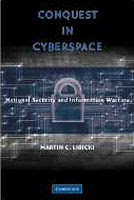
    Cyber-warfare? Martin C. Libicki says don't believe the hype

    Martin C. Libicki of the RAND Corporation has written a report about the potential for conquest in cyberspace. Libicki argues that many fears about cyber-warfare are overstated, but he also considers the threat of social engineering and the use of computers to persuade. Here's the abstract:
    The global Internet has served primarily as an arena for peaceful commerce. Some analysts have become concerned that cyberspace could be used as a potential domain of warfare, however. Martin C. Libicki argues that the possibilities of hostile conquest are less threatening than these analysts suppose. It is in fact difficult to take control of other people’s information systems, corrupt their data, and shut those systems down. Conversely, there is considerable untapped potential to influence other people’s use of cyberspace, as computer systems are employed and linked in new ways over time. The author explores both the potential for and limitations to information warfare, including its use in weapons systems and in command-and-control operations as well as in the generation of “noise.” He also investigates how far “friendly conquest” in cyberspace extends, such as the power to persuade users to adopt new points of view. Libicki observes that friendly conquests can in some instances make hostile conquests easier or at least prompt distrust among network partners. He discusses the role of public policy in managing the conquest and defense of cyberspace and shows how cyberspace is becoming more ubiquitous and complex.

    August 6, 2007

    The Fermi Paradox: Possible solutions and next steps

    This article is partly adapted from my TransVision 2007 presentation, “Whither ET? What the failing search for extraterrestrial intelligence tells us about humanity's future.”

    In my previous two articles I attempted to re-affirm the Fermi Paradox (FP) and circumscribe some of the possible interstellar activities and developmental aspects of advanced extraterrestrial intelligences (ETI’s).

    In this article I will offer two broad solutions to the FP: 1) unavoidable self-destruction and 2) localized non-migratory existence.

    It is not my intention at this time to provide a complete list of possible reconciliations, nor am I claiming to have found any kind of special answer; I just wish to explore these two particular possibilities.

    At the conclusion of this article I offer some suggestions to help us move forward as we work to solve the observational problem that is the Great Silence.

    Self-Destruction and the Great Filter


    This is the most likely and philosophically satisfying answer to the Fermi Paradox – although hardly the most desirable.

    Looking at ourselves as a typical example of a pre-Singularity civilization, what do we find? We find a species already in possession of apocalyptic technologies and on the verge of developing an entirely new generation of lethal weapons. In short order we will be required to manage an assortment of apocalyptic technologies; it will be akin to spinning plates. There are only so many that can be managed before one of them falls – and one is all that is needed to end the story.

    Examples of pending existential risks include the ongoing threat of nuclear holocaust, a nanotechnological disaster, poorly programmed artificial superintelligence (ie Singularity as extinction event), catastrophic pandemic, and so on.

    A counter-argument is often made that self-inflicted catastrophism could never be exclusive to all civilizations. How is it, ask critics, that all civilizations cannot escape such a fate? Robin Hanson attempted to answer this question by proposing the Great Filter hypothesis – the suggestion that a developmental stage exists for all life which is insurmountable. The question then: is the Great Filter behind us, or does it await us in our future?

    I would argue, based on much of the data I presented earlier, that the Rare Earth hypothesis has to be rejected. Moreover, a healthy application of the self-sampling assumption strongly indicates that the filter is ahead of us should it exist. The Galaxy is likely brimming with life, including complex life.

    As for as the search for extraterrestrial life is concerned, Hanson argues that the detection of ETI's would be bad. This would indicate, given our observation of an unperturbed, uncolonized galaxy, that the Great Filter is indeed still ahead of us.

    Another disturbing data point as a self-sampling species is that we here on earth have come to possess apocalyptic technologies long before we have developed the capacity to live off-planet or live in self-contained biospheres. All our eggs are in one basket and they will continue to remain that way into the foreseeable future.

    And then there's the disturbing Doomsday Argument which suggests that we're closer to the end than the beginning of human civilization.

    Perhaps the most common and smug solution to the Fermi Paradox is the suggestion that we are the first. It is frequently used because it is said to best satisfy Occam’s Razor. But while it may be the simplest solution, it defies our sense of probability and disregards the central lesson of the Copernican Principle – the idea that we are not unique, and very likely a typical example.

    Earlier I presented a picture of a biophilic Universe. If this issue is to be settled by a battle between Occam’s Razor and the Copernican principle, on this matter I’ll take Copernicus any day.

    Interestingly, the longer we survive as a species without extraterrestrial contact, the more we can assume that we have passed the Great Filter.

    Localized non-migratory digital existence

    Now, the prospect of human extinction is quite obviously mere speculation. As Morpheus proclaimed in the Matrix: “We are still here!” Consequently, there are some non-extinction scenarios that I would like to explore.

    The past 40 years of scientific progress has forced a re-evaluation of humanity’s potential. We appear to be headed for a transformation that takes us away from biological existence and towards a postbiological, or digital existence. Our future visions must take this into account. As Milan Cirkovic and Robert Bradbury have noted, we need to adopt a digital perspective (pdf).

    Why leave the local system when everything can be accomplished at home? Localized existence may hold promise for all the aspirations that an advanced intelligence could conceivably conjure.

    Specifically, advanced intelligences may engage in computational megaprojects and live virtual reality existences. It would be an existential phase transitioning into virtual space such that interstellar colonization would never emerge as a feasible option or experiment.

    For example, advanced ETI’s may construct Jupiter (pdf) and Matrioshka Brains. A Jupiter Brain would utilize all the matter of entire planet for the purpose of computation, while a Matrioshka Brain (a kind of Dyson sphere) would utilizes the energy output of its parent star.

    Determining an upper bound for computational power is difficult, but a number of thinkers have given it a shot. Eric Drexler has outlined a design for a system the size of a sugar cube that would perform 10^21 instructions per second. Robert Bradbury gives a rough estimate of 10^42 operations per second for a computer with a mass on order of a large planet. Seth Lloyd calculates an upper bound for a 1 kg computer of 5*10^50 logical operations per second carried out on ~10^31 bits – this would likely be done on a quantum computer or computers built of out of nuclear matter or plasma [see this article and this article for more information].

    More radically, John Barrow has demonstrated that, under a very strict set of cosmological conditions, indefinite information processing (pdf) can exist in an ever-expanding universe.

    This type of computational power is astounding and defies human comprehension. It’s like imagining a universe within a universe -- and that may be precisely be how it's used.

    What would a future civilization do with all this power?

    A civilization’s transition into high-speed digital mode may come about as natural consequence of its development. The switch from an analog civilization to a digital one – one in which the clock-speed would be accelerated to billions if not trillions of times faster than before – would preclude the desire to interact with the outside world.

    Megascale computers may be used to support uploaded civilizations. It may prove to be the existential substrate of choice – one in which the potential for self-destruction is greatly mitigated.

    Advanced civilizations may also use this computer power to run simulations for reasons of scientific research, running ancestor simulations or for entertainment (pdf) purposes. Simulations may also be run as a part of some sort of ethical or sociological necessity.

    Another possibility is the Hedonistic Imperative, a term attributed to David Pearce. Given that virtually every religion has fantasized about an afterlife of bliss and an end to suffering, paradise engineering may come to represent the optimal end-state for intelligent life. Ultimately, societies will always be comprised of conscious individuals. The optimization of subjective experience may take precedence over colonial ambitions.

    This tendency may be part of a broader, more 'existential' focus on life. Civilizational achievement may not be measured by the rate of imperialistic expanse or by how much energy it can consume, but in how individuals relate to themselves and their place in the Universe. This quest for introspective enlightenment may be characterized by efforts to optimize the mode of conscious experience.

    What about long term survival?

    In regards to long-term survival, Vernor Vinge has predicted that post-Singularity intelligences will build local secondary systems to ensure the near-immortality of the infocomplex. These could exist in off-planet repositories. Shields composed of nanotechnology and femtotechnology could deal with the issue of gamma ray bursters and other cosmological threats.

    As for the local star, it could be given added life through stellar-engineering projects in which the crucially low elements are re-introduced. Eventually, however, migration to a younger star would be necessary.

    There may also be unknown reasons for this type of existence. But what is certain is that wide-scale colonization is not in the cards.

    Moving Forward

    Admittedly, these two broad solutions -- self-destruction and non-migration scenarios -- are unsatisfactory. The notion that not even one civilization can escape self-destruction is difficult to believe. Moreover, localized digital existence and the proliferation of colonization waves are not either/or scenarios; one can imagine a civilization embarking on both paths.

    As we move forward in attempting to solve the FP we need to apply much stricter methodologies to the problem.

    Solutions to the FP must avoid the trappings of sociological analyses, which often present non-exclusive scenarios. Answers like the ‘zoo hypothesis,’ ‘non-interference,’ or ‘they wouldn’t find us interesting,' tend to be projections of the human psyche and our own modern-day realities. Moreover, these sorts of solutions, while they may account for some of the actions of advanced civilizations, cannot account for all.

    Instead, a more rigid and sweeping methodological frame needs to be applied– one which takes cosmological determinism and sociological uniformitarianism into account. In other words, we need to be concerned with cosmological limits and the pressure of physical and resource constraints.

    This is what is Nick Bostrom refers to as the strong convergence hypothesis -- the idea that all sufficiently advanced civilizations converge towards the same optimal state. This is a hypothesized developmental tendency akin to a Dawkinsian fitness peak -- the suggestion that identical environmental stressors, limitations and attractors will compel intelligences to settle around optimal existential modes. This theory does not favour the diversification of intelligence – at least not outside of a very strict set of living parameters.

    The trick will be to predict what these deterministic constraints are. One can imagine factors such as limited resources, access to energy, computational requirements (including heat dissipation, error correction, and latency problems) and self-preservational modes (i.e. political and social orientations that eliminate the possibility of self-destruction).

    A side benefit of this exercise is that it doubles as a foresight activity. The better we become at predicting the make-up of advanced ETI's, the better we will be at predicting our own future.

    Consequently, our very own survival may depend on it.

    Part I: The Fermi Paradox: Back With a Vengeance

    Part II: The Fermi Paradox: Advanced Civilizations Do Not...