August 13, 2006

Sue Savage-Rumbaugh on the welfare of apes in captivity

Tomorrow, on August 14, Dr. Sue Savage-Rumbaugh will be giving a presentation about the welfare of apes in captivity at a conference oraganized by the Animal Behavior Society. Savage-Rumbaugh, who is a lead scientist at the Great Ape Trust of Iowa (a world-class research center dedicated to studying the behavior and intelligence of great apes), is the first and only scientist doing language research with bonobos.

I recently cited her work in my animal uplift paper, "All Together Now", noting how the Great Ape Trust was not merely an excellent example of cultural uplift in nonhuman animals, but also a viable model for future institutions that may engage in more advanced uplift projects. As I stated in the paper: "...the Great Ape Trust model is an excellent starting block for not just cultural uplift, but for biological uplift as well. This endeavor is not meant to assimilate or “humanize” nonhuman species, but instead efforts that work to advance apes and their proto-culture. In this way, bonobos and other potentially uplifted nonhumans will ideally become autonomous decision making agents within a larger inter-species society. As the organizers of the Trust themselves state, the apes’ intelligence, communication, social interactions and cultural expression must be advanced respectfully, honorably and openly."

Dr. Savage-Rumbaugh was kind enough to send me an advance copy of her ABS ape welfare presentation, which is titled "Welfare of Apes in Captive Environments: Comments on, and by, a Specific Group of Apes." Her thesis takes a look at a very important issue that pertains directly to the problem of human and nonhuman social and cultural stratification. And as the title suggests, she will be presenting material on behalf of the great apes themselves.

Specifically, Savage-Rumbaugh argues that zoo and other ape confinement administrators, despite their best intentions to create idyllic environments for apes in captivity, have in reality created the illusion of appropriate care. "It is a manufactured 'happy ape world' based on a false dichotomy between ourselves and apes," she writes, "It is like something akin to saying that a human prison be a wonderful place if we would but provide prisoners with bedspreads, televisions, and beer." These illusions, she argues, "are constructed by our peculiarly scientifically informed western view of what apes ought to be, rather than what they might have the potential to be." Moreover, these are illusions we wish to see, she says, because they cover "more difficult and deeper truths." What she is alluding to is the rampant speciesism that runs through Western society and the fear and confusion about what we should actually be doing about ape socialization and inclusion.

What zoo administrators have done in recent years to improve captive welfare in apes is focus on the need for social companions, adequate cage space, fresh fruits and vegetables, variety in the diet, and some type of 'enrichment' (i.e. the opportunity for apes to provision or forage for food). Efforts like these are attempts to mimic what the apes would encounter in their natural environment. Quite obviously these measures are vastly superior to small and sterile cages, but what Savage-Rumbaugh argues is that these new models make the 'visual aspect' of the bonobos environment more entertaining and acceptable to the viewer, namely visitors to the zoo and the administrators themselves. What is not happening, however, is taking into consideration what the apes themselves would prefer.

At the core of Savage-Rumbaugh's work is the conviction that these preferences can in fact be assessed. What she has uncovered in her decades of work studying the language capacities of the bonobo people is the profoundly powerful way in which they can comprehend and apply language (for an example of how she works, watch this video). Essentially, Savage-Rumbaugh claims we can simply ask the apes themselves what it is they want and need.

And this is exactly what she has done, and this is precisely what she intends to show at the ABS conference on August 14. Based on her questioning of the bonobos, here is a list of a dozen things that the bonobos claim to desire for themselves:
1. A recognition of their level of linguistic competency and ability to self-determine and self-express through language by the humans who keep them in captivity
1. To travel from place to place
2. To obtain their own sustenance
3. To plan ways of maximizing travel and resource procurement
4. To transmit their cultural knowledge to their offspring
5. To be apart from others for periods of time
6. To develop and fulfill a unique role in the group
7. For the group to split apart and to come together to share information regarding distal locations
8. To maintain life-long contact with individuals whom they love.
9. To go to new places they have never been before
10. To live free from fear of human beings attacking them
11. To have food that is fresh and of their choice.
12. To experience the judgment of their peers regarding their capacity to appropriately carry out their role in the social group, on behalf of the good of the group
Acknowledging the inevitable disbelief and hostility that will confront her findings, Savage-Rumbaugh says, "I did not invent these items on my own." She writes,
These items represent a distillation of specific kinds of things that these bonobos have requested repeatedly across the 4 decades of research with them. When these requests are met, to the degree that I have been able to do so, new and unexpected competencies have emerged in this group. Many of these competencies remain to be documented in sufficient detail. Keeping up with their emergence has proven to require a full-time effort in and of itself. Providing bonobos with these kinds of opportunities has not fit comfortably within the standing cultural views of what one ought to do for apes and thus has constantly resulted cultural clashes which express themselves in reviews of submitted articles, reviews by groups ostensibly trying to protect animals (by keeping them extremely restrained), by funding agencies, by state and federal requirements and by peers. The need to design and maintain a proper environment for these bonobos has become an all consuming task, because our culture beliefs are not structured to accord them the kind of world they require.
The real issue, she says, is not ‘What are they like and how should we treat them?’ The real issue is ‘What do we want to permit them to become?’

I applaud the work of Dr. Sue Savage-Rumbaugh and the Great Ape Trust who I believe are doing remarkable and truly progressive work on behalf of all the great apes.

Tags: , , , , , , , , .

Cryonics Society of Canada potluck dinner, 2006

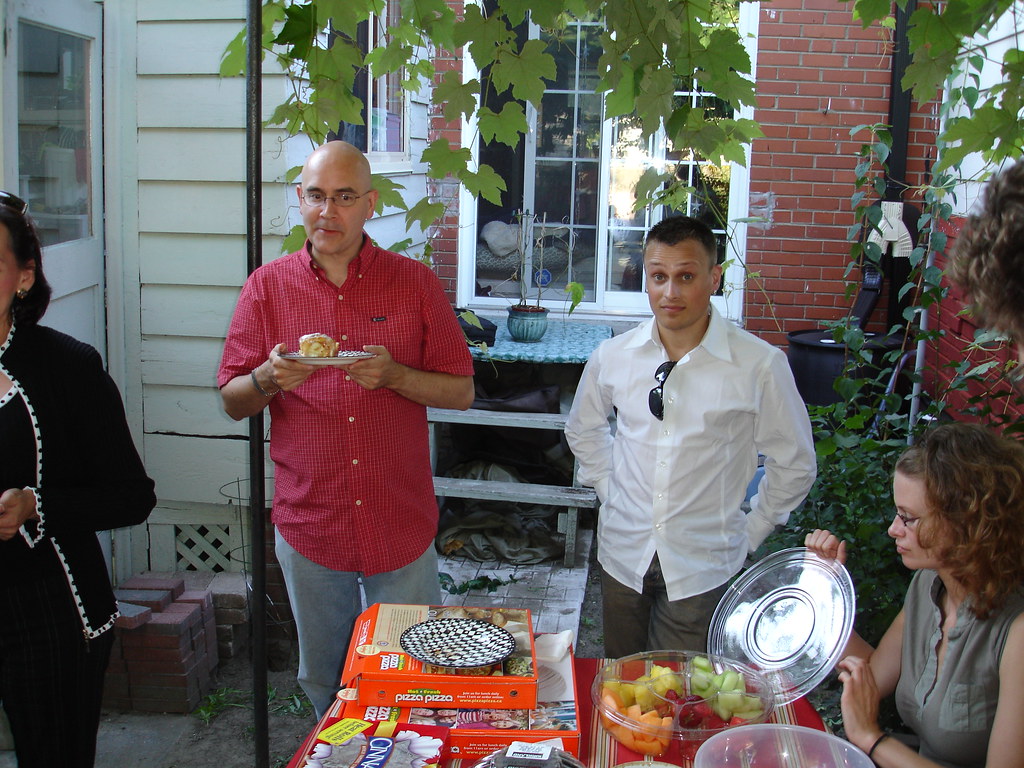
This past Saturday August 12 was the Cryonics Society of Canada's annual potluck dinner. Allan Randall, the director of CSC, was kind enough to organize and host the event.

This was my first time attending a CSC event (I don't have a cryonics contract, but I'm an avid supporter of the cause). The Toronto Transhumanist Association and the CSC have worked together to support each other over the years.

This year the CSC was fortunate to have the Cryonic Institute's Ben Best give a presentation.

I don't think Ben was taking his audience into consideration when he gave his talk; he gave a broad overview of cryonics and talked about his recent battles with neysayers. I think the crowd was hoping for some more technical information and cutting edge inside news into the cryonics and cryogenics industry.

The potluck and lecture was held outdoors and it was hotter than hell. With the midday sun pounding down on us, it was somewhat surreal and out of context to be talking about freezing bodies at extremely low temperatures. Over the course of Ben's talk, a number of us migrated to the far back to find shelter in the shade.

I took some photographs during the event, including some of Ben's posters. Click here to see the slideshow.

Ape plays Ms. Pacman


This is an extremely telling video of an ape playing Ms. Pacman.

August 12, 2006

Islamic fascism? Actually, yes.

George W. Bush has caused quite a row with his recent ‘Islamic fascism’ remark. The neo-cons are quite obviously establishing the ideological parameters within which they are continuing their propaganda campaign and maintaining the American public’s high level of agitation and fear. In the process, Bush has grossly over-simplified both the nature of current geopolitics and the religion of Islam itself. Quite justifiably, a number of Muslims are quite upset with Bush’s rather sweeping and inconsiderate remarks.

That said, there are some underlying truths to the characterization of radical Islam as a fascistic ideology (again, I take great pains to distinguish between Islamic fundamentalism and the more commonly recognized benign and mainstream variant of Islam). The rise of fanatical theocracies (Ahmadinejad’s Iran) and extremist non-state actors (al-Qaeda) have the indelible marks of far-right totalitarian politics.

And I’m hardly alone on this one. Earlier this year, for example, a number of prominent intellectuals published a statement in condemnation of what they regarded as the rise of Islamic totalitarianism. The list of thinkers who signed this statement included Salmon Rushdie, French philosopher Bernard Henri-Levy and exiled Bangladeshi writer Taslima Nasreen. In the statement, they wrote that "After having overcome fascism, Nazism and Stalinism, the world now faces a new global threat: Islamism…We, writers, journalists, intellectuals, call for resistance to religious totalitarianism and for the promotion of freedom, equal opportunity and secular values for all."

Rushdie et al are correct in their assertion that radical Islam has the characteristics of a totalitarian ideology, but I believe they have understated its fascistic elements.

Many people have the idea that fascism is the monopoly of white supremacist types. This is not the case. At its core, fascism describes the rise of a self-identified group that has grossly exaggerated its historical and societal significance. This self-identity, which typically manifests as a sense of superiority or shared destiny, can encompass anything from race, nationhood, religion, and a shared cultural heritage.

As historian Allan Cassels noted in his book, Fascism, virtually every nation has what is referred to a pre-fascist culture. For the early 20th century Germans, they identified with their race, the volk, and their mythical 'glorious' past. At the same time, many other European nations experimented with fascism, including Italy, Spain, England and even the United States.

Today, this pre-fascist culture is weak in liberal society, but it is rearing its ugly head in some of the Islamic nations. Al-Qaeda, for example, is a paramilitary organization with the stated task of reducing the outside influence of Islamic affairs. This is very much an example of cultural xenophobia and an overstated sense of social mission. Like the fascists of 20th century Europe who feared the specter of Bolshevik globalization, many Muslims today fear the encroachment of American and Jewish values. The result is a far-right, exclusionary, militaristic, and hyper-sensitive counter-reaction in the form of fascism.

Which leads to the next indelible characteristic of fascism: a common enemy. The racist Nazis rallied the nation to deal with what they considered to be the Jewish problem. The Jews were an identifiable enemy who could be blamed for all the problems of the state. They also targeted the Bolsheviks, whose extreme left position polarized and radicalized the right even further. Today, the Jews have once again been targeted by a far-right group, this time in the Mid East—but now they have been joined by the Americans (whose capitalist imperialism and social liberalism has taken the place of communism).

Other characteristics of fascism include a charismatic and populist leader, which Iran quite clearly has in President Mahmoud Ahmadinejad. What’s particularly frightening is that Ahmadinejad clearly believes his own hype. He is not so much a dictator as he is an ideologue.

By hype I mean ideology--or in this case, theological ideology. And in this sense Islamic totalitarianism is distinguished from the more secular or socialistic forms of totalitarianism. Where Marxism and fascism had ideologies informed by political, philosophical, and even (pseudo)scientific texts, radical Islam is a theocratic framework that draws its authority from religious sources.

It’s a fine point, but it’s worth mentioning. Islamic totalitarianism, while arguably far-right, is an ideological horse of a different colour. What it shares with more traditional notions of totalitarianism, however, is that is that the source of authority does not come from one individual or group of individuals (i.e. authoritarianism), but instead emanates from a monopolistic ideological framework that is enforced as the only true law of the land.

Indeed, democracy, due process and other elements of social justice as we know it in liberal democracies are absent in countries like Iran and the former Taliban Afghanistan. The goal of these theocracies is to embed religious ideology across the land and to maintain a monopoly on all ideas and institutions; radical Islam, like any totalitarian ideology, is enforced as the alpha and omega of personal existence (the state regulates nearly every aspect of public and private behavior). In this sense the revolution that is Islamic totalitarianism is comparable to the Stalinization of the Soviet Union and the work of the Nazis in 1930’s Germany. The Soviets tried to create a worker's utopia and the New Man, while the Nazis worked to ensure racial purity and create a 1,000 year Reich; Islamic fundamentalists want to create a heaven on earth – a phenomenon comparable to the quasi-totalitarian and theocratic efforts of the Calvinists in 16th century Geneva.

As for the Islamic revolution, one example that will forever stand out in my mind is when the Taliban destroyed Afghanistan’s Buddhist statues. This was an explicitly revolutionary act against those ideas and institutions that potentially rivaled the tenants of the ruling ideology; all revolutions seek to destroy the past, and this one is no different. Another example of zero tolerance toward opposing viewpoints was the recent row over the caricatures of the Prophet Mohammed in the Danish daily newspaper Jyllands-Posten. Western notions of free expression and the free press are lost on the theologues.

So, while Bush and the neo-cons wage their obverse Christian crusade against the ‘Islamic fascists’, they have (likely unintentionally) revealed a disturbing aspect of extremist politics in the Middle East. And as each side continues to antagonize each other, modern politics migrates further and further into the extreme fringes.

Tags: , , , , , .

When do uplifted nonhumans become citizens?

[this post is a copy of my response to question recently posted on the Technoliberation list]:

> A colleague of mine asks: "I understand personhood theory to include
> animals, or at least "uplifted" animals. Who decides when they have
> been uplifted enough to gain the right to vote, drink alcoholic
> beverages, or apply for credit? If not every "citizen" is equal, then
> the degree of chimerism of a chimera, for example, or genetic
> concordance with some agreed on standard in a genetically engineered
> ape, or genetically mis-engineered human, may lead to "demotion" as
> well as uplifing with respect to civil rights and liberties."


The first thing to ask is how human society goes about this. Your first question is "who decides?" Well, who decides in human society that humans can vote, drink booze, and apply for credit?

The state declares that if you're a citizen and you've reached the age of consent, you can vote. That's a pretty liberal and sweeping allowance. There's a general assumption of personhood; other factors, like level of education, race, gender, sexual orientation, etc., are irrelevant. So, when it comes to uplifted animals, citizenship and the right to vote can't be tied into their "species," or other superfluous characteristics that we ourselves don't invoke as reasons for not allowing a person to vote.

Regarding the booze question, again that's the state deciding in conjunction with democratically achieved consensus and a dash of social contract thrown in. And as for applying for credit, that's quite obviously up to the individual companies who are offering it. Based on what I've seen to date in terms of how credit cards are given out like candy, I'm surprised that credit card companies haven't already offered credit to bonobos and platypuses.

Your next question is about the equality of citizens. Actually, once the age of consent is achieved (and you haven't violated the social contract with anti-social behaviour), you are equal under the law regardless of your physical and psychological proclivities. We don't have tiers of citizenship in liberal democracies -- to do so would be a form of apartheid. I think it would be an extremely bad idea to start "demoting" uplifted nonhumans or psychological delayed humans based on some personhood metric. It's a binary concept - you're either an equal citizen under the law or you're not a citizen.

Ultimately, I think your question is this: at what point does an uplifted nonhuman enter the social contract? I would argue that once personhood is determined in an animal, the social contract comes into play. We cannot discriminate between animal and human societies. Nonhumans today already deserve state protection and laws to defend their interests (ergo the pending progressive citizenship legislation in Spain that would recognize the great apes) -- even though they cannot articulate their needs themselves. It's obvious when abuse happens, and it's our responsibility to look out for nonhuman interests. They are part of the social contract, but we acknowledge that their limited psychologies don't allow for other citizenship type behaviour like voting. The same policy is applied to small children and the severely disabled. There is nothing new here.

As for voting and other citizenship perks, we'll know that uplifted animals want to participate in the social and political arena when they start asking for it -- and we'll have to listen. To ignore their pleas for political inclusion, the right to vote and organize, would be discrimination and unconstitutional.

August 8, 2006

Metal for the masses

As most of my friends know, I'm a total metal head. I've been listening to heavy metal and other forms of extreme music since I was 13 years old. If it's loud, dark, and thrashy, I'm there. And I’ve also been known to join a mosh pit or two.

Surprised? Even a bit disappointed? Well, you shouldn't be.

Heavy metal is a much misunderstood and maligned genre that allows for the expression of aggressive, raw and alternative forms music. It also allows for the expression of unconventional and even taboo subject matter as well. Metal often addresses social issues that other genres don't dare touch: violence and cruelty, the existence of evil, the problem of religion, the paranormal and occult, drug use, alienation, existentialism, apocalyptic visions and the horrors of war.

While often criticized as being supportive of these darker themes (which some bands undeniably are), metal acts often provide a window to the world in which the uglier elements are brought out and exposed. Some people go to horror movies or read the latest news headlines, others crank the metal.

One band that epitomizes the best and worst that heavy metal has to offer is Slayer. These guys have been around for nearly a quarter of a century and have conceded nothing in terms of their ability to churn out extreme music. Lyrically and musically, they’re everything you’d expect from a metal band—-including frequent (and often juvenille and hypocritical) references to the occult.

Thus it was with some anticipation that I picked up their latest CD. It has been 14 years since the original line-up, Tom Araya (bass guitar and vocals), Kerry King (guitars), Jeff Hanneman (guitars) and Dave Lombardo, have put out an album. And it would appear that this time around Slayer have some serious axes to grind.

Slayer has chosen to direct their ire at the two things they most love to hate: religion and war. Given the current geopolitical situation, they have lots to complain about—and there’s plenty of ugliness to unveil. Their new CD, titled “Christ Illusion,” targets the warped aspects of religion and its role as the instigator of current global conflicts.

Slayer explicitly attacks the culture war between the two competing religions, Christianity and Islam. The opening track, “Flesh Storm,” declares:
It's all just psychotic devotion
Manipulated with no discretion
Relentless
Warfare knows no compassion
Thrives with no evolution
Unstable minds exacerbate
Unrest in peace...only the fallen have won
Because the fallen can't run
My vision's not obscure
For war there is no cure
So here the only law
Is men killing men
For Someone else's cause...
Another track, "Eyes of the Insane," engages in the subjective perspective of a soldier suffering from post traumatic stress disorder.

And in the anti-religion track, “Cult,” Araya sings:
Oppression is the holy war
In God I Distrust...Is war and greed the Master's plan?
The bible's where it all began
Its propaganda sells despair
And spreads the virus everywhere
Religion Is hate
Religion Is fear
Religion is war...
Today, very few artists have the audacity to express their anger and frustration in this way. Perhaps it was possible back in the 1960’s with the rise of the anti-war and folk movement, but that kind of naive approach would wear thin today. We’re far too cynical and even defeatist to think about putting flowers in the nozzles of rifles.

That’s where metal comes in. It’s cathartic, sincere and hard-line. Metal artists can thematically deal with the ravages of war and the perverseness of religion while sneering at their critics or those who would dismiss them out of hand.

It’s metal for the masses.

August 7, 2006

Good critique of SETI

A very good and concise critique of the SETI project was recently published on Space Daily. The article is largely a rebuttal to Seth Shostak's recent article, Is SETI Barking Up the Wrong Tree? (which I also critiqued a few weeks back).

Excerpt:
The situation is significantly more complex: while we, for instance, think that the astrobiological revolution gives us very strong reasons to expect life and intelligence abound, this has almost nothing to do with actual practice of SETI which we believe is largely misguided (with some exceptions listed above).

Defenders of the SETI orthodoxy obviously-as, sadly enough, similar to many other well-documented cases in the history of science-put more weight upon the "orthodoxy" than upon the "SETI" part of the syntagm. In order for this rhetorical trick to pass below the radars, they substitute a scarecrow: whoever doubts the prospects of SETI as we do it, surely holds the pretentious and preposterous view that we are alone in the Galaxy. We strongly beg to differ.

SETI is a human endevoar, perhaps most quintessentially human of all scientific pursuits in the entire history of our species. As such, it is prone to typically human mistakes and delusions. This is clearly unavoidable. What is eminently avoidable, however, is that such mistakes and delusions are publicly defended in a dogmatic, "no-alternative" manner; especially when such mistakes and delusions are grounded in an old-fashioned, conservative and anthropocentric view of the mind and the universe.
[As an aside, I had a pretty good laugh after I read this article. My immediate reaction was to forward a link to my cosmologist friend, Milan Cirkovic. As I was about to do so, I realized that the article was written by none other than Milan himself (along with Larry J. Klaes).]

August 6, 2006

Louann Brizendine's Female Brain

Louann Brizendine's latest book, The Female Brain, looks very interesting. Description:
Every brain begins as a female brain. It only becomes male eight weeks after conception, when excess testosterone shrinks the communications center, reduces the hearing cortex, and makes the part of the brain that processes sex twice as large.

Louann Brizendine, M.D. is a pioneering neuropsychiatrist who brings together the latest findings to show how the unique structure of the female brain determines how women think, what they value, how they communicate, and who they’ll love. Brizendine reveals the neurological explanations behind why

• A woman uses about 20,000 words per day while a man uses about 7,000

• A woman remembers fights that a man insists never happened

• A teen girl is so obsessed with her looks and talking on the phone

• Thoughts about sex enter a woman’s brain once every couple of days but enter a man’s brain about once every minute

• A woman knows what people are feeling, while a man can’t spot an emotion unless somebody cries or threatens bodily harm

• A woman over 50 is more likely to initiate divorce than a man

Women will come away from this book knowing that they have a lean, mean communicating machine. Men will develop a serious case of brain envy.

August 5, 2006

Minority Report's future visions

I watched Minority Report for the umpteenth time this evening and kept track of the various futuristic elements that were portrayed in the film.

Most of the ideas are quite plausible, and this is not by accident. During pre-production, Speilberg assembled a group of futurists and technologists to brain-storm the various futuristic elements that eventually made their way into the movie. According to Wikipedia:
In 1999, Spielberg invited fifteen experts convened by Global Business Network and its chairman, Peter Schwartz (and the demographer and journalist Joel Garreau) to a hotel in Santa Monica, California to brainstorm and flesh out details of a possible "future reality" for the year 2054. The experts included Stewart Brand, Peter Calthorpe, Douglas Coupland, Neil Gershenfeld, biomedical researcher Shaun Jones, Jaron Lanier, and former MIT architecture dean William J. Mitchell. While the discussions didn't change key elements needed for the film's action sequences, they were influential in introducing some of the more utopian aspects of the film, though John Underkoffler, the science and technology advisor for the film, described the film as "much grayer and more ambiguous" than what we envisioned in 1999.
My list includes:
- murder precognition (ie the ability to predict murders by converting human brains into 'pattern filtering devices')
- holographic and fully interactive user interfaces
- genetically modified flora (including modifications like poison and mobility)
- immersive virtual reality
- self driving automobiles and smart roads (including roads that allow cars to traverse the walls of buildings)
- automobile lock-down (eg so police can seize control of an automobile)
- mag-lev vehicles (magnetic levitation)
- flying troop carriers
- retinal eye scanners
- robots endowed with AI, surveillance robots (eg robotic 'spyders' that perform search-and-scan sweeps, can problem solve and communicate with each other)
- fully automated factories (eg a car assembly plant)
- smart materials with the capacity for animated graphic display (eg cereal boxes with cartoons on them and scrolling headlines on magazine covers)
- tailored narcotics (eg. recreational drugs for "the educated")
- targetted advertising, holographic advertising ("Hey John Anderton, you could use a Guinness")
- holographic projection devices with removable media
- detention centres in which prisoners are in stasis but are fed a stream of images and experiences (grossly unethical and something I should blog about)
- non-lethal weapons, including sick-sticks (causing the person on the receiving end to projectile vomit), neural paralyzer (ie brain-cuffs) and audio guns (low frequency audio projectile weapons)
- hoverpacks(ie the 'ol rocket-pack idea)
- mention of molecular nanotechnology (a newspaper headline)
- eye transplants

Let me know if I missed any!

August 1, 2006

World Future Society conference review

I was at the annual World Future Society conference this weekend manning a table for the World Transhumanist Association. The theme of this year’s conference was “Creating Global Strategies for Humanity’s Future.” Key speakers included Ray Kurzweil, Joel Garreau and Walter Truett Anderson.

At our table I had a number of WTA brochures, including literature promoting the WTA’s annual TransVision conference which will be held at Helsinki from August 17-19. I also brought along literature promoting the Institute for Ethics and Emerging Technologies, Betterhumans, and local groups like the Toronto Secular Alliance. I was also fortunate to have the assistance of a couple local volunteers. I was hoping to do some live blogging, but the WiFi connection at the hotel was utterly inadequate and virtually non-existent.

The WFS conference, which boasted upwards of 1,000 attendees, was held at the Sheraton Centre in downtown Toronto. At any given time during the 3-day conference there were 5-10 presentations running simultaneously, with topics touching upon such themes as business and careers, future methodology, resources and the environment, technology and science, and values and spirituality. There were a number of table-top displays in addition to our own, including other futurist groups and new age style religions. There were also a number of students at the conference, including a very friendly and enthusiastic group from Venezuela [thanks for hanging out with us, guys].

Having never been to a WFS event before, I wasn’t sure what to expect—particularly from the perspective of an exhibitor. While the conference theme was largely about “humanity’s future,” my sense going into the conference was that the WFS crowd would be more conservatively minded and more focused on near-term and business related issues.

For the most part this proved to be largely true, but overall I’d have to say I was impressed with the futurists at the conference. Terms that echoed in the conference rooms included the usual suspects: AI, nano, MEMS, virtual reality, and cybernetics. For this particular audience, most of whom were interested in corporate futurism, the idea of ‘enhancing’ human capacities was a given. I got the sense from several attendees that the ‘transhumanism’ moniker wasn’t completely necessary.

This was somewhat revealing for me, mostly because I spend a significant amount of my time addressing criticisms and fears as they pertain to human enhancement. Coming from the perspective of the corporate and futurist world, the enhanced human future is largely assumed. This attitude, while laudable in some respects, is disturbing in another; bioethics is largely absent in the corporate vernacular.

These conference attendees were certainly not a random sampling of society; very few people appeared openly shocked or appalled about human enhancement. That’s not to say that there weren’t detractors or voices of caution – there were certainly many different voices heard at the event. What was revealing, however, was that no one was hysterically opposed to the transhuman future.

Well, perhaps that’s not entirely fair. We did get a couple of real “live ones” at our tabletop.

I shouldn’t give the impression that this was a purely business oriented conference. There were many futurists and forward thinkers present who were genuinely interested in some of the broader existential, philosophical and ethical issues pertaining to humanity's future. What surprised me, though, was the new age feel of some of the presenters and exhibitors. In my mind, it seems that scientific literacy cannot be assumed among all futurists and WFS members.

As for the quality of the presentations, they were generally uneven. Some were genuinely mind enhancing (the virtual teams panel was excellent), while others were mind-boggingly idiotic. “Futurism lite’ would be too kind a term to describe some of the more pedestrian and boosteristic presentations.

As for our WTA tabletop, most people who came to our table quickly scanned our literature, avoided eye contact, and moved on. But a good number of them eagerly scooped up our material and initiated conversation. We moved a serious amount of literature—hundreds and hundreds of pamphlets, booklets and pages—the most I’ve ever distributed at a single event. A number of passers-by engaged me in lengthy conversations, sometimes as long as half an hour. I was glad to participate in these discussions and describe and defend transhumanist thought, but it made for a rather exhausting couple of days. And add to that the after-parties at the pubs, sleep was at a premium for me.

One last note: this was my first opportunity to hear Ray Kurzweil speak live in person. He is truly an amazing speaker and an even more amazing individual.

Thanks go out to all the people who helped me with the WTA tabletop, and a special thanks goes out to the WTA who made it possible.

July 31, 2006

Bookchin dead at 85

Murray Bookchin, 1921-2006.

"Our Being is Becoming, not stasis. Our Science is Utopia, our Reality is Eros, our Desire is Revolution." (from Desire and Need, 1967)

"An anarchist society, far from being a remote ideal, has become a precondition for the practice of ecological principles." (from Ecology and Revolutionary Thought, 1965)

"Peter Kropotkin described Anarchism as the extreme left wing of socialism - a view with which I completely agree. One of my deepest concerns today is that the libertarian socialist core will be eroded by fashionable, post- modernist, spiritualist, mystic individualism."

"The assumption that what currently exists must necessarily exist is the acid that corrodes all visionary thinking."

"The ecological principle of unity in diversity grades into a richly mediated social principle; hence my use of the term social ecology." (from What Is Social Ecology?, 1984)

"If we recognise that every ecosystem can also be viewed as a food web, we can think of it as a circular, interlacing nexus of plant animal relationships (rather than a stratified pyramid with man at the apex)... Each species, be it a form of bacteria or deer, is knitted together in a network of interdependence, however indirect the links may be." (from The Ecology of Freedom, 1982.)

July 30, 2006

All Together Now: Animal uplift paper complete and published

I've finally completed my paper on animal uplift: All Together Now: Developmental and ethical considerations for biologically uplifting nonhuman animals. It's been published at the Institute for Ethics and Emerging Technologies site under the monograph series.

This paper is the fleshed out and refined version of the presentation that I gave at the IEET's HETHR conference at Stanford last May.

Here's the abstract (comments welcome):
As the potential for enhancement technologies migrates from the theoretical to the practical, a difficult and important decision will be imposed upon human civilization, namely the issue as to whether or not we are morally obligated to biologically enhance nonhuman animals and integrate them into human and posthuman society. Precedents for intra-species cultural uplift abound in human history, providing both sobering and edifying episodes showcasing the possibilities for the instigated and accelerated advancement of technologically delayed societies. As a number of scientists, philosophers and futurists have recently argued, there is mounting evidence in support of the suggestion that these historical episodes are symptomatic of a larger developmental trend, namely the inexorable and steady advancement of intelligence. Civilizational progress necessarily implies increasing levels of organization and refinement across all realms of activity. Consequently, the status of nonhuman species and the biosphere will eventually come under the purview of guided intelligence rather than autonomous processes. That said, a developmental tendency towards uplift does not imply that it is good or right; more properly, it can be argued that uplift scenarios do in fact carry moral currency. Through the application of Rawlsian moral frameworks, and in consideration of the acknowledgement of legally recognized nonhuman persons, it can be shown that the presence of uplift biotechnologies will represent a new primary good and will thus necessitate the inclusion of highly sapient nonhumans into what has traditionally been regarded as human society. In addition to issues of distributive justice, the Rawlsian notion of original position can be used to answer the question of whether or not there is consent to uplift. Finally, it will be shown that the presence of uplift biotechnologies in the absence of the legal recognition of nonhuman persons and a mandate for responsible uplifting will ultimately lead to abuse, adding another important consideration to the uplift imperative.
Tags: , , , , , , , , .

July 21, 2006

Shostak: Is SETI Barking Up the Wrong Tree?

Seth Shostak is once again trying to justify the work of SETI. But seeing as that's his job, it's to be expected. He has to perpetually defend the work of SETI to secure public support and funding.

Shostak notes that there are four primary suggestions as to why SETI hasn’t found a signal:
1. “You’re counting on the aliens using communication technology (radio, light) that’s oh-so-last century. They will be far beyond this.”

2. “If hi-tech societies or thinking machines were out there, they’d have colonized the Galaxy by now. Clearly, we’re alone… lone… lone.”

3. “The aliens don’t want to communicate with us. Look at what we’re doing to the planet!”

4. “You SETI types are just looking in the wrong places. We know where the extraterrestrials are: on a planet in the Zeta Reticuli system.”
Reasons #1, #3 and & #4 are useless, but #2 is one I'm partial to. As I've written before, the apparent dearth of ETI's in our galaxy is a disturbing observation.

In response to suggestion #2, Shostak writes:
This is, of course, an appeal to the Fermi Paradox, which assumes that if sophisticated societies are common, they should also be ubiquitous. Well, I just checked the parking lot outside the Institute, and I see no large animals with long, prehensile noses. The conclusion a la Fermi is that elephants don’t exist on this Earth, right? After all, any putative pachyderms have had plenty of time to get to my office, even if only a few of them are so inclined. To use the Fermi Paradox as a reason for the lack of a SETI signal is to make a very big extrapolation from a very local observation. Seems chancy to me.
This is a surprisingly weak answer from Shostak who has clearly misinterpreted the FP. No one is arguing that elephants should be ubiquitous. If we thought, for whatever reason, that elephants should occupy specific ecospaces on Earth, but they don't, then that would be a sort of observational conundrum much like the FP. I don't expect this, so I don't see this as a problem.

On the other hand, our expectations of AETI migratory behaviour and their potential megascale engineering projects are a horse of a different colour. The FP is about the absence of evidence when there should be evidence. And Shostak knows this; otherwise he wouldn't be pointing his radio arrays at the sky. It would be a convenience of the highest order if the first signs of ETI life were to be discovered now.

Shostak and others are guilty of grossly underestimating the characteristics of post-Singularity AETI's. Those, like Shostak, who dismiss the FP betray a misunderstanding of the potentials of artificial superintelligence, radically advanced computing and such technological artifacts as Von Neumann and Bracewell probes. And as usual, these dismissals fail to take into account the extreme age of the universe and the huge expanse of time that has preceded our own.

That said, Shostak may be (inadvertently) right about ETI localization. As argued by Cirkovic and Bradbury, AETI's may migrate from a biological habitable zone to a technological habitable zone -- one more conducive to megascale information processing projects like matrioshka and Jupiter Brains.

But Shostak and SETI, I'm sure, aren't considering these types of scenarios. My advice to SETI: keep on listening, but don't expect to hear anything.

Tags: , , , , , , , .

Key perspectives on the Bush stem cell fiasco

Ronald Bailey is mad.
Art Caplan's is too.
Jim Fossett says calm down.
Elizabeth Gettelman of MoJo chimes in.
But when all is said and done we'll probably be able to get stem cells another way.

July 19, 2006

Americans get a taste of Canadian biopolitics

Now that George Bush has vetoed a bill rejecting legislation passed by Congress that would have expanded federal research on embryonic stem cells, Americans have been given a taste of what Canadians have had to deal with for the past four years.

Actually, that’s not entirely fair to our American friends. The situation here in Canada is actually far worse.

Surprised? Well, don’t be. Back in 2002 the Liberal government passed Bill C-6 – the so-called Assisted Human Reproduction Act. Where Bush has limited federal funding, the Liberals have banned research into human embryonic stem cells altogether. As is the situation in the United States, religious injunctions against meddling with embryos are dominating Canadian legislatures.

And this is exactly the issue at hand. It’s actually not such a big deal that embryonic stem cell research has been curtailed. There have been remarkable advancements in deriving stem cells from adults and non-human animals. The pending stem cell revolution is in no danger of being interrupted.

Rather, the real problems raised by Bill C-6 and Bush’s recent veto have to do with deplorable politicking and the incessant intrusion of religion onto daily life. When announcing the veto, Bush unabashedly surrounded himself with babies – babies born as a result of embryo adoption programs. Bush’s implied statement of embryo sanctification flies in the face of the fact that thousands upon thousands of embryos are destroyed each year, most arising from IVF efforts.

I’m sure Bush isn’t about to tread on that old issue. What used to be called “test tube babies” now accounts for over 112,000 births each year in the United States alone. Worldwide, it’s been estimated that over 3 million children have been born through IVF since its inception in 1978. Clearly Bush’s rhetoric of “crossing a moral line” is grossly insincere and laughable, especially considering the appalling deaths of innocents as a result of his war on terror. What Bush is really doing by virtue of his embryo baby kissing and stem cell vetoing is pandering to one of his most important constituencies, namely the religious right.

Meanwhile, here in Canada, the (very) silent but powerful Christian minority has completely taken advantage of Canadian complacency. Not knowing and not caring is truly our national pastime. As I write this, many Canadians are up in arms in regards to Bush’s veto, with very few realizing that our own legislation is far more restrictive. Worse, Canadians are oblivious to the fact that Christian notions of personhood are directly inhibiting medical research and potential breakthroughs.

Ultimately, as biopolitics matures as a social issue, Canadians and Americans will eventually come to their senses and acknowledge the importance of stem cell research. The benefit of regenerative medicine carries profound implications for nearly everyone. There are people alive today who could desperately use these types of interventions. It’s about time we honoured the sanctity of those lives that are actually being lived rather than levying nonsensical notions of personhood onto a clump of cells.

Tags: , , , , .

July 12, 2006

Global warming and the end of human freedom

Humans and human institutions are clearly failing the planet.

And when environmental catastrophes finally hit the tipping point, panicked societies will start to fail humanity itself. Preventing global warming, it would seem, is not just about preserving the biosphere, it’s also about preserving human freedom.

At the recent IEET conference at Stanford University, environmentalist Walter Truett Anderson declared that global warming is the single most important problem to ever face humanity. In a history dominated by everything from plagues to genocide, that's a rather bold statement to make, and likely very true.

So, why aren't we mobilizing en masse to deal with the crisis? Why isn’t it the first thing we think about when we wake up and the last thing before bed? The reasons are frustratingly multifaceted--a long list that includes such factors as corporatist indifference (think of the Kyoto failure), a population largely ignorant and in denial, and an insufficient sense of crisis. The sky, after all, is not falling...at least not yet.

Another reason is the democratic and libertarian streak that now permeates all liberal societies. Rather than state coercion, people are expected to act voluntarily and to democratically establish institutions that will contend with problematic issues like global warming. The general assumption is that people tend to be intelligent, reasonable and self-preserving. Give them a good reason to act and they will do so out of their own volition.

Unfortunately, as the global warming issue has revealed, this tendency has not been put into practice to any great extent. SUV’s and Hummers dominate the streets, factories churn out the pollutants, and country after country fail the minimum requirements established by Kyoto—with other countries either not participating or threatening to pull out altogether (like Canada, for example).

Sadly, the only time in human history when people have been effectively mobilized for mega projects is when a state declares war on another, or when the state declares war on its own citizens (as witnessed by authoritarian dictatorships or totalitarian fascism, communism and theocratism). I don’t use these examples lightly. They reveal disturbing insights into human behavior and selfishness, the inefficacy of political and corporate institutions, and ultimately, the role of state coercion throughout human history. In the case of war and totalitarianism, they are political phenomenons that are both emblematic and driven by feelings of desperatism. Under these conditions, populations are compelled by their governments to fanatically work towards desired ends. And these ends, of course, trump such niceties as human liberty.

Sure, there’s no seemingly obvious reason for alarm or desperatism today—-but it’s not implausible to suggest that quai-totalitarian frameworks will arise as a result of the calamitous effects of global warming. Once the environment truly goes to hell and it becomes overtly obvious that a catastrophe is actually happening, our respective governments will find ways to a) control its fearful populace, and b) compell its citizens to live and work a certain way. It would be George Orwell on hydraulic despotism.

Such state prerogatives may come about through democratic processes—governments elected out of fear and panic. Or, these political regimes may arise from unilateral political action (a la the current Bush regime; as American libertarians are finally learning, when times get tough, the liberties get going). Regardless, they will morph into governments driven by a frantic and panicked call to action.

So, along with the environment, it’ll only be a matter of time before you can kiss your free ass good bye.

Tags: , , , , , .

Gone to that great gig in the sky

Syd Barrett, 1946-2006.

Lime and limpid green, a second scene
A fight between the blue you once knew.
Floating down, the sound resounds
Around the icy waters underground.
Jupiter and saturn, oberon, miranda and titania.
Neptune, titan, stars can frighten.
Lime and limpid green, a second scene
A fight between the blue you once knew.
Floating down, the sound resounds
Around the icy waters underground.
Jupiter and saturn, oberon, miranda and titania.
Neptune, titan, stars can frighten.
Blinding signs flap,
Flicker, flicker, flicker blam. pow, pow.
Stairway scare dan dare whos there?
Lime and limpid green, the sounds around
The icy waters under
Lime and limpid green, the sounds around
The icy waters underground.

July 11, 2006

Wikipedia, postgenderism and me

I found out today that the postgenderism entry on Wikipedia was deleted and a new re-direct set up in its place that points to the wiki entry on me, George Dvorsky.

That's completely weird and unexpected. I'm not necessarily thrilled with having a philosophical or social movement essentially equated with my name on Wikipedia. Moreover, it's hardly emblematic of my work and writings in futurism and transhumanism in general.

It's my understanding that the reason for shutting down the discrete 'postgenderism' entry was due to a lack of citations and other examples of expositions on the matter (other than my own). I'm not convinced that's entirely fair. Other people did contribute to the postgenderism wiki entry, and citations were made to such thinkers as Donna Haraway.

Well, we'll see how the entry evolves over time. I'm inclined to stay out of it and watch what happens. It's also about time that I write a formal paper on the matter and submit it to a journal like JET. But first things first -- I'm still working on my animal uplift paper.

SENS survives Pontin's challenge

Not surprisingly, at least not for me anyway, Aubrey de Grey's "Strategies for Engineered Negligible Senescence" (SENS) survived a Technology Review challenge which sought to determine whether or not the theory was worthy of "learned debate."

Here's a nice summation of the judge's conclusion:
We need to remember that all hypotheses go through a stage where one or a small number of investigators believe something and others raise doubts. The conventional wisdom is usually correct. But while most radical ideas are in fact wrong, it is a hallmark of the scientific process that it is fair about considering new propositions; every now and then, radical ideas turn out to be true. Indeed, these exceptions are often the most momentous discoveries in science.

SENS has many unsupported claims and is certainly not scientifically proven. I personally would be surprised if de Grey is correct in the majority of his claims. However, I don't think Estep et al. have proved that SENS is false; that would require more research. In some cases, SENS makes claims that run parallel to existing research (while being more sensational). Future investigation into those areas will almost certainly illuminate the controversy. Until that time, people like Estep et al. are free to doubt SENS. I share many of those doubts, but it would be overstating the case to assert that Estep et al. have proved their point.
Here's TR editor-in-chief Jason Pontin's account of the judge's findings.
Here's the Estep et al. dissention to the decision.
Read more about it in ImmInst and Betterhumans.
And here's my rant from a few weeks back.

July 3, 2006

Superman’s return to a post 9/11 world

I have a real soft spot for the 1978 version of Superman, so it was with some anticipation that I went to see Superman Returns yesterday with my eldest son – who is practically the same age now as I was back in ’78. After sitting (and often squirming) through the 2½ hour updated version, let’s just say that Superman Returns didn’t have nearly the same impact as its predecessor. It was actually quite mediocre, but it’s given me some fodder for a rant.

Like most of my reviews, this one is spoiler ridden, so stop reading now if this poses a problem for you.

Superman Returns is a curious movie in that it is more a re-imagining of the 1978 version than an amalgamation of previous versions or a completely revised approach along the lines of what Christopher Nolan recently did with the Batman franchise. A number of stylistic and plot elements from the 1978 film were retained, including aspects like Lex Luthor’s attempt to profit from a massive land grab and even the crystalline Fortress of Solitude itself. That said, the writers did alter the canon to a significant degree by having Superman return from a five year space mission in a failed attempt to find any remaining survivors of Krypton, and most surprisingly, the revelation that he has a son – one who looks to be endowed with similar powers.

Superman’s return from his five year hiatus is a key theme in the movie. Disappearing from the world without so much as saying good-bye, Superman’s return is met with mixed emotions, particularly by one Lois Lane who has since married and formed a family. In fact, Lane is set to receive a Pulitzer Prize for a shocking editorial titled, “Why the World Doesn’t Need Superman.” Lane and the inhabitants of Earth, it would seem, have come to grips with Superman’s absence and have learned to cope without their savior; indeed, Lane’s bitter piece was fueled by an existentialist sense of unfair abandonment and could have very well been titled, “Why the World Doesn’t Need God.”

At first I was puzzled by the script writer’s decision to have Superman gone for so long, but the reason eventually dawned on me. Five years. Not an arbitrary number when you realize that we are quickly approaching the five year anniversary of 9/11. Like the arrival of the extraterrestrials in The Day the Earth Stood Still, Superman’s return is a quasi-messianic example of wish fulfillment in popular culture. Five years after 9/11, and deeply intertwined in the so-called war on terror, Americans are most assuredly looking to the sky for help.

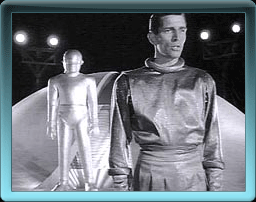
In The Day the Earth Stood Still, aliens Klaatu and Gort arrive to 1951 Earth in an attempt to rescue a civilization that had only recently come into possession of apocalyptic weapons. Given the trauma of World War II, the rise of the Cold War, and the loss of innocence wrought from the development of planet destroying technology, nervous audiences were offered some (fictional) hope by having (fairly) benign creatures fall from the sky to set things right. God, it appears, was dead -- even in the 50s; if aliens couldn’t save us, after all, then who would?

And like the arrival of Klaatu and Gort, the return of Superman in 2006 is also reflective of contemporary geopolitical concerns and desperatism. When Christopher Reeve donned the red cape back in the late 70’s, Superman had to address the disturbing rise of urban violence and crime. Today, the stakes are much higher. With the United States under the perceived threat of super-terrorism, and with an incompetent and largely ineffective government in place to deal with the issue, defeatism has led to to those hopes that can only be realized in religious or science fictional outlets.

One could interpret the work of Superman, who works for truth, justice and the American way, as an analogy and rationalization of the geopolitical aggressiveness of the United States. Superman Returns can also be seen as a metaphor or craving for religious messianism, or simply as an example of escapism and wish fulfillment. Those partial to religious sensibilities will most certainly sympathize with the messianic overtones. Lois Lane, embarrassed by her earlier lack of faith, eventually decides to pen a new editorial -- this time making a case for “Why the World Needs Superman.” Or is that God? It’s Superman Returns as a call to prayer.

Alternately, given the fact that Superman doesn’t exist in our reality, one wonders if the film is making a case for passivity, despair and escapism. Given the hopelessness of the current geopolitical situation, are we better off disengaging from reality and slipping into dreamy Hollywood diversions?

I certainly hope not. Other post 9/11 science fiction franchises have taken a different approach. Battlestar Galactica, for example, has a decidedly West Wing element to it. The show is hard-edged, cynical and at times maudlin, but more representative of current realities than movies like Superman Returns.

Well, the kid in me that marveled at Superman in 1978 is most certainly dead, replaced by a thirtysomething sensibility that’s now easily irritated by simplistic and opportunistic pop culture drivel. But even if my tolerance for mindless distractions has withered over the years, it still doesn’t hide the fact that Superman Returns is a crappy movie. This film, while desperately trying to retain the majesty of Superman: The Motion Picture – it usurped the old musical score and Marlon Brando’s performance – utterly failed to incorporate the charm, poignancy, and depth of its forerunner.

And worse, by unabashedly making this a post 9/11 wish fulfillment movie, its creators have pandered to one of the more pathetic elements of American society and human nature itself.

Tags: , , , .