I'd like to plug some blogs I've been visiting lately:
Simon Smith's blog: This is Simon's new personal blog. He is the editor-in-chief of Betterhumans and enhancementQuest and one of my best friends.
Stephen Batchelor's blog: Yes, agnostic Buddhist Stephen Batchelor has a blog. It's on Tricyle, which is apparently "America's leading Buddhist Magazine."
Arthur Caplan's Bioethics blog: Caplan is one of the leading bioethicists in the US. There are always some gems on this one.
AnneC's Existence is Wonderful: Anne's blog deals with various transhumanist issues, with a particular focus on radical life extension and neurodiversity. Be sure to check out her podcasts.
The IEET's Latest From Fellows and Staff and blog: The Institute for Ethics and Emerging Technologies, of which I'm on the Board of Directors, regularly publishes the work of its members. These articles are always worth checking out, with contributions from such writers and thinkers as Jamais Cascio, Mike Treder, Douglas Rushkoff, and Russell Blackford.
Some of my favourite blogs these days include Michael Anissimov's Accelerating Future, The Neurophilosopher's blog, Anders Sandberg's Andart, Jeff Patterson's Gravity Lens, and Martin Striz's Strizblog (which is now sadly quite low volume as he's busy with other priorities).

October 14, 2006


October 13, 2006
I, neologist nuisance
As best as I can tell, I have spawned several neologisms that are now modestly viraling their way around the internet. They are: techlepathy, astrosociobiology and postgenderism.
Techlepathy gets 1,620 results in Google. Astrosciobiology gets 738 results, while postgenderism gets 511. Each word has a corresponding Wikipedia entry, but postgenderism redirects to an entry on me for some strange reason.
I first used the term 'techlepathy' in my Betterhumans article, “Evolving Towards Telepathy.” The other two were words that I had been using informally; I decided to flesh out the ideas in Wikipedia to see what would happen. Of the two, astrosociobiology has had the most work done to it terms of contributions and revisions. I believe that the term 'postgenderism' has been used before, but not in the same posthumanist/transhumanist context--more as a gender issues thing.
Some questions I have are: When does a word cease to be a neologism and become a bona fide word? Is Wikipedia correct in their stance against the posting of neologisms (which is why postgenderism redirects back to me)? Or are they reacting unfairly to new ways in which information emerges?
Techlepathy gets 1,620 results in Google. Astrosciobiology gets 738 results, while postgenderism gets 511. Each word has a corresponding Wikipedia entry, but postgenderism redirects to an entry on me for some strange reason.
I first used the term 'techlepathy' in my Betterhumans article, “Evolving Towards Telepathy.” The other two were words that I had been using informally; I decided to flesh out the ideas in Wikipedia to see what would happen. Of the two, astrosociobiology has had the most work done to it terms of contributions and revisions. I believe that the term 'postgenderism' has been used before, but not in the same posthumanist/transhumanist context--more as a gender issues thing.
Some questions I have are: When does a word cease to be a neologism and become a bona fide word? Is Wikipedia correct in their stance against the posting of neologisms (which is why postgenderism redirects back to me)? Or are they reacting unfairly to new ways in which information emerges?
October 12, 2006
The U.S. plan for a 21st century nuclear blitzkrieg
 Strangely, the end of the Cold War, for whatever reason, ended the global impetus behind the development and enforcement of non-proliferation treaties for nuclear weapons. The current North Korean situation, and soon to be Iranian situation, is an example of inexorable technological globalization. It is also symptomatic of the current nation-state era, in which geographical regions claim political, economic and militaristic sovereignty; each country claims that it has the right to develop nuclear weapons and to protect itself.
As a number of commentators have pointed out, the fact that North Korea has joined the Nuclear Club is a joke of horrendous proportions. This is exactly the situation that was feared back in the mid-40's when nuclear weapons first emerged. Nuclear weapons have not been used in combat since World War II, but that should not be taken as an indication that they will never be used again. That said, there may be some very good reasons for their non-use during the course of the past sixty years.
Theory suggests that full-out nuclear war is highly improbable between nuclear capable countries -- an assumption based on the idea that nations are self-preserving rational actors – namely the mutually assured destruction concept. This idea, which is really a strategy to create deterrent, is a real-world application of the game theoretic Nash Equilibrium, in which both sides attempt to avoid their worst possible outcome — nuclear annihilation.
I can't be certain that the twisted communist regime under Kim Jong-Il is such a rational actor, nor can I be certain about Ahmadinejad's Iran in which he has threatened to wipe "Israel off the map." M.A.D. does not apply to psychotic leaders or nihilistic ideologies.
Relatedly, conventional warfare between nuclear capable nations may also be a recipe for mutually assured destruction -- particularly if it's total war. Again, presuming the presence of rational actors, should one side start to lose the war (and consequently lose hope), they could threaten to annihilate the enemy with nuclear force, an action that would most assuredly be reciprocated. Thus, because conventional war would either result in stalemate or the complete destruction of both sides, such a conflict would never be entered into. This might be an explanation as to why India and Pakistan have not dared to go to war with one another.
This said, given the need for military “options” in the nuclear age, the Pentagon has recently provisioned for both nuclear and conventional war against enemy states. These are quick-strike campaigns that have been under development since 2002 and are meant for crisis situations in which the enemy would be engaged and debilitated in short order. These plans, which are named JFCCSGS and CONPLAN 8022, are the modern day equivalent to Nazi Germany's Blitzkrieg of World War II -- but with much more sophisticated technology and tactics behind it.
JFCCSGS, which stands for "Joint Functional Component Command Space and Global Strike," is the establishment of a space and earth attack command unit for the purpose of engaging in pre-emptive nuclear strikes. Seriously. It has the mandate to oversee the launching of a nuclear attack and the pre-emptive use of nuclear warheads not only against "rogue states" but also against China and Russia. As of December 2005, JFCCSGS is said to be in "an advance state of readiness." One month earlier, the unit successfully completed an exercise called "Global Lightning," which was meant to mirror an attack on North Korea. It is assumed that JFCCSGS exists almost exclusively to deal with potential problems raised by both North Korea and Iran.
CONPLAN 8022, which is short for "Concept Plan 8022," is different from other war plans in that it posits a small-scale operation and no (or minimal) "boots on the ground." CONPLAN would not require a focus on conventional forces such as air, ground and sea. Rather, it provisions for two different scenarios: 1) a response to a specific and imminent nuclear threat, and 2) a quick-reaction, highly choreographed strike combining pinpoint bombing with electronic warfare and cyberattacks to disable an enemy's response (I'm not sure what kind of electronic infrastructure N. Korea and Iran have, but I would have to think it minimal), with commandos operating deep in enemy territory, perhaps even to take possession of the nuclear device or WMD. Also in its arsenal are "clandestinely enabled effects," which are "non-kinetic" ways of disabling the workings of modern society (I’m sure you can use your imagination to figure out what some of these ‘effects’ might be).
CONPLAN can be instigated by presidential order; it is a "global strike" war plan that is meant to provide the president with options in the case of an imminent WMD threat. Military thinkers began working on the plan back in 2002 and were finished in November 2003. General Richard B. Myers signed the Global Strike "Alert Order" on June 30, 2004, putting the armed forces on notice that they needed to be ready to carry out a strike on the president's order.
These are frightening provisions, particularly in their call for the use of nuclear weapons (even if some of them are low yield). And these "options" have been made all the more plausible and threatening by virtue of the collapsing international effort to curtail the spread of nuclear arms. The North Korean example (or was that Pakistan?) should act as yet another wake-up call for the global community to enact and enforce stricter treaties that limit the spread of nuclear weapons. The idea of national sovereignty and the "right" to produce nuclear weapons is as invalid as it is dangerous. Given the sorry state of some countries, whether it is the result of an erratic leader, a fanatical ideology, or an insecure political infrastructure, the number of counties in the nuclear club must remain at minimal levels.
At the same time, there also needs to be a concerted collective effort to foster a more influential United Nations and a stronger pan-international security force to help countries defend themselves. This one is more difficult, particularly when you have nation-state pariahs like Iran and North Korea who feel persecuted by the international community. Ultimately, however, a centralized and democratized world federalism would go a long way to curtailing some of the geopolitical instability we are currently experiencing in this highly multi-polar world.
References:
Washington Post: Not Just a Last Resort?
Washington Post: The Truth Behind Military Inaction in North Korea
Global Research: Nuclear War Against Iran
Related articles:
The perils of miniaturization on the battlefield
October 11, 2006
Future threat: annihilation from within
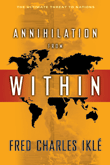 Here's an interesting book from Fred Charles Iklé, an expert in defense and foreign policy, nuclear strategy, Korea and the emerging international order. It's a 107 page book called Annihilation from Within that warns of potential security issues in a very future-realist sort of way.
What's interesting about this book is that Iklé is assessing the impacts of future technologies on security, and at the same time dismissing current geopolitical fixations such as the United States's global war on terror. These issues, including the killing in Iraq and Afghanistan, the danger of new terrorist attacks and the nuclear programs in Iran and North Korea are, in Ikle's opinion, already in the rearview mirror of history.
Instead, Iklé is looking at the pending impacts of such things as nanotechnology, superintelligence and other radical information and communication based technologies. Ikle recognizes the fact that we are in the midst of accelerating change, the outcome of which will not be subtle or easily predictable. Suffice it to say, however, the pending leap of history will "obliterate all previous notions about military power, pose a fundamental challenge to all religions, and eventually upend human civilization," he says.
Iklé recognizes that the quest is now on for superhuman intelligence. Its attainment, he says, will revolutionize all prior considerations about national security and transform the human condition. "We can no more imagine the political order of this new world," he writes, "than a group of chimpanzees in the forest can comprehend what goes on among humans in a nearby village."
Our greatest threat, Iklé argues, is a cunning tyrant gaining possession of a few weapons of mass destruction. His purpose would not be to destroy landmarks, highjack airplanes, or attack railroad stations, but rather, to annihilate a nation's government from within for the purposes of assuming dictatorial power. The twentieth century, he says, offers vivid examples of tyrants who have exploited major national disasters by rallying violent followers and intimidating an entire nation. As a recent interview of Iklé in the Washington Times noted:
"An aspiring dictator who is an insider endowed with political charisma and extraordinary strategic vision might have his henchmen obtain a couple of nuclear weapons. With a carefully timed use of these weapons the sudden nuclear devastation would cause great shock and widespread despair. The morning after, the new dictator could exploit this despair and political crisis to grab total power -- much like Lenin exploited the misery and chaos of war-ravaged St. Petersburg."It's refreshing to see a book written by a respected security advisor who has some sense as to what the 21st century is going to be all about. It's not a perfect projection, but at least we're getting there.
Here's a link to that Washington Times review, Annihilation Omens.
Slayer's 'Christ Illusion' banned in India
 As liberal society progressively moves in the direction of increased secularization, one would think that it would be easier to critique religions, including the promotion of material that might be considered offensive. This hasn’t been the case. In the past, as today, seriously scathing agitprop and art were considered by many to be sacrilegious (remember Piss Christ and Ecce Homo?) and anti-social. But these days, there’s the added fear of backlash and violence (witness the recent Idomeneo show cancellation in Germany).
Fear is starting to settle in.
This said, I suppose I should have seen this one coming: Slayer's latest CD, 'Christ Illusion,' has been banned in India because it is considered "offensive and in very bad taste."
Specifically, the album cover depicts a mutilated Jesus Christ, while the songs are overtly anti-religious. Song titles include "Skeleton Christ" and "Jihad." EMI India has banned and destroyed all existing copies, fearing that both Christians and Muslims would be offended (destroying the copies seems a bit excessive, but that's just me).
I blogged about this album when it was released back in August.
A censored version of the album cover has been produced, but EMI India has not indicated that they will be re-releasing the CD any time soon. It appears to me that they are doing this to avoid a potential row similar to the one created by the controversial Danish cartoons from earlier this year.
Mark this as another victory for anti-secular forces and a blow against free speech. By this action, EMI India is caving to the pressure of religious groups, particularly the extremists.
 That's right, folks -- keep on pandering. Keep on giving inches. Keep on promoting the idea that anti-religious polemics are unacceptable and potentially "offensive." Keep cowering in the face of threats. Worry about offending the religious. Keep on giving them a sense of entitlement and legitimacy. And at the same time let's admit to having an inferiority complex and let's admit that we're scared shitless of religious groups and what they might do when they find some material "offensive and in very bad taste." Let's completely forgo the liberal mission to separate church from state and to protect people from the forces of evangelical religion.
 And let's see where this all gets us.
Deservedly, Slayer gets to have the last word; "Jihad" is sung from the perspective of a religious extremist:
I have witnessed your death
I've seen it many times
Your tortured screams
Your decrypted little mind
A father's son
With pathetic eyes that bleed
Twins in the end
Begin and let the brothers fall
I will see you buried alive
Screaming for your God
I will watch you die again for him
God won't touch what I've done
He cries upon my feet
A privilege pain
Beneath buried are your dead
On splintered bones I walk
Sifting through the blood
Besieged in fear
Await the coming of the God
I will watch you die again for him
Blood is raining downward
The stain reflects the sun
Conquer divide within
Terrorize the mind
I have seen the end it's yours
Rosary in hand
Your selfish flesh it melts
Spilling from the sky
I will see you burn alive
Screaming for your God
I will watch you die
This is God's War
God's War
This God's War
God's War
War of Holy principles
I'm seeking God's help in your destruction
Slit the throat of heathen man
And let his blood dilute the water
Bury your dead
Fuck your God erase his name
A lady weeps insane with sorrow
I'll take his towers from the world
You're fucking raped upon your deathbed
This is God's War
God's War
This God's War
God's War
Fucking Holy War
[spoken]:
Be optimistic, happy and calm
Show no fear or anxiety
Smile at the face of God
And your reward will be eternity
Holy warriors
Your patience will be justified
Everything is for him
You must not comfort the animal before you kill it
Strike as champions at the heart of the nonbelievers
Strike above the neck and at all extremities
For it's a point of no return for almighty God
God will give victory to his faithful servant
When you reach ground zero you will have killed the enemy
The great Satan!
October 10, 2006
Anders Sandberg's warning signs for tomorrow
Neuroscientist and transhumanist philosopher Anders Sandberg has developed a set of potential warning symbols for the future. My favourites include Memetic Hazard, Nonstandard Spacetime and Group Intellect. Anders goes on to explain the rationale behind each symbol at his blog.


October 6, 2006
The state of cryonics in Canada's B.C.
 Did you know that cryonics is outlawed in the Canadian province of British Columbia? Seriously. Back in 1991 the Socreds criminalized cryonics describing it as "speculative life support technology." The legislation stands to this very day, causing great concern for B.C.'s cryonauts who aren't getting the support and re-assurance they need.
 This past July, freelance writer Danielle Egan chronicled the situation in The Tyee. The article, titled "Fighting for the Right to Be Frozen," analyzes the state of cryonics in British Columbia and Canada in general.
Excerpt:
With his 68th birthday approaching, Charles Grodzicki slapped down $28,000 USD for a plot to call home after his death. Like many people his age, the West Vancouverite is working on his will and has briefed his loved ones so they know exactly what he wants done with his remains. But he's having trouble finding a local funeral director to sell him a pre-arranged package, thanks to a little-known B.C. law enacted in 1990. "I've talked to so many people," says Grodzicki over juice at The Bread Garden. "Two Vancouver funeral directors, the head of the Western School of Funeral Services and the B.C. Association of Funeral Directors. All of them tell me what I want is illegal."Entire article
Grodzicki wants to be cryopreserved. The goal is to be "deanimated," then shipped to the Cryonics Institute (CI) just outside Detroit, Michigan, where he'll be preserved in liquid nitrogen and hopefully reanimated at a future date. "I'm very curious to know what life will be like in 100 years," says the fit, good-looking retiree who returned to Vancouver after decades working in finance at a Toronto-based global communications company. "At this point, I think the chances of reanimation are very slim. But even if there's less than a one per cent chance of success, it's better than the alternative, which to me is zero per cent."
But before he can embark on the next step towards being cryopreserved, he has to navigate the bureaucratic red tape around cryonics, which became illegal just before the Socreds lost power to the NDP in 1991. The law makes B.C. the only province in Canada to criminalize this so-called "speculative life support technology."
Joanna Newsom concert review
I've posted my review of the recent Joanna Newsom concert over at Moment Slice.
October 4, 2006
Tagged
 Okay, I've been tagged by The Neurophilosopher (if you haven't been reading his blog, you should). I'm now going to write 9 things about myself, but I'm going to be a killjoy by not tagging 6 other persons.
Without further ado, here are 9 things you may not have known about me:
1. I am a secular Buddhist in the tradition of Stephen Batchelor. Eastern philosophies began to interest me about 5 years ago, with Buddhism in particular speaking to me in a very profound way. In addition to practicing mindfulness, I meditate daily.
2. I am now practicing Sivananda yoga, which is a variant of Hatha yoga (read my earlier post). I also jog regularly.
3. I have been a vegetarian for 4 years. I avoid meat for three primary reasons: ethical, environmental and health. I am not vegan, but it’s something I frequently consider. I do eat animal bi-products like cheese, milk and eggs (laid by free-run chickens), and I will eat fish (like Salmon) for health reasons (namely for omega 3).
4. I have a degree in history from the University of Western Ontario. My specialties were American history, totalitarianism, and 19th century science.
5. I am a classically trained pianist and I play at the grade 8 Conservatory level. Back in the early 90’s I was a beta tester for an electronic musical equipment manufacturer (synthesizers, effects processors, samplers, etc.). It was also during this time that I did some electronic music composition under the name Vor. I put together about 3 or 4 CDs – an accomplishment that I’m still very proud of. After university, during the mid 90s, I went to a community college and earned diplomas in recorded music production and digital audio editing. After graduation I worked at a recording studio for year creating high-end radio commercials. I’ve pretty much left the music industry behind me -- although I often get together with Simon Smith to jam and compose.
6. I am constantly listening to music. I love going to concerts and I closely follow the music scene. My most recent concerts include Joanna Newsom, Tool, Roger Waters, The Gathering, Fiery Furnaces, Mogwai and Porcupine Tree. And I’m a complete genre slut: I listen to classic rock, alternative rock, prog rock, post rock, psychedelia/space rock, adult alternative, alternative country, industrial, hip hop, trip hop, rap, jazz, blues, folk, neo-folk, electronic (and all subgenres), and metal (and all subgenres). I adore shows like Austin City Limits and NPR’s All Songs Considered. I don’t know what I’d do without the All Music Guide. I have over 10,000 MP3s on my hard-drive.
7. I’m a bit of a film buff. I adore classic films, particularly those by Orson Welles and Alfred Hitchcock. My favourite directors include Stanley Kubrick and the Cohen brothers. I also have a modest DVD collection of science fiction movies, including classics like Metropolis, The Day the Earth Stood Still, and THX 1138. I’m also a big fan of anime.
8. My maternal grandfather, who died last year, was a devout communist who participated as a high ranking party official during the Stalinization of Czechoslovakia back in the 1950s (in what is now Slovakia). Prior to this, during WWII, he was sent to a forced labour camp in Germany where he made munitions for the Nazis. My grandfather managed to survive the many bombings by the allies, and watched several of his comdrades get killed during these raids. He never really recovered from this trauma, leading to his dedication to Marxist philosophy and social policy. In 1968, shortly after the Soviet invasion, my mother escaped to Canada. As a result, he was blackmailed by the party and accused of raising the black flag against the communists. He was so upset he didn't speak to my mom for well over 10 years. He remained socially active until the very end of his life.
9. I enjoy gourmet cheese, quality red wine and micro-brewed beers. I have no problem dropping $20-$40 on cheeses like English stiltons, aged cheddars, and luscious bries. I adore cabernet sauvignons from California and South America. My favourite beers are lagers, particularly those from central European countries like Slovakia and the Czech Republic.
Bonus: #10: I own Timothy Leary's copy of Philip Glass's Songs From Liquid Days.
Awareness in the vegetative state?
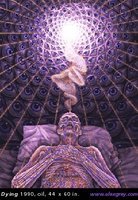 A bioethics that isn't informed by science isn't a bioethics at all.
This is the principle reason why I'll never settle for a static or absolutist vision of ethics or morality; conventions or so-called 'truths' are often overturned when new evidence comes to the surface. As John Maynard Keynes once said, "When my information changes, I change my opinion. What do you do, Sir?"
Such a thing is happening right now in regards to our perception of those stuck in a vegetative state and in how we treat them. As it turns out, these patients may not be as 'vegetative' as previously thought, nor in all cases are their conditions permanent. New and emerging information indicates that some of these individuals are experiencing some form of internal consciousness or mental state. Further, some of these patients have, quite shockingly, been revived by the most unassuming and unintuitive of things: sleeping pills.
In regards to conscious awareness, for example, a team in Cambridge recently discovered that a patient in a vegetative state can communicate through her thoughts. Their claim is a serious one: they say they have discovered a way to show preserved conscious awareness in a patient who has been diagnosed as vegetative. Specifically, by using a functional magnetic resonance imaging (fMRI) scanner, the patient's brain activity was mapped while she was asked to imagine playing tennis or moving around her home. The scientists found she was able to do this; the fMRI indicated that different areas of her brain were activated in the same way as healthy volunteers. Dr Adrian Owen, who led the research, had this to say:
These are startling results. They confirm that, despite the diagnosis of vegetative state, this patient retained the ability to understand spoken commands and to respond to them through her brain activity, rather than through speech or movement. Her decision to work with us by imagining particular tasks when asked represents a clear act of intent which confirmed beyond any doubt that she was consciously aware of herself and her surroundings.It is not clear to me, however, if this activity was indeed the result of the patient thinking about such things, or if the activity was some sort of unconscious autonomous response to verbal cues. Yet, despite this uncertainty, it's my opinion that medical practitioners should err on the side of caution and assume that the patient's reaction was a genuine conscious response.
And on a related note, some patients who were thought to be in an unrecoverable vegetative state are awakening after being administered a $5 over-the-counter sleeping pill called zolpidem. This pill seems to be invigorating brain cells that were once thought to be dead. The implications of this are broad, indicating a need to revisit assumptions about voluntary euthanasia, the current investment we put into this type of medical care, and the long-term recovery potential of these patients.
More specifically, and in consideration of possible conscious brain-state in some of these patients (obviously, this won’t apply to all people in permanently vegetative states; for many, necrosis has set in to the point where the capacity for conscious brain functioning has ceased and is truly unrecoverable), we will have to once again re-evaluate our conceptions and definitions of death and re-think how we should be treating people in these conditions.
The key will be to develop the scientific know how to detect which patients are permanently unconscious from those who have the capacity to receive sensory input and are experiencing internal awareness. Those patients with any semblance of consciousness must have their quality of care improved, including frequent visitors and other positive stimuli. And finally, medical scientists will need to work more diligently to devise ways of helping these patients emerge from their vegetative conditions.
This whole issue reminds of the haunting lyrics from “One,” a classic track from Metallica. It’s the story of a soldier who is trapped in a coma but has full conscious awareness. His experience is nothing less than hellish. I’ll end this post by reprinting the lyrics from the entire song:
I can't remember anything______________________
can't tell if this is true or dream
deep down inside I feel to scream
this terrible silence stops me
now that the war is through with me
I'm waking up, I cannot see
that there's not much left of me
nothing is real but pain now
hold my breath as I wish for death
oh please God, wake me
back in the womb it's much too real
in pumps life that I must feel
but can't look forward to reveal
look to the time when I'll live
fed through the tube that sticks in me
just like a wartime novelty
tied to machines that make me be
cut this life off from me
hold my breath as I wish for death
oh please God, wake me
now the world is gone I'm just one
oh God, help me hold my breath as I wish for death
darkness imprisoning me
all that I see
absolute horror
I cannot live
I cannot die
trapped in myself
body my holding cell
landmine has taken my sight
taken my speech
taken my hearing
taken my arms
taken my legs
taken my soul
left me with life in hell
Related reading:
Death and the brain: Recent voluntary euthanasia hullabaloos such as the Terry Schiavo case have revealed a public that’s largely divided and somewhat confused as to what death is and when it should actually be declared.
Fight for Your Right to Die: We must repeal laws against euthanasia if we're to copewith such future realities as cryonics and extreme life extension.
October 2, 2006
Back on the yoga wagon
 I've been doing hatha yoga for a number of years now, but for the past several years I've been doing it on my own and without an instructor. What was once a daily ritual has degraded to about 2-3 times a month.
That's going to change now that I've finally found a new instructor in Toronto. I'll be learning a variant of hatha yoga called Sivananda which incorporates pranayama (breathing techniques), strengthening excercises, a relaxation component and 12 base asanas (poses) from which to start off.
During my first lesson my instructor actually had me doing a headstand with a bit of help. I initially refused to do it thinking the pose was much more difficult and dangerous than it really was. With her help, however, it wasn't so bad. The real trick for me will be to get into the pose without any assistance. Another new pose for me was the crow, which looks worse than it is -- even though I fell flat on my face after holding it for a few seconds.
This practice will keep me physically active during what will surely be another long winter here in Toronto.
Unidentified flying idiots
 Bob Dylan once sang, “We sit here stranded, though we're all doin' our best to deny it.” While this might have been a reference to God, Dylan’s lyric often gets me thinking about how utterly abandoned we are here on Earth – and it’s not just by some illusory God. We haven’t heard so much as boo or moo from anyone, namely extraterrestrial intelligences (ETIs).
Now, many people will read that last paragraph and nod their heads in agreement. Trouble is, however, a significant and burgeoning segment of society doesn’t believe this to be true – the so-called UFOlogists. You know, the folks who talk about flying saucers, little green men (or is that grey men?), crop circles – the whole X-Files bit. Today, an entire sub-culture exists devoted to these topics as if they were matter of fact.
Closer to home, I’ve known for some time that UFO aficionados frequent my blog. I often get nasty letters from them complaining about my UFO denial and my fixation with such empirical anomalies as the Fermi Paradox. At the same time however, I have to assume that UFOlogists read my blog and integrate my reports on science and philosophy with their own beliefs in extraterrestrial visitations.
For example, last week I blogged about the search for artificial objects in the cosmos. A quick Googling for that post shows that the article was referenced by the UFO site, Virtually Strange and distributed on their newsletter (much to my chagrin and without my permission). My hit counter revealed similar referencing links.
I am also aware that Raelians frequently visit Sentient Developments; I’ve even had the opportunity to meet some of them in person – but once the conversation turns to a discussion of how to quantify the varying energy content of crop circles, I tend to lose it and start to rant. I don’t have many friends among the Raelians, but I don’t have very many Seventh Day Adventists and Scientologists as friends either.
And I also know that Mac Tonnies over at Posthuman Blues links to my articles from time-to-time. Posthuman Blues often deals with transhumanist and other future issues, but Tonnies’s legitimate content is offset by his misguided focus on UFOlogy. As a result, the transhumanist movement may have a harder time gaining public acceptance and support with this kind of negative association.
I’m sorry, folks, but you can’t have your cake and eat it to. You can’t choose and pick the science that appeals to you and then attempt to tie it in with bogus and unfounded speculations. It's like Fox Mulder in the X-Files who has a poster on his wall which reads, "I want to believe." Well, I also want to belive in UFOs. I also want to belive in Jesus and the tooth fairly, but wanting to believe in those things ain't gonna make it so.
Part of the problem here, aside from wishful thinking, is the rampant scientific illiteracy that now pervades much of Western society, particularly in parts of the United States. Many people these days are unable to determine which claims have scientific credence and which do not. Popular culture does little to remedy this, with shows like the X-Files and Coast to Coast perpetuating the idea that it’s okay to discuss UFOs and other pseudoscientific claims in the context of legitimate science.
Let’s take my blog entry on the search for artificial objects in space. Many UFOlogists, I’m sure, took that article as further proof that there are aliens in our midst. Wrong! It’s actually telling us the opposite. The work that Luc Arnold is doing is important from the perspective that we have devised yet another way of detecting signs of ETIs. Given the sheer simplicity and elegance of Arnold’s theorized calling-card technique, the cosmos should be screaming with signs of ETIs. I fully suspect that work by astronomers over the next several decades will reveal none of these calling cards. The search for artificial objects, like SETI’s impossible search for radio signals, will provide further proof that there’s nobody out there zipping around in spaceships.
I am already imagining the comments and emails I’m going to receive in response to this post. I’m going to read about how UFOlogy is in fact a legitimate scientific endeavor and that I’m being both unfair and closed minded. I’m going to be asked where I get off denying all the sightings and testimonials and how I can account for these things. Bla, bla, bla.
While I’m loathe to engage in these conversations, there is one point that I wish to make in hopes that I can influence the thinking of those UFOlogists who visit my blog, particularly those with an interest in such things as posthumanism and the Singularity.
My message is this: STOP THINKING SO SMALL!
This whole UFO thing reminds me of something Carl Sagan once said about religion: “How is it that hardly any major religion has looked at science and concluded, 'This is better than we thought! The Universe is much bigger than our prophets said, grander, more subtle, more elegant'? Instead they say, 'No, no, no! My god is a little god, and I want him to stay that way.' A religion, old or new, that stressed the magnificence of the Universe as revealed by modern science might be able to draw forth reserves of reverence and awe hardly tapped by the conventional faiths.”
Indeed, the advanced space-faring species of the UFOlogist is a little UFO. He zooms around in his flying saucer annoying us with his crop circles, all the while looking to inflict his anal probe on some poor unsuspecting trailer trash. And of course he’s a frail and little creature, clammy grey skin, big head and all.
Give me a break. What kind of pathetic vision of advanced intelligence is this?
Meanwhile, transhumanists are discussing the radical potential for god-like artificial superintelligences, megascale computational projects like matrioshka and Jupiter brains, uploaded societies, metaconsciousness, Kardashev scale civilizations, existential paradigm shifts, universe re-engineering and immortality.
Given these potentials, the UFO vision is an absurdity of the highest order. The fact that our civilization hasn’t been uplifted by an advanced ETI is a blatant indication that something strange and different is going on out there in the depths of space. That’s where the Fermi Paradox comes in, and it’s in that discussion that we can meaningfully discuss topics as they pertain to astrobiology, astrosociobiology, cosmology, and computer science. It will also give us an indication as to where we ourselves may be headed as a species.
One final note to the UFOlogists, you’re obviously welcome to keep visiting my blog, but it’s apparent to me that you’re just not getting it.
________________
Related reading:
The False Promise of Pseudoscience: Real science offers hope. Mysticism and belief in the paranormal are just plain dangerous
The Cult of Irresponsible Cloning: A wacky religious sect and misguided scientists are giving Transhumanists and other advocates of reproductive choice a bad name
Political inaction on climate change a crime against humanity
 I just finished reading Jamais Cascio's excellent new column, "The Geoengineering Option," in which he argues that terraforming the planet may be a necessary evil to combat the effects of global warming. Cascio writes, "The early examination of options we’d rather not use is vital. If the climate collapses faster than expected, or if our efforts fail (or are blocked by recalcitrant leaders), we will see people desperate for survival trying out these kinds of last-ditch solutions." He offers a number of potential options:
 ...blocking a fraction of incoming sunlight with a giant mirror in space: using genetically-engineered plants and microbes to remove atmospheric carbon dioxide and methane at a faster-than-natural rate; seeding the atmosphere with fine particles to reflect sunlight away; dumping iron into the oceans to stimulate the growth of carbon dioxide-devouring plankton; and more. None of these would be done easily, or cheaply; quite possibly, none of these could be done effectively, or without grossly negative results (for example, a too-large plankton bloom has the potential to render parts of the ocean sterile).Cascio is right to note that we should be aware of our options in the event our environment go to the shits, and he's also right to note that these interventions are radical and have the potential to be disastrous. Re-working an autonomous system like the Earth's biosphere is a task of exquisite complexity that is quite beyond our current know-how.
Which leads me to the point I wish to make.
The evidence for anthrogenic climate change is now incontrovertible, as is the realization that this is the greatest catastrophe to ever confront our species. The time to act is now. Governments need to put measures into place that will drastically reduce greenhouse gas emissions as quickly as possible.
Moreover, given all the evidence to support global warming, I believe it is time to issue a warning and a threat to all ruling politicians around the world: you will be held accountable. At this time of crisis, your inaction as elected and accountable leaders in the face of obvious looming catastrophe will be held against you.
Barring the onset of real and effective measures, once the flood waters start to rise, the mass extinctions enter into full swing, the superstorms start to hit with regularity, and diseases and famines start to ravage populations, it will be necessary to gather all former politicians to make them answer for their reckless disregard while they were in power. Inaction today is nothing less than a crime against humanity and a crime against the environment.
These days politics has mutated into a sad and pathetic game where the only thing that matters is politicking, pandering to the ruling elites, and taking advantage of the complacent masses. It’s time that politicians actually start to lead instead of worrying about their fate in the next election.
Otherwise, they’ll have to start worrying about a different kind of fate altogether.
September 29, 2006
Protecting our children from the god delusion
 There are times when I feel my anti-religious views tend to the extreme, but then I'll read something by evolutionary biologist Richard Dawkins and I suddenly get the feeling that I'm being downright reasonable. He often reminds me how my own opinions get tempered over time by dominating cultural norms, and how my anti-religious sensibilities are susceptible to the drift of cultural normalization.
His latest book, The God Delusion, is another wake-up call for all members of secular society who pander to those who decry the need for freedom of religion, when what we should be doing is our darndest to ensure that minds are fostered and raised such that they are free from religion.
Just this morning my son asked me a question about Mary, Jesus and God (he gets this from my ex-wife), and rather than responding with some kind of convoluted answer drawn from Christian mythology, I closed the conversation outright by saying, "Ask your mother, I don't believe in this stuff."
That's a bit harsh, I know -- I'm grumpy in the mornings; I usually deal with these issues with a bit more tack, but ultimately my message to my kids is the same: we can either choose to believe things without foundation, or we can use our capacity for exploration and discovery to prove and know those things that truly exist. Otherwise, we are susceptible to all sorts of strange beliefs. I ask my children, both of whom are under 10 but freakishly bright, do you believe in sasquatch, werewolves, ghosts, UFOs and telekinesis? And if not, why not? I try to convey to them the notion that belief in god falls under the same category of pseudoscience, fairy tails, urban legends, and mythology.
The world is complicated enough for children without feeding them fantastically bizarre stories about gods, demi-gods, heaven and hell. At the same time we as parents are responsible for nurturing a sense of right and wrong behaviour in our children without blackmailing them via the idea that their negative actions will result in reprisals from Beyond. People should act in a moral manner not because an ancient book tells them to, or because of a fear of a delusional God, but because it feels right in both heart and mind.
Indeed, as Richard Dawkins notes in his new book, teaching religion to children borders on abuse. On this point I agree. I can't help but feel that parents who proselytize their children are acting pathetically -- targeting those members of society who cannot yet formulate their own opinions or methodological frameworks that help them make sense of their world and existence. Religion deserves an R rating.
Rather, we as parents should be broadening the minds of our children as much as possible. We need to help our children think for themselves and to think critically. We should teach them that skepticism is both a value and a healthy activity. At the same time however, we need to help kids feel comfortable in exploring all the realms of culture and society that the world has to offer. It is our job and responsibility to provide our children with the requisite tools for free and critical thought.
Parents need to open doors rather than close them. Religions not only close the doors to our rational faculties and our experiential potentials, they often act as the deadbolt that locks the door tight forever.
_________________
Related reading:
Scientific Ignorance Dooms Democracy: Increasingly hi-tech nations need informed citizens, making scientific literacy a human right and scientific illiteracy a disability
Ending Biblical Brainwash: For better mental and cultural health, it's time we classified religious fundamentalism as a psychological disorder
The False Promise of Pseudoscience: Real science offers hope. Mysticism and belief in the paranormal are just plain dangerous
September 28, 2006
Vilenkin's Many Worlds in One
 This book by Alexander Vilenkin looks interesting: Many Worlds in One: The Search for Other Universes. Check out this article of his at the Edge, "The Principle of Mediocrity."
Quick reviews:
From Publishers Weekly: Cosmologists ask many difficult questions and often come up with strange answers. In this engagingly written but difficult book, Vilenkin, a Tufts University physicist, does exactly this, discussing the creation of the universe, its likely demise and the growing belief among cosmologists that there are an infinite number of universes. Vilenkin does an impressive job of presenting the background information necessary for lay readers to understand the ideas behind the big bang and related phenomena. Having set the stage, the author then delves into cutting-edge ideas, many of his own devising. He argues persuasively that, thanks to repulsive gravity, the universe is likely to expand forever. He goes on to posit that our universe is but one of an infinite series, many of them populated by our "clones." Vilenkin is well aware of the implications of this assertion: "countless identical civilizations [to ours] are scattered in the infinite expanse of the cosmos. With humankind reduced to absolute cosmic insignificance, our descent from the center of the world is now complete." Drawing on the work of Stephen Hawking and recent advances in string theory, Vilenkin gives us a great deal to ponder.
From Booklist: Cosmology has moved from establishing that there was a finite start to the cosmos to theorizing about the initial conditions that kicked off the whole shebang. Vilenkin is a leading theorist whose scenarios about the enigma of the big bang emerge in this estimably clear, personable treatment. Vilenkin explains the idea of inflation, a phenomenal increase in the volume of space in the first infinitesimals of time, propounded by physicist Alan Guth (The Inflationary Universe, 1997). Inflation solved some theoretical problems but left others dangling, such as inducing inflation to stop; if it didn't, life could not have begun. Explaining that his solutions to the "graceful exit problem," as it is whimsically called, involve the concept of "eternal inflation," Vilenkin guides readers through its bizarre and head-spinning propositions. One is that our observed universe is embedded in a suprauniverse that infinitely spawns an infinite number of other universes. This and other gigantic ideas concisely presented will provoke the interest of readers intrigued by the origin of the big bang.
AbioCor artificial heart approved by FDA
 Several weeks ago on September 5, 2006 the U.S. Food and Drug Administration approved the first ever totally implantable artificial heart. Called the AbioCor, the device was approved under the Humanitarian Use Device (HUD) provisions of the Food, Drug and Cosmetic Act and is intended for people who are not eligible for a heart transplant and who are unlikely to live more than a month without intervention.
The FDA has sanctioned a number of HUD's, many of these devices representing the cutting edge of medical technology. From my perspective this seems like a reasonable and ethical policy; as part of the approval process, novel and seemingly radical medical devices should be given to desperate patients who have nothing to lose -- and who will in turn assist greatly to the testing process.
A fully implantable artificial heart was finally made possible due to converging advances in miniaturization, biosensors, plastics and energy transfer. The unit runs on a rechargeable source of power and its internal battery is charged by a transcutaneous energy transmission (TET) system. This means that no wires or tubes penetrate the skin creating virtually no risk of infection. The internal battery of the device allows users to move freely for one hour, with external power devices extending endurance to two hours. The device can even be charged/operated using a common household electrical outlet.
The FDA describes AbioCor in further detail:
The AbioCor system consists of: a two-pound mechanical heart that takes over the pumping function of the diseased heart, which is removed during the implantation procedure; a power transfer coil that powers the system across the skin and recharges the internal battery from the outside; and a controller and an internal battery, which are implanted in the patient's abdomen. The controller monitors and controls the functioning of the device, including the pumping rate of the heart.Because AbioCo was approved as a HUD, it is given only to the most desperate of patients. For someone to be eligible for implantation with the AbioCor, the person must have severe heart failure (with failure of both ventricles) and must be likely to die within two weeks without transplantation. While most patients eventually succumb to heart failure, the device has allowed people to prolong their lives anywhere from 3 to 17 months.
The first patient to receive the AbioCor was Robert Tools who lived for 151 days before having a fatal cerebrovascular accident. Tom Christerson lived for 512 days after receiving the artificial heart.
AbioCor, which is manufactured by Danvers, Mass.-based Abiomed Inc., hopes to make the artificial heart commercially available to treat "a defined subset of not more than 4,000 irreversible end-stage heart failure patients."
Sources: Wikipedia, FDA, Business First.
September 26, 2006
Injured dolphin to become cyborg
 Okay, I couldn't resist giving this post a sensationalistic title, but this news is really quite interesting. An injured dolphin named Winter lost her tail fin when it got caught in fishing wire. What used to be the tail is now just a stump which she desperately swishes from side to side to keep moving. Her handlers are concerned that she will suffer in the long-term from spinal damage if it's not corrected.
So, marine scientist Steve McCulloch and Dana Zucker, chief operating officer of the Clearwater Marine Aquarium, want to do something about it, namely by getting Winter a prosthetic tail fin.
Zucker has put together a team to discuss the prospects of designing a tail for Winter. They've consulted with a diving gear manufacturer, a tire company and the Navy, which has experience attaching items to dolphins for military research.
From an engineering perspective, the task will not be easy. "The dolphin's tail fin is the most powerful swimming mechanism Mother Nature ever designed," McCulloch said. "When you see how much pressure they put on their flukes, the prosthesis is going to take a marvel of modern engineering."Compounding the problem, Winter's tail flukes and peduncle, a wrist-like joint that allows a dolphin's tail to move up and down, were lost to necrosis. It's not immediately clear to the team how the prosthetic tail should be attached to her stump, but it will have to be tough.
I hope to see updates as this project develops.
The limits to cultural uplift
J. Hughes recently interviewed animal behaviourist Sue Savage-Rumbaugh on Changesurfer Radio (see my earlier post). Toward the end of the interview he asked Dr. Savage-Rumbaugh her opinion on the potential for augmenting nonhuman animals using future biotechnologies and techniques like neural grafting. She responded by making the case for environmental uplift rather than biological.
 Specifically, she imagined an experiment in which a bonobo child would be raised by humans and given all the advantages and social considerations that are given to human children (including and especially exposure to verbal language starting from a very early age). A bonobo raised in this way, argued Savage-Rumbaugh, would be 'uplifted' to a significant degree relative to their default state-of-nature being.
Quite obviously she has a point. Imagine a counter-experiment (which will have to remain a thought experiment for obvious ethical reasons) in which a human child is raised in the wild in the same way a great ape would be today. Tarzan notwithstanding, a Homo sapien stripped of all civilizational accoutrements would more closely resemble a wild bonobo than a socialized human.
That being said, there are definite limits to the cognitive and language capacities of the great apes no matter the degree to which they are integrated into 'human' society and educated. In this sense, if we are to consider and treat them as persons, and should we refuse to help them with meaningful biological augumentation, these primates would live in perpetuity as severely disabled persons relative to both humans and their full potential as uplifted agents.
Dr. Savage-Rumbaugh's thought experiment sparked a discussion between myself and Dr. J. Here's an excerpt taken from an email I received from him:
Yet, with all that said, such a project would forever remain a work in progress without real biological augumentations. As I noted to J in a follow up email, "Without significant improvements to their cognition and language skills, they would forever remain as hopeless dependents, with the line distinguishing them as dependent or pet remaining hazy at best."
Specifically, she imagined an experiment in which a bonobo child would be raised by humans and given all the advantages and social considerations that are given to human children (including and especially exposure to verbal language starting from a very early age). A bonobo raised in this way, argued Savage-Rumbaugh, would be 'uplifted' to a significant degree relative to their default state-of-nature being.Quite obviously she has a point. Imagine a counter-experiment (which will have to remain a thought experiment for obvious ethical reasons) in which a human child is raised in the wild in the same way a great ape would be today. Tarzan notwithstanding, a Homo sapien stripped of all civilizational accoutrements would more closely resemble a wild bonobo than a socialized human.
That being said, there are definite limits to the cognitive and language capacities of the great apes no matter the degree to which they are integrated into 'human' society and educated. In this sense, if we are to consider and treat them as persons, and should we refuse to help them with meaningful biological augumentation, these primates would live in perpetuity as severely disabled persons relative to both humans and their full potential as uplifted agents.
Dr. Savage-Rumbaugh's thought experiment sparked a discussion between myself and Dr. J. Here's an excerpt taken from an email I received from him:
A final thought on the experiment of raising a bonobo as a human being: similar arguments can and were used to argue that it would be unethical to adopt a child from another race, or to bear a child with a disability. But we don't take those arguments as prohibitive of parents' rights to adopt or bear disabled kids. Instead we focus on the obligation to the child to be raised with the fullest help in facilitating their full flourishing.Like Savage-Rumbaugh and Hughes, I also support the idea of environmental and cultural uplift for the great apes, particularly for those already in confinement. Dr. Hughes in particular brings up some fascinating considerations that would be part of the uplift process.
In other words, although we generally don't stop people with cognitive deficits from having children, if we find a child being raised by mute and profoundly retarded parents they can be taken into protective custody and adopted by parents who can teach them to speak and so on. Taking a trans-ape ethics seriously might then obligate us to do the experiment you propose, with all the complexity of remaining sensitive to not causing the bonobo existential angst, loneliness and loss of connection with their racial/ethnic roots. (A good thing that our reproductive and adoptive decisions aren't subject to "human subjects" IRB reviews!)
I suspect that as we have more non-surgical means for cognitive enhancement of apes, such as gene therapies and pharmaceuticals, the ethical debate over the 'uplift' of apes will heat up.
Yet, with all that said, such a project would forever remain a work in progress without real biological augumentations. As I noted to J in a follow up email, "Without significant improvements to their cognition and language skills, they would forever remain as hopeless dependents, with the line distinguishing them as dependent or pet remaining hazy at best."
September 25, 2006
The search for artificial objects in the cosmos
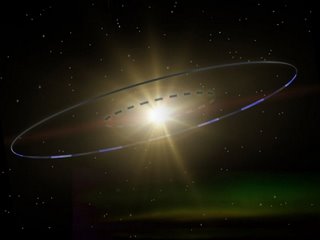 Considering how difficult it is to detect radio signals from ETI's, it has often been suggested that we also look for signs in the cosmos that may indicate the presence of intelligent life. Given vast distances, however, that task is certainly more easily said than done.
 An interesting paper that may help in this regard was recently published by French astronomer Luc Arnold in which he suggests that scientists should be searching for light signatures that would indicate not just the presence of artificial objects such as Niven Rings and Dyson Spheres (i.e. megastructures), but of calling-card objects as well.
His paper, "Transit Lightcurve Signatures of Artificial Objects," offers guidelines for astronomers indicating the kinds of signatures they should looking for that could indicate the presence of a megastructure of some sort. The abstract reads like this:
The forthcoming space missions, able to detect Earth-like planets by the transit method, will a fortiori also be able to detect the transit of artificial planet-size objects. Multiple artificial objects would produce lightcurves easily distinguishable from natural transits. If only one artificial object transits, detecting its artificial nature becomes more difficult. We discuss the case of three different objects (triangle, 2-screen, louver-like 6-screen) and show that they have a transit lightcurve distinguishable from the transit of natural planets, either spherical or oblate, although an ambiguity with the transit of a ringed planet exists in some cases. We show that transits, especially in the case of multiple artificial objects, could be used for the emission of attention-getting signals, with a sky coverage comparable to the laser pulse method. The large number of expected planets (several hundreds) to be discovered by the transit method by next space missions will allow to test these ideas.Should such an object be detected, however, the challenge will be to determine whether or not the object is indeed synthetic and not natural. For example, when pulsars were first discovered the unnaturally regular nature of its emissions baffled scientists, leading to the tongue-in-cheek name, LGM-1 which stands for "little green men." Of course, it's been shown that pulsars are indeed natural phenomenon.
What's interesting about Arnold's paper is his suggestion that the transit method will enable scientists to pick up on the presence of unnatural objects. As he notes, "A remarkable lightcurve would be created by free-flyers transiting their star successively in a distinguishable manner. At each period, we would observe a series of transits whose number and timing would claim its artificial nature and will of communication."
What he's suggesting is that ETI's may devise megastructures as a means to indicate their presence to other intelligences. Arnold analyzes three different shapes that could be detected, including a perfectly triangular structure and a 2-screen object (think of a rectangle with a box-like hole cut in the middle). It's these "attention getting" lighcurves that Arnold is interested in.
The suggestion that ETI's might be using gigantic calling cards that orbit around suns to say "hi" is a fascinating idea -- and arguably more plausible than the notion that we should be listening for radio signals.
September 24, 2006
Tool, September 23, Toronto: Review
 Last night Tool played the Molson Amphitheatre in Toronto, marking the third time I’ve had an opportunity to see them perform live. And as I’m usually reminded at their shows, there are rock bands out there, and then there’s Tool. It’s truly an experience to seem live.
I went to the show with 5 other friends, all of us die-hard fans. Our seats were in the front of the 300 section and off to the side, which is still closer to the stage than half way. Having seen many concerts at the outdoor Molson Amphitheatre, I knew not to expect anything acoustically; the PA system there is often mediocre. All considered, however, Tool sounded great last night.
As is so often the case, the quality of the show is not always in the sound quality but in the precision of the performances, the amount of energy the band is willing to give out and the vibe given out by the crowd. Last night had all of these things in spades.
Maynard, who is battling an illness, came out wearing a Leaf’s jersey. They opened with “Stinkfist,” “The Pot,” and “46&2.” Maynard was very animated and established a physical presence on stage that I’d never seen before. He would crouch over and spread his legs in characteristic fashion, lean into the mic, and then prowl around on stage. Maynard would often shift between singing duty and playing the keyboards.
The set was quite minimal with two small video screens off the side displaying their usual artistic eye candy and clips from their videos. Above the band was a large black backdrop which was lit up with lights that created dynamic patterns. The floor could be lit up like a disco floor, as could a 6' wall that stood behind the band. These were used to brilliant effect. One specific moment comes to mind when they were playing “Lateralus” and the set was ablaze in fiery washes of orange and red.
And then there were the lasers. As fog rose up near stage area, beams of green lasers would shoot up and sweep up and down. Individual beams were used to spectacular effect during “10,000 Days.”
Musically the band was intense and creative, performing alternative intros and outros, constantly keeping the fans guessing as to what they were going to do next. As my friend noted during the concert, “Tool does whatever the hell Tool wants to do.” And that pretty much sums up what this band is all about. There’s very little that they do that can be considered cliché or run-of-the-mill. Even the way they position themselves on stage is unique; Maynard, the lead vocalist, stands far at the back next to Danny Carey, the drummer, while the two guitarists, Justin Chancellor and Adam Jones, stand out front.
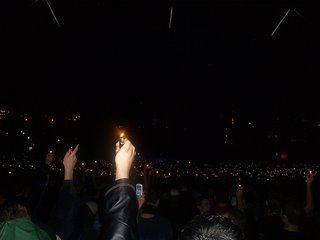 The highlight of the concert for me, oddly enough, was not a musical moment, but rather a moment when the audience took over to show their appreciation for the band. Late into the show Tool decided to take a break onstage. Danny moved himself away from his kit and sat on the stairs beside Justin and Adam. Maynard was lying down on his back next to them. After a few seconds the audience started to hold up their lighters en masse.
Now, let me tell you, I’ve been to a fair share of concerts and I’ve seen the lighters go up time and time again – but nothing compared to last night. It was like looking into a sea of tiny flames as far as the eye could see. And this went on for what seemed an eternity. Even the members of Tool held up their lighters. It was truly a magical moment. Goosebumps.
As for a musical highlight, it was “Lateralus” that moved me the most. Other strong songs included “Schism” and “10,000 Days.” They did not play any songs from Undertow, which for me was a disappointment.
This was the most fun I’ve had yet at a Tool concert, and I can only hope they’ll come back to Toronto soon. Here’s the entire setlist:
Stinkfist
The Pot
46 & 2
Jambi
Schism
Lost Keys / Rosetta Stoned
Wings / 10,000 Days
Lateralus
Vicarious
Aenema
Subscribe to:
Posts (Atom)