Showing posts with label ibm. Show all posts

February 15, 2011

When computers exceed our ability to understand how the hell they do the things they do

Which would be pretty much now.

Great quote from David Ferrucci, the Lead Researcher of IBM's Watson Project:
"Watson absolutely surprises me. People say: 'Why did it get that one wrong?' I don't know. 'Why did it get that one right?' I don't know."
Essentially, the IBM team came up with a whole whack of fancy algorithms and shoved them into Watson. But they didn't know how these formulas would work in concert with each other and result in emergent effects (i.e. computational cognitive complexity). The result is the seemingly intangible, and not always coherent, way in which Watson gets questions right—and the ways in which it gets questions wrong.

As Watson has revealed, when it errs it errs really badly.

This kind of freaks me out a little. When asking computers questions that we don't know the answers to, we aren't going to know beyond a shadow of a doubt when a system like Watson is right or wrong. Because we don't know the answer ourselves, and because we don't necessarily know how the computer got the answer, we are going to have to take a tremendous leap of faith that it got it right when the answer seems even remotely plausible.

Looking even further ahead, it's becoming painfully obvious that any complex system that is even remotely superior (or simply different) relative to human cognition will be largely unpredictable. This doesn't bode well for our attempts to engineer safe, comprehensible and controllable super artificial intelligence.

February 8, 2011

Elementary, my dear Watson: Jeopardy computer offers insight into human cognition

Being the astute Sentient Developments readers that you are, I'm sure you're up to speed on Watson, IBM's Jeopardy playing computer:


The more I think about Watson, the more I'm astounded about what IBM has done here. This isn't just some glorified answer engine. If you think about what this system has to do to get these questions right, you quickly realize that there's a lot more going on behind the scenes.

At its core, Watson is an expert answer engine that utilizes natural language processing technology.

And it's probably doing it in a way that's very, very close to how the human brain does it. I'd be willing to bet that the processes behind Watson's programming is very analogous to how the human mind goes about it. Watson, which has access to a massive repository of information, has to interpret all the nuances of language—synonyms, puns, slang, and all—and quickly come up with an answer. It typically builds a list of around four to five answers, and based on a probability analysis, selects what it thinks is the most likely answer. I'm almost certain that the human mind goes about it in the exact same way. It has been suggested, for example, that the mind applies Bayesian probabilism in its calculations. Wouldn't be amazing if we eventually discover that even the algorithms are the same? If this is the case, then IBM has actually created a stand-alone module of the human brain.

So, in terms of the rule based AI vesus whole brain emulation debate, you can strike this down as a victory for the former.

The big difference, of course, is that Watson is not conscious. But that doesn't make a difference. You are not conscious, either, of how you process natural language, access the memory stores in your brain, and come up with an answer. Your brain does this for you behind the scenes and presents the answer to your consciousness; you're none the wiser. You only think you're clever, and that "you" came up with the answer, but in reality the unconscious mechanistic parts of your brain did all the work.

Some people may complain or freak out about that, but I think it's rather cool. We're biological robots; get over it.

More on Watson:

November 19, 2009

IBM's claim to have simulated a cat's brain grossly overstated

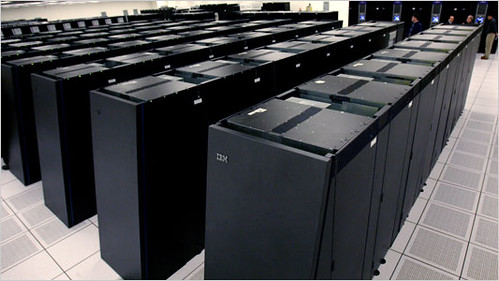
Blue Gene
This is not a brain.

I'm a big fan of IBM's Brain and Mind Institute (BMI) and the Blue Brain project. Initiated in May 2005, the Blue Brain project is an attempt to to model the mammalian cerebral cortex with computers. The intention is not to re-create the actual physical structure of the brain, but to simulate it using arrays of supercomputers. Ultimately, the developers are hoping to create biologically realistic models of neurons. In fact, the results of the simulation will be experimentally tested against biological columns.

But I take exception to the recent claim that IBM has created a simulation that is supposedly on par, in terms of complexity and scale, with an actual cat's brain. The media tends to sensationalize these sorts of achievements, and in this case, grossly overstate (and even misstate) the actual accomplishment.

Contrary to what some people may believe, IBM has not created a virtual cat. There's no simulated cat somewhere pouncing around simulated fields chasing simulated mice inside a supercomputer. All IBM has done is replicate the power of a cat's cebebral coretex using a bunch of powerful computers. Nothing more -- there's no psychological or AI element involved whatsoever. They're merely creating a physical power structure and computational infrastructure that may someday run a properly engineered mind.

But credit where credit is due.

IBM has made incredible progress in the sophistication and detail level of human brain mapping. By reverse engineering the human brain, IBM hopes to bring about the era of "cognitive computing," -- a development that would bring about new ways for building computers which mimic natural brain structures.

Essentially, IBM is hoping to simulate a neocortical column, which is the smallest functional unit of the neocortex. This is the part of the brain that is responsible for higher functions such as conscious thought. In humans, the neocortical column is 2mm tall, has a diameter of 0.5mm and contains 60,000 neurons. Project developers initially worked to replicate the neocortical column of a rat, which has only 10,000 neurons, and now they've achieved the same thing with the cat brain. Developers hope to model the human brain in about seven to eight years.

To model these components the developers use a Blue Gene supercomputer that runs the MPI-based 'Neocortical Simulator' combined with 'NEURON' software. Blue Gene is a computer architecture project that has will spawn several next-generation supercomputers -- computers that will reach operating speeds in the petaflops range, and are currently reaching speeds over 280 sustained teraflops. Its 8,000 processors will crunch away at 23 trillion operations per second.

I don't want to take away from IBM's accomplishment, but it's important to note that we are extremely far off in terms of our ability to emulate the true complexity of a mammalian brain. Creating an array of supercomputers that mimics the brute force of a biological brain and then claiming that it matches the 'complexity' and 'scale' of the real thing is pure hyperbole. True whole brain emulation (PDF) is still a far ways off.