January 30, 2006

BBC: analytic couples produce autistic children

The BBC is reporting on a report by Simon Baron-Cohen who claims that analytical couples, namely scientific types, may be more likely to produce children with autism.

Baron-Cohen, a prof at the University of Cambridge, said the phenomenon might help explain the recent rise in diagnoses.

This is similar to the claim made by Steve Silberman in Wired a few years ago in his article The Geek Syndrome in which he argued that the high prevalency of Asperger's Syndrome (a high-funtioning form of autism) in Silicon Valley was due to the pairing off of couples with "tech" and "math" genes.

Baron-Cohen labels people such as scientists, mathematicians and engineers as "systemizers" (ie. people skilled at analysing systems). He argues that systemizers are often attracted to each other - and thus more likely to pass "autism" genes to their offspring. On a related note, other researchers have found that both mothers and fathers of children with autism score highly on a questionnaire measuring autistic traits.

This shouldn't really come as a surprise; it's simple genetics. What he's really saying is that nerds give birth to more nerds. What's unique, I suppose, is that in today's society more systemizers are able to hook-up with other sytemizers. Revenge of the nerds, I guess (check out my column on that exact topic: "Once outcasts, some autistics now see their condition as a cognitive gift and even the next stage in human evolution—at the dawn of the transhuman age, who's to say they're wrong?".

Tags: , , , .

People are eating better -- just ask Kraft

Kraft Foods -- the largest U.S. food manufacturer and the maker of Kraft cheese, Nabisco crackers, Oscar Mayer meats and Post cereals -- announced today that it would eliminate 8,000 jobs, or about 8% of its work force, and close up to 20 production plants as it broadens an ongoing restructuring effort.

This restructuring comes less than 2 years after their most recent shake-up when in 2004 there had just been a re-jigging of top management that followed more than a year of disappointing sales and earnings. At the time, Kraft executives blamed the poor results on "American consumers' increased health concerns, which had put the entire packaged food industry under severe pressure to change quickly."

Yes, obesity and other food issues are a problem in N. America, but I have to think that people are starting to get the message about healthy eating and the importance of avoiding processed foods.

Tags: .

The malevolence and gross negligence of the Bush Administration

NYT: Climate Expert Says NASA Tried to Silence Him:
The top climate scientist at NASA says the Bush administration has tried to stop him from speaking out since he gave a lecture last month calling for prompt reductions in emissions of greenhouse gases linked to global warming.

The scientist, James E. Hansen, longtime director of the agency's Goddard Institute for Space Studies, said in an interview that officials at NASA headquarters had ordered the public affairs staff to review his coming lectures, papers, postings on the Goddard Web site and requests for interviews from journalists.
And in other news re: global warming:

BBC: Stark warning over climate change -- Rising concentrations of greenhouse gases may have more serious impacts than previously believed, a major scientific report has said.

Tags: , .

Guardian: There is no stop button in the race for human re-engineering

Madeleine Bunting has written a piece for the Guardian in which she describes the inexorable tendency towards transhumanism.

Bunting notes how transhumanists believe that humanity is on the point of being liberated from its biology. "In their advocacy of our 'technological rights'," she says, "they believe that human beings are on the brink of a huge leap in development, leaving behind the sick, quarrelsome, weak, fallible creatures we have been up to now. We will be, as their slogan goes, 'better than well'."

She feels that North America has had a head start in the human enhancement debate and that Europeans need to get their heads around the issues soon so that they can influence what technologies are developed, rather than leaving it to the scientists and the pharmaceutical and military interests who sponsors research into human enhancement.

Much of the research that could be ultimately used for human enhancement, she argues, is urgently needed to counter such neuro-degenerative diseases as Alzheimer's. Consequently, Bunting writes with cautious optimism and concern, but also with a reserved sense of defeat. Transhumanism is coming, she argues, whether we like it or not -- so we'd better start managing the process now.

At the same time, however, she says it's possible to "envisage how fast, in a competitive, unequal world, we could hurtle towards some horrible futures."

Ultimately, however, Bunting believes that there's no point in sci-fi style panic. "The best hope lies in the strength and quality of public debate and democratic institutions to regulate and direct the use of these powerful technologies," she says.

Tags: , , , .

January 27, 2006

Omega-3

RAND Study Finds No Link Between Consuming Omega-3 Fatty Acids and Lower Incidence of Cancer: Consuming food or dietary supplements such as fish oil that contain omega-3 fatty acids provides no protection against developing cancer, according to a RAND Corporation study published today in the Journal of the American Medical Association.

The omega point: The Economist reports on how omega-3 fatty acids are a crucial component of a healthy diet—particularly, it seems, for pregnant women wanting bright, sociable children. The article also notes how omega-3's may also help men who have a difficult time controlling their anger.

And Wikipedia says that: Many studies have supported the health benefits of increasing omega-3 fatty acids in diets deficient in this nutrient; these studies have also provided information as to the detrimental effects of an omega-3 deficient diet. Many studies have shown that high doses of omega-3 can treat bipolar disorder and depression, while other research has shown a better benefit at a lower doses and no benefit, and even worsening of the symptoms at higher doses. Some have explained those surprising results by the hypothesis that higher doses deplete and create a deficiency of Omega 6, which is also essential for the conditions which are believed to be treated with Omega 3. In those same studies, doses between 1 to 2 grams for psychiatric conditions were optimal. The researchers believe that omega-3 fatty acids have shown great results in treating those disorders, and if approved, it could be a better drug (fewer side effects) than others such as lithium carbonate. Limited research also suggests that omega-3 is useful for treatment of borderline personality disorder and migraine. Non-topical use of certain omega-3 fatty acids has been shown to be useful for treating and healing distressed skin (eczema, psoriasis).

On September 8, 2004, the U.S. Food and Drug Administration gave "qualified health claim" status to eicosapentaenoic acid (EPA) and docosahexaenoic acid (DHA) omega-3 fatty acids, stating that "supportive but not conclusive research shows that consumption of EPA and DHA omega-3 fatty acids may reduce the risk of coronary heart disease."

Tags: , .

January 26, 2006

Mikko Rauhala is unarmed, dangerous and transhumanist

Six Degrees, a Finnish magazine that publishes in the English language, has interviewed activist Mikko Rauhala, a Finnish transhumanist, vegan, and most recently, anti-copyright law agitator.

Rauhala is a systems administrator at the University of Helsinki and is a founding member of Electronic Frontier Finland. In 2003 he co-founded the Finnish Transhumanist Association and is currently a member of the Information Society Working Group of the Green Party.

In the Six Degrees interview, Rauhala primarily discusses his work to combat what he sees as unfair practices in copyright law in Finland. He rightfully criticizes the stifling nature of copyright laws, which threatens to significantly constrain how end users can enjoy and use various forms of media. “[I]n this century,” he says, “we have seen both the absurd lengthening of the period of copyright at the behest of large corporations but also the runaway strengthening of the powers it gives to its wielders, who are in quite a real way monopolising our culture.”

Rauhala, like many transhumanists, holds libertarian-like values. In regards to state control, he argues that “[s]ome like to sell the idea that freedom is inherent in our Western capitalist society, but totalitarianism is not fundamentally a matter of left or right politics. There is a strong trend in Western societies today to reduce freedom and civil rights. We’re sliding towards more state control and more privileges for large corporations, who wield considerable political power.”

On this point I can't help but agree with Rauhala; today's corporatist world shares many of the totalitarian tendencies seen on the extreme left and right, particularly as it pertains to overwhelming political influence, media, culture, memetic dominance, and the perpetuation of the idea of citizen as consumer.

In regards to his transhumanist views, Rauhala encapsulates the movement quite well:
“The core of transhumanism lies basically in secular humanism, but with emphasis on the self-directed improvement of humanity. The common notion of some things being ‘natural’ and others ‘unnatural’ is cast aside. Transhumanism doesn’t apply any arbitrary limits to the methods that can be used to improve the human condition, or to the extent of the improvement. It’s basically that simple.

For example, if you ask whether people should be able to live longer productive lives, the answer would probably be yes. But if you talk about living to be, say, a thousand years old, many people hesitate and consider it unnatural. In transhumanist circles talking about living to be a thousand is almost conservative. Of course, life extension is just an example. Transhumanism advocates that people should generally be able to become more the people they want to be. Increased intelligence is often seen as central in this respect. The world has its share of difficult problems, and we need all the smart brains that we can get.”

For those interested in transhumanism and its ties to Finland, be sure to check out TransVision06 which will be held at the University of Helsinki from August 17-19, 2006.

Tags: , , .

ABC reports on cryonics bound couple

ABC has a little report on a couple who has recently signed up for cryonic suspension with Alcor Life Extension Foundation.

Typical of the media, ABC gets their terminology wrong, mistakenly referring to the procedure as cryogenics (which is a branch of physics that studies low temperatures). Rather, it's cryonics in which people are frozen in hopes of being reanimated in the future.

Anyway, the couple, David and Trudi Pizer, want to be frozen along with their dogs at Alcor. "I want to be with [my wife] forever, I mean it," says David, but "I would rather take an anti-aging pill than have to do this." Sounds like David has a case of the pre-vitrification jitters.

The ABC article also has a video of the couple being interviewed.

However, as I read the article, I couldn't help but feel that ABC was covering it from the "freak-show" perspective. You know, it was time for the 'lighter' side of the news. I wonder how long it will take before the cryonics option is socially normalized.

Tags: , , , .

January 25, 2006

Change is good

I've changed my blog template (again). I got tired of working with such a dark site. I think this works a bit better and I hope you like it.

2005: Warmest year in over a century

Zimmer: Return of the puppet masters

Carl Zimmer of Corante has written a piece about mind viruses. No, not memes -- real, biological parasites that may be altering emotional subjectivity in humans.
Specifically, Zimmer is referring to Toxoplasma gondii, a single-celled parasite that lives in the stomachs of cats, sheddding eggs that can be picked up by rats and other animals that can just so happen be eaten by cats. This parasite forms cysts throughout its intermediate host's body, including the brain.

What's scary, however, is what it does to the host's brain: scientists believe that Toxoplasma changes the personality of its human hosts, bringing different shifts to men and women.

Parasitologist Jaroslav Flegr of Charles University in Prague administered psychological questionnaires to people infected with Toxoplasma and controls. Those infected, writes Zimmer, show a small, but statistically significant, tendency to be more self-reproaching and insecure. Paradoxically, infected women, on average, tend to be more outgoing and warmhearted than controls, while infected men tend to be more jealous and suspicious.

Yikes.

As Zimmer notes, it's disturbing to think that parasites are tinkering with humanity's personality -- perhaps even giving rise to cultural and sexual diversity.

Tags: , , , ,

Buddha on the Brain


"As much as the Dalai Lama enjoys dabbling in science, he has a greater purpose: to alleviate suffering. Buddhism has an extensive toolkit of techniques intended to reduce misery and perfect humanity through quieting the mind and cultivating compassion. The Dalai Lama wants to extract these methods from their religious context and ground them in the science of the brain in the hope that they will be widely adopted."
Wired explores the Dalai Lama's recent participation at the Society for Neuroscience's annual meeting: Buddah on the Brain.

Tags: , , .

Bostrom's letter from utopia

Transhumanist Nick Bostrom has penned a Letter From Utopia. The letter is written from the perspective of a potential future self who hopes that they will be realized in actuality. "I am one of your possible futures," writes the posthuman self, "If all goes well, you will one day become me. If that does happen, then I am not only a possible future of yours but your actual future. In that case, I am a coming phase of you."

He writes that there are three fundamental transformations that describes the journey from humanity to posthumanity:

- Transformation one: Extend your healthy lifespan
- Transformation two: Boost your cognitive capacities
- Transformation three: Elevate your emotional well-being

Bostrom argues that nothing in the laws of nature indicate that posthuman forms and utopian society are impossible. The trick, he says, is to get from here to there without "burning our wings."
I am concerned that the pursuit of utopia could bring out the worst in you. Please take my message in the right spirit. Many a moth has been incinerated in pursuit of a brighter future. Seek the light! But approach with care, and change course if you smell your wingtips burning. Light is for seeing, not dying.
Ultimately, the letter from the future conveys a future that we cannot begin to fathom:
You could say I am happy, that I feel good. You could say that I feel surpassing bliss. But these words are used to describe human experience. What I feel is as far beyond ordinary human feelings as my thoughts are beyond human thoughts. I wish I could show you what I have in mind. If only I could share one second of my conscious life with you! But that is impossible. Your container could not hold even a small splash of my joy, it is that great.
Tags: , , , .

The Web: a new mind for an old species

Back in August of 2005, Kevin Kelly wrote a highly detailed and fascinating account of the World Wide Web for Wired. Titled We Are the Web, Kelly reviews the history of the Web -- including its early conceivers (Vannevar Bush wanted hyperlinked pages in 1945!) and its naysayers. He also describes its present manifestation and predicts its potential form in 2015.

Kelly's main thrust in the article is that we shouldn't under-estimate where the Web will be in 10 years. Massive parallel processing, he argues, is made possible by the Web. Consequently, in 10 years, the entire Web "system" will contain "hundreds of millions of miles of fiber-optic neurons linking the billions of ant-smart chips embedded into manufactured products, buried in environmental sensors, staring out from satellite cameras, guiding cars, and saturating our world with enough complexity to begin to learn. We will live inside this thing." It's conceivable that the first real attempts at creating AI will happen in this environment rather than massive supercomputers.

By 2015, he says, it will anticipate disturbances and avoid them, while having "a robust immune system, weeding spam from its trunk lines, eliminating viruses and denial-of-service attacks the moment they are launched, and dissuading malefactors from injuring it again."

He calls it the "Anticipation Machine."

Ultimately, as the Web becomes more brain-like, it will be a near-literal extension of our own minds. "What will most surprise us is how dependent we will be on what the Machine knows - about us and about what we want to know," writes Kelly. "We already find it easier to Google something a second or third time rather than remember it ourselves. The more we teach this megacomputer, the more it will assume responsibility for our knowing. It will become our memory. Then it will become our identity. In 2015 many people, when divorced from the Machine, won't feel like themselves - as if they'd had a lobotomy."

Tags: , , , .

January 23, 2006

James Lovelock's Gaian despair

James Lovelock, an independent scientist, author, researcher and environmentalist, has written an OpEd for the Independent Online that is receiving a fair amount of attention. Most famous for proposing and popularizing the Gaia hypothesis (the idea that the Earth functions as a kind of superorganism), Lovelock contends that the Earth's symptoms are pointing to the blatantly obvious fact that our planet is very, very sick.

Lovelock doesn't mince words in this article; he says we're in deep trouble.

"The Earth's physical condition," he argues, will "soon to pass into a morbid fever that may last as long as 100,000 years." Lovelock says that humanity and its civilization is in "grave danger" and that before this century is over billions will die and the "few breeding pairs of people that survive will be in the Arctic where the climate remains tolerable."

Lovelock is fairly certain that we've passed the point of no return and that the only thing to do now is to maximize the time we have left before extinction. "We have to keep in mind the awesome pace of change and realise how little time is left to act," he says, "and then each community and nation must find the best use of the resources they have to sustain civilisation for as long as they can. Civilisation is energy-intensive and we cannot turn it off without crashing, so we need the security of a powered descent."

In other words, he argues that we need to slowly turn back the technological clocks in hopes of reverting to a state of being with the Earth that's more amenable to symbiosis rather than parasitism.

Throughout the article it's clear that Lovelock lives and breathes Gaianism. He speaks of the Earth in a flowerly and quasi-religious tone. "If we chose to be the stewards of the Earth," he writes, "then we are responsible for keeping the atmosphere, the ocean and the land surface right for life. A task we would soon find impossible - and something before we treated Gaia so badly, she had freely done for us."

While I realize that part of his choice of language is meant for literary effect, he does comes across as being a fair bit over the top. Compounded by his pessimistic tone, he doesn't endear himself to his readers.

But perhaps that's the point. There's a part of me that believes the planet is now officially fucked and that we've entered into the opening salvo of a runaway greenhouse effect (ie similar to the effect as it occurs on Venus where the interaction of the greenhouse effect with other processes results in feedback cycles). If that's the truth -- and certainly that's how Lovelock perceives it -- then it really needs to get out now matter how much it hurts to hear it.

However, I do take exception to his idea that a) humanity cannot get over the complexity issue in regards to managing the environment, and that b) Luddism is the only recourse left to us.

First, over-complexity as an excuse is never satisfying, and in this day in age in which Moore's law still very much in effect, and with molecular assembling nanotechnology and SAI on the horizon, all bets are off in terms of what we can or cannot do as "stewards" of this planet.

Secondly, Luddism is another way of saying, "abandon all hope ye who enter here." While continuing to progress technologically may result in our eventual extinction, Luddism will almost guarantee our eventual extinction. A primitive civilization still requires energy and resources, and with no hope of technological progression, a civilization will eventually wither away. Like any system that requires energy, Earth is heading toward an entropy point. Consequently, Luddism is a dead-end street that would leave humans consistently helpless to environmental stressors and easy prey to catastrophes like NEO impacts.

As biologist Rene Dubois once said, "despair is a sin." Moreover, it's caused by sheer lack of imagination. Quick glances at World Changing, the Viridian design movement, and burgeoning environmental technology disciplines show that there is still a lot of vigor and hope in making this planet work for us and vice-versa.

Rather than despair and permanently pull the plug on human civilization and progress, we need to better develop our minds and tools to help us manage our super-organism planet before it's truly too late. We have passed a point of no return of sorts; there's no going back to the Stone Age. We have no choice but to make our technologies work for us now if there to be any hope for our survival into the 21st century and beyond.

Tags: , , , , , .

January 20, 2006

David Deutsch has revamped his website

Quantum physicist David Deutsch has finally updated his Website. He's doing a bit of blogging now and has some links to his articles. Deutsch pioneered the field of quantum computers and is a proponent of the many-worlds interpretation of quantum mechanics.


Tags: , .

Quantum communication and SETI


It's conceivable that radio signals may not be the preferred form of communication for ETI's. Rather, quantum communication may be where it's at for linking up interstellar chat rooms.

There may be a number of reasons for this.

First, radio signals betray location. For those civs who are paranoid enough, or for those who don't want to "shout in the jungle," the anonymity of quantum communication may be desirable.

Second, it may be a more elegant and advanced form of instantaneous communication that takes non-locality into account.

Consequently, SETI may be barking up the wrong tree by listening for radio signals. At some point, when our quantum communication technology matures (see Quantum Communication Moves Into the Unknown by Deutsch and Ekert), perhaps we'll know how to listen for ET's signal.

Fore more, read Seth Shostak's article from 2003.

Tags: , , , , .

January 19, 2006

Stephen Batchelor's Agnostic Buddhism

Stephen Batchelor is a Buddhist scholar and philosopher who has promoted the idea of an agnostic or existential Buddhism in favour of the heavily metaphysical and ritualized forms of Buddhism that characterize much of Buddhism today.
He is a controversial figure among many Buddhists, mainly because he has divorced the concepts of karma and reincarnation from the dharma claiming that they are not overly necessary concepts on the path to personal self-discovery and in how we create authentic relationships with others.

In this, Batchelor is not too far removed from the current Dalai Lama who has surprised many with his liberal and modern approach to Buddhism. The Dalai Lama dismisses traditional Buddhist cosmology as invalidated by science, and questions the need for belief in rebirth (while stating that ultimately meditation will lead to conviction about it).

Batchelor has also championed not only Buddhism in the West, but a practical Buddhism that relates to modern life. He recognizes that today's socio-economic realities mean that not everyone can shave their heads, put on a robe, and meditate in a temple for the rest of their lives (he also argues that a purely monastic Buddhism is not good for Buddhism in general). Batchelor, who disrobed more than 20 years ago, practices what he preaches and now lives the lay life in France.

Batchelor believes that a practical and real Buddhist approach to life is possible today in the West. He says we should strive for contentment, selflessness, and a rejection of all forms of attachment while maintaining a strong enough ego to achieve these things and continue along the path of self-discovery.

I recently took a look at Batchelor's homepage and discovered that it's full of excellent articles. Every one is a little gem worth exploring. For insights into Buddhism today and the Dalai Lama, I recommend The Future is in Our Hands.

If you're interested in his books, check out:
Alone With Others: An Existential Approach to Buddhism
Buddhism Without Beliefs: A Contemporary Guide to Awakening

Tags: , , .

January 18, 2006

New podcast available


The latest Sentient Developments podcast is now available.
Feed: http://feeds.feedburner.com/PodcastSentDev

Tags: , , , , , , , , .

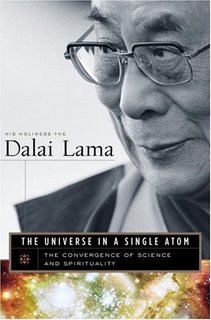
Dalai Lama: The Universe in a Single Atom

I'm not a huge fan of Tibetan Buddhism (I'm more partial to the existentialist Buddhism of Stephen Batchelor), but this looks very interesting (particularly his opinions re: genetic modification of offspring). But as The Dalai Lama himself once said, "My Tibetan goals are the same as those of Western science: to serve humanity and to make better human beings."

The Universe in a Single Atom: The Convergence of Science and Spirituality
by Dalai Lama XIV, Bstan-dzin-rgya-mtsho

Quick Reviews:

From Publishers Weekly
"As the Dalai Lama observes in this wise and humble book, dialogue between scientists and those interested in spirituality is important because science is not neutral; it can be used for good or ill, and we must approach scientific inquiry with compassion and empathy. Similarly, a spirituality that ignores science can quickly become a rigid fundamentalism. Sometimes the Dalai Lama discovers similarities between the two fields. For example, Einstein's idea that time is relative dovetails neatly with Buddhist philosophical understandings of time. Still, His Holiness does not accept all scientific thinking as holy writ: though he is intrigued by scientific stories of origins, like the Big Bang theory, Buddhism holds that the universe is "infinite and beginningless." The penultimate chapter brings ethical considerations to bear on technological advancements in genetics. The Dalai Lama gently suggests that although parents who select certain genetic traits for their children may intend to give their children a leg up, they may in fact simply be capitulating to a social pressure that favors, say, boys over girls or tall people over short. He also cautions that we do not know the long-term consequences of genetically modifying our crops. In fact, it is disappointing that the Dalai Lama devotes only 18 pages to these urgent and complex topics. Perhaps this prolific author has a sequel in the works."

From Booklist
"Fascinated by science since boyhood, the Dalai Lama, unlike fundamentalists who resist scientific realities, has become convinced that a dialogue between religion and science will advance the wisdom of both disciplines and greatly benefit humankind. He explains why in illuminating explications of how Buddhism and science are both predicated on focused observation, reasoning, and the ability to abandon outmoded ideas in the ongoing search for reality. He compares quantum physics with Buddhist philosophy and reveals how the theory of evolution echoes the Buddhist understanding that all of life is interconnected and in flux, and he writes with deep feeling about the pressing ethical questions raised by advancements in biotechnology. For all the provocative and detailed reasoning found in this soulful and mind-expanding book, what emerges most powerfully is the Dalai Lama's belief that science must embrace Buddhism's mission and work toward increasing compassion and alleviating suffering." -- Donna Seaman

Tags: , .