July 31, 2006

Bookchin dead at 85

Murray Bookchin, 1921-2006.

"Our Being is Becoming, not stasis. Our Science is Utopia, our Reality is Eros, our Desire is Revolution." (from Desire and Need, 1967)

"An anarchist society, far from being a remote ideal, has become a precondition for the practice of ecological principles." (from Ecology and Revolutionary Thought, 1965)

"Peter Kropotkin described Anarchism as the extreme left wing of socialism - a view with which I completely agree. One of my deepest concerns today is that the libertarian socialist core will be eroded by fashionable, post- modernist, spiritualist, mystic individualism."

"The assumption that what currently exists must necessarily exist is the acid that corrodes all visionary thinking."

"The ecological principle of unity in diversity grades into a richly mediated social principle; hence my use of the term social ecology." (from What Is Social Ecology?, 1984)

"If we recognise that every ecosystem can also be viewed as a food web, we can think of it as a circular, interlacing nexus of plant animal relationships (rather than a stratified pyramid with man at the apex)... Each species, be it a form of bacteria or deer, is knitted together in a network of interdependence, however indirect the links may be." (from The Ecology of Freedom, 1982.)

July 30, 2006

All Together Now: Animal uplift paper complete and published

I've finally completed my paper on animal uplift: All Together Now: Developmental and ethical considerations for biologically uplifting nonhuman animals. It's been published at the Institute for Ethics and Emerging Technologies site under the monograph series.

This paper is the fleshed out and refined version of the presentation that I gave at the IEET's HETHR conference at Stanford last May.

Here's the abstract (comments welcome):
As the potential for enhancement technologies migrates from the theoretical to the practical, a difficult and important decision will be imposed upon human civilization, namely the issue as to whether or not we are morally obligated to biologically enhance nonhuman animals and integrate them into human and posthuman society. Precedents for intra-species cultural uplift abound in human history, providing both sobering and edifying episodes showcasing the possibilities for the instigated and accelerated advancement of technologically delayed societies. As a number of scientists, philosophers and futurists have recently argued, there is mounting evidence in support of the suggestion that these historical episodes are symptomatic of a larger developmental trend, namely the inexorable and steady advancement of intelligence. Civilizational progress necessarily implies increasing levels of organization and refinement across all realms of activity. Consequently, the status of nonhuman species and the biosphere will eventually come under the purview of guided intelligence rather than autonomous processes. That said, a developmental tendency towards uplift does not imply that it is good or right; more properly, it can be argued that uplift scenarios do in fact carry moral currency. Through the application of Rawlsian moral frameworks, and in consideration of the acknowledgement of legally recognized nonhuman persons, it can be shown that the presence of uplift biotechnologies will represent a new primary good and will thus necessitate the inclusion of highly sapient nonhumans into what has traditionally been regarded as human society. In addition to issues of distributive justice, the Rawlsian notion of original position can be used to answer the question of whether or not there is consent to uplift. Finally, it will be shown that the presence of uplift biotechnologies in the absence of the legal recognition of nonhuman persons and a mandate for responsible uplifting will ultimately lead to abuse, adding another important consideration to the uplift imperative.
Tags: , , , , , , , , .

July 21, 2006

Shostak: Is SETI Barking Up the Wrong Tree?

Seth Shostak is once again trying to justify the work of SETI. But seeing as that's his job, it's to be expected. He has to perpetually defend the work of SETI to secure public support and funding.

Shostak notes that there are four primary suggestions as to why SETI hasn’t found a signal:
1. “You’re counting on the aliens using communication technology (radio, light) that’s oh-so-last century. They will be far beyond this.”

2. “If hi-tech societies or thinking machines were out there, they’d have colonized the Galaxy by now. Clearly, we’re alone… lone… lone.”

3. “The aliens don’t want to communicate with us. Look at what we’re doing to the planet!”

4. “You SETI types are just looking in the wrong places. We know where the extraterrestrials are: on a planet in the Zeta Reticuli system.”
Reasons #1, #3 and & #4 are useless, but #2 is one I'm partial to. As I've written before, the apparent dearth of ETI's in our galaxy is a disturbing observation.

In response to suggestion #2, Shostak writes:
This is, of course, an appeal to the Fermi Paradox, which assumes that if sophisticated societies are common, they should also be ubiquitous. Well, I just checked the parking lot outside the Institute, and I see no large animals with long, prehensile noses. The conclusion a la Fermi is that elephants don’t exist on this Earth, right? After all, any putative pachyderms have had plenty of time to get to my office, even if only a few of them are so inclined. To use the Fermi Paradox as a reason for the lack of a SETI signal is to make a very big extrapolation from a very local observation. Seems chancy to me.
This is a surprisingly weak answer from Shostak who has clearly misinterpreted the FP. No one is arguing that elephants should be ubiquitous. If we thought, for whatever reason, that elephants should occupy specific ecospaces on Earth, but they don't, then that would be a sort of observational conundrum much like the FP. I don't expect this, so I don't see this as a problem.

On the other hand, our expectations of AETI migratory behaviour and their potential megascale engineering projects are a horse of a different colour. The FP is about the absence of evidence when there should be evidence. And Shostak knows this; otherwise he wouldn't be pointing his radio arrays at the sky. It would be a convenience of the highest order if the first signs of ETI life were to be discovered now.

Shostak and others are guilty of grossly underestimating the characteristics of post-Singularity AETI's. Those, like Shostak, who dismiss the FP betray a misunderstanding of the potentials of artificial superintelligence, radically advanced computing and such technological artifacts as Von Neumann and Bracewell probes. And as usual, these dismissals fail to take into account the extreme age of the universe and the huge expanse of time that has preceded our own.

That said, Shostak may be (inadvertently) right about ETI localization. As argued by Cirkovic and Bradbury, AETI's may migrate from a biological habitable zone to a technological habitable zone -- one more conducive to megascale information processing projects like matrioshka and Jupiter Brains.

But Shostak and SETI, I'm sure, aren't considering these types of scenarios. My advice to SETI: keep on listening, but don't expect to hear anything.

Tags: , , , , , , , .

Key perspectives on the Bush stem cell fiasco

Ronald Bailey is mad.
Art Caplan's is too.
Jim Fossett says calm down.
Elizabeth Gettelman of MoJo chimes in.
But when all is said and done we'll probably be able to get stem cells another way.

July 19, 2006

Americans get a taste of Canadian biopolitics

Now that George Bush has vetoed a bill rejecting legislation passed by Congress that would have expanded federal research on embryonic stem cells, Americans have been given a taste of what Canadians have had to deal with for the past four years.

Actually, that’s not entirely fair to our American friends. The situation here in Canada is actually far worse.

Surprised? Well, don’t be. Back in 2002 the Liberal government passed Bill C-6 – the so-called Assisted Human Reproduction Act. Where Bush has limited federal funding, the Liberals have banned research into human embryonic stem cells altogether. As is the situation in the United States, religious injunctions against meddling with embryos are dominating Canadian legislatures.

And this is exactly the issue at hand. It’s actually not such a big deal that embryonic stem cell research has been curtailed. There have been remarkable advancements in deriving stem cells from adults and non-human animals. The pending stem cell revolution is in no danger of being interrupted.

Rather, the real problems raised by Bill C-6 and Bush’s recent veto have to do with deplorable politicking and the incessant intrusion of religion onto daily life. When announcing the veto, Bush unabashedly surrounded himself with babies – babies born as a result of embryo adoption programs. Bush’s implied statement of embryo sanctification flies in the face of the fact that thousands upon thousands of embryos are destroyed each year, most arising from IVF efforts.

I’m sure Bush isn’t about to tread on that old issue. What used to be called “test tube babies” now accounts for over 112,000 births each year in the United States alone. Worldwide, it’s been estimated that over 3 million children have been born through IVF since its inception in 1978. Clearly Bush’s rhetoric of “crossing a moral line” is grossly insincere and laughable, especially considering the appalling deaths of innocents as a result of his war on terror. What Bush is really doing by virtue of his embryo baby kissing and stem cell vetoing is pandering to one of his most important constituencies, namely the religious right.

Meanwhile, here in Canada, the (very) silent but powerful Christian minority has completely taken advantage of Canadian complacency. Not knowing and not caring is truly our national pastime. As I write this, many Canadians are up in arms in regards to Bush’s veto, with very few realizing that our own legislation is far more restrictive. Worse, Canadians are oblivious to the fact that Christian notions of personhood are directly inhibiting medical research and potential breakthroughs.

Ultimately, as biopolitics matures as a social issue, Canadians and Americans will eventually come to their senses and acknowledge the importance of stem cell research. The benefit of regenerative medicine carries profound implications for nearly everyone. There are people alive today who could desperately use these types of interventions. It’s about time we honoured the sanctity of those lives that are actually being lived rather than levying nonsensical notions of personhood onto a clump of cells.

Tags: , , , , .

July 12, 2006

Global warming and the end of human freedom

Humans and human institutions are clearly failing the planet.

And when environmental catastrophes finally hit the tipping point, panicked societies will start to fail humanity itself. Preventing global warming, it would seem, is not just about preserving the biosphere, it’s also about preserving human freedom.

At the recent IEET conference at Stanford University, environmentalist Walter Truett Anderson declared that global warming is the single most important problem to ever face humanity. In a history dominated by everything from plagues to genocide, that's a rather bold statement to make, and likely very true.

So, why aren't we mobilizing en masse to deal with the crisis? Why isn’t it the first thing we think about when we wake up and the last thing before bed? The reasons are frustratingly multifaceted--a long list that includes such factors as corporatist indifference (think of the Kyoto failure), a population largely ignorant and in denial, and an insufficient sense of crisis. The sky, after all, is not falling...at least not yet.

Another reason is the democratic and libertarian streak that now permeates all liberal societies. Rather than state coercion, people are expected to act voluntarily and to democratically establish institutions that will contend with problematic issues like global warming. The general assumption is that people tend to be intelligent, reasonable and self-preserving. Give them a good reason to act and they will do so out of their own volition.

Unfortunately, as the global warming issue has revealed, this tendency has not been put into practice to any great extent. SUV’s and Hummers dominate the streets, factories churn out the pollutants, and country after country fail the minimum requirements established by Kyoto—with other countries either not participating or threatening to pull out altogether (like Canada, for example).

Sadly, the only time in human history when people have been effectively mobilized for mega projects is when a state declares war on another, or when the state declares war on its own citizens (as witnessed by authoritarian dictatorships or totalitarian fascism, communism and theocratism). I don’t use these examples lightly. They reveal disturbing insights into human behavior and selfishness, the inefficacy of political and corporate institutions, and ultimately, the role of state coercion throughout human history. In the case of war and totalitarianism, they are political phenomenons that are both emblematic and driven by feelings of desperatism. Under these conditions, populations are compelled by their governments to fanatically work towards desired ends. And these ends, of course, trump such niceties as human liberty.

Sure, there’s no seemingly obvious reason for alarm or desperatism today—-but it’s not implausible to suggest that quai-totalitarian frameworks will arise as a result of the calamitous effects of global warming. Once the environment truly goes to hell and it becomes overtly obvious that a catastrophe is actually happening, our respective governments will find ways to a) control its fearful populace, and b) compell its citizens to live and work a certain way. It would be George Orwell on hydraulic despotism.

Such state prerogatives may come about through democratic processes—governments elected out of fear and panic. Or, these political regimes may arise from unilateral political action (a la the current Bush regime; as American libertarians are finally learning, when times get tough, the liberties get going). Regardless, they will morph into governments driven by a frantic and panicked call to action.

So, along with the environment, it’ll only be a matter of time before you can kiss your free ass good bye.

Tags: , , , , , .

Gone to that great gig in the sky

Syd Barrett, 1946-2006.

Lime and limpid green, a second scene
A fight between the blue you once knew.
Floating down, the sound resounds
Around the icy waters underground.
Jupiter and saturn, oberon, miranda and titania.
Neptune, titan, stars can frighten.
Lime and limpid green, a second scene
A fight between the blue you once knew.
Floating down, the sound resounds
Around the icy waters underground.
Jupiter and saturn, oberon, miranda and titania.
Neptune, titan, stars can frighten.
Blinding signs flap,
Flicker, flicker, flicker blam. pow, pow.
Stairway scare dan dare whos there?
Lime and limpid green, the sounds around
The icy waters under
Lime and limpid green, the sounds around
The icy waters underground.

July 11, 2006

Wikipedia, postgenderism and me

I found out today that the postgenderism entry on Wikipedia was deleted and a new re-direct set up in its place that points to the wiki entry on me, George Dvorsky.

That's completely weird and unexpected. I'm not necessarily thrilled with having a philosophical or social movement essentially equated with my name on Wikipedia. Moreover, it's hardly emblematic of my work and writings in futurism and transhumanism in general.

It's my understanding that the reason for shutting down the discrete 'postgenderism' entry was due to a lack of citations and other examples of expositions on the matter (other than my own). I'm not convinced that's entirely fair. Other people did contribute to the postgenderism wiki entry, and citations were made to such thinkers as Donna Haraway.

Well, we'll see how the entry evolves over time. I'm inclined to stay out of it and watch what happens. It's also about time that I write a formal paper on the matter and submit it to a journal like JET. But first things first -- I'm still working on my animal uplift paper.

SENS survives Pontin's challenge

Not surprisingly, at least not for me anyway, Aubrey de Grey's "Strategies for Engineered Negligible Senescence" (SENS) survived a Technology Review challenge which sought to determine whether or not the theory was worthy of "learned debate."

Here's a nice summation of the judge's conclusion:
We need to remember that all hypotheses go through a stage where one or a small number of investigators believe something and others raise doubts. The conventional wisdom is usually correct. But while most radical ideas are in fact wrong, it is a hallmark of the scientific process that it is fair about considering new propositions; every now and then, radical ideas turn out to be true. Indeed, these exceptions are often the most momentous discoveries in science.

SENS has many unsupported claims and is certainly not scientifically proven. I personally would be surprised if de Grey is correct in the majority of his claims. However, I don't think Estep et al. have proved that SENS is false; that would require more research. In some cases, SENS makes claims that run parallel to existing research (while being more sensational). Future investigation into those areas will almost certainly illuminate the controversy. Until that time, people like Estep et al. are free to doubt SENS. I share many of those doubts, but it would be overstating the case to assert that Estep et al. have proved their point.
Here's TR editor-in-chief Jason Pontin's account of the judge's findings.
Here's the Estep et al. dissention to the decision.
Read more about it in ImmInst and Betterhumans.
And here's my rant from a few weeks back.

July 3, 2006

Superman’s return to a post 9/11 world

I have a real soft spot for the 1978 version of Superman, so it was with some anticipation that I went to see Superman Returns yesterday with my eldest son – who is practically the same age now as I was back in ’78. After sitting (and often squirming) through the 2½ hour updated version, let’s just say that Superman Returns didn’t have nearly the same impact as its predecessor. It was actually quite mediocre, but it’s given me some fodder for a rant.

Like most of my reviews, this one is spoiler ridden, so stop reading now if this poses a problem for you.

Superman Returns is a curious movie in that it is more a re-imagining of the 1978 version than an amalgamation of previous versions or a completely revised approach along the lines of what Christopher Nolan recently did with the Batman franchise. A number of stylistic and plot elements from the 1978 film were retained, including aspects like Lex Luthor’s attempt to profit from a massive land grab and even the crystalline Fortress of Solitude itself. That said, the writers did alter the canon to a significant degree by having Superman return from a five year space mission in a failed attempt to find any remaining survivors of Krypton, and most surprisingly, the revelation that he has a son – one who looks to be endowed with similar powers.

Superman’s return from his five year hiatus is a key theme in the movie. Disappearing from the world without so much as saying good-bye, Superman’s return is met with mixed emotions, particularly by one Lois Lane who has since married and formed a family. In fact, Lane is set to receive a Pulitzer Prize for a shocking editorial titled, “Why the World Doesn’t Need Superman.” Lane and the inhabitants of Earth, it would seem, have come to grips with Superman’s absence and have learned to cope without their savior; indeed, Lane’s bitter piece was fueled by an existentialist sense of unfair abandonment and could have very well been titled, “Why the World Doesn’t Need God.”

At first I was puzzled by the script writer’s decision to have Superman gone for so long, but the reason eventually dawned on me. Five years. Not an arbitrary number when you realize that we are quickly approaching the five year anniversary of 9/11. Like the arrival of the extraterrestrials in The Day the Earth Stood Still, Superman’s return is a quasi-messianic example of wish fulfillment in popular culture. Five years after 9/11, and deeply intertwined in the so-called war on terror, Americans are most assuredly looking to the sky for help.

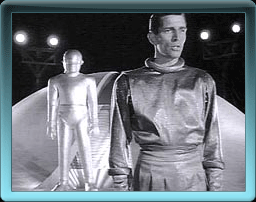
In The Day the Earth Stood Still, aliens Klaatu and Gort arrive to 1951 Earth in an attempt to rescue a civilization that had only recently come into possession of apocalyptic weapons. Given the trauma of World War II, the rise of the Cold War, and the loss of innocence wrought from the development of planet destroying technology, nervous audiences were offered some (fictional) hope by having (fairly) benign creatures fall from the sky to set things right. God, it appears, was dead -- even in the 50s; if aliens couldn’t save us, after all, then who would?

And like the arrival of Klaatu and Gort, the return of Superman in 2006 is also reflective of contemporary geopolitical concerns and desperatism. When Christopher Reeve donned the red cape back in the late 70’s, Superman had to address the disturbing rise of urban violence and crime. Today, the stakes are much higher. With the United States under the perceived threat of super-terrorism, and with an incompetent and largely ineffective government in place to deal with the issue, defeatism has led to to those hopes that can only be realized in religious or science fictional outlets.

One could interpret the work of Superman, who works for truth, justice and the American way, as an analogy and rationalization of the geopolitical aggressiveness of the United States. Superman Returns can also be seen as a metaphor or craving for religious messianism, or simply as an example of escapism and wish fulfillment. Those partial to religious sensibilities will most certainly sympathize with the messianic overtones. Lois Lane, embarrassed by her earlier lack of faith, eventually decides to pen a new editorial -- this time making a case for “Why the World Needs Superman.” Or is that God? It’s Superman Returns as a call to prayer.

Alternately, given the fact that Superman doesn’t exist in our reality, one wonders if the film is making a case for passivity, despair and escapism. Given the hopelessness of the current geopolitical situation, are we better off disengaging from reality and slipping into dreamy Hollywood diversions?

I certainly hope not. Other post 9/11 science fiction franchises have taken a different approach. Battlestar Galactica, for example, has a decidedly West Wing element to it. The show is hard-edged, cynical and at times maudlin, but more representative of current realities than movies like Superman Returns.

Well, the kid in me that marveled at Superman in 1978 is most certainly dead, replaced by a thirtysomething sensibility that’s now easily irritated by simplistic and opportunistic pop culture drivel. But even if my tolerance for mindless distractions has withered over the years, it still doesn’t hide the fact that Superman Returns is a crappy movie. This film, while desperately trying to retain the majesty of Superman: The Motion Picture – it usurped the old musical score and Marlon Brando’s performance – utterly failed to incorporate the charm, poignancy, and depth of its forerunner.

And worse, by unabashedly making this a post 9/11 wish fulfillment movie, its creators have pandered to one of the more pathetic elements of American society and human nature itself.

Tags: , , , .

June 28, 2006

Philanthrocapitalism or philanthrobabble?

My libertarian socialist sensibilities were both tickled and agitated this week when I learned that Warren Buffett, the world’s second richest man, donated virtually his entire $31 billion fortune to the Gates Foundation. Buffett is known for his philosophical opposition to dynastic wealth, but the donation was also emblematic of his support for what is coming to be regarded as "philanthrocapitalism" – the increasing trend toward entrepreneurial approaches to philanthropy.

This latest trend has me both delighted and concerned. I’ve always had a problem with conspicuous money hoarding, and it’s good to see some considerable coin being tabled for humanitarian needs. But at the same time I have to question both the sincerity and the motivation of the so-called philanthrocapitalists. Are they truly working in the best interests of the world’s poor? Or are they merely working to further their own causes and those of other capitalists by creating entirely new targetable consumers? Is this yet another example of how corporatism is increasingly entrenching itself in global society?

Perhaps it’s all the above. The question to ask is whether or not the outcome will truly be beneficial for all.

Most people acknowledge the problems and limitations of small scale charities. These groups are often resource strapped, idealistic, bureaucratic, and stunningly ineffective. The new supercharities, on the other hand, promise to operate in a way that more closely resembles the corporate world. Prospective donors act as potential investors, looking for high returns in terms of how the donations will benefit recipients. More and more, donations are given only after cost-benefit analyses are performed to ascertain what the gifts might actually accomplish. In this sense, charities resemble capitalist economies in which benefactors become consumers of social investment.

Further, as some are quick to point out, the costs of not investing are startlingly high—-and it’s not just the human cost but the fiscal cost as well. Bill Gates calculated that had malaria been wiped out in Africa in the 1960’s its gross domestic product would have been $100 million higher than it is today. Well funded groups like the Gates Foundation can micro-manage every dollar it commits and judge the exact impact of its interventions. What I'm left wondering is, was Gates concerned that people were dying of malaria, or that a potential GDP market of $100 million was left squandered for so long?

For those like myself with leftist tendencies, there’s significant potential for concern here. The rise of philanthrocapitalism is essentially for-profit philanthropy. While I’m sure that many of the donors who are “investing” their money in charities are truly doing so with good intentions, it is clearly not an entirely selfless act. The motivations are legitimately suspicious, and one wonders if Gates, Buffett and others are merely trying to open up new markets and new demographics.

Hold on -- now am I being all sour grapes, here? Are my concerns symptomatic of my own petit bourgeois complacency and cynicism? Do the motivations and intentions of the benefactors really matter? Sustainability issues aside, if people are healthy, fed, clothed, and sheltered, while also having jobs and things to buy, isn’t that a great and noble achievement unto itself?

Well, I suppose it’s a great achievement in a Fukuyamaesque end-of-history sort of way, but it brings to light the unsettling issue of overwhelming global (and even totalitarian-like) corporatism and the withering away of governmental accountability in this domain. Given the proliferation of philanthrocapitalism, one can imagine governments growing increasingly indifferent to spending money on aid. Why bother, after all, when the capitalists are doing such a good job? What a great opportunity to lower taxes and shrink government even further!

Unlike philanthrocorporate interests, which are self-serving and subject to cost-benefit analyses, states and their governments – which are supposedly working on behalf of the public interest – are in a special position to gauge the worthiness or urgency of certain causes and broader social interests. While the philanthrocapitalists can arbitrarily choose which humanitarian battles to wage, governments can be better persuaded (ie democratic due process) to enter into those arenas that may seem unpalatable to the capitalists but are worthy and important problems nonetheless.

I’m not opposed to supercharities. In fact, I think it’s a remarkable development in the history of philanthropy and the affairs of the obscenely rich. What I’d like to see, however, are strong governments and international bodies who will stand up to the corporatist tsunami and offer a guiding voice.

The goal, after all, is to create healthy, happy, and prosperous people – something most people agree is a good thing. The risk, however, is the demise of democratic and participatory values that are replaced by a corporatist world in which all aspects of human existence are shaped by capitalist urges.

Tags: , , , , , , , , .

June 22, 2006

When did intelligence first emerge in the universe?

Here’s a question that has a direct bearing on both the Drake Equation and the Fermi Paradox: When did life first emerge in the universe? More important to the SETI discussion, however, is determining the earliest point at which a radio-capable or Singularity era intelligence could have emerged. My initial suspicion is that the conditions required to support intelligent life have been established for quite some time now – a conclusion that will only reinforce the Fermi quandary rather than diminish it.

A lot of hand waving goes on when people dismiss the Fermi Paradox. The fact that the universe isn’t already teeming with ETI’s and machine intelligences is more disturbing than most people realize. One such person is Ray Kurzweil who believes that we are the first (or among the very first) intelligences in the universe to approach the Singularity. I find this absurdly improbable, but it’s an hypothesis that I’m willing to entertain.

For the sake of this discussion, let’s set aside Ward and Brownlee’s Rare Earth hypothesis and invoke the self-sampling assumption about our conditions here on Earth. We can heretofore assume that the circumstances on Earth are extremely typical in regards to how life emerges and evolves.

According to cosmologist Charles Lineweaver's estimates, planets started forming 9.1 billion years ago. Obviously, radio-communicating or pre-Singularity intelligences didn't emerge overnight. So, how long does that take? Using the Earth as an example we can come up with a rough idea.

Life on Earth first emerged about 600 million years after its formation (that’s awfully quick – a strike against the Rare Earth hypothesis, I would say). Consequently, given similar conditions in other parts of the universe, I’d say that life could not have arisen any earlier than 8.5Gyr ago. What I’d be interested to know is, in what way, if any, were planets and solar systems different 8.5Gyr ago as compared to those which formed 4.57Gyr ago (which is when the Earth formed)? Would any of those differences negate or retard the processes of life?

The next factor to look at is the complexification of life. On Earth, it took RNA/DNA about 3.7Gyr to get to the point where it was able to express complex land dwelling organisms. This is the time when, about 220 million years ago, that dinosaurs emerged. It’s conceivable that hominid-type creatures and their attendant civilizations could have emerged around this time instead of super-predator dinosaurs. Let's work with this assumption.

Now, I suppose we should account for the mass extinction events that characterized the early phases of Earth. Given the short period of time in which it’s taken Homo sapiens to emerge from beast to virtual cyborg (less than 2 million years), it’s safe to say that the high frequency of mass extinctions wouldn’t have been a factor.

That said, NEO impacts and other mass extinction events have been the cause of drastic evolutionary re-starts, but have decreased in frequency over the course of our solar system’s history. The solar system is stabilizing. A fair question to ask is, were mass extinction events necessary for the emergence of intelligence life, and if so, why?

Given the length of time required to go from the ignition of life through to complex life, the earliest that civilizations could have emerged on Earth is 220 million years ago. I'm going to conclude that natural selection requires 3.7Gyr before it can express creatures that are morphologically sophisticated enough to resemble humans. As an interesting aside, that doesn’t necessarily suggest that organisms could have evolved the cognitive capacity of humans at that time. For all we know, the mammalian brain requires the 200 million years of evolution and accumulated/refined DNA data to get to the sophistication it has today. I’ll admit, however, that that’s a stretch; time-to-evolve is not a fixed rate and is largely dictated by the severity of environmental stressors.

Using the 3.7Gyr metric, the earliest that complex humanoid life could have emerged in our universe is 4.72Gyr ago. That figure does not negate the Fermi Paradox. Given the potential emergence of intelligent life in our galaxy around that time, and given Fermi’s estimate that an ETI could colonize the galaxy within 10 million years, our galaxy could have been colonized nearly 500 times over by now.

Let’s try to whittle the figure down even further. Assuming that an advanced civ could have emerged on earth 220 million years ago, what would they have used to fuel their industrial revolution? Working under the assumption that fossil fuels are a necessary prerequisite for an industrial revolution to occur, how many years of accumulated biomass is required? By the same token, how much biomass is required to get to the Singularity?

Today, considering the threat of peak oil, we don’t know the answer to that question ourselves. We know that human civilization had enough to get to an industrialized phase of existence, but we don't actually know if we have enough energy to get to the Singularity (although I'm inclined to believe that we do).

Let’s assume here, however, that we have enough energy to make it. Vast forests of clubmosses (lycopods), horsetails, and tree ferns started to cover the land 300 million years ago – biomass that decayed and eventually formed coal and oil. Let’s use that as our metric for the time required to establish energy needs. That knocks our figure of 3.7Gyr down to 3.4Gyr – barely a dent.

I’m making an assumption, here – that the presence of oil and coal are a necessary condition for the emerge of radio-capable and pre-Singularity intelligences. I remember getting into a discussion with Eliezer Yudkowsky about this a number of years ago who begged to differ. He essentially claimed that 'where there’s a will there’s a way,' particularly given long enough time frames (I think he used the example of solar power).

I’m still unconvinced and would argue that fossil fuels are absolutely necessary. I'm going to use that in our calculation to push back the emergence of complex civs in the universe from 4.72Gyr ago to 4.42Gyr ago.

There are undoubtedly a plethora of factors I’m either omitting or exaggerating. The exact conditions required for the emergence of human-like intelligences may be more complex than it appears, and the universe may only be intelliphillic at this unique time (a violation of the Copernican Principle, I know, but one that should be considered; is the universe entering a phase transition?).

Formalizing my argument about when intelligences could first emerge in the universe, I'm going to use this as a starting equation:

[y.a. planets formed (P)] – [years it takes for life to emerge (L)] – [years it takes for DNA to become hominid-expressible (H)] – [years it takes to accumulate required biomass for energy (E)] = [y.a. radio-capable civs first emerged in the galaxy (A)]

P – L – H – E = A

Using my figures (in Gigayears):
9.1 – 0.6 – 3.78 – 0.3 = 4.42Gyr

So, it’s conceivable that Singularities and outward galactic expansions could have happened as long as 4.42 billion years ago. This is still an immense amount of time, keeping the Fermi problem deeply relevant.

So, where is everybody?

Tags: , , , , , , , , .

June 20, 2006

World Future Society Conference: Toronto, July 28-30

In late July I will be attending the World Future Society's annual conference which is going to be held at the Sheraton Centre in Toronto. The theme for this year's conference is "Creating Global Strategies for Humanity's Future." Featured speakers include Ray Kurzweil, Joel Garreau, Walter Truett Anderson, and many others.

I, along with Simon Smith (editor of Betterhumans and VP of the Toronto Transhumanist Association), will be manning the table for the World Transhumanist Association and the TTA. Please drop by and say hello if you're going to be there.

Go here for more information about the conference.

June 15, 2006

All Together Now II

Okay, time to call it a night; my mind now resembles a bowl of pudding. After returning from Stanford and receiving a ton of feedback about my presentation on animal uplift, I decided to seriously revise my paper. I've significantly revamped it and tightened my line of argumentation. Once complete, it will be published by the IEET along with other papers that were presented at the HETHR conference. I'd like to see it get published elsewhere as well.

Here's the abstract in its current incarnation (feedback welcome):
As the potential for enhancement technologies migrates from the theoretical to the practical, a difficult and important decision will be imposed upon human civilization, namely the issue as to whether or not we are morally obligated to biologically enhance nonhuman animals and integrate them into human and posthuman society. Precedents for intra-species cultural uplift abound in human history, providing both sobering and edifying episodes showcasing the possibilities for the instigated and accelerated advancement of technologically delayed societies. As a number of scientists, philosophers and futurists have recently argued, there is mounting evidence in support of the suggestion that these historical episodes are symptomatic of a larger developmental trend, namely the inexorable and steady advancement of intelligence. Civilizational progress necessarily implies increasing levels of organization and refinement across all realms of activity. Consequently, the status of nonhuman species and the biosphere will eventually come under the purview of guided intelligence rather than autonomous processes. That said, a developmental tendency towards uplift does not imply that it is good or right; more properly, it can be argued that uplift scenarios do in fact carry moral currency. Through the application of Rawlsian moral frameworks, and in consideration of the acknowledgement of legally recognized nonhuman persons, it can be shown that the existence of uplift biotechnologies will represent a new primary good and will thus necessitate the inclusion of highly sapient nonhumans into what has traditionally been regarded as human society. In addition to issues of distributive justice, the Rawlsian notion of original position can be used to answer the question of whether or not there is consent to uplift. Finally, it will be shown that the presence of uplift biotechnologies in the absence of the legal recognition of nonhuman persons and a mandate for responsible uplifting will ultimately lead to abuse, adding another important consideration to the uplift imperative.

June 14, 2006

Hey, deep ecologists: the planet is not your nature preserve!

In the absence of a Creator a number of people have taken to worshipping the next best thing, creation itself. This phenomenon has been exemplified by the rise of Gainism and the Gaianists. Given the poor state of the environment today this sentiment has mutated into the kind of reverential desperatism and misanthropism that is now the all too familiar opium promoted by the deep ecologists. God may be dead, but religious sensibilities that showcase the unworthiness of man have been retained by these radical environmentalists, resulting in a worldview that perpetuates defeatism, shamefulness and self-loathing.

The deep ecologists and Gainists ascribe divine status to nature—a kind of neo-pantheism--and like their religious forbearers, have insisted on keeping humanity outside the gates of heaven. In their view, man is dirty, irreverent, and profane. His sheer presence is an affront to the divine processes of nature, the very cause of paradise lost; terms like ‘biodiversity’, ‘symbiogenesis’, ‘biosphere’, and ‘homeostasis’ have replaced the old religious canons.

The Earth, they would argue, would be better off without the meddling of humanity and their omnipresent disruptive technologies. The deep ecologists are on a self-prescribed mission to recover paradise and turn the Earth into a giant nature preserve where the only observers would be those creatures trapped in endless cycles of mindless selection and procreation. Birth, life, death, birth, life, death—the perpetuation of the Darwinian cycle as an end unto itself, a cycle with no other purpose than to satiate the aesthetic sensibilities of the nature worshippers.

But there is a cure to the new quasi-religious environmentalist fervor: humanism. And it doesn’t matter what kind of humanism, be it secular humanism, Christian humanism, Buddhist humanism, or transhumanism. Even better are those humanistic codes, like Buddhism and transhumanism, which are nonanthropocentric and demand the respect of all life. Humanist sensibilities work to ensure that it is the quality of life that is maintained rather than pseudoscientific and quasi-religious abstractions.

One can be an environmentalist and a humanist. The key is to make this planet habitable, sustainable and humane. It is this last crucial point that the Gainists and deep ecologists have failed to grasp, and in so doing, have come to represent a dangerous and misguided ideology.

Tags: , , , , .

June 12, 2006

Help the Great Apes

[Re-directed from the Great Ape Project]

June 10, 2006

Great Apes Need Your Help! The Spanish Parliament is scheduled to consider a resolution supporting legal rights for non-human great apes at the end of June. This resolution recognizes the need for basic legal protections and rights that will protect the non-human great apes from mistreatment, slavery, torture, death and extinction.

The proposed proposition:

The Parliament demands the Government to declare its adhesion to the Great Ape Project and to undertake the actions necessary in the international round tables and organizations, for the protection of The Great Apes from miss treatment, slavery, torture, death and extinction.

Please take just a few minutes to let the Spanish government know that there is worldwide support for this important legislation. You can do this by posting a comment on the Great Ape Project's website in Spain by clicking on http://www.proyectogransimio.org/completa.htm and selecting "libro de visitas"

June 9, 2006

SENS scrutinized

A couple of weeks ago I was walking with Aubrey de Grey in picturesque Palo Alto when I asked him what the latest word was on Technology Review’s SENS challenge. He looked at me quite seriously and said, “The first three submissions will be presented in just two days.” I asked him if he was worried, and he responded by noting that he was pleased with the selection of judges – a panel that includes Rodney Brooks and Craig Venter, among others.

If I was to read into de Grey’s answer, he was suggesting a certain degree of confidence in not just the integrity of SENS, but also in the judges’ ability to satisfactorily assess the nature of the contest.

For those who are a) interested in radical life extension and are b) living in a cave, Technology Review editor Jason Pontin offered a challenge last year to anyone who can demonstrably show that de Grey’s Strategies for the Engineering of Negligible Senescence “is so wrong as to be unworthy of learned debate.” Should a winner be declared, they would be the recipient of a US$20,000 prize. A group of judges was recently assembled to assess the entries and the first 3 challenges are now up for review.

I’ve read through the arguments, rebuttals and counter responses and have a number of things to say.

First, regardless of the outcome, it is extremely important that both de Grey and SENS be put under this kind of scrutiny -- even if the contest is a tad sensationalistic. If de Grey is guilty of propagandizing pseudoscientific beliefs and establishing a cultish personality around himself – and I am not suggesting that he is – it is important that this be considered and brought to the public’s attention. More importantly, however, the ad hominem that has in no small way characterized this contest has similarly got to be fleshed out and exposed; as Reason aptly pointed out in his Fight Aging review, “SENS is not de Grey.” This heated debate has brought out the worst in all parties as far as I’m concerned.

Indeed, cutting through all the noise to get at the substance has been difficult. The submission by Estep et al, for example, was thin on content and never short on criticisms of de Grey. At one point the authors compared de Grey’s ‘delusions’ to those of Lysenko’s and Velikovsky’s.

But once the wheat is separated from the chafe, the various arguments against SENS are complex and provocative:

Can microbial hydrolases be used to degrade intracellular aggregates that accumulate with age? How viable is mitochondrial engineering? Is SENS a strategy against symptoms rather than cures? Are there informational limits to the brain? Can the brain be reprogrammed for extreme longevity? Will medical science be able to keep up with all the unforseen problems of aging?

Open issues such as these are not just the concern of de Grey and his detractors, but also of speculative biologists, gerontologists, neurologists, and other scientists. Today, it’s not uncommon to see conferences, dissertations, and experiments directly addressing these various biological and medical issues.

Which brings up a very interesting point. By virtue of Technology Review’s SENS Challenge, and in consideration of the various arguments and counter-arguments, is this not already “learned debate?” Isn’t this very contest a blatant demonstration that the experts are in fact already debating the inner aspects of SENS? What kind of farce is this?

Perhaps I’m being facetious; I do realize, after all, that the contest is an attempt to exorcise SENS from scientific credibility. But at what point is it acceptable for scientists to denigrate opposing viewpoints by banishing their opponents and their ideas outright? Just what, exactly, is the intention of the contest organizers? Do they want to see de Grey disappear from the scene? Do they want all this anti-aging mumbo-jumbo to stop?

I'm reminded how bitter rivalries are the stuff of science. A quick roll-call includes Darwin v. Owen, Gould v Mayr, Haldane v. Mayr, Dawkins v. Gould, and Margulis v Dawkins.

This whole contest, it would seem, appears to be a rather bizarre forum for the peer review of SENS – or a desperate attempt to prevent de Grey from actually getting the chance for more formal peer review and, by virtue, increased academic credibility.

Or, more simply, this contest is just a personal battle between Jason Pontin and Aubrey de Grey. Ah, but let’s face it – it’s likely just a silly publicity stunt that will ultimately benefit Technology Review, the panel of judges, and Aubrey de Grey himself regardless of the outcome.

So, what will the judges decide? Is SENS truly unworthy of learned debate (excluding the very exercise of debating it for the purpose of the contest :-P). Well, there’s a better than excellent chance that SENS in its current incarnation is absolutely wrong. It’s very possible that the judges will concur with this possibility and rule against de Grey. What would be absurd, however, would be a declaration that the war against aging itself is an idea unworthy of debate.

To all you de Grey groupies on the edge of your seats in anticipation of The Big Decision, it's time to take a chill pill and a deep breath. The outcome of this contest will have no bearing on the work to come against the ravages of aging. A ruling by the judges against de Grey would have no bearing on anti-aging research, and would at worst cause de Grey to have to revise his strategy (or his approach). But he needs to do this anyway as SENS should at no time be considered a static document. Twenty years from now we may laugh at the naiveté of SENS, but I highly doubt we’ll laugh at the maturation of real anti-aging interventions that will have sprung from this seed of an idea.

When all is said and done (whatever that means), it may be that de Grey will have had very little to contribute to bona fide anti-aging advances (although I doubt that). De Grey will not cure aging by himself and any assertion that he will is patently ridiculous. The war against aging will be a concerted and protracted effort that will in all likelihood take many decades, numerous researchers and vast resources. Further, the efforts to halt the aging process will be the result of converging therapeutic interventions that will address aging related pathologies on an individualized basis. While an all-reaching overview like SENS is laudable and even practical, it will still come down to the specialists working on their focused aging related problems.

While de Grey may not be in the trenches, what’s undeniable is his work as an anti-aging pioneer who’s blazing an inspirational trail for future gerontologists. And cancer researchers. And neurologists. And anyone else who considers an aging related problem to be potentially solvable. De Grey is an archetype in the making.

So, my pre-interpretation of the judge’s decision should they vote against SENS is that they will likely take issue with the inner working of SENS and de Grey’s methodology. And as I said, on this point they may be right – an outcome that may cause de Grey to go back to the drawing board to come up with SENS 2.0. If they declare, however, that speculations into anti-aging interventions per se are “beyond learned debate,” then they will have made a significant judgemental error.

If, on the other hand, the judges vote in favour of SENS, it would represent a clear victory for those who continually push the boundaries of science into uncharted and controversial areas. It’s artist as scientist, drawing outside the lines to conceive of new possibilities and charting all the terra incognita. Perhaps this is why de Grey is happy with the current set of judges; like himself, the panel is filled with visionaries and big thinkers.

But is this more philosophy than science? Indeed, a part of me thinks that de Grey is more philosopher than anything else, but I also realize that philosophers ain’t what they used to be. Take Daniel Dennett, for example – a new breed of thinker who is equal parts philosopher and scientist. It’s a fair question to ask, at what point does philosophy graduate to science? Is SENS already at the stage where it’s a testable, refutable strategy? How about Eric Drexler’s projections for molecular assembling nanotechnology? Is that also outside the boundaries of learned debate? What about theoretical physics and quantum mechanics? Do these questions even matter in the context of deciding whose ideas deserve 'learned debate' and those whose don’t?

There’s no question that de Grey’s strategy is out there. It's dependant on vapourware, broad extrapolations, and several leaps of faith. At the same time I can accept the fact that his timelines may be overly optimistic, his interventions incomplete, and that he may be underestimating the complexities of aging.

But longer timescales, incompleteness and complexity do not imply intractability – and this is what de Grey’s detractors have failed to comprehend.

I think it’s obvious that de Grey is on to something.

Tags: , , , , , .

Bukowski on aging radicals

I like this poem by Charles Bukowski called, "having the flu and with nothing else to do."
I read a book about John Dos Passos and according to
the book once radical-communist
John ended up in the Hollywood Hills living off investments
and reading the
Wall Street Journal

this seems to happen all too often.

what hardly ever happens is
a man going from being a young conservative to becoming an
old wild-ass radical

however:
young conservatives always seem to become old
conservatives.
it's a kind of lifelong mental vapor-lock.

but when a young radical ends up an
old radical
the critics
and the conservatives
treat him as if he escaped from a mental
institution.

such is our politics and you can have it
all.

keep it.

sail it up your
ass.

June 8, 2006

Jobs change

As I review this list of mid 19th century jobs in London, England I marvel at the effects of constant technological change on the nature of the workplace:

168,701 domestic servants.
29,780 dressmakers and milliners.
28,574 boot and shoemakers.
21,517 tailors and breechesmakers.
20,417 commercial clerks.
18,321 carpenters and joiners.
16,220 laundrykeepers, washers, and manglers.
13,103 private messengers and errand boys.
11,507 painters, plumbers, and glaziers.
9,110 bakers.
7,973 cabinetmakers and upholsterers.
7,151 silk manufacturers, (all branches).
7,002 seamen.
6,741 bricklayers.
6,716 blacksmiths.
6,618 printers.
6,450 butchers.
5,499 booksellers, bookbinders, and publishers.
4,980 grocers and teadealers.
4,861 tavernkeepers, publicans, and victuallers.
4,290 clock and watchmakers.

Jobs come and go. Entire industries come and go. And the sentiments and politics surrounding these rapid changes struggle to keep up. People try to fight the fact that demand for certain jobs disappear over time. Political parties, such as the NDP in Canada, struggle to remain relevant in an increasingly post-industrial world.

But is the quality of jobs improving? For the most part, yes, as jobs are less physically demanding and dangerous than they have been in the past. Where there might be a problem is in how desk jobs are mind-numbingingly repetitive and physically un-demanding. I don't think the human body fares very well in such sedentary conditions. No wonder coffee is so popular at the workplace; I for one am dependant on its stimulant properties.

With accelerating change in effect, it should be interesting to see the fleeting nature of certain jobs and industries in the coming decades.