IEET Program Director Kyle Munkittrick interviewed director Rupert Wyatt, and stars Andy Serkis and James Franco, about the ethics of cognitive enhancement and animal uplift in the film Rise of the Planet of the Apes.

Showing posts with label science fiction. Show all posts
Showing posts with label science fiction. Show all posts
August 7, 2011
Rise of the Planet of the Apes and Enhancement
IEET Program Director Kyle Munkittrick interviewed director Rupert Wyatt, and stars Andy Serkis and James Franco, about the ethics of cognitive enhancement and animal uplift in the film Rise of the Planet of the Apes.


July 25, 2011
Trailer for "H+" web series
In the not-too-distant future, most of humanity has forsaken smartphones and the trappings of technology for "HPlus," a direct connection to the Internet via a neural transmitter.More here.
And then someone uploads a virus. All of the world's HPlus users, a full third of the world's population, suddenly die.
If this sounds intriguing, you're not alone. Bryan Singer (The X-Men movies, The Usual Suspects, Superman Returns) is serving as producer for the second Warner Premiere Digital Web series, made in conjunction with Dolphin Entertainment. Warner Premiere is expected to show the final episode of its first Web series, the live-action "Mortal Kombat: Legacy," at the Comic-Con show this week in Los Angeles.
April 2, 2011
Revisting Yevgeny Zamyatin's We (1921)

The Russian Zamyatin completed We in 1921, a book that was largely written in response to the Bolshevik Revolution of 1917 and his work in the Tyne shipyards during the First World War. The result was a characteristically unique vision of the future, one that in turn spawned the satirical science fiction dystopia genre.
There's no questioning Zamyatin's influence on 21st Century writers like Aldous Huxley, George Orwell, Kurt Vonnegut and even Ayn Rand. In fact, Orwell himself said that it served as the model for 1984. Like the writers who followed him, Zamyatin took the burgeoning totalitarian and conformative elements of modern industrial society to an extreme conclusion, conveying a surveillance state that considered free will as the cause of unhappiness—and who in turn took it upon itself to control and direct the lives of its citizens.
The novel is set in the future where the protagonist, D-503, lives in the One State, an urban nation constructed almost entirely of glass and which serves as a kind of Benthamite Panopticon; the configuration allows the secret police and spies to inform on and supervise the public more easily. Society is thus portrayed as a kind of prison.
Life in this society is organized to promote maximum productive efficiency along the lines of the system advocated by the hugely influential F.W. Taylor. People march in step with each other and wear identical clothing. Names have been replaced by numbers; men have odd numbers prefixed by consonants while women have even numbers prefixed by vowels. The story itself follows the plight of D-503 as he struggles to reconcile his obligations to the state with his discovery of a nascent revolt called the Mephi.
Like 1984, the dystopian society is presided over by the Benefactor (who Orwell called Big Brother) and every hour "The Table" offers instructions to citizens (a precursor to the telescreen).
Needless to say Zamyatin's book was immediately banned in the Soviet Union. His literary position quickly deteriorated during the 1920s and he eventually fled to Paris in 1931. The novel was first published in English in 1924, but its first publication in the Soviet Union had to wait until 1988, when glasnost resulted in it appearing alongside 1984. A year later We and Brave New World were published together in a combined edition. In 1994, the novel received a Prometheus Award in the "Hall of Fame" category.
February 8, 2011
December 13, 2010
How to engineer a zombie virus

While it doesn't necessarily speak to the kind of speculative fiction that I normally enjoy, it does offer some food for thought as far a the science is concerned. And it got me thinking: Could such a thing ever happen? Moreover, given the potential power of future technologies, could a 'zombie virus' be deliberately engineered? The more I thought about this, the more I became convinced that such a thing might actually be possible.
Solanum virus
According to zombie canon, it's a virus called Solanum that is responsible for converting the living to the undead. According to the Zombie Survival Guide, the virus works by traveling through the bloodstream from the original point of entry to the brain where it uses the cells of the frontal lobe for replication, destroying them in the process. During this period, all bodily functions cease and the infected subject is eventually pronounced "dead." The brain remains alive but dormant while the virus mutates its cells into a completely new organ.
Once the mutation is complete, this new organ reanimates the body—but typically to a form that bears little resemblance to the original corpse. Some bodily functions remain constant, others operate in a modified capacity, and the remainder shut down completely.
The result of the transformation is a zombie, a member of the living dead.
But it doesn't stop there. The reanimated corpse develops an insatiable appetite for human flesh, the brain in particular. It is through the relentless stalking and attacking of the living that zombies attempt to satiate their appetites, while spreading the virus to their surviving attack victims.
Solanum is 100% communicable and 100% fatal. While the virus is neither waterborne nor airborne, infection can only occur through direct fluidic contact. A zombie bite is the most common vector for transferring the virus, but it's not the only one. Humans can be infected by brushing their open wounds against those of a zombie or being splattered by its remains after an explosion.
As for the zombies, there is no cure. Nor can their relentless thirst for the living be quenched. They are single-purpose automatons, stalking the living until their bodies have completely rotted away, or their brains destroyed.
The zombies among us
This might all sound rather fantastical, the stuff of cheesy horror flicks, but the concept is not as outlandish as it might appear. Natural selection has, quite disturbingly, produced a number of viruses that, for all intents and purposes, turn their hosts into virtual zombies.
Take mind controlling parasites, for example. These are viruses and simple organisms that have evolved such that they can alter the behavior of their hosts. Essentially, they cognitively re-engineer their victims, turning them into their transmission vectors. It is not uncommon for organisms to leech off several different species in this way as part of their reproductive cycle.
For example, there is Plasmodium gallinaceum, more commonly known as malaria. It's been known for some time that this protozoan uses mosquitoes as its vector. What has not been known until recently, however, is how malaria alters the blood sucking behavior of mosquitoes. Malaria has had a significant impact on the evolution of mosquitoes and their behavior, much like flowers, have contributed to the evolution of its pollinators, namely bees and other flying insects. Specifically, a mosquito will continue to search for victims until it reaches a threshold volume of blood. When it hits this threshold point, it stops host-seeking. It is thought that the stage-specific effect of the malaria parasite on host-seeking behavior is likely to be an active manipulation to increase its transmission success.
 |
| Toxoplasma gondii |
Hairworms, which live inside grasshoppers, eventually need to leave their hosts to continue their life cycle. Rather than leave peacefully, however, they release a cocktail of chemicals that makes the grasshoppers commit suicide by leaping into water. The hairworms then swim away from their drowning hosts. Nice, eh?
Think humans are immune to mind controlling parasites? Think again. It is suspected that Toxoplasma gondii, a parasite that is often contracted by humans from their cats, affects human psychology. Normally the parasite works to manipulate rodents, but some scientists speculate that human cognition can also be altered. It is thought that that those who are infected show a small tendency to be more self-reproaching and insecure. Less controversial are studies that have shown links between Toxoplasma and schizophrenia.
And of course, there's rabies—a disease with frightening parallels to Solanum. Rabies is a viral disease that infects the central nervous system, causing acute encephalitis (inflammation of the brain) in warm-blooded animals. It is most commonly transmitted by a bite from an infected animal, but occasionally by other forms of contact. As the disease progresses, symptoms include insomnia, anxiety, confusion, slight or partial paralysis, excitation, hallucinations, agitation, hypersalivation (increase in saliva), difficulty swallowing, and hydrophobia (fear of water). Death usually occurs within days of the onset of these symptoms. But it is during the phase of agitation and excitation that those infected with rabies will attack anything and anyone, spreading the disease even further.
Given that rabies kills around 55,000 people a year, mostly in Asia and Africa, it can be said that we are already in the midst of a zombie outbreak.
Creating a zombie virus

The answer is yes—and given recent advances in biotechnology and artificial life, such a disease could be right around the corner should someone want to create such a thing. Moreover, given future insights into the neurosciences and the inner workings of the brain, a potential zombie virus could be scripted in very specific and nefarious ways.
Thanks to natural selection we don't even have to start from scratch. We already possess the foundation for creating a mind-controlling parasite: rabies. In Venteresque fashion, we could make a genetic tweak here, a genetic tweak there, and create a virus that could be much more devastating than what nature created. It would for all intents-and-purposes be Rabies 2.0.
It could be made more contagious and induce a quicker onset of symptoms. The virus could also be engineered such that it would result in more specific host-behavior; the virus could re-work the areas responsible for volition (i.e. free will and action taking) and decision making, while simultaneously re-wiring the reward and moral centers of the brain. The sight of another human, for example, could create a sense of extreme hunger, and consequently trigger an atavistic predatorial instinct. The feelings might even be accentuated by co-opting sexual desire.
Frighteningly, it could also be transformed into an air-borne virus, significantly increasingly the likelihood of person-to-person transmission.
Should we want to get more literal than just a rage inducing virus—something that more closely resembles Solanum—our malicious bio-engineer would require some nanotechnology. Specifically, nanobots, working in tandem with the brain bugs already described, could reanimate a corpse and work to maintain essential bodily functions even though the brain is essentially dead. It's even possible that advances in regenerative medicine could allow for neurogenesis in which dead neurons are re-generated; stem cells never sounded so evil.
But would it be apocalyptic?

I believe the answer is no.
As rabies has shown, animal-to-animal transmission is quite containable. The spread of rabies, while persistent and pernicious, is easily identifiable and slow. Consequently, it has been all but eliminated in North America. And even if it somehow became airborne, it's an open question as to how quickly it would spread. We might very well be able to contain it.
No virus is perfect. Even the Black Plague couldn't wipe out the mass of humanity (it killed 30-60% of Europe's population). And sometimes viruses are too vicious for their own good. Take Ebola, arguably the nastiest of the viruses, which tends to be too efficient at killing its host.
But I'm just speculating. I really don't know. Given the unique nature of zombies, such an outbreak could be a potential game changer. Let's hope we never have to find out.
December 22, 2009
Avatar: The good, the bad and ugly
 Great science fiction films are few and far between, so it was with great anticipation that I went to see Avatar on opening night.
I had been looking forward to this film since 2006 when James Cameron began working on the script. My expectations were significantly heightened after learning that Cameron, the director of Aliens, the first two Terminator movies and Titantic, was drawing inspiration from Japan -- namely through such directors as Mamoru Oshii (Ghost in the Shell) and Hayao Miyazaki (Princess Mononoke, Spirited Away).
I was particularly interested to see if Cameron could pull of the Miyazaki. As fans of his films know, there's nothing quite like a Miyazaki picture; they are as delightful, provocative and as imaginative as they come. Not since the early days of Disney have animated films been so good. Miyazaki weaves a magical touch that has eluded Hollywood since their Golden Age (think Pinocchio and Snow White).
After watching Avatar, I can honestly say that Cameron gave it a good shot. The Pandoran jungle was as atmospheric and alive as anything that Miyazaki has ever produced. The 3D element added an immersive and visceral component that was particularly powerful; there were times when I truly felt lost in the jungle alongside Jake and Neytiri. The bioluminescent forest was truly jaw dropping.
Further, the tastefulness and care with which Cameron added the CG elements is unparalleled (with a tip of the hat to Lord of the Rings). This is the kind of film that George Lucas could watch but not have the slightest clue as to why Cameron's CG works and his does not. Cameron, unlike Lucas, has learned to weave the fabric of all on-screen elements into context such that nothing is superfluous and everything adds to the entire composition and story. Where Lucas works to bash viewers over the head with a 'look what I can do!' approach to movie making, Cameron has taken a more thoughtful and artistic course.
 Take, for example, the floating seeds that land on Jake when he first meets Neytiri. I was genuinely moved by the delicacy and beauty of each tiny seedling as it floated through the air. Moreover, my feelings were heightened after learning about the sacred status of the seeds and the implication to the story. This is exactly the kind of aesthetic moment I imagined when I thought about the potential for CGI back when it was first introduced so many years ago.
Spoilers follow.
In addition to the visual elements borrowed from Japan, Cameron also dipped heavily into one of Miyazaki's most famous films, Princess Mononoke. Indeed, one could say that he borrowed perhaps a bit too greedily. Rarely does imitation of this sort lead to anything deeper or superior than what was provided by the original.
 Specifically, both films feature a majestic and beautiful forest teeming with a life that's intimately interconnected with itself and an ethereal spiritual realm. And both feature a nature that is under threat. The balance of the natural worlds are in jeopardy from greedy miners who are consuming its resources at an alarming rate. The miners are in turn threatened by an outsider who, after learning the ways of the forest, has come to protect and preserve it at all costs. Ultimately, the creatures of the natural world are forced to band together and deal directly with the parasitic elements. Even the character of Neytiri is a close parallel to San; both are deeply connected to the natural world, borderline feral and ride on the backs of wolves.
Interestingly, Princess Mononoke was Japan's top grossing movie until Cameron's Titanic usurped it from that position in 1999. This certainly looks like a case where if you can beat them, you should still join them.
Princess Mononoke wasn't the only story co-opted by Cameron; aside from the Miyazaki touches (both graphically and narratively), Avatar closely resembles another classic story, Frank Herbert's Dune. In fact, Avatar is essentially Dune -- Cameron simply replaced the desert planet with a jungle and removed all the depth, complexity and profundity that made Dune the classic science fiction story that it is.
Again, the comparisons: A young man arrives on a strange and inhospitable planet occupied by hostile natives -- natives who are perfectly adapted to the planet and live in harmony with it. The young man's civilization is there to exploit the planet for a precious resource and at the expense of the planet's ecological balance. Our hero, awkward at first, learns the ways of the locals and eventually 'goes native.' He finds a girlfriend among his new clan and is accepted and revered by the natives on account of signs that point to his unique purpose and status. The hero-messiah then starts to exceed the abilities of his new comrades -- there's even a test of manhood involving the taming and riding of a dangerous animal. In the end, the hero leads a charge against the outsiders by banding together natural resources and the local population. They eventually win and drive the outsiders out.
 Now, while this certainly describes the general plot of both stories, Herbert's universe is filled with intelligent and provocative commentary that touches upon such themes as ecology, evolution, commerce, politics, religion, technological advancement and even social Darwinism. The best that can be said of Cameron's adaptation is that he got the environmental message across. But where Herbert's discourse on the environment was treated with subtly and complexity (including the issue of terraforming), Cameron chose to bang his audience over the head with a blatantly overt, simplistic and ridiculously biased sledge hammer.
In Avatar, Cameron rekindled the tired and cliched "noble savage" myth and set it in space. It was an effort that seemingly attempted to romanticize Stone Age culture and promote a Gaianist agenda. The film was anti-technology, anti-corporatist, anti-progress, and dare I say anti-human.
Gaianism in space? Really, Cameron? That was the best story you could come up with on a $237,000,000 budget?
Okay, some credit where credit is due. Given that the story is, whether I liked it or not, a Gaianist treatise, I did appreciate how Cameron achieved the sense of interconnectedness between the characters and Pandora. The ability of the Na'vi to link with other animals in a symbiotic fusion was very cool, as was the ability to upload conscious thought through the very fabric of the planet (a nice interplay on the high-tech/lo-tech theme knowing that the humans were also dabbling in mind transfer). I also liked how the humans could not breath the air of the planet, a strong hint that they truly had no business being on Pandora. The natives, on the other hand, were at complete peace with their environment.
So, overall some very mixed feelings about Avatar. The graphical and aesthetic achievements were certainly impressive, and for that it's a must-see film. And for those with a pronounced environmentalist bent, you will likely swoon over this movie. But if you're looking for a story with depth, complex characters and some challenging commentary, you're going to have to look elsewhere. And in this sense, the movie is a significant let down. One that I'll gladly watch over and over again.
July 19, 2009
Surrogates [trailer]
Surrogates is based on the five-issue comic book series written by Robert Venditti and drawn by Brett Weldele.
June 28, 2009
Exploring transhumanist themes in Battlestar Galactica: Caprica
 Good news for Battlestar Galactica fans: the new Caprica series is excellent.
I finally caught the two-hour pilot and was quite impressed with the new direction. If this first episode is any indication, this is going to be a provocative and fascinating series -- one that will touch upon many topics near and dear to transhumanists, including artificial intelligence, whole brain emulation, consciousness transfer, virtual reality and even immortality.
Set 58 years before the events of Battlestar Galactica, the Caprica series will primarily chronicle the events behind the rise of the Cylons. The show will explain how they were created and why the Cylons attempted to destroy the Twelve Colonies. Caprica, which is dark and filled with foreboding, takes place in a civilization not too far removed from our very own; this is a futuristic society at its peak, but one that's self-absorbed, hedonistic, and fully distracted by its dazzling array of advanced technologies.
Caprica takes place in a pre-Singularity civilization, so unlike the previous series it speaks more directly to a number of issues soon to be faced by our very own. Set within a drama involving two families and their hopeful attempt to resurrect loved-ones lost in an act of terror, Caprica explores the ethical and philosophical implications of emerging and disruptive technologies -- many of which will soon be within our reach.
Warning: Spoilers follow.
Fully immersive virtual reality
A technology that's prominently featured in Caprica is virtual reality. By using the "holoband", a device that's worn like a pair of glasses, users are transported into a fully realized virtual reality world. How the holoband works is not made entirely clear (there must be something to those cheesy colored flashing lights), but unlike the brain-jacks of The Matrix, these devices bring conscious awareness to a simulated world in a non-invasive way.
 Interestingly, the specific VR world that's portrayed in Caprica is an illegal one developed by hackers. It features a teen club complete with girl on girl sex, human sacrifice and gunplay. This is commentary that's clearly directed at Second Life, but the debauched nature of the club is also important to the story; this is a world of extreme excess and withering values -- one that's headed in a bad way.
Whole brain emulation
But there's more to the virtual reality than just that. The developer of the holoband, Daniel Graystone, only intended for it to be a soft simulation (meaning the user has a corporeal body outside the VR -- see my article on Simulation Taxonomy for more info). But his daughter Zoe, a genius in her own right, figured out a way to copy her own mind in the simulation and create a virtual clone of herself.
Virtual Zoe is able to live and function within the simulation, but because she has no body in the real world she cannot leave; her mind resides completely within the simulation's architecture.
This is what transhumanists refer to as whole brain emulation. While grossly over-simplified in Caprica, it's the concept that's interesting (hey, television science fiction refuses to go hard so we'll take what we can get). Whole brain emulation involves the complete scanning and mapping of a biological brain in detail and copying its state into a computer system or other computational device. In this hypothesized scenario, the 'simulation model' that's run by the computer is faithful to the source, and the agent behaves in essentially the same way as the original.
Virtual Zoe's existence sparks considerable debate and suspicion among those who meet her -- including her father. He initially refuses to believe that an emulated version of his daughter could actually be 'real' and worthy of serious consideration. Discussions ensue as to what is real and natural -- and whether or not there is such a thing as the human soul.
Daniel eventually changes his mind, however, and learns to accept that she is just as real as the original Zoe; as the motto of his own company proclaims, "The difference that makes no difference is no difference."
 Mind transference (aka mind 'uploading')
Something I didn't mention in the previous section was that the original Zoe died at the beginning of the pilot episode. Her grieving father was shocked to discover that she had copied herself in the virtual world and that he could still interact with a representation of her.
Not content to leave virtual Zoe in cyberspace, and true to his role as the show's 'mad scientist', Graystone decides to upload her consciousness into a military robot that his company is developing -- what he's dubbed a cybernetic lifeform node, or Cylon.
You can see where this is going.
But while Graystone has the requisite robotic hardware for the task, he and his company have yet to develop a 'metacognitive device' -- a platform that can hold and express an artificial intelligence. Undaunted, he does the next best thing: he steals it from a rival company who has developed it.
So, Graystone now has all the pieces he needs: a robotic body, an artificially intelligent agent in the form of virtual Zoe and the cybernetic brain to house it. He then does something that transhumanists refer to as mind uploading or consciousness transfer -- he transfers (or copies, depending on your persuasion) Zoe's mind from the VR to the metacognitive device. The experiment proves to be a limited success, but for a fleeting moment Zoe has corporeal form. Before suffering some sort of malfunction, Zoe moves the cylon's body and tries to speak. The proto-cylon is born (for what it's worth, the hairs on the back of my neck stood on end during this scene).
This is interesting for a number of reasons. First, based on where we know the series and the Cylons are headed, this is a suggestion that artificial superintelligence won't be coded from a discreet source, but that it will emerge from an existing human mind (a highly controversial topic among transhumanists and AI theorists). Second, it hints at something that roboticist Hans Moravec has said, namely that humanity will spawn its own mind children. Moravec has suggested that we'll eventually create our own successors through our technologies -- the next giant leap in the evolution of intelligent life -- and that these 'mind children' will allow humanity to go on permanent vacation.
And of course, the entire idea of mind transference is profound unto itself. It calls into question issues of the permanent and immutable self, and the broader philosophical and scientific quandaries about how such a technological feat could ever be accomplished.
Resurrection and immortality
Another theme explored by Caprica that's near and dear to transhumanists is immortality. The pilot episode suggests that people can be resurrected after their deaths by piecing them back together from all the artifacts that made up their life. Zoe, for example, didn't create a replica of herself by mapping her entire brain from the original (as I may have suggested above), but instead created an amalgam of herself by recompiling all the data bits of her life.
Personally, I believe this is a load of rubbish, but others take this possibility more seriously. One such thinker is the transhumanist Martine Rothblatt. She argues that in our cybernetic and virtual world of the future, genes are not going to matter so much. Instead, we’ll be concerned about ‘bemes' -- a fundamental, transmissible, unit of beingness. This will give rise to what she calls the 'transbeman person.'
Bemes will eventually become the currency of the future – the stuff that will help prospective persons restore their memories and sense of identity. She believes that people should create digital ‘mindfiles’ that chronicle their lives; eventually, after death, persons could be revived by means of ‘mindware’ transfer when the requisite technology is powerful enough (namely the advent of artificial intelligence).
According to Rothblatt, bemes can be virtually anything that could later be used to restore a person’s history, identity and tendencies. Bemetic mindfiles could be comprised of old photos, blogs, transcripts, diaries, and so on; these artifacts could later be used to restore and re-define a person’s personality (including mannerisms, feelings, beliefs, attitudes and values). Most importantly, these files could restore a person's memory.
As I've mentioned elsewhere, there is much more to resurrecting a brain and a person than just piecing together 'mindfiles.' But the suggestion does bring to mind some provocative issues as they pertain to memory, the continuity of self and who we think we are.
Bring on Caprica!
All of these themes were explored in the pilot to Caprica, so it'll be interesting to see where they go from here. But clearly the writers have set an excellent precedent in the first episode; spaceships and laser beams have been replaced by cyberpunk, and that's a good thing.
Additionally, one of the strengths of Caprica will be the proximity of its timeline to our very own. Unlike the previous series, these issues are a bit more tangible and within reach (especially the commentary on the extended self and simulated worlds).
And as already mentioned, the science behind the science fiction may be a bit sketchy and pedestrian, but it's the broader philosophical and social themes that are worth discussing. This is the part that the writer's have gotten right, and that's why I have high hopes for this series.
Look for me to post more articles about Caprica as the show unfolds.
May 10, 2009
The Shifgrethor of Changelings
Athena Andreadis is guest blogging this month.
A slightly different version of this essay appeared in her blog on April 17, 2008. Since then, Thomas Beatie and Nancy Roberts had a daughter and they are expecting a second child.
“Maybe there are only two sexes: men and mothers.”
Alice Sheldon, writing as James Tiptree Jr. to Joanna Russ
A year ago, I caught sight of a headline exclaiming “Pregnant Man!” Intrigued, I read on, only to become more puzzled. I couldn’t figure out the novelty: the future parent, Thomas Beatie, identified and was legally classified as male. However, s/he was chromosomally and somatically female, modified by breast surgery and testosterone injections. So Beatie’s fallopian tubes, ovaries and uterus were intact, making this a conventional pregnancy (and not the first of its kind, either).
For me, the real surprise was how reactions split. With few exceptions, women were positive, whether hetero- or homo-sexual. Most men (again, regardless of sexual orientation) were negative, many virulently so, resorting to utterances that could have emanated from fundamentalist tracts. The transgender community was ambivalent — and amazingly there, too, the division was along lines of gender identification. In essence, the men — born or made — were saying: Why would anyone calling himself a man go through this? That’s what women are for! Could this ever happen to me?? Some said this more or less verbatim. Beatie’s pregnancy pushed the buttons of this issue as forcefully as if the coming child had burst, Alien-like, from a male torso.
While I was pondering this, it dawned on me that unconventional biological and social human genders seem to be predominantly the domain of women in speculative fiction, from singletons (Le Guin’s androgynous Gethenians, Constantine’s hermaphroditic Wraeththu, Slonczewski’s parthenogenetic Sharers) to multiples (Scott’s five-gendered post-FTL humans) to bona fide male pregnancy (in Butler’s Bloodchild). Men tend to stick to dyadic genders and traditional family patterns, even when depicting otherwise exotic aliens.
Biologically, the two gametes of terrestrial lifeforms are a result of evolution once it went down the path of sexual reproduction. There is nothing pre-ordained about this outcome, nor does phenotype mirror genotype: many plants and several animals are unisexual or hermaphroditic, while other animals can switch sexes. Too, biomorphic and behavioral outcomes are not invariably binary. Humans are capable of an enormous repertoire of responses, and I cannot think of one that is completely gender-specific. The troubles start with the relative value assigned to the two genders — and to their behavior, conditioned and enforced by edicts throughout the ages that are as arbitrary as they are punitive.
I can understand the worries of the trans community, whose members are trying to gain acceptance as gay people did before them by adopting rigidly orthodox gender roles. Such stereotyped assignations also occurred in cultures that tolerated intersexes: the North American two-spirited, the Indian hijra. However, the men’s objections reminded me of the “eew” reaction of boys to girls, before the hormonal rise (or is it fall?) of puberty overcomes social conditioning. They highlight a profound and visceral male unease over blurred identities or breached boundaries — in bodies, gender roles, power; a wish to make an absolute, immovable distinction between penetrator and penetrated, implanter and implanted.
In most cultures, men are trained to compartmentalize and make a virtue out of this necessity. Additionally, surgery that accentuates sexual dimorphism draws surprisingly little criticism. Beatie’s biggest transgression was becoming a changeling, someone who cannot be easily pigeonholed. Shapeshifters, from Raven to Loki to Star Trek’s Odo, are never trusted even though all mythologies found it necessary to invent them. What set off the fuses was the perception that Beatie is claiming the perks of both genders — if pregnancy can be viewed as such, considering how dangerous it could be (both physically and socially) before the advent of reliable contraception.
In the last few decades, medical advances have made it possible for people to conceive and bear children by assisted reproduction: sperm banks, artificial insemination, in vitro fertilization, surrogate motherhood. Yet all these procedures kept one condition intact: women’s involvement and hence traditional gender roles. Schwarzenegger in Junior notwithstanding, there is no concerted effort to create artificial wombs, which would make childbearing optional for women and possible for men. With the continuing furor over embryonic stem cells, it is unlikely that such an endeavor will be pursued any time soon.
Childbearing and childrearing, even when greatly desired and welcome, take a toll on women individually and collectively, since their investment is much greater. As long as this dichotomy remains, all discussions of true equality (to say nothing of radical social engineering) will remain just vaporous talk. It is possible, of course, that once in vitro pregnancy becomes possible, women will disappear except for a few kept as trophies or specimens — and that humans will designate another group as the perpetual Other. However, I prefer to hope that this will bring true equality, and make everyone able to adopt fluid, flexible identities that, at their best, combine the gentle strength of the Gethenians with the passionate flair of the Wraeththu.
Shifgrethor: to cast a long shadow; prestige, face, social authority (language of Karhide; Ursula Le Guin, The Left Hand of Darkness).

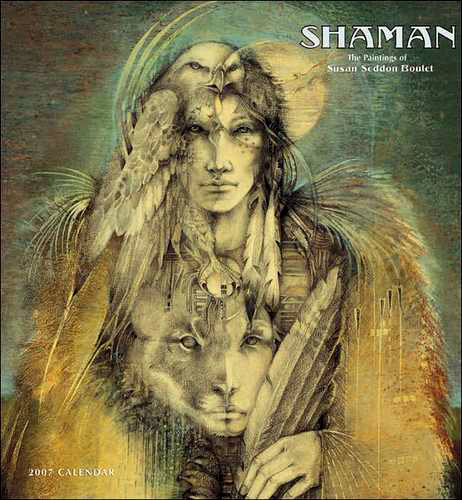
Credits: Top, Shaman by Susan Seddon Boulet;
Bottom, Tilda Swinton as Gabriel in Constantine.
Athena
March 29, 2009
When superheros run amok: Exploring posthuman and technological themes in Watchmen
 Warning: Spoiler alert.
Many things have been said about the recent film adaptation of the Watchmen graphic novel series, particularly the ways in which it has come to redefine the superhero genre. While it's certainly a brave film that's succeeded in pushing a number of boundaries, I believe its true strength lies in its various philosophical themes and social commentary. In particular, I was drawn to the discussions of technological power and the innovative ways in which this commentary was represented on the screen.
Looked at metaphorically, Watchmen is largely a treatise on the use and misuse of advanced technologies and the resultant soul-searching, dehumanization and loss of innocence that inevitably follows. It's a cynical and sobering look at weapons technologies in particular and how they often work to create disparities -- whether it be the militaristic disparities between combatant nations or the ways in which it pulls people apart.
And with the presence of a god-like posthuman superhero, Watchmen shows the ways in which a greater-than-human intelligence could either serve humanity's needs or bring it to its knees.
Doctor Manhattan and The Bomb
By far, the most powerful of the Watchmen is Doctor Manhattan, a "quantum superhero" with powers so incredible that he is essentially considered a god. He has the ability to manipulate matter with his thoughts, allowing him to teleport, change his size, copy himself, move objects through space and disintegrate people. His powers are frightening to say the least.
As his name suggests, Manhattan is the walking, talking personification of the nuclear bomb. And as it turns out, god happens to be an American -- a god that the U.S. government isn't afraid to utilize. In Strangelovian manner, the United States uses Manhattan (both directly and indirectly) as a super-weapon to stave off the Soviet Union. Disturbingly, Manhattan does as he's told. He is indifferent to the nature of his powers and the horrors he can unleash; like the bomb itself -- or any technology for that matter -- Dr. Manhattan is largely neutral. It's those who choose to unleash his awful powers who make the moral judgments.
But as the unfolding story suggests, there are consequences to the use of such power.
Take the episode in Vietnam, for example, and the awesome image of the gigantic Doctor Manhattan cutting a swath through the jungle and annihilating the Viet Cong with the wave of his hands. As the explosions around him would indicate, this is an alternate history in metaphor -- one in which the United States has chosen to use nuclear weapons in Vietnam.
This alternate history in which the U.S. wins in Vietnam doesn't end there, however. The impact of this action is felt back home; sure, the Americans may have won, but the resulting social climate and negative reaction results in a completely decayed and degraded America -- one whose population no longer wants anything to do with "superheros."
A cynical and pessimistic outlook
 And it's not just Dr. Manhattan -- all the Watchmen can be seen as representing the impacts of one-sided weapons technologies. The flame throwing Edward Blake was right alongside Manhattan in Vietnam and for good reason. Blake is there to represent the dark and ugly side of America -- a symbol for the arrogant and jaded sentiment that tends to accompany militaristic success. Edward Blake represents the worst of a belligerent and techno-happy America as he runs amok with callous indifference.
The cynicism of the Watchmen doesn't stop there. Even the final outcome of the story, where millions of deaths are the only way to prevent all out human extinction, is a sobering look at the powers at our disposal. It's only through the use of apocalyptic scale technologies that world peace can be secured; it's The Day the Earth Stood Still all over again, but this time with the fist coming down hard.
Doctor Manhattan and the posthuman
"I've walked across the sun. I've seen events so tiny and so fast they hardly can be said to have occurred at all, but you... you are a man. And this world's smartest man means no more to me than does its smartest termite." -- Doctor Manhattan to OzymandiasInterestingly, the Watchmen commentary goes beyond the advent of nuclear weapons. The discussion extends to the potential emergence of those powers that radically exceed human capacities. Given the incredible scale of Dr. Manhattan's abilities, he can also be seen as a personified instantiation of a posthuman or superintelligent artificial intelligence (SAI). The film explores the ways in which such a power could be an alienating, alienated, and dehumanizing force.
For context, transhumanists and speculative AI theorists consider the emergence of an SAI -- an entity with intellectual capacities that are radically more advanced than the human mind (such an intelligence could emerge from an AI or as an outgrowth from a highly modified human brain). Such discussions have evoked images of god-like intelligences capable of reworking human affairs and even the fabric of the Universe itself. Because we lack the proper terminology or frame to envision such an intelligence, many have referred to this potential AI as being 'god-like.'
 Doctor Manhattan encapsulates many of these characteristics. He is the reluctant god, one who is largely indifferent to human affairs. Manhattan lives in the quantum universe and does not perceive time with a linear perspective, something that alienates him even further from those around him. Consequently, his interests and intellectual endeavors lead him to a different mind-space altogether; he is primarily concerned with the inner workings and unfolding of the Universe. His ability to relate to humanity recedes with each passing day, almost to the point where he can no longer distinguish between a living and dead human being.
This is a fear levied by some futurists as they worry about the emergence of a poorly programmed or indifferent SAI. Indeed, how and why would an intellect that runs at a radically increased clock-speed and expanded/alternative mind-space relate to unaugmented humans? It's an open question. In Watchmen this problem nearly results in human extinction, not due to the actions of Manhattan, but out of inaction and apathy.
At one point in the film, Manhattan escapes to Mars so that he can avoid human contact. He does so because he finds personal interaction with humans annoying and a distraction. This is a god who would rather retreat into himself, preferring solitude on Mars where he can ruminate on existence and construct masterful structures.
Eventually Laurie Jupiter convinces Manhattan to come back to Earth and rescue humanity from nuclear armageddon -- but it's on account of an improbable existential quirk that he changes his mind -- the closest he can come to actually caring.
[As an aside, and looking as his inability to empathize and relate to other people, Doctor Manhattan can also be seen as an 'autistic superhero'. He is very much locked-in to his inner life, he has a fascination with the minutiae of all that is around him, and he is the beneficiary of prodigious talents. Sounds very autistic to me.]
A defeatist tale?
Despite the seemingly happy ending (even in consideration of the millions of deaths that were required to make it happen), Watchmen leaves the viewer with a profound sense of defeat. Indeed, what kind of a world do we live in if megadeaths are required to keep the peace? Is near-armageddon required to keep us in line? Will a common enemy (climate change, perhaps) unite all people in a common cause?
Or is all this rather pedestrian and grossly over-simplified? And what about the potential benefits that technologies may bring?
These are all questions for discussion at the very least. Watchmen leaves the viewer asking more questions than when they came in -- certainly the sign of a great and provocative film.
March 23, 2009
A formative moment: Superman 3 and the 'robot scene'
I can't even begin to tell you how disturbing this was to me as an impressionable 13-year old. It literally gave me nightmares and I had a hard time shaking it off. It was my first encounter with the suggestion that our minds and flesh could intertwine with our technologies.
This image, that of a person being forcibly turned into a controllable machine, has stuck with me ever since; it was, in retrospect, an undeniably potent formative experience. Even as a teenager, the thought of having synthetic components work in conjunction with and override our biological functions was all too plausible.
Perhaps it is this nightmarish vision that has drawn me to transhumanism, and with it a strong desire to see these technologies work in our favor rather than against it.
March 19, 2009
David Brin guest blogging here next week
 Science fiction writer, scientist and renowned futurist David Brin will be guest blogging here on Sentient Developments next week.
Brin is a best-selling author whose future-oriented novels include Earth and Hugo Award winners Startide Rising and The Uplift War (a part of the Uplift Series -- and yes, he coined the term).
He is also known as a leading commentator on modern technological trends. His non-fiction book, The Transparent Society: Will Technology Force Us To Choose Between Privacy And Freedom?, won the Freedom of Speech Award of the American Library Association. Brin consults and speaks for a wide variety of groups interested in the future, ranging from Defense Department agencies and the CIA to Procter & Gamble, Google and other major corporations. He has also been a participant in discussions at the Philanthropy Roundtable and other groups seeking innovative problem solving approaches.
There's a lot of simpatico between Brin's work and my own, so his contributions will be right at home here. David will be writing about biological uplift, the Singularity, Active SETI (messages to extraterrestrial intelligences), and how a transparent society might work to help us mitigate catastrophic risks.
You can follow David's blog at Contrary Brin. Be sure to check out his home page.
February 28, 2009
Isaac Asimov interviewed by Bill Moyers on World of Ideas
Another reason why YouTube is so great: Bill Moyers talks to Isaac Asimov about learning, computers, population growth, the universe and the efficacy of reason over faith.
December 31, 2008
New Year's Eve sci-fi recommendation: Strange Days
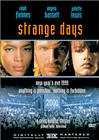
It's a sleek, edgy and fascinating sci-fi film from 1995. Not a classic science fiction movie by any means, it is most definitely worth watching as it has some interesting and provocative transhumanist themes in it.
Directed by Kathryn Bigelow and produced and written by James Cameron, it stars Ralph Fiennes, Angela Basset, Juliette Lewis, Tom Sizemore, Michael Wincott, and Vincent D'Onofrio. The film takes place on the eve of the millennium (December 31, 1999) in LA, and centers on the story of Lenny Nero (Ralph Fiennes), an ex-cop who peddles a kind of conscious-experience recorder and playback system. Called a "squid," it's a headpiece that allows one to transmit digital recordings of other people's thoughts, feelings, and memories into their brain. As Lenny describes it, "this is real life, pure and uncut, straight from the cerebral cortex."
Lenny deals "clips" (the recordings) as well as "squids" for this new and illegal entertainment system. Of course, sex and violence are the most popular themes, but Lenny refuses to deal in "blackjack" -- a slang term for snuff clips.
Reminiscent of 1983's Brainstorm, Strange Days is a film that deals with not just the potential addictive and drug-like quality of such technologies, but with the ethical aspects as well.
Lenny, for example, can't quite get over his break-up with his former girlfriend. He happens to have clips of his experiences with her when they were together, so to help ease the pain, he escapes into the past by putting on a squid.
While the creation of snuff clips certainly attracts unwanted elements, the film also explores the potential benefits of this technology, namely the advantage of having completely realistic and shared out-of-body experiences. In one scene, for example, a character without legs is able to experience what it's like to run on a beach.
The film is also notable for its extended first person POV shots which required Bigelow's team to create entirely new, light-weight 35mm cameras. The opening scene, for example, is a dramatic no-cut sequence that is quite breathtaking, leaving you wondering how they hell they pulled some of the effects and stunts off.
Just one word of warning to the faint-of-heart, as there's some pretty graphic violence and sexuality in this movie.
May 2, 2008
Two years ago on SentDev: "Review of Mamoru Oshii's Avalon"
Two years I go wrote a review of Mamoru Oshii's sci-fi flick, Avalon.
_____
 [Warning: this review contains lots of spoilers, but please, don't let that stop you.]
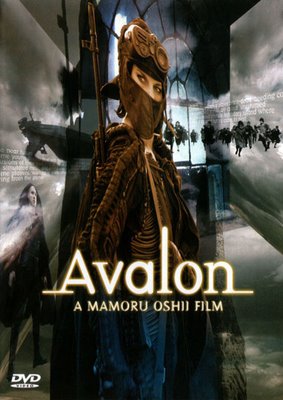
Back in 2001, Japanese anime director Mamoru Oshii went to Poland to direct his first live action movie, Avalon. Oshii, who is primarily known for his work in anime, is the director of the acclaimed 90's science fiction classic, Ghost in the Shell (1995) and the sequel, Ghost in the Shell II: Innocence (2004).
Now, before I get too deep into this review, I just want to make it clear that from a production perspective Avalon is a borderline B movie. The film was created on a limited budget and lacks the polished look and crisp dialogue of most mainstream films, particularly those that come out of Hollywood. The look and feel of Avalon is similar to a made-for-TV movie, although many of the special effects are of a superior quality. Also, the movie was a Japanese-Polish collaboration, which, given its Orwellian setting, gives it a unique authenticity.
That being said, like Ghost in the Shell, Avalon offers considerable food for thought.
Avalon is set in the near future, a world in which fully immersive virtual reality gaming is all the rage. Many players are able to earn a living through gaming, particularly in an ultra-violent war game called 'Avalon'. The game, however, is highly addictive and dangerous, causing some less skilled players to suffer from severe and permanent brain damage. Those who meet this fate are referred to as the 'unreturned.' Because of the risks, the game is outlawed by the state and made illegal.
The main character, Ash, lives a boring, lonely and mundane life in the real world. Her life in the simulation, by contrast, is filled with action, danger, and fulfillment. Where her real life is repetitive, pointless and safe, her virtual life is dynamic, challenging and frightening. Avalon is a world in which people come to value their virtual lives over their real ones. The game-master himself is looked upon in near reverential terms and is unmistakably made to resemble a priest.
In the game itself, Ash is an elite player driven to complete level after level. Her motivation for doing so is not entirely clear, even to her, save for the hope that something greater awaits her in the 'next level.' Eventually, after the introduction of a rival player and the discovery of certain clues, Ash succeeds at finding an elusive hidden level.
As Ash transitions to the mysterious level, the sepia tones that dominated the film's appearance are washed away to reveal a full colour panorama. The sensation is much like in The Wizard of Oz when Dorothy opens the door in her black and white world and enters a new world filled with dazzling colour. Where Dorothy enters a world of fantasy and whimsy, Ash finds herself undergoing an existential paradigm shift.
Ash's previous reality, one that was draped in drab monotone, is immediately understood to represent a partially realized existence. The overwhelming sepia and lack of colour come to symbolize limitations to human and social capacity – limits of perception, cognition and sensation. Alternately, the new world, with all its visual richness and dynamism, opens up an entirely new set of possibilities for Ash.
Oshii is making a number of interesting analogies here, including a comparison of the past with the future. But more aptly, he is comparing life as it was in communist Europe to modern life in capitalist democracies. It is no accident that Oshii made this movie in Poland using native actors and Polish dialogue.
Prior to her entry into the final level, Ash's world was filled with Orwellian imagery. Bleak and eerie tones dominated the screen along with retro-futurist gadgetry reminiscent of such films as 1984, Brazil and Gattaca. Computer terminals were limited to 3D text displays. Books containing no text whatsoever filled shelves. People gathered at communal soup kitchens to eat gruel. Public transportation was dominated by shaky old-fashioned streetcars. The new world, by contrast – Ash's mysterious new level - was filled with billboards, streets filled with bustling people, modern cars and a rich cultural life (including a vivid performance by an actual orchestra).
The new level, however, also presented its challenges. Ash was instructed to hunt down a 'computer bug' -- a former player who escaped to the advanced level. The 'bug' turns out to be a former teammate of Ash's, Murphy, and when she finally confronts him he declares, “Reality is what we tell ourselves it is!” As instructed, she shoots the defector and transcends to yet another level -- another mode of existence -- but this time to the mythical Avalon itself.
In Oshii's Avalon, the comparison of a totalitarian system with that of a modern democratic one can be understood as a transition of simulations in the postmodernist sense. It is reminiscent of Baudrillard's cultural simulation as constructed by the media and the state itself.
Similarly, according to modal reality theory, any system that appears rational to an observer will be construed as real; what we as observers don't know, however, is what possibilities might lie beyond our own modal reality. In the Avalon war game, by advancing to the final level, Ash is given an opportunity to transcend her original modal reality and enter into one with entirely new possibilities.
The relevancy to transhumanism is also pertinant. Given the potential human augmentation, and given the possibility of our own existential mode shift (i.e. the Singularity and virtual existences), humanity might find itself much like Dorothy and Ash, exiting a world of black and white and entering a world of undiscovered colour.
Ultimately, Avalon is a treatise on how we choose to perceive life and how perception is imposed on us by life itself. The movie raises questions about the authenticity of existence in any type of world and how environmental, social and biological restraint/constraint impacts on a person's sense of their subjective life.
And as always, Mamomru Oshii has tapped directly into the zeitgeist of our times.
_____
[Warning: this review contains lots of spoilers, but please, don't let that stop you.]Back in 2001, Japanese anime director Mamoru Oshii went to Poland to direct his first live action movie, Avalon. Oshii, who is primarily known for his work in anime, is the director of the acclaimed 90's science fiction classic, Ghost in the Shell (1995) and the sequel, Ghost in the Shell II: Innocence (2004).
Now, before I get too deep into this review, I just want to make it clear that from a production perspective Avalon is a borderline B movie. The film was created on a limited budget and lacks the polished look and crisp dialogue of most mainstream films, particularly those that come out of Hollywood. The look and feel of Avalon is similar to a made-for-TV movie, although many of the special effects are of a superior quality. Also, the movie was a Japanese-Polish collaboration, which, given its Orwellian setting, gives it a unique authenticity.
That being said, like Ghost in the Shell, Avalon offers considerable food for thought.
Avalon is set in the near future, a world in which fully immersive virtual reality gaming is all the rage. Many players are able to earn a living through gaming, particularly in an ultra-violent war game called 'Avalon'. The game, however, is highly addictive and dangerous, causing some less skilled players to suffer from severe and permanent brain damage. Those who meet this fate are referred to as the 'unreturned.' Because of the risks, the game is outlawed by the state and made illegal.
The main character, Ash, lives a boring, lonely and mundane life in the real world. Her life in the simulation, by contrast, is filled with action, danger, and fulfillment. Where her real life is repetitive, pointless and safe, her virtual life is dynamic, challenging and frightening. Avalon is a world in which people come to value their virtual lives over their real ones. The game-master himself is looked upon in near reverential terms and is unmistakably made to resemble a priest.
In the game itself, Ash is an elite player driven to complete level after level. Her motivation for doing so is not entirely clear, even to her, save for the hope that something greater awaits her in the 'next level.' Eventually, after the introduction of a rival player and the discovery of certain clues, Ash succeeds at finding an elusive hidden level.
As Ash transitions to the mysterious level, the sepia tones that dominated the film's appearance are washed away to reveal a full colour panorama. The sensation is much like in The Wizard of Oz when Dorothy opens the door in her black and white world and enters a new world filled with dazzling colour. Where Dorothy enters a world of fantasy and whimsy, Ash finds herself undergoing an existential paradigm shift.
Ash's previous reality, one that was draped in drab monotone, is immediately understood to represent a partially realized existence. The overwhelming sepia and lack of colour come to symbolize limitations to human and social capacity – limits of perception, cognition and sensation. Alternately, the new world, with all its visual richness and dynamism, opens up an entirely new set of possibilities for Ash.
Oshii is making a number of interesting analogies here, including a comparison of the past with the future. But more aptly, he is comparing life as it was in communist Europe to modern life in capitalist democracies. It is no accident that Oshii made this movie in Poland using native actors and Polish dialogue.
Prior to her entry into the final level, Ash's world was filled with Orwellian imagery. Bleak and eerie tones dominated the screen along with retro-futurist gadgetry reminiscent of such films as 1984, Brazil and Gattaca. Computer terminals were limited to 3D text displays. Books containing no text whatsoever filled shelves. People gathered at communal soup kitchens to eat gruel. Public transportation was dominated by shaky old-fashioned streetcars. The new world, by contrast – Ash's mysterious new level - was filled with billboards, streets filled with bustling people, modern cars and a rich cultural life (including a vivid performance by an actual orchestra).
The new level, however, also presented its challenges. Ash was instructed to hunt down a 'computer bug' -- a former player who escaped to the advanced level. The 'bug' turns out to be a former teammate of Ash's, Murphy, and when she finally confronts him he declares, “Reality is what we tell ourselves it is!” As instructed, she shoots the defector and transcends to yet another level -- another mode of existence -- but this time to the mythical Avalon itself.
In Oshii's Avalon, the comparison of a totalitarian system with that of a modern democratic one can be understood as a transition of simulations in the postmodernist sense. It is reminiscent of Baudrillard's cultural simulation as constructed by the media and the state itself.
Similarly, according to modal reality theory, any system that appears rational to an observer will be construed as real; what we as observers don't know, however, is what possibilities might lie beyond our own modal reality. In the Avalon war game, by advancing to the final level, Ash is given an opportunity to transcend her original modal reality and enter into one with entirely new possibilities.
The relevancy to transhumanism is also pertinant. Given the potential human augmentation, and given the possibility of our own existential mode shift (i.e. the Singularity and virtual existences), humanity might find itself much like Dorothy and Ash, exiting a world of black and white and entering a world of undiscovered colour.
Ultimately, Avalon is a treatise on how we choose to perceive life and how perception is imposed on us by life itself. The movie raises questions about the authenticity of existence in any type of world and how environmental, social and biological restraint/constraint impacts on a person's sense of their subjective life.
And as always, Mamomru Oshii has tapped directly into the zeitgeist of our times.
March 20, 2008
Peter Berg to direct new Dune movie
Director Peter Berg has been brought on by Paramount to create a new bigscreen version of Frank Herbert's classic novel, Dune.
As the article notes, "The filmmakers consider its theme of finite ecological resources particularly timely."
There can never be enough versions of this story.
The spice must flow.


As the article notes, "The filmmakers consider its theme of finite ecological resources particularly timely."
There can never be enough versions of this story.
The spice must flow.


March 11, 2008


February 5, 2008
PUMA's portrayal of cyborg athletes
PUMA takes you to the world of football in the year 2178 AD where they launch the v1.178 Speed Legs and transform the game as we know it. Oscar Pistorius, eat your heart out.
You can see a much better version at the PUMA site.
February 2, 2008
New Terminator show brings Singularity to prime time

Like most science fiction on television these days, the new Terminator show is virtually unwatchable. That said, they correctly introduced futurist lingo into the story.
At one point in the episode "The Turk," John Connor tells his mom, Sarah Connor, about the Singularity and describes it as a point in time when machines are able to build superior versions of themselves without the aid of humans--after which point they can pretty much kiss their asses goodbye.
That's just about right, actually. And I've always found the Terminator future to be one of the more disturbing dystopic visions. Given the potential for robotic armies and greater-than-human artificial intelligences, one has to pause for thought...
November 1, 2007
My sci-fi DVD collection is coming along nicely
Here's a list of my science fiction film collection (all on DVD):
2001: A Space OdysseyAny glaring omissions?
A Clockwork Orange
A Scanner Darkly
Akira
Alien
Andromeda Strain
Animatrix
Appleseed
Artificial Intelligence
Avalon
Battle Star Galactica (2005-06)
Blade Runner
Castle in the Sky
Children of Dune
Children of Men
Close Encounters of the Third Kind
Code 46
Contact
Dark City
Donnie Darko
Forbidden Planet
Frank Herbert's Dune (2000)
Futurama (Seasons 1-4)
Gattaca
Ghost in the Shell
Ghost in the Shell 2: Innocence
Johnny Mnemonic
Logan's Run
Matrix
Matrix: Reloaded
Metropolis (1927)
Metropolis (2002)
Minority Report
Planet of the Apes
Return of the Jedi
Robocop
Serial Experiments: Lain
Silent Running
Solaris (1972)
Star Wars
Stargate
Strange Days
Terminator 2: Judgement Day
The Day the Earth Stood Still
The Empire Strikes Back
The Fifth Element
The Thing (From Another World!)
The Thirteenth Floor
THX 1138
Titan AE
Tron
Vanilla Sky
War of the Worlds
Wizards
Subscribe to:
Posts (Atom)