 My latest audiocast has been posted here. You can subscribe to the feed here. In this episode I discuss why I have no intentions to give up sleep, protopanpsychism and the consciousness conundrum and whether or not the brain taps into the future.

December 18, 2006
New podcast posted
My latest audiocast has been posted here. You can subscribe to the feed here. In this episode I discuss why I have no intentions to give up sleep, protopanpsychism and the consciousness conundrum and whether or not the brain taps into the future.


December 15, 2006
Vegetarians are smarter, so there
The BBC is reporting on a study that shows a high IQ link to being vegetarian. The Southampton University study shows that intelligent children are more likely to become vegetarians later in life. Researchers noted that those who were vegetarian by 30 had recorded five IQ points more on average at the age of 10.
What I take from this study is a stronger conviction that people who eat meat are stupid. They're also mean spirited. And a bunch of poopy faces.
Ah, it's great to be morally and cognitively superior.
What I take from this study is a stronger conviction that people who eat meat are stupid. They're also mean spirited. And a bunch of poopy faces.
Ah, it's great to be morally and cognitively superior.
I ain't givin' up on sleep
 A common human 'limitation' that many transhumanists would like to overcome is that of sleep. I am not one of them.
Yes, there are days when I most certainly wish I had more time and energy to do all the things I want to do, but in my mind there are simply too many trade-offs involved that are simply not worth it and possibly even dangerous. Moreover, there are emotional, psychological and aesthetic reasons for not wanting to eliminate sleep.
Before I get into these considerations its worth noting that I may be in the minority here. Demand for stimulants and sleep-replacement drugs are skyrocketing. Take Modafinil, for example. This is truly a lifestyle drug for 24/7 age. Sales are so good that Cephalon, the company that produces Modafinil, is already developing its successor, Armodafinil, and the experimental drug CEP-16795. Looking further into the future, there will be wakefulness promoters that can safely abolish sleep for several days at a stretch, and sleeping pills that will deliver what feels like 8 hours of sleep in half the time. This is an idea, it appears, whose time as come.
Modafinil is truly a remarkable drug. Users can get by on very little sleep -- as little as 4 to 5 hours per night. It has even been known to help people stay awake for as much as 48 consecutive hours.
Unlike other stimulants like caffeine or amphetamines, Modafinil does not result in side effects like jitters, euphoria and crashing. Remarkably, users don't seem to have to pay back any sleep debt. It is different than other stimulants in that it offers the brain many of the same benefits that normal sleep does. Traditional stimulants tend to fake the effects of proper sleep, often with long-term consequences like sleep disorders and ongoing mental fatigue. Modafinil, on the other hand, tends to deliver a genuine feeling of alertness and wakefulness.
There have been very few complaints of side effects from users aside from some complaints of headaches. That said, there may be unseen problems down the road as Modafinil and other drugs start to become more widely used.
What's interesting and even a bit disturbing is that no one one is really sure how it works -- although speculation exists that Cephalon is keeping the answer secret. What is known is that modafinil prevents nerve cells from reabsorbing dopamine, an excitatory neurotransmitter, once it is released into the brain -- but it does so without producing the addictive highs and painful crashes associated with most stimulants. It has been suggested that this is possible because modafinil also interferes with the reuptake of another neurotransmitter, noradrenalin.
Keeping people awake and alert is one thing, addressing the host of things sleep does for the brain is quite another. The sleep cycle is a complex process with multiple phases (e.g. "slow-wave" sleep versus shallower stage 2 sleep, REM phase, etc.). Each phase plays a particular role in brain restoration and regeneration. It will be some time yet before all aspects of the sleep architecture are cataloged, understood and converted into pill form. In the meantime, there may be many individuals who in their rush to eliminate sleep from their lives are putting their cognitive health at risk.
For example, scientists at the Max Planck Institute for Medical Research recently discovered that sleep helps consolidate memories. According to their findings, new information is transferred between the hippocampus, the short term memory area, and the cerebral cortex during sleep. They concluded that it is the cerebral cortex that actively controls this transfer. Quite obviously, if pills like modafinil and other stimulants don't address something as vital as memory storage, people who completely avoid sleep will soon begin to exhibit serious problems.
I'm not suggesting that the sleep architecture is intractably complex. The general consensus amongst the developers is that is not a question of if but when. Some day soon we will have the option to give up on sleep entirely and live 24-hour days.
For myself personally, I can understand the desire for these drugs on an as needed basis. I most certainly could have used something like modafinil back in 2004 when I chaired the TransVision conference; I think I slept a total of only 10 hours during a 4-day stretch. It took me weeks to recover.
But as for eliminating sleep all together, I'm not so sure I'm inclined to do that. I love going to bed and sleeping. I adore that sleepy, dreamy feeling in the early morning when the body is relaxed and I'm hitting the snooze button. I'm reminded of John Lennon's lyrics to "I'm Only Sleeping,"
When I wake up early in the morning,Like Lennon, I am also very fond of dreaming. It's the only time that I can become (quite literally) someone else and dwell in utterly insane and surreal worlds. I wish some of my dreams could be made into movies.
Lift my head, I'm still yawning
When I'm in the middle of a dream
Stay in bed, float up stream
Please don't wake me, no
don't shake me
Leave me where I am
I'm only sleeping
Everybody seems to think I'm lazy
I don't mind, I think they're crazy
Running everywhere at such a speed
Till they find, there's no need
Keeping an eye on the world going by my window
Taking my time
Lying there and staring at the ceiling
Waiting for a sleepy feeling
There are also some emotional and social aspects of sleep to consider. There's nothing quite like making love to your partner and having them fall asleep in your arms. And how wonderful it is to snooze, cuddle and wake up next to someone (provided they didn't steal the sheets, of course).
Sure, sure -- I may sound overly sentimental about the whole thing and even a little Kassian in my seemingly bioLuddite tone. But in all seriousness, these sleepy Dali-like and Learyesque dreamlike states closely resemble my own expectations as to what a posthuman existence might be like. Given how unorthodox and unreal Second Life is becoming, I can't even begin to imagine what an open-ended digital existence might be like. And like the uploaded character in Egan's Diaspora who refuses to give up urinating and defecating for aesthetic reasons, I too would want to retain those biological vestiges that I believe have an intrinsic value.
Aside from these somewhat romantic notions, there are other day-to-day practicalities about not sleeping that should be considered.
I find that sleep provides and essential break to the routine of life. It not only provides a physical and emotional break, but an existential one as well. Sleep is like a temporary death you have each night, only to be reborn the next day (a very Buddhist notion). I also find that the length of time sleeping is important as well. Despite being unconscious for an extended period, I can estimate with excellent accuracy the length of time I have been sleeping. I don't think 3 to 4 hours would cut it for me.
Moreover, there is always the risk that our corporatist society will change the rules of the game once sleep becomes optional. Working hours may be extended to unacceptable levels, and poor people will take the opportunity to work the full 24 hours just to make ends meet. The mind may not need sleep, but the physical body most certainly does.
I would certainly hope that, given the added time, people would instead focus their energies on leisure activities. Still, coming from personal experience, the intensity of my leisure activities are starting to demand respites of their own.
Again, I'm not suggesting that everybody abandon the thought of giving up on sleep. I'm merely making the point that this is not for me. Be careful of what you wish for, as they say, but even more careful about what you may come to lose.
_________________________
References:
Get ready for 24-hour living (New Scientist) To Sleep, Perchance to Process Memory (Wired) An end to sleep? (Futurismic) Learning During Sleep? (Max Planck Society) A real eye opener (The Age)
December 13, 2006
I will be appearing on CBC's 'The Hour'
 The Canadian Broadcasting Corporation (CBC) will be interviewing me next week for an appearance on their show, The Hour. I will be speaking about some of the more futuristic and radical possibilities in store for the human species.
The Hour, which is hosted by George Stroumboulopoulos, is running a 3-part series called 'Looking Forward' which should air early next year. They will be interviewing me in front of a green-screen to allow for cool backgrounds to be added in post-production.
I'll blog about the experience later next week.
Canadian Context 2006.12.13

Up to 5 Canadians die at work each day. Suddenly my stapler looks threatening. Canadian nurses say they're abused and stressed. The Americanization of Canadian healthcare continues: Vancouver private clinic given green light to expand Ontario is rolling out its own centre for disease control to better handle another outbreak of SARS or a flu pandemic. The Ontario government aims to boost the rights of patients and make other changes to the health-care system. Surgeons in Montreal have implanted a long-term mechanical heart in a 65-year-old man, the first Canadian to receive the HeartMate II device. Take a look at Canada's A-Team of stem cell science.
December 12, 2006
Gettin' better all the time
 My chess chops are steadily improving and so too are the quality of my matches. Case in point: this game that wrapped up today with my opponent resigning at the 45-move mark. I played with my usual aggressive style and was able to force much of the game.
The opening was quite interesting and untypical for me. I played white and tried to open with Queen's Gambit but it was declined. The opening went:
1. d4 c5
Rather than take the free pawn I used the Benoni Defense with 2. d5. My opponent responded with 3...Nf6. The rest of the opening went like this:
2. d5 Nf6 3. Nc3 g6 4. e4 Bg7 5. e5 Nh5
So after the first five moves I had both centre pawns at the 5th rank, a knight developed, and my opponent with his knight shunted off to the side.
Moving to the middle game, we exchanged queens at the 17 move mark. The game settled into a real battle of wits after that with high density play on the king side. Lots of threatening pins and skewers and their corresponding actions and reactions. I managed to trade my bishop for a rook at the 25th move and worked to exploit the advantage for the rest of the game.
This was an intense match that required lots of concentration -- any false move would have resulted in catastrophe. The entire match went like this:
1. d4 c5
2. d5 Nf6
3. Nc3 g6
4. e4 Bg7
5. e5 Nh5
6. Nf3 O-O
7. Bc4 d6
8. e6 fxe6
9. dxe6 Qa5
10. O-O Nc6
11. Ng5 Bd4
12. Bd3 Ne5
13. Be3 Bxc3
14. bxc3 Qxc3
15. Be4 Nc4
16. Qd3 Qxd3
17. cxd3 Ne5
18. Nf3 Ng4
19. Bg5 Bxe6
20. Bxe7 Rf7
21. Bxd6 Rd8
22. Bxc5 b6
23. Ng5 Rf6
24. Be7 Re8
25. Bxf6 Ngxf6
26. Nxe6 Rxe6
27. g4 Nf4
28. g5 Ng4
29. Bg2 Re5
30. h3 Ne2+
31. Kh1 Rxg5
32. hxg4 Rxg4
33. Bf3 Rh4+
34. Kg2 Nf4+
35. Kg3 g5
36. Rh1 Rxh1
37. Rxh1 Nxd3
38. Be4 Nb4
39. Rxh7 a5
40. Kg4 Nxa2
41. Kxg5 Nc3
42. Bg6 Ne2
43. Rf7 Nd4
44. Kf6 Nc6
45. Rc7
Wicked Tool/Nightmare Before Christmas mashup
Tool fans will understand why this is as cool as it is clever.
Buddha Break 2006.12.12
Buddhism is growing by leaps and bounds in North America, leading to a shortage of facilities for spiritual practice and meditation. As it has throughout history, however, Buddhism is adapting for a new audience. Christmas is about as unBuddhist as you can get, but even Buddhists can adapt to the holiday of extreme want. Visakha Kawasaki would like to remind the Dalai Lama that he is not the Buddhist pope. This brouhaha is in regards to the Dalai Lama's disapproval of Singapore Expo on "Buddhist Relics." According to Smita Poudel, religion is never a barrier to people who want to explore the truth; religion becomes disastrous when people start interpreting religion according to their convenience. Not all Buddhists, it would seem, have the same neuro-centric focus when it comes to discerning life from death. I'm still surprised that a Korean Buddhist family recently fought with their hospital refusing to allow the plug from being pulled for their permanently brain-dead family member. According to the Taiwanese family, the beating heart meant his spirit and consciousness were not ready to move on. Taking him off life support, they believed, would be the same as killing him. And here I thought it was just the Abrahamic religions that have some catching up to do. As Colleen Keating says, it’s not just the Christian scientists. A monk asked Chao Chou, “What is the lone summit of Mount Sumeru?” Chao Chou said, “I won’t answer that question of yours.” The monk asked, “Why won’t you answer my question?” Chao Chou said, “ I’m afraid that if I answered you, you would fall to flat ground.” Jeff Wilson wonders if Courtney Love is using Buddhism as her 'get out of jail free' card. Wilson has also declared a temporary moratorium on a number of phrases, words, and tropes that are all too frequently used by the media when writing about Tibet.
From time to time, it is delicious to walk in church with bare feet.
December 11, 2006
Latest Sentient Developments podcast posted
Yay, I'm podcasting again. You can check out my latest broadcast here. Or, you can subscribe to the feed here. In this edition I review The Fountain, I discuss the future of chess, and I talk about how Canada is going green.
December 10, 2006
Aronofsky's pro-death 'Fountain'
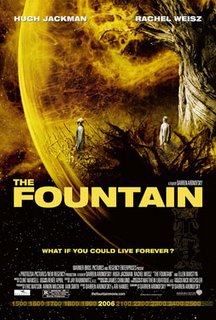 I'm somewhat of a film buff, particularly sci-fi, so when it comes time to watch an eagerly anticipated movie it's often difficult for me to leave my emotional baggage and lofty expectations at the door. Darren Aronofsky's latest film, The Fountain, is a good case in point. I was totally expecting to love this movie, but instead now find myself forced to write a very negative review.
Considering the subject matter -- namely radical life extension and immortality -- The Fountain had oodles of potential. But as is so often the case these days, rather than critically re-examine and re-consider long-held convictions, Aronofsky chose to create a visually stunning vehicle that perpetuates long-standing myths and misconceptions about death and the quest for extended life.
**Note: this review contains spoilers.
To unravel the morality behind immortality, Aronofsky explored three unique settings: the past, the present and the future.
He used Inquisition era Spain and South America to represent the historic quest for immorality (think Indiana Jones as Ponce de Leon among the Mayans) and to provide an analogy for the relationship between the two main protagonists from a different narrative. In my mind, this was one of the more compelling and revealing aspects of the story. A Spanish queen sends a conquistador to the New World on a quest to find the mythic Tree of Life -- the sap of which offers eternal youth. All the while the queen's life is in great danger as the Inquisition draws near, ready to pounce on her for her unholy desire for extended life. This side-story, which beautifully mirrors current religious and popular inhibitions against life extension (perhaps unconsciously), was never fully developed and under exploited. But given that the purpose of The Fountain is to ascribe value to death, this only makes sense.
The second and most prominent setting takes place in modern day. Thomas Creo, a medical researcher and doctor (played by Hugh Jackman), is on an obsessive quest to cure his ailing wife of terminal cancer. Aronofsky has explored the theme of obsession before, most notably in his 1998 film Pi, in which a mathematical genius is driven to insanity as he tries to discover the meaning of existence in numbers and patterns.
In The Fountain, the main protagonist's obsessive flaw is his inability to come to grips with death and its greater purpose. His dying wife, Izzy (played by Rachel Weisz), has completely come to grips with the fact that she will soon die and has reached an inner peace. Tommy, on the other hand, is utterly blind to this and refuses to acknowledge it and understand his wife's decision. Instead, Tommy retreats to the lab in search of a miracle breakthrough; rather than spend quality time with his wife during her last days, he is away from her working feverishly to find a cure.
Aronofsky's portrayal of a patient dying of a brain tumor was dishonest and infuriating. Aside from the odd fainting spell and lack of sensation, Izzy did not look like someone who is dying of a terminal illness. By showing her as a young and intellectually and emotionally vibrant person just days away from death, Aronofsky irresponsibly idealizes and misrepresents the dying process (and ignores the ravages of aging altogether). Moreover, Izzy's grace at the prospect of her death, while certainly laudable, is hardly representative of all terminally ill thirtysomethings. There is a fine line that often separates inner peace from utter resignation.
Predictably, Tommy does not save Izzy in time. He is devastated by her death and resolves to take his research to the next level. At her funeral he admonishes the defeatism of the mourners and declares that aging is a disease that must be cured.
This is a damning characterization of today's life extensionist -- the notion that work on anti-aging falls outside the natural scheme of things and that the desire to avoid death leads to obsessiveness and an unfulfilled life.
And this is where The Fountain falls flat. Now, as a Buddhist, I regularly contemplate and meditate on the inevitableness of my own death. As a consequence, I like to think that I have a fairly healthy and non-traditional attitude about my mortality. I harbor no false illusions about the impermanence of my life. Future breakthroughs in life extension notwithstanding, I fully expect to die at some future point.
But that doesn't mean I have to like it. Nor does it mean I have to rationalize death in such a way that I must put a positive spin on it. In The Fountain, Aronofsky dips into Mayan mythology and suggests that there can be no life without death and that it is only through death that life can emerge. Consequently, Aronofsky portrays death as a creative force rather than a destructive one.
Personally, I find very few redeeming qualities in aging and involuntary death. Death is destructive. Its course brings about great suffering, both for those who are dying and for those who have ailing loved ones. Death destroys memories, wisdom, brilliance and unique personalities. More to the point, death is not a requisite for birth and life.
Which leads to the final setting explored by Aronofsky: a fantasy sequence set in the distant future. Thomas, it would appear, eventually comes to possess the Tree of Life and finds himself afloat in space in a giant snowglobe. His hope is to reach a dying nebula before the tree dies -- perhaps as some last gesture of re-birth and dedication to his long dead wife. It is here that he has an existential epiphany in which he comes to grips with his own mortality. His seed-like spaceglobe enters the birth-canal-like nebula in a symbolic representation of fertilization and renewal. In death there is new life.
In The Fountain's final shot we return to modern day as Tommy visits Izzy's grave -- a indication that Tommy has come to accept death and the passing of his wife.
Talk about sentimental claptrap. I was expecting something considerably deeper and intellectual from Aronofsky. Instead, he offers an over-hyped, sugar-coated and humorless film that perpetuates idealized and tired notions of death and what it means to humanity.
When will someone in Hollywood finally offer a thoughtful treatise on the human condition and truly challenging vision of the future?
Oh, yeah -- it has been done. Time to pull 2001: A Space Odyssey and Blade Runner from my DVD shelf.
December 7, 2006
Canadian Context 2006.12.07
December 6, 2006
The future of chess
 Now that the RAG Tournament featuring Vladmir Kramnik and Deep Fritz has concluded with the machine emerging victorious, it's time for some contemplation about the current state of chess and its future.
First off, credit where credit is due. The Fritz team put together an excellent program that defeated Kramnik quite soundly -- an achievement made all the more impressive by the fact that Kramnik's style is considered quite difficult for computers to handle. Fritz v.10 may be the best chess playing entity of all time (not including Hydra which hasn't been pitted against a world champion). Yes, Kramnik blundered away Game 2, but that, like fatigue, stress and over-confidence, are indelible parts of the human condition -- intangibles that don't apply to machines. Moreover, Kramnik never really threatened Fritz and lost quite soundly in game 6; he played for the draw in virtually every match and never assumed he could win.
And this is where we find ourselves at the end of 2006: the best chess playing humans, it would seem, are now unable to beat the expert chessbots. It's at the point now where the victory is in the draw. The day is soon coming where even this may become impossible, but a part of me believes that chess is too complex for today's computers to achieve consistent victories. Computer power and programming will have to be more powerful by an order of magnitude before computers can generate algorithms that will result in perfect play resulting in perpetual streams of victories.
This is assuming, of course, that chess could be solved in the strong sense. I'm not convinced this is possible. In the vast space of all possible games, perfect play in chess will lead to draws more often than not. The most solved that chess could ever become is in the weak sense where an algorithm can secure a win for one player, or a draw for either, against any possible moves by the opponent from the initial position only.
How complex is chess? Well, before I get to that let's look at tic-tac-toe and checkers for a frame of reference.
Tic-tac-toe has the potential for 765 different positions, or 26,830 possible games on the 3x3 grid. When taking into account both rotational and mirroring symmetry, there are 31,896 possible unique games. Consequently, it is very easy to write a computer program that can deal with all possible variations and play a perfect game. In fact, it's so simple that even humans can consistently play tic-tac-toe with perfect play (which is why every errorless game ends in a draw).
Checkers is a bit more complicated. It is played on an 8x8 grid with an estimated 10^(12) possible positions with other estimates reaching upwards of 5x10^(20) and 10^(18) positions reachable under the rules of the game.
There is a popularly held myth that checkers is a solved game, but it's not -- at least not entirely. Endgames up to 9 pieces (and some 10 piece endgames) have been solved. Not all early-game positions have been solved, but almost all midgame positions have been. It has been estimated that several more years of computer advancement is required before machines will completely solve checkers.
And then there's chess. An average chess position has 30 to 40 possible moves, sometimes with as many as 218. Subsequent game-tree possibilities explode exponentially with each potential step into the future. The number of legal positions in chess is thought to be between 10^(43) and 10^(50). It has an estimated game-tree complexity of 10^(123) -- yes, that's a 1 with 123 zeros behind it! To put this into perspective, there are more possibilities in chess than there are atoms in the Universe. Actually, to say that's putting it into 'perspective' is a bit of a sad joke. To the paleolithic human brain it might as well be infinite; we cannot even come close to comprehending what a vastly huge number that is.
So, a computer like Deep Fritz, which is able to calculate millions of moves each second, still has a rather profound game-tree horizon to deal with. It still cannot chart an algorithmic course to guaranteed victory. That being said, modern chess computers are powerful enough such that they will not allow themselves to be put into dangerous situations. While Fritz might have a formidable game-tree horizon to contend with, it is a horizon that is way off in the distance as far as humans are concerned. This is a tremendously demoralizing prospect from the perspective of human competitors.
Adding insult to injury, chess is a partially solved game (and powerful computers should be able to calculate these winning maps on their own). Retrograde computer analysis for all 3 to 6 piece and some 7 piece endgames have been solved (counting the two kings as pieces). It is solved for all 3–3 and 4–2 endgames with and without pawns. Chessbots also have access to the opening books (typically up to the first 12 moves), which human chess players have to memorize.
So what does this mean for the future of human and machine competitions? Given Fritz's excellent performance against Kramnik, and given that chessbots are improving much faster than their human counterparts, I believe that the era of meaningful human/machine interactions is behind us. Fritz made moves during the tournament that left other grandmasters scratching their heads wondering how and why it did what it did. In many respects, the internal machinations of the computer is beyond human comprehension. Consequently, even advanced chess as envisaged by Garry Kasparov, where humans pair-up with computer assistants, may be an obsolete idea as even the best human minds are already incredulous to the findings of the computer. A human collaborator may actually undermine the work of the machine.
In regards to human versus machine situations, the only option at this point is to start handicapping the computer. Otherwise, there's no point to these match-ups.
One thing I'd like to see are fairer time controls that take the slow human clock speed into consideration. I'm not proposing that players take weeks in between moves, but something fairer like giving the computer less time to ruminate. What's needed is a sliding ratio depending on the power of the machine (Anatoly Karpov has suggested a ratio of 2.15 on 1.40 (hours). I'd be inclined to give the machine even less time).
Also, computers should not be given access to the opening book, while humans should have access to the entire chess database. Other ideas include collaborative human teams consisting of multiple grandmasters, time-outs for the human player, and even the ability to take back a move.
The trouble is, however, that the developers of the chess playing computers are reluctant to handicap their machines. These events are, for all intents-and-purposes, money making ventures. IBM stock skyrocketed after Deep Blue's famous victory over Kasparov back in 1997.
That said, the developers run the risk of eating themselves up by putting an end to meaningful match-ups. It'll only be a matter of time before the grandmasters refuse to be humiliated by number crunching behemoths. Moreover, the advent of handicaps would offer an excellent opportunity for immensely entertaining tournaments and high quality chess.
But as far as the advancement of chess is concerned, it is time for humans to take a backseat to the computers. Chessbots have moved beyond us now and are playing the most sophisticated matches in the history of the game.
But that doesn't mean that you and I can't still enjoy the game, or that human versus human tournaments are obsolete. There's still a lot of chess that needs to be played.
December 5, 2006
Deep Fritz crushes Kramnik in Game 6, wins tournament
 Vladimir Kramnik, the reigning world champion, was soundly defeated today by Deep Fritz v.10 in the final game of the RAG tournament. Kramnik, who was getting increasingly boxed in, tendered his resignation at the 47th move. The win gave Fritz the championship title, who had two wins and 4 draws against its human opponent. Kramnik never came close to defeating Fritz in any of the games. By virtue of this victory, we have to assume that Fritz 10 is the best chess playing entity on the planet.
Kramnik was in the unenviable position of having to play as black in a must-win game. He opened very competently with the Sicilian Defense and looked very good until about the 20 move mark. In fact, most of the commentating experts were ecstatic about Kramnik's early development and Fritz's back-tracking.
But as shown time and time again, it's one thing to sense that you have a good position against the machine, and an entirely other thing to actually execute a win. Over the next several moves, Fritz recovered and maneuvered itself such that Kramnik was absolutely hogtied. It didn't help that Kramnik made some questionable moves; he had far too many pieces that were inert and out of the action. Kramnik thought he might have achieved a small victory by sacrificing queens at the mid-stage (a recurring strategy utilized by Kramnik who strove to simplify the board), but it proved to be of no real gain.
I'm going to mull over these results and put together an article about the current state of chess and what the future might hold for man versus machine interactions.
December 4, 2006
Buddha Break 2006.12.04
Ideas are emerging on what “Mindful Politics” might be. Seems folks have agreed on the name, but what this political force is is getting worked out in a bit of a chaotic way in unconnected spheres – which is good; it’s exactly how words and phrases should come into use: in the jungle of untamed ideas. What is consistent is that there’s a search afoot by compassion-minded politics-interested folks for something new in reaction to harsh political discourse and many years of hardhearted, mule-headed policy decisions. Doubtless, some have in mind creation of a counterforce to the sickening and democracy-destroying game playing and truth twisting of Karl Rove and his brand of power politics.
Right livelihood has ceased to be a purely personal matter. It is our collective karma. Suppose I am a schoolteacher and I believe that nurturing love and understanding in children is a beautiful occupation. I would object if someone were to ask me to stop teaching and become, for example, a butcher. But when I meditate on the interrelatedness of all things, I can see that the butcher is not the only person responsible for killing animals. He does his work for all of us who eat meat. We are co-responsible for his act of killing. We may think the butcher's livelihood is wrong and ours is right, but if we didn't eat meat, he wouldn't have to kill, or he would kill less. Right livelihood is a collective matter. The livelihood of each person affects us all, and vice versa. The butcher's children may benefit from my teaching, while my children, because they eat meat, share some responsibility for the butcher's livelihood.
December 3, 2006
Kramnik and Fritz draw game 5
Ho hum, another draw in Bonn. Kramnik squandered his last opportunity to defeat Fritz with the white pieces. He must win game 6 to salvage a draw in the tournament, but with Fritz playing white, and with Kramnik unable to figure out this excellent chessbot, an overall loss seems most likely.
Blogging pathologies
The Armchair Anarchist offers 18 signs you spend too much time in the blogosphere (the science fiction edition). After reading this, it's obvious to me that I need help.
December 2, 2006
Greens, environmental issues surging in Canada
 It was quite the shocker at the Liberal Party leadership convention this past weekend as former university professor Stephane Dion defeated front runners Michael Ignatieff and Bob Rae. Dion's victory was in part driven by his promise to address the environment, something the current minority Conservative government has considered a low priority.
It may only be a matter of time before Dion becomes Canada's next prime minister. The current Harper regime is beginning to unravel (as witnessed by the recent row caused by their 'Quebecois are a nation within a nation' proclamation). Canada's recent performance at the UN's climate change conference was an utter fiasco and the cause of great national embarrassment. Add to this Canada's poor track record as one of the world's worst polluters and you have a potent recipe for political change.
Dion, who was the former Liberal environment minister, is riding the green wave that is currently sweeping Canada. The Liberal convention underscored the rising political weight of climate change issues. During his acceptance speech, Dion emphasized that his main goal is dealing with "the greatest challenge we have today, sustainable development."
And just last week the Green Party had its best ever election showing by claiming over 25% of the vote in London North's bi-election. GP candidate Elizabeth May finished in second place, but it is indicative of the larger mood that is emerging across Canada.
It's been said that Canadian sociopolitics follows the European example rather than the American one. The Greens, who have had political clout in Europe for some time now, may be on the verge of similar successes here.
Of course, the traditional parties will seek to capitalize on these trends. The danger is that these parties will only give lip service to environmental issues for political gain.
Politics is interesting in Canada again.
Kramnik and Fritz draw game 4
Vladimir Kramnik and Deep Fritz played to a 54 move draw yesterday in what is turning out to be a rather predictable contest. Counting aside Kramnik's blunder in game 2 -- a game that most likely would have ended in a draw -- it appears that Kramnik cannot figure out how to defeat Fritz, and Fritz cannot figure out how to breach Kramnik's brilliant defenses. Chessbase provides an analysis of game 4.This tournament will most likely end with Fritz the winner (due to Kramnik's loss), but it appears that computers still cannot consistently defeat the human grandmasters, but the grandmasters cannot muster any kind of winning strategy.
November 29, 2006
Kramnik and Fritz draw game 3
Vladimir Kramnik had to play tough against Deep Fritz today to salvage a draw. Fritz, despite playing black and being down a pawn for most of the game, pushed hard and controlled much of the play. Kramnik, who opened with Catalan again, was able to hold off the machine after 44 moves. This was made all the more impressive by the fact that Kramnik exchanged a rook for a bishop late in the game. The match was theoretically drawn soon after that.Kramnik plays for the draw every time he enters into a match with Fritz -- even when he plays white. Several times during the game he offered Fritz an exchange of equal pieces, which Fritz brazenly refused, opting instead to keep pushing for the win. My thinking on the matter is that Fritz calculated a draw as worst case scenario at these junctures and could still sniff a winning position should Kramnik make some mis-plays.
Fritz assumed its own perfect play and calculated either the probability of a loss as very minimal or even nil. Must be nice.
November 28, 2006
Animal welfare notes
 Mirror, Mirror: Evidence that psychology, like biology, is conserved between human and nonhuman species augurs a shake-up for science and society. Excerpt:
"This idea isn't new. Charles Darwin placed human beings on the continuum of animal species nearly 150 years ago. Somehow that insight was lost. Nurture is being reconciled with nature, and boundaries that once separated academic disciplines are dissolving, all of which bring models of animal and human behavior to unity. Separation has given over to integration, and what seemed like a haphazard collection of observational anomalies is now taking form as a coherent, human-inclusive, trans-species theory of mind and body."U.S. Congress has passed an animal terrorism bill: Legislation gives additional legal protection to scientists and companies that provide services and support for animal research. The proposed bill expands protection for scientists by outlawing economic damage against "animal enterprises." It will soon be a crime in the U.S. to trespass, harass, vandalize, or otherwise threaten anyone associated with an animal enterprise, including scientists and their families. Similar legislation was enacted in England last year. Personally, I'd rather be hearing about proposed animal welfare bills like the ones in the UK and New Zealand.
Humpback whales share brain cells with humans: Humpback whales have joined an exclusive evolutionary club alongside humans, gorillas and dolphins, thanks to the discovery of a particular type of brain cell in the large aquatic mammals.
Subscribe to:
Posts (Atom)