January 2, 2005

Diamond: The Ends of the World as We Know Them

Jared Diamond, who won the 1998 Pulitzer Prize in general nonfiction for "Guns, Germs and Steel: The Fates of Human Societies" and the author of the forthcoming "Collapse: How Societies Choose or Fail to Succeed" has published a new OpEd in the New York Times. Called The Ends of the World as We Know Them (registration required), Diamond complemplates the questions surrounding humanity's future in the face of numerous previous societal extinctions.
When it comes to historical collapses, five groups of interacting factors have been especially important: the damage that people have inflicted on their environment; climate change; enemies; changes in friendly trading partners; and the society's political, economic and social responses to these shifts. That's not to say that all five causes play a role in every case. Instead, think of this as a useful checklist of factors that should be examined, but whose relative importance varies from case to case.
Ultimately, suggests Diamond, we will need to choose between the status quo or adaptation:
History also teaches us two deeper lessons about what separates successful societies from those heading toward failure. A society contains a built-in blueprint for failure if the elite insulates itself from the consequences of its actions. That's why Maya kings, Norse Greenlanders and Easter Island chiefs made choices that eventually undermined their societies. They themselves did not begin to feel deprived until they had irreversibly destroyed their landscape.

Could this happen in the United States? It's a thought that often occurs to me here in Los Angeles, when I drive by gated communities, guarded by private security patrols, and filled with people who drink bottled water, depend on private pensions, and send their children to private schools. By doing these things, they lose the motivation to support the police force, the municipal water supply, Social Security and public schools. If conditions deteriorate too much for poorer people, gates will not keep the rioters out. Rioters eventually burned the palaces of Maya kings and tore down the statues of Easter Island chiefs; they have also already threatened wealthy districts in Los Angeles twice in recent decades.
The entire article can be found here.

January 1, 2005

Institute of Biomedical Gerontology (IBG) Survey

Is an Institute of Biomedical Gerontology (IBG) devoted solely to the development of engineered negligible senescence viable? John Schloendorn has set-up a poll to find out:
With the increasing support that the anti-aging movement has gained lately, we might soon be able to commence a new phase of active goal-directed research and development. I have set up a brief survey to estimate the human and material resources that the community is willing and able to throw at a major anti-aging R+D project today.

You have probably heard of Aubrey de Grey’s proposal to set up a large Institute of Biomedical Gerontology (IBG) devoted solely to the development of engineered negligible senescence. As many of you know, the ingenuity of Aubrey’s plans to reverse aging is only surpassed by nearly everyone else’s lack of courage to actualise them.

The IBG is proposed as a coordinated project involving many scientific groups to cure first mouse, and then human aging. It will represent a goal-directed, problem-solving approach to aging, which is often absent in the fundamental biosciences. If you have not heard of the IBG before, please take a look into Aubrey’s proposal before you go into the survey.

To participate in the survey,

Click here!

December 31, 2004

Happy New Year

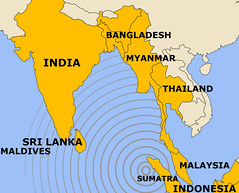
Don't feel much like celebrating tonight given the situation in South Asia. Rob Cockerham has compared the death count from the Tsunami to the deaths at the World Trade Center. Here are some videos of the tsunami.

Today's links:

Managing Care Through the Air
Growing old in a wireless world will mean not just keeping your body healthy but keeping it online.

The New and Improved SETI
SETI's Seth Shostak reveals the latest technology and techniques used in the search for extraterrestrial life.

Robots and Emotion: Tetchy the Turtle Meets Sonny and HAL
Affective Media is planning for a future in which it will be important that machines are able to understand the different states of their human colleagues.

Small Wonders
Nanotechnology will give humans greater control of matter at tiny scales. That is a good thing, says Natasha Loder

Is Mechanosynthesis Feasible?
The nanotechnology debate moves up a gear.

December 29, 2004

Conversation with Dale Carrico on denaturalization


I've been corresponding with Betterhumans columnist and Amor Mundi blogger Dale Carrico about his latest set of articles, The Trouble with Transhumanism Parts I and II.

Dale's been engaging the fine people at WorldChanging about enviro related issues, particularly the issue of humanity's tenancy to denaturalize itself and its environment. In Part II of his BH column, Carrico made the very astute observation that both bioconservative and tech-progressive sensibilities, positions and politics have arisen and exert their force uniquely in consequence of what he describes as the ongoing denaturalization of human life in this historical moment. "This denaturalization is a broad social and cultural tendency," writes Carrico, "roughly analogous to and even structurally related to other broad tendencies such as, say, secularization and industrialization." He continues:
It consists essentially of two trends: First, it names a growing suspicion (one that can provoke either fear or hopefulness, sometimes in hyperbolic forms) of the normative and ideological force of claims made in the name of "nature" and especially "human nature," inspired by a recognition of the destabilizing impact of technological developments on given capacities and social norms. Second, it consists of an awareness of the extent to which the terms and pace of technological development, and the distribution of its costs, risks and benefits, is emerging ever more conspicuously as the primary space of social struggle around the globe.

It is a truism that the technical means to eliminate poverty and illiteracy for every human being on Earth have existed since the 18th century, but that social forms and political will have consistently frustrated these ends. The focus for most tech-progressives remains to use emerging technologies to transform the administration of social needs, to provide shelter, nutrition, health care and education for all, as well as to remedy the damaging and destabilizing impact of technology itself on complex, imperfectly understood environmental and social orders on which we depend for survival. To these ends, a deepening and widening of democratic participation in development and accountability of governance through emerging networked information and communication technologies is also crucial. Beyond this, many tech-progressives also champion the idea of morphological freedom, or consensual practices of genetic, prosthetic and cognitive modification considered as personal practices of self-creation rather than as the technological imposition of social conformity figured questionably as "health."
A couple of days ago I wrote to Dale to congratulate him on his articles. Here's the conversation that ensued:

George:
Dale, what an excellent set of articles! Your second one was particularly strong. Your notion that denaturalization follows along such trends as secularization and industrialization is a zinger.
Dale:
I agree with you that the discussion of "denaturalization" is especially promising, but maybe you can help me think through some of the quandaries of the term.

I have heard some criticisms among environmentalists I respect about this “anti-nature” aspect of my argument. I can see the point of arguments that would say that technology is the *form* human "nature" takes, and I can see the point of arguments that say we depend for our survival on complex systems we imperfectly understand (which seems to be what some people mean by "nature") even if we impact them with our own activity and this must make us especially careful.

But I can't for the life of me figure out a way to weave these insights into the point I was making myself about technological destabilization as a risky but promisingly emancipatory force, and "nature" as a word people mostly use just to defend customs that have outlived their usefulness. I want to say culture trumps nature, and human dignity must come from critical freedom not uncritical customs from now on -- but I don't want to deny there is some sense in these objections.
George:
Another way of describing denaturalization is the steady encroachment of intelligent interventions in what are normally autonomic processes; consequently, we must be wary of the motives that underlie these interventions. But we must also be wary of those arguments that take a non-interventionist approach, which can sometimes be an indifferent hands-off approach for merely romantic reasons, or sentiments that arise from the fear that we might make the situation worse (and that certain systems are optimized before intelligence intervenes -- a hard argument to sell).

Once thing I don't buy, however, is that the complexity found in natural systems are ineffable and/or intractable. Because complexity is often merely a data or mapping problem, it's just a matter of time and diligence.

Another angle would be to include practical applications of personhood ethics in consideration of how it applies to utilitarianism. A trick will be to show a kind of cost/benefit analysis of non-intervention versus intervention in terms of its impact on all living, emotional, and experiential creatures. To do so, the value of say, maintaining a certain biological function for aesthetic (romantic) reasons, would have to be qualitatively determined, and then set against what we value through intervening in the process.

Non-interventionists need to be careful, however, in that they risk applying Darwinianism to their ethical worldview, which is not IMO tied into our collective set of values as thinking and compassionate creatures; rather, we need to be Lamarckian as we apply non-anthropocentric personhood values in our dealings with living creatures and systems.
Dale:
I agree with all of this! When I tell people culture should trump nature I've been trying to say in a sloppy too-intuitive way what you are saying here, I think. It's funny, once "culture" is set in motion "hands-off" is always a *kind* of intervention itself, there is no way to not "intervene," the process of intervention has already begun. The question becomes where and how one intervenes, and non-intervention is always non-intervention in processes stamped by ongoing interventions. That's why I agree with you that the very notion of non-intervention is always a romantic mystification, pure ideology.

This stuff speaks to the Precautionary Principle discussion too (another topic on which I seem to swim against the tide) -- though for me the key thing with the Principle is not whether it generally recommends stagnation or development but *who* gets to participate in the decision-making about what forms intervention takes.

Ain't nature grand?


It's looking like 100,000 dead, with prospects for even more than that. Unreal. This is emotionally affecting me. I feel helpless and I wish I could be out there helping these people dig themselves out. I made a small donation today to the relief efforts in an attempt to assuage my anxieties and feelings of helplessness. I read that Canada gave a paltry $4-million. Our government should be ashamed of itself. [Canada has upped its aid donation to $40-million dollars--much better.]

NASA speculates that the megathrust earthquake may have shifted the Earth's axis, causing the Earth to wobble by an inch or so. The quake altered regional geography by a few meters and cut the length of the day by a few millionths of a second. The tsunami itself was felt as far as Mexico and right on into the Pacific.

And for all the nature worshipers out there, the deep ecologists and gaianists, this should serve as a reminder of just how much Mother Nature cares for the Earth's inhabitants. Here are some examples of how ant-like we truly are when confronted with the elements:

- Bangladesh was hit by a cyclone in 1970 killing 500,000 people. Winds of up to 230 km/h whipped up massive waves that took away entire villages.

- An 8.3 earthquake obliterated the Chinese city of Tangshan in 1976. The official number of people killed was put at around 250,000, although some said the figure was more like 750,000.

- Chinese provinces Shanxi and Henan lost more than 800,000 people when hit by a quake in 1556.

- In 1887, about 900,000 people died when China's Yellow River burst its banks in the worst-ever recorded flooding.

And if you think all this is bad, that's nothing. Of course, the Earth's creatures have suffered through phases of mass extinctions, many of them facilitated by catastrophic events like celestial object impacts. But worse still is what's happening across the Universe on a near daily basis as the result of gamma-ray bursts (GRBs).


A gamma ray burst, the single most powerful cataclysmic force known to us, occurs at a rate of about 1 per minute across the entire Universe. That's a rather terrifying figure considering the terrible punch that these explosions pack.

Likely the result of a black hole being created from a dying star, a GRB radiation blast spreads out evenly, with the gamma-ray energy released by the burst being equivalent to that which would be produced by converting the entire mass of a star 1.3 times the mass of our Sun completely into gamma radiation. Put into perspective, if a GRB were to happen as far away as 2,000 light years, it would shine twice as bright in our night sky as the Sun does during the day. Given a GRB close enough to Earth, it would rip apart our ozone layer and likely extinguish life on our planet.

Consequently, it is speculated that GRBs are a major factor in regulating the presence of extraterrestrial civilizations across galaxies. Some believe that a GRB can sterilize as much as a quarter of an entire galaxy. Given even modest guesses about the number of extraterrestrial civilizations per galaxy, and given that a GRB happens at a rate of 1/minute across the Universe, it's safe to assume that mass civilization extinctions are happening across the Universe on a daily basis.

The Universe, it appears, is a very dangerous and indifferent place. What's not indifferent, however, are the sentiments and actions of its intelligent inhabitants.

December 28, 2004

Tsunami from hell


At least 56,000 dead. My puny paleolithic brain is having a hard time comprehending the totality and humanity of this natural disaster. Time for a prayer:

Dear God,
as we marvel at Thy creation,
this tiny planet Earth on which we dwell,
we stand in awe and reverence in the Universe's unfolding.
As we continue to stand by You and worship Thee,
and as You in turn answer our prayers and watch over us, Your blessed children,
we remain in blissful ignorance as to Thine divine plan.
But far be it for us to question the motives of God,
for You have blessed us with brains too small and weak to comprehend Thine divine logic.
Surely there is great wisdom in sweeping 56,000 souls out to sea, 18,000 of them children.
For certain Thou has shown great mercy by granting these people a life of poverty and their subsequent reward of death by tsunami.
And absolutely must there be kindness in the disease and strife that will inevitably ensue.
And in addition to this holy earthquake,
we thank You for rectal cancer, male nipples, and for all the hopeful mothers who get to live through a miscarriage.
We welcome our ignorance and confusion, and pray that you continue to bless us with Thy merciful bounty and guardianship.
Amen.

December 27, 2004

Hapgood: More Than Human


Fred Hapgood has an interesting article about the transhumanist potential in Bio-IT World. Called More Than Human, the article describes numerous posthuman possibilities, particularly as they pertain to neural enhancements and integration with IT. Says Hapgood:
Transhumanism might be described as the technology of advanced individual enhancement. While it includes physical modifications (diamondoid teeth, self-styling hair, autocleaning ears, nanotube bones, lipid metabolizers, polymer muscles), most of the interest in the technology focuses on the integration of brains and computers — especially brains and networks. Sample transhumanist apps could include cell phone implants (which would allow virtual telepathy), memory backups and augmenters, thought recorders, reflex accelerators, collaborative consciousness (whiteboarding in the brain), and a very long list of thought-controlled actuators. Ultimately, the technology could extend to the uploading and downloading of entire minds in and out of host bodies, providing a self-consciousness that, theoretically, would have no definitive nor necessary end. That is, immortality, of a sort.
He also cautions against the blanket condemnation of enhancement technologies, complaining about the impracticality of enforcing such a policy of restraint:
Still, it's not clear that boycotting neurotech will be a realistic option. When the people around you — competitors, colleagues, partners — can run Google searches in their brains during conversations; or read documents upside down on a desk 30 feet away; or remember exactly who said what, when and where; or coordinate meeting tactics telepathically; or work forever without sleep; or control every device on a production line with thought alone, your only probable alternative is to join them or retire. No corporation could ignore the competitive potential of a neurotech-enhanced workforce for long.


And as a CIO, Hapgood also offers some practical solutions to mind violations of the kind depicted in Ghost in the Shell:
One possible approach to neurosecurity might be to implant a public-key infrastructure in our brains so that every neural region can sign and authenticate requests and replies from any other region. A second might be maintaining a master list of approved mental activities and blocking any mental operations not on that list. (Concerns about whether the list itself was corrupted might be addressed by refreshing the list constantly from implanted and presumably unhackable ROM chips.) It might also be necessary to outsource significant portions of our neural processing to highly secure computing sites. In theory, such measures might improve on the neurosecurity system imposed on us by evolution, making us less vulnerable to catchy tunes and empty political slogans.
Definitely give this article a read.

December 25, 2004

Favourite albums of 2004

In no particular order, here are my favorite albums of 2004:

Wilco: A Ghost is Born
Air: Talkie Walkie
Ghost: Hypnotic Underworld
Joanna Newsom: The Milk-Eyed Mender
The Beta Band: Heroes to Zeros
Ron Sexsmith: Retriever
Feist: Let it Die
The Black Keys: Rubber Factory
Fiery Furnaces: Blueberry Boat
Interpol: Antics
Madvillain: Madvillainy
Modest Mouse: Good News for People Who Love Bad News
PJ Harvey: Uh Huh Her
Probot: Probot
Beastie Boys: To the Five Boroughs
Loretta Lynn; Van Lear Rose
The Streets: A Grand Doesn't Come for Free
Freescha: Casino Versus Japan

[Oh, forgot another good one, Arcade Fire: Funeral (revision 01/16/05)]

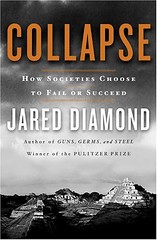
Jared Diamond: Collapse


Jared Diamond's latest book: Collapse: How Societies Choose to Fail or Succeed.

Description:
"In his million-copy bestseller Guns, Germs, and Steel, Jared Diamond examined how and why Western civilizations developed the technologies and immunities that allowed them to dominate much of the world. Now in this brilliant companion volume, Diamond probes the other side of the equation: What caused some of the great civilizations of the past to collapse into ruin, and what can we learn from their fates?

As in Guns, Germs, and Steel, Diamond weaves an all-encompassing global thesis through a series of fascinating historical-cultural narratives. Moving from the Polynesian cultures on Easter Island to the flourishing American civilizations of the Anasazi and the Maya and finally to the doomed Viking colony on Greenland, Diamond traces the fundamental pattern of catastrophe. Environmental damage, climate change, rapid population growth, and unwise political choices were all factors in the demise of these societies, but other societies found solutions and persisted. Similar problems face us today and have already brought disaster to Rwanda and Haiti, even as China and Australia are trying to cope in innovative ways. Despite our own society’s apparently inexhaustible wealth and unrivaled political power, ominous warning signs have begun to emerge even in ecologically robust areas like Montana.

Brilliant, illuminating, and immensely absorbing, Collapse is destined to take its place as one of the essential books of our time, raising the urgent question: How can our world best avoid committing ecological suicide?"

December 24, 2004

...in the palm of our hands


I like this image--the idea that our genetic constitutions will soon be within our very grasp. Very transhumanist.

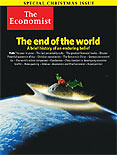
The End of the World


This week's Economist has a cover article on humanity's propensity for conjuring up doomsday scenarios. In the article A Brief History, the Economist discusses a number of historial scenarios and antecedents, including such things as the religious underpinnings of apocalyptic scenarios and the recent Raelian phenomenon:
The Raelians' claim to be atheists who belong to the secular world must come as no surprise to Mr Cohn, who has long detected patterns of religious apocalyptic thought in what is supposedly rational, secular belief. He has traced “egalitarian and communistic fantasies” to the ancient-world idea of an ideal state of nature, in which all men are genuinely equal and none is persecuted. As Mr Cohn has put it, “The old religious idiom has been replaced by a secular one, and this tends to obscure what otherwise would be obvious. For it is the simple truth that, stripped of their original supernatural sanction, revolutionary millenarianism and mystical anarchism are with us still.”
The Economist also notes the contributions from political science, including Hegel and Fukuyama:
Hegel saw history as an evolution of ideas that would culminate in the ideal liberal-democratic state. Since liberal democracy satisfies the basic need for recognition that animates political struggle, thought Hegel, its advent heralds a sort of end of history—another suspiciously apocalyptic claim. More recently, Francis Fukuyama has echoed Hegel's theme. Mr Fukuyama began his book, “The End of History”, with a claim that the world had arrived at “the gates of the Promised Land of liberal democracy”. Mr Fukuyama's pulpit oratory suited the spirit of the 1990s, with its transformative “new economy” and free-world triumphs. In the disorientating disconfirmation of September 11th and the coincident stockmarket collapse, however, his religion has lost favour.
And in a refreshing surprise, the article also brings up the contributions of Kurzweil and Moravec:
Noting an exponential acceleration in the pace of technological change, futurologists like Hans Moravec and Ray Kurzweil think the world inhabits the “knee of the curve”—a sort of last-days set of circumstances in which, in the near future, the pace of technological change runs quickly away towards an infinite “singularity” as intelligent machines learn to build themselves. From this point, thinks Mr Moravec, transformative “mind fire” will spread in a flash across the cosmos. Britain's astronomer royal, Sir Martin Rees, relegates Mr Kurzweil and those like him to the “visionary fringe”. But Mr Rees's own darkly apocalyptic book, “Our Final Hour”, outdoes the most colourful of America's televangelists in earthquakes, plagues and other sorts of fire and brimstone.

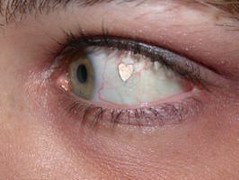
Cosmetic Extraocular Implant


Check out this cool ocular mod:
The Cosmetic Extraocular Implant (JewelEyeTM) was developed by the Netherlands Institute for Innovative Ocular Surgery. The device can be implanted within the superficial, interpalpebral conjunctiva. The implant does not interfere with the ocular functions, ie the visual performance and ocular motility. The implant is made of a specially designed material that can be molded in all kinds of desired shapes and sizes.

The JewelEyeTM device is 3.5 mm in diameter and available in the following shapes: ring, heart, star. ring. The devices are packaged in a box with 10 sterile devices and the guidelines for use.

In the Netherlands, a Cosmetic Extraocular Implant is not considered a medical device.

Patent applications for the Cosmetic Extraocular Implant are pending.

December 23, 2004

Links

Holy light blogging, batman. Sorry about the lack of posts. Very busy. Here are some cool links I've discovered lately:

Brain versus Machine Control: Dr. Octopus, the villain of the movie Spiderman 2, is a fusion of man and machine. Neuroscientist Jose Carmena examines the facts behind this fictional account of a brain-machine interface

Religion and Science: Buddhism on the Brain: Many religious leaders find themselves at odds with science, but the head of Tibetan Buddhism is a notable exception. Jonathan Knight meets a neurologist whose audience with the Dalai Lama helped to explain why.

You, Robot: He says humans will download their minds into computers one day. With a new robotics firm, Hans Moravec begins the journey from warehouse drones to robo sapiens.

Natural Selection Acts on the Quantum World: Objective reality may owe its existence to a 'darwinian' process that advertises certain quantum states.

Betterhumans columnist Dale Carrico's The Trouble with "Transhumanism": Part One and The Trouble with "Transhumanism": Part Two.

Does Transhumanism Suck?: Annalee Newitz In Conversation With R.U. Sirius

Robots Suffer for Art's Sake: Through his art, Fernando Orellana is turning the public fear of robots and future technology on its head by creating fearful and shy robots.

How About Not 'Curing' Us, Some Autistics Are Pleading: "We don't have a disease," said Jack, echoing the opinion of the other 15 boys at the experimental Aspie school here in the Catskills. "So we can't be 'cured.' This is just the way we are." (NYT registration required)

November 30, 2004

Recent European bioethics breakthroughs

A couple of reminders about our bioconservative proclivities here in North America:

Netherlands proposes euthanasia for newborns in agony: A hospital in the Netherlands — the first nation to permit euthanasia — recently proposed guidelines for mercy killings of terminally ill newborns, and then made a startling revelation: It has already begun carrying out such procedures, which include administering a lethal dose of sedatives.

Mother carrying "designer baby": A woman who was given permission to have embryo screening treatment in a bid to save her son is carrying the UK's first "designer baby;" Stem cells from the new baby could save its brother's life.

November 11, 2004

Engineering deliberate NEO impacts


Anders Sandberg and I have been having a conversation about the possibility for a deliberately engineered NEO (near Earth object) attack. The possibility of such a thing was brought to my attention in a recent Astrobiology article called "Tugboat as Lifeboat?" In this article, Russell Schweikart, a former Apollo 9 astronaut and the current Chairman of the B612 Foundation (an advocacy group endorsing 'a gentle push' approach to asteroid risk mitigation), had this to say about the prospect:
It takes little imagination to visualize the extreme political and social controversy if we wait for a specific impact to become known before developing the path deviation criteria.

The opportunity for abuse and the underlying human characteristics that concerned Carl Sagan (when he reflected in 1992 on potential "negligence, fanaticism or madness") still remain a challenge while the instantaneous impact point is slowly guided off the Earth. This deflection dilemma arises in the recognition that if one can deflect an incoming NEO such that it misses the Earth, one can as well deflect a NEO that would otherwise miss the Earth such that it now hits the Earth, presumably in a particular location.

This is clearly a challenging task since the few space faring nations of the world are powerful, and such intrusive oversight will not be easily negotiated. It is crucial to realize that the appropriate time-window to negotiate these international agreements is not the time available until an impact occurs, but rather the time available until an impact is predicted.
I wrote transhumanist polymath Anders Sandberg about the potential problem and a conversation ensued. Here's the thread:

Me: Here's another consideration for a nihilistic human extinction scenario:
The deliberate engineering of an asteroidal impact: "Tugboat as Lifeboat?"

Anders: As my gaming group remarked as they debated asteroid braking and mining strategies in one of our games: "Don't even think of it! Aerobraking asteroids easily becomes lithobraking!" :-)

Like weather control attempts, asteroid deflection attempts may be subject to huge risks of liability claims - if the defelction does not work 100% somebody is still going to be hurt, and survivors may claim that they suffered because of the attempt. This might actually reduce the incentive to deal with lesser impactors (preventing extinction level events will likely be accepted by everyone, even if a few small pieces are likely to drop on someone). It would be interesting to make a probabilistic analysis of the defense schemes published so far and see in which regimes (size-warning time - method) there are liability problems.

As a strategic weapon asteroids are rather bad - you put your mass driver on a NEO, and it will be in the vicinity of Earth every 10-20 years rather than all the time. Also, it is hard to discreetly send a spacecraft to an asteroid, so everybody will know you did it. Unless of course there are already plenty of space traffic, but then the deadliness of impacts may be blunted.

As for nihilistic kills, asteroids do have a certain charm. Smiting the world from the sky and all that. But I have not seen much evidence for nihilism as motivation on large scales. If you look at various atrocities and the effort that went into them, most seem to be fairly direct projects with fairly non-nihilistic (if nasty) goals. Hence I would worry more about somebody thinking the world would be a better place with a thoroughly smashed America/Europe/Asia/wherever than someone trying for extinction - specific rather than general malevolence.

Smaller asteroids could of course be used instead of nukes, but they appear somewhat unwieldy (as described above). Hence warfare with smaller asteroids is unlikely to kill off mankind, just to make us very sorry. One could imagine automated second-strike systems launching asteroids if one's home nation is destroyed causing some form of chain reaction bombing the Earth into a crater wasteland, but again that seems to be using slow and inefficient means to achieve what lots of nukes (or bioweapons) likely can do more cheaply.

Replicating asteroid mining stations building mass drivers and sending off new stations to other asteroids could set up a very dangerous system. This in addition to the *huge* arms race incentives - if you launch one of these a few weeks before me, I may end up with an immense disadvantage, so I better launch first. Even if all we do is peaceful resource extraction, we still are likely to compete for free asteroids. But such robotization of the solar system is a separate threat from asteroid impacts. The asteroids become mere tools and raw materials to the replicating infrastructure rather than the threat in themselves.

Me: One concern I have is, with all the mass movers working out there, and given the potential for someone to hack into its system, this kind of attack could be instigated remotely and even somewhat clandestinely.

Anders: Yes, if you have automated robofacs across the solar system the system can become a tremendous danger if it is insecure. It ought to be possible to make a fairly secure system: each robofac only accepts commands with the right crypto-authentification, copies are prevented from running if their multiply redundant checksums do not work out, tamperproofing of various kinds etc. But then the owner goes on a coffee break, leaving the master password written on a post-it next to his computer...

Of course, one could also use the fruits of such an infrastructure to set up asteroid defenses fairly easily. Make a few of the robofacs build interception missions, and you will have lots and lots of interceptors distributed across the solar system waiting for an emergency. But even that solution can become a problem if badly implemented (imagine a mistaken command making the interceptors attack anything leaving from Earth, and no easy way to get rid of them: a bit of a whimper).

In general, the greater the amount of mass/energy people can throw around, the greater the risks to isolated or concentrated targets.

November 9, 2004

Looming influenza pandemic


According to a number of infectious diseases experts, the human population is on the verge of another influenza pandemic--this one being the H5N1 avian strain from Asia:
“We're very limited in what we can do for this virus,” Dr. David Heymann of the World Health Organization told participants at the two-day conference, organized by the University of Toronto and St. Michael's Hospital's Centre for Global Health Research.

“This virus is rapidly spreading around the world, the fear of course being that H5N1 from chickens will enter a human and . . . reassort to form a human influenza virus which will then have genetic characteristics of a human virus, spread rapidly around the world and cause deaths,” said Dr. Heymann, executive director of the WHO's communicable diseases division.

The process Dr. Heymann was referring to would mark the start of a new influenza pandemic, an event most flu researchers believe is both inevitable and overdue.

In the 400 years of recorded influenza history, pandemics have occurred on a regular if sporadic basis. The longest period between pandemics has been 30 to 40 years, noted Dr. Allison McGeer, an infectious diseases specialist at Toronto's Mount Sinai Hospital.
Assuming that it does indeed infiltrate the human population as expected, I would predict that 1) due to countermeasures and other health interventions, the effects will not be as devastating as previous outbreaks, and 2) if it does wreak considerable havoc, it's the kind of thing that will force people's head out of the sand in regards to the potential and need for further research and development into novel medical interventions and health technologies--including the potential for such things as the ability to decode a virus's genome and develop counter-phages and immunizations.

November 8, 2004

Institute for Ethics and Emerging Technologies launched

The Institute for Ethics and Emerging Technologies was officially launched today. With the mandate of "promoting the ethical use of technology to expand human capacities," the IEET is an organization that is closely associated with the World Transhumanist Association and is the brainchild of Nick Bostrom and James Hughes (who is the Executive Director). I currently serve on the IEET Board of Directors along with Bostrom, Giulio Prisco, Mike LaTorra and Mark Walker.

Here's the press release that was released today:
FOR IMMEDIATE RELEASE

Contact:
James Hughes Ph.D.
Executive Director
Institute for Ethics and Emerging Technologies
http://ieet.org
56 Daleville School Rd.
Willington CT 06279 USA
(office) 860-297-2376
director@ieet.org

New Institute to Provide Balanced Views on Human Enhancement Technologies

Willington, CT, USA -- November 8, 2004 -- When should parents be permitted to genetically enhance their children? How can we regulate psychoactive drugs in ways that respect cognitive liberty? How can we avoid exacerbating inequality as human enhancement technologies spread?

The IEET's mission is to become a center for responsible, constructive approaches to emerging human enhancement technologies. We believe that technological progress can be a catalyst for positive human development so long as we ensure that technologies are safe and equitably distributed.

As yet there has been no institutional home for the consideration of the ethical challenges of emerging human enhancement technologies free from both anti-regulatory dogmas that deny the legitimacy of democratic public policy, and technophobic red herrings such as anxieties about transgressing the boundaries of humanness. The Institute for Ethics and Emerging Technologies intends to fill that gap.

The Institute for Ethics and Emerging Technologies will be directed by Oxford philosopher Nick Bostrom, who will chair the Board of Directors, and bioethicist James J. Hughes, who teaches at Trinity College in Hartford Connecticut USA and who will serve as Executive Director. The IEET is incorporated as a nonprofit organization in the United States. The IEET's Board of Directors currently come from Spain, Canada, the UK and the United States. The IEET will also be served by a Board of Advisors, which is now being formed.

The IEET has appointed six 2004-2005 Fellows: nano-policy thinker Mike Treder; development policy futurists Jose Cordeiro and Jamais Cascio; biogerontologist Aubrey de Grey; human rights writer Dale Carrico; and philosopher, and science fiction author and critic, Russell Blackford. The work of the IEET will also be served by student interns. Applications for internships are now being accepted.

The Fellowships, internships and work of the IEET is structured around six programs of action: Global Health; Relationships, Community and Technology; Consequences and Ethics of Emerging Technologies; Self-Determination and Human Rights; Longer, Better Lives; and Visions of Utopia and Dystopia.

Specific activities of the IEET include placing essays in newspapers and journals, underwriting selected research and analysis, promoting leading thinkers through events and publicity campaigns, and producing publications, journals and audio-visual materials. In particular the IEET has assumed management of the Journal of Evolution and Technology which has published academic research on questions of human enhancement and technological futurism since 1998.

The Institute will organize several events per year in Europe and North America. In July 2005 the IEET will co-sponsor a conference in Caracas Venezuela, focusing on human enhancement technologies and the developing world, with the World Transhumanist Association. (The IEET will work closely with the World Transhumanist Association, which is also chaired by Dr. Bostrom and served by Dr. Hughes as its Executive Director.) In September 2005 the IEET will co-sponsor a conference on Human Rights and Human Enhancement with the Center for Cognitive Liberty and Ethics.

For more information: http://ieet.org or Contact:
director@ieet.org
Phone: 860-297-2376

November 5, 2004

Go north, young man.

As a Canadian, I can't even begin to express how interesting I find this.

November 4, 2004

Signs of the coming apocalypse

More signs that the coming apocalypse is near:

- A lion attacked a man who jumped into its enclosure and shouted at it: "Jesus will save you!" at a zoo in Taiwan's capital.

- Blood sucking monkeys lurking at an ancient Hindu temple in India's northeast have attacked as many as 300 children in the past 3 weeks; "They hide in trees and swoop on unsuspecting children loitering about in the temple premises or walking by, clawing them and even sucking a bit of blood," Bani Kumar Sharma, a priest at the Kamakhya temple in Assam state, said Tuesday.

- George Bush wins the 2004 US presidential election

....the end is near my friends...