March 31, 2006

The end of livestock

The science of tissue engineering and the development of in vitro meat may one day, hopefully, result in the end of livestock.


And with it, the end of unnecessary cruelty to non-human animals, a decrease in the frequency of animal-to-human borne diseases (which is like, all of them), the alleviation of environmental degradation caused by animal farming, and an end to unhealthy, unclean, hormone-ridden and antibiotic laden meat.

Humans eat 240 billion kilograms of meat every year. Imagine how many animals that represents. Now imagine each of those lifetimes as they are individually experienced: caged, crammed, frightened, diseased, poked, prodded, neurotic, psychotic, and all followed by slaughter. Don’t think so? Read this, this, this, this, and this. And then watch this.

Then there’s all the cropland, water, fertilizer, pesticides and energy required to produce animals for the killing floor. And what about the millions of tonnes of manure and other waste produced every year in North America?

As Jared Diamond noted in Guns, Germs, and Steel, humans have been consistently traumatized by the continual spread of diseases, which in virtually every case has been spawned by human-to-animal contact (predominantly the result of maintaining livestock). Current health and pandemic risks such as mad cow and avian flu are all heightened as a consequence of animal farming.

Moreover, with the introduction of in vitro foods, in vitro meat products would be far healthier than the real thing. Cultivated meats would be engineered to be healthier and cleaner.

In vitro meat is still meat in every sense of the term. According to Wikipedia, the process is as follows:

Meat essentially consists of animal muscle. There are loosely two approaches for production of in vitro meat; loose muscle cells and structured muscle, the latter one being vastly more challenging than the former. Muscles consist of muscle fibers, long cells with multiple nuclei. They don't proliferate by themselves, but arise when precursor cells fuse. Precursor cells can be embryonic stem cells or satellite cells, specialized stem cells in muscle tissue. Theoretically, they can relatively simple be cultured in a bioreactor and then later made to fuse. For the growth of real muscle however, the cells should grow "on the spot", which requires a perfusion system akin to a blood supply to deliver nutrients and oxygen close to the growing cells, as well as remove the waste products. In addition other cell types need to be grown like adipocytes, and chemical messengers should provide clues to the growing tissue about the structure. Lastly, muscle tissue needs to be trained to properly develop.
In vitro meat, referred to by some as laboratory-grown meat, is animal flesh that has never been part of a complete, living animal.

According to a recent Globe and Mail article, scientists can grow frog and mouse meat in the lab, and are now working on pork, beef and chicken. Their goal is to develop an industrial version of the process in five years. It will be at that point that we can say a viable threat exists to the ongoing presence of animal farming. And at the very least it will certainly make the presence of livestock that much less justifiable.

That being said, it will be a struggle to convince people to eat synthetic meat over the real thing. Most people who have ethical issues with eating meat are already vegetarians--so devout meat eaters aren’t really listening. And it’s doubtful that die-hards will give up their tried-and-true meat over an artificial and likely inferior-tasting product.

Perhaps it’ll take the death of millions and millions of people from avian flu for people to start questioning meat eating culture.

One last thought: if there are any arguments from anybody that in vitro meat is still somehow unethical or demeaning to an animal, they seriously need to rethink things. A chunk of tissue grown in a petri dish is as far removed from an existential, emotional, and conscious creature as is a rock.

That being said, I can already hear the howls of outrage...

Tags: , , , , , , .

March 30, 2006

Toronto Transhumanist Association events for April

The Toronto Transhumanist Association is pleased to announce a pair of upcoming events.

First, on Thursday April 6 at 7:00 PM, Allan Randall will introduce us to the fascinating world of cryonics and cryonicists. Mr Randall is the current Secretary and Director for the Cryonics Society of Canada.

Mr Randall is also a teacher and graduate student in philosophy, mathematics and quantum mechanics at York University. He has a BSc in mathematics and an Msc in Computing. Mr Randall has worked on AI research at NTT Systems for the Canadian Department of National Defence.

Allan Randall's talk will be held at the Bahen Centre for Information Technology, 40 St. George Street, Room 1200 (see BA on the map at http://www.osm.utoronto.ca/map).

Second, on Thursday April 20 at 7:00 PM, Mark Walker Ph.D. will be presenting a talk on the ethics and merits of radical life extension. The talk will be based on his recent paper, “Universal Superlongevity: Is It Inevitable And Is It Good?

Dr Walker is a research associate in philosophy at Trinity College, University of Toronto. He is founder and president of Permanent End International, a nonprofit organization devoted to ending hunger, illiteracy and environmental degradation. He serves on the editorial board of the Journal of Evolution and Technology and served on the Board of Directors of the World Transhumanist Association from 2002 to 2006. He is currently serving on the Board of Directors for the Institute for Ethics and Emerging Technologies.

Mark Walker's talk will also be held at the Bahen Centre for Information Technology, 40 St. George Street, Room 1200 (see BA on the map at http://www.osm.utoronto.ca/map).

I hope to see you all there!

Cheers,
George Dvorsky
President, Toronto Transhumanist Association

Tags: , , , , .

I, Telepath: Inching towards 'techlepathy'

Forbes Magazine is reporting on the ongoing work that Chuck Jorgensen is doing in developing subvocal speech for NASA.

Chuck Jorgensen is a NASA scientist whose team has begun to digitize subvocal speech using nerve signals in the throat that control speech. Jorgensen's team discovered that small, button-sized sensors, stuck under the chin and on either side of the 'Adam's apple,' could gather nerve signals, and send them to a processor and then to a computer program that translates them into words.

It's thought that this technology will initially help astronauts working in space, Navy Seals working underwater, emergency workers charging into loud, harsh environments, fighter pilots, and so forth. More practically, one can imagine this technology taking a considerable role in defining the next generation of cell phone and Internet communications.

The team's next goal is to see how much of a speech system can be generated. They are in the equivalent of the early stages of auditory speech recognition, where there is only one speaker and individual words. Ultimately, the team wants to have multiple speakers and continuous speech. They're also working on capacitive sensors which are sensors that don't touch the body and are embedded into clothing or other wearable device.

Jorgensen's work is an obvious precursor to technologically enabled telepathy, or techlepathy as I've referred to it. It's conceivable that someday the neural signals sent to the vocal chords to instigate speech will be re-routed and converted to a signal that can be received directly by another individual's neural audio receptors. The result will be virtual subvocal telepathy.

This won't be true telepathy in the classic sense, however, as it is language that's been conveyed rather than subjective conscious experience.

But one hurdle at a time....

Tags: , , .

March 29, 2006

Some scientists say SENS not up to snuff

The BBC is reporting on how twenty-eight scientists working in gerontology have submitted a rebuttal to a paper published by Dr Aubrey de Grey in the journal EMBO Reports last year.

The rebuttal is not so much a technical account of the apparent failings of Strategies for Engineered Negligible Senescence (SENS) as it is a blanket discrediting of Aubrey de Grey and his methodology. Essentially, the 28 scientists are refusing to acknowledge de Grey's work on account of the supposed far flung and futuristic nature of the requisite technologies and medical interventions called for in de Grey's strategy.

An excerpt from the scientists' statement reads, "Each one of the specific proposals that comprises the SENS agenda is, at our present state of ignorance, extremely optimistic...A research programme based around the SENS agenda... is so far from plausible that it commands no respect at all from within the scientific community."

Dr Richard Miller in particular has some harsh things to say about de Grey's research. "I was amazed that we found no-one who refused on the grounds that they agreed with Aubrey; a couple of people said they didn't want to sign anything about his work because they didn't want to draw attention to it," he says, "We got 28 people who astonishingly were willing to say in public that they had evaluated the science and had found it to be worthless." Miller is the associate director of the Geriatric Centre at the University of Michigan.

Interestingly, Miller and others have refrained from entering a submission to Technology Review's SENS Challenge for fear that it would only be "feeding the fire." Needless to say, de Grey is frustrated that opposition exists to SENS, but few, if any, are willing to explain exactly why they object to his theories. In regards to the SENS Challenge, de Grey recently noted, "I essentially felt that it was critical for me to smoke out the opposition...I had to move things along to an on-the-record opposition so that people would be forced not simply to say what they thought of these ideas, but why."

The SENS challenge offers an award of US$20,000 to anyone who can demonstrate that SENS is wrong and unworthy of learned debate. To date, no one has claimed the award.

Tags: , , , , , .

The EU's ENHANCE Project

ENHANCE is a specific targeted research project put together by the EU that examines the ethics of human enhancement within cognitive enhancement, life extension, mood enhancement, and physical performance. The goal of the project is to reach a deeper understanding of the ethical and philosophical issues of the use of these technologies beyond the purpose of therapy.

Transhumanist philosopher and neuroscientist Anders Sandberg is participating in the cognitive enhancement project. And Nick Bostrom's Future of Humanity Institute has the 'ethics in cognitive enhancement' special assignment.

This project is being funded by the European commission's Sixth Framework programme, "Deepening Understanding in Ethical Issues." The study is in anticipation of biotechnologies that will have the potential of being applied to "make people think better, feel happier or even to improve their physical skills in sports or to extend the life-span." From the website:

The ENHANCE project investigates the latest development within research on biology, biogerontology and neuroscience in order to reach a deeper understanding of the ethical and philosophical consequences when moving from ‘therapy’ perspective towards the one of ‘enhancement’.
The main objectives are to document current and imminent scientific advances that may enhance human capacities in cognition, mood, physical performance (in sport) and aging, to evaluate these advances from a philosophical, ethical and social perspective, to facilitate policy-making to the emerging dual-use technologies, and to promote public understanding of dual-use technologies and the ethical debate.

I'm amazed that the EU is this far ahead in the discussion. Europeans have shown considerable distaste up to this point in time with anything having to do with human genetics and issues of enhancement. Here in North America, the only governmental group I see this in tune with humanity's future is the National Science Foundation. Specifically, I'm thinking about their NBIC report from a few years back, the effects of which are still being felt. As for Canada, these issues aren't even close to the policy issues map.

Best of luck to Anders, Nick, and all those involved in the ENHANCE project.

Tags: , , , , .

March 28, 2006

Latest SentDev Podcast posted [28-Mar-06]


The latest Sentient Developments podcast is now available.

Feed: http://feeds.feedburner.com/PodcastSentDev

Tags: , , , , , , , .

March 27, 2006

Goin' to California

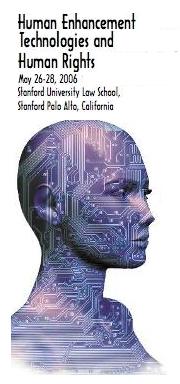
Looks like I'm goin' to Stanford University for the IEET's conference on Human Enhancement Technologies and Human Rights. The conference will run from May 26 to May 28.

I will also be presenting. I'll be on the "From Human Rights to the Rights of Persons" panel along with Jeff Medina and Martine Rothblatt. Martine also happens to be on the IEET's Board of Advisors. I'll be speaking on Saturday May 27 from 4:15 to 5:30.

So, now I've got to put together a talk related to personhood ethics. This is one of my favourite issues, so I should do alright. The trick will be to say something interesting and new, and to tie it into the theme of the conference.

I'll likely bring a laptop and digital camera to the event so that I can blog it as close to real time as possible. That should prove to be an interesting experience.

March 26, 2006

Lynn Margulis's talk at UWO

This past Saturday I attended a talk by evolutionary biologist Lynn Margulis at the University of Western Ontario (my alma mater).

Margulis is known for her work developing symbiogenesis theory -- the idea that organisms come about primarily through the merger of individual and separate organisms.

The talk was attended by about 150 people, mostly profs and grad students. Margulis arrived a little late and looked a bit frazzled from her hectic schedule. She was a bit hoarse and under the weather, but was openly pleased to see a standing room only audience on a rainy Saturday afternoon.

Her presentation was done primarily through PowerPoint, and a number of her videos were accompanied by music; you could tell that some in the audience felt her presentation to be a tad on the "pop-science" side. It was certainly not technical enough for this particular audience, and meant more for undergrads (which was fine by me because I was able to follow most of it). Margulis was also guilty of incessant name dropping, a habit that grew quite tiresome after some time. Some people took early opportunites to leave -- individuals who were probably hoping for something more advanced and informative.

That being said, her presentation did result in some ooohs and aaaahs from the audience, including videos of photosynthetic worms and an equisitely camouflaged octopus.

Margulis, who was significantly influenced by 20th century Russian biologists like Konstantin Mereschkowsky, fleshed out her theory in her 1981 work, In Acquiring Genomes: A Theory of the Origins of Species. In this paper, Margulis argued that symbiogenesis is a primary force in evolution. According to her theory, acquisition and accumulation of random mutations are not sufficient to explain how inherited variations occur. Instead, new organelles, bodies, organs, and species arise from symbiogenesis.

Margulis is also a pioneer in gaia theory. Along with James Lovelock, Margulis has helped to popularize the concept and give it its modern form. Symbiogenesis theory clearly works well within gaianism, as it stresses the need to look at interactions of populations of organisms at given periods of time. During her talk, Margulis stressed the fact that individuals don't evolve but populations do. Her only qualms with Darwinism was that she believes the diversity of life arose not through competition but through organisms networking with each other.

Recent work on the human genome project has certainly added credence to Margulis's claim. During the talk, Dr. Shiva Singh noted that upwards of 41% of the human genome is comprised of viral DNA. Margulis also noted that the human body is not one singular organism. Rather, like the Earth's ecosystem, the human body is a community of life. We have bacteria in our gut and critters on our skin. Without them, we couldn't survive. She noted the case of one individual who lacked the ability to maintain such a balance, and it cost extreme sums of money to keep the person alive before he eventually died.

During her career Margulis has had to consistently defend her ideas against the established brands of evolutionary biology, particularly the likes of Richard Dawkins and other neo-Darwinists. Margulis has also had to work particularly hard as a woman in a field largely dominated by men. She noted how at one time a physicist snidely remarked that her theory of symbiogenesis was something to be expected from a female biologist who would naturally accept processes of co-operation rather than competition.

But during her talk, Margulis dismissed the efficacy of using such terms as co-operation and competition when describing the processes of evolution. "They belong in an economics class or on the basketball court," she said. The actual processes at work, she argued, are far too complex to reduce to such simple "cultural" phrases.

Disappointingly, Margulis's argument was quite weak in regards to explaining the actual mechanisms behind symbiogenesis and the encoding of such information at the genetic level. Nor did she offer much in the way of explaining how these relationships arise amongst populations of organisms so that they become common traits of particular species.

But Margulis certainly got me thinking about the dangers of reductionism and over-specialization when studying the processes of evolution. There are a multitude of mechanisms at work at all levels in the linear and inter-species cycles of evolution and the rise of individual species.

Natural selection, competition, co-operation, parasitism, mutualism, population genetics, fitness peaks, puntuated equilibrium, symbiogenesis, gaia -- it's all good.

Tags: , , , , .

Brights Generate More Heat than Light

Aiming to legitimize and popularize atheism, the brights offer little for living or relating to others and are already guilty of tribalism characteristic of their religious rivals

By George Dvorsky, October 13, 2003

Björk is one. John Malkovich, Noam Chomsky, Angelina Jolie and Annika Sörenstam are too. So are Eddie Vedder, Jack Nicholson, Howard Stern, Linus Torvalds and Camille Paglia.

Atheists. Dirty, godless atheists, every last one of them. And there are many more. So many more. Worse, many of them are actually open about their atheism—even proud of it. How could this have happened?

For the sarcasm impaired: I'm being facetious. But let's face it, the word "atheism" is still fairly risqué for most social contexts, and is a downright profanity in some circles. I can certainly relate. Although currently agnostic, I recently went through a phase of being a born-again atheist. But I was a regular church-goer and there was a time when I couldn't bring myself to even say the word.

Indeed, for many the term carries considerable spiritually and socially negative connotations. It's for this reason that a number of atheists have recently come out in favor of the term "bright" instead—a bright being an atheist, agnostic or, more simply, a person with a naturalistic worldview.

The hope is that the more positive label will take off and permanently usurp the word "atheist." Moreover, a key goal of the brights movement is to bring together atheists and agnostics to form a culturally distinct and influential demographic—one that could pose a legitimate political and cultural challenge to currently overwhelming religious influences, particularly those of the religious right in the US.

At first glance this seems like a good idea. For those with sympathetic philosophical and political persuasions it is certainly seductive. In fact, when I initially decided to write on this topic, I was going to write in favor of the idea. As I learned more and thought deeper about it, however, I became quite torn about the whole thing, and I still am. But ultimately, I came to the conclusion that it's a rather empty idea, and one filled with all the old traps.

Aside from the superiority and elitism that the term "bright" evokes, the brights represent yet another unnecessary manifestation of tribalism. They have positioned themselves in a dichotomous and defensive relationship with their rivals, forcing each camp to further stratify and polarize.

And as for the brights themselves, while they claim intellectual superiority over their religious and supernaturally minded opponents—legitimately or otherwise—they are conspicuously quiet on the nuts-and-bolts issues of how to live and relate to others, and how to deal with the overwhelming totality of existence. Atheism for the sake of atheism is a rather empty and unfulfilling modus operandi, and the brights, should they hope to stand the test of time, must realize this and seek to become more than what they initially appear to be.

Introducing the brights

A number of atheists have recently decided to come out of the closet. This metaphor is hardly accidental; as with gays before them, atheists aim to engage in some memetic engineering.

Prior to the 1960s and 1970s, gays were pretty much referred to in the pejorative. Labels such as homosexual, queer or fairy were hardly flattering, leading some gay activists to conclude that a new, uplifting and positive term was needed to replace the old labels. Thus, the word "gay" was co-opted, and the rest is history.

Inspired by this, two Californians, Paul Geisert and Mynga Futrell, recently coined the term "bright" to refer to atheists and agnostics. The word was carefully chosen (whether Geisert and Futrell will admit it or not) as one that could perform double duty as both a noun and an adjective. "Bright" evokes images of cleverness and intelligence. And, of course, those who are not bright are, well, you get the picture.

This past summer, efforts to propagate the new meme got a huge boost from two famous and outspoken atheists, evolutionary biologist Richard Dawkins and consciousness theorist Daniel Dennett—Dawkins writing "The Future Looks Bright" for the Guardian and Dennett writing "The Bright Stuff" for The New York Times.

Dennett explains that "a bright is a person with a naturalist as opposed to a supernaturalist world view. We brights don't believe in ghosts or elves or the Easter Bunny—or God. We disagree about many things, and hold a variety of views about morality, politics and the meaning of life, but we share a disbelief in black magic—and life after death."

Brights, proclaims Dennett, are all around us. They are "doctors, nurses, police officers, schoolteachers, crossing guards and men and women serving in the military. We are your sons and daughters, your brothers and sisters. Our colleges and universities teem with brights. Among scientists, we are a commanding majority."

What atheists "want most of all," Dennett says, is "to be treated with the same respect accorded to Baptists and Hindus and Catholics, no more and no less."

Since the Dawkins and Dennett articles, the official brights Website has experienced considerable volume and a slew of new member signups. Articles both in support and in condemnation of the new term have littered the media. The meme appears to be taking off, prompting critics such as the Southern Baptist Albert Mohler to comment, "This is, no pun avoidable, a diabolically brilliant public relations strategy."

If you can't beat 'em, join 'em

Don Hirschberg once said, "Calling atheism a religion is like calling bald a hair color." Unfortunately, too many atheists have lost sight of the meaning of Hirschberg's insight.

Dennett's claim that brights just want to be treated with the same respect accorded to other religious groups is as disingenuous as it is revealing. Dennett, after all, has made a career arguing for the cultural health of the meme pool, one in which supernatural beliefs are segregated or eliminated altogether. I question the sincerity of this newfound tolerance, as it would seem that the raison d'être of the brights is to legitimize atheism so that it can be a cultural and political force to rival theistic influences.

Moreover, the bright strategy smacks of quasi-religious overtones. The fact that Dennett would compare the brights to Baptists, Hindus and Catholics exposes the true nature of the movement. It would seem that the brights are trying to defeat the enemy at its own game. By creating a distinctive club with specific metaphysical convictions, the brights have essentially created their own religion, and that is unfortunate. It is for this exact reason that I have rejected atheism in favor of agnosticism; both theists and atheists are profoundly guilty of taking monumental and irrational leaps of faith.

Orson Welles was once quoted as saying, "I have a great love and respect for religion, great love and respect for atheism. What I hate is agnosticism, people who do not choose." This is utter nonsense, and utterly dangerous. It is this mentality that has caused so much suffering and fanaticism in the name of religion, and it is the same mentality that compels people to think that they must choose one or the other, lest they be labeled a fence sitter or as lacking convictions.

As far as I'm concerned, the skeptical and responsible thinker, when it comes to making grand proclamations about the true nature of the universe and existence, will at best posit a series of hypotheses and declare that one cannot know given limited amounts of data. As Clarence Darrow said during the Scopes trial, "I do not consider it an insult, but rather a compliment to be called an agnostic. I do not pretend to know where many ignorant men are sure—that is all that agnosticism means." Now that's what I call being bright.

As a result, there is a part of me that resents the brights including agnostics amongst their flock. I consider agnosticism to be in a different category altogether from atheism and theism.

Atheist evangelism

Atheist activism—or evangelism, depending on your taste—has a time and a place. Without question, the struggle against pseudoscience, misinformation and psychologically damaging worldviews is an important and noble cause, as is the struggle against religious impositions. Ellen Johnson's leadership of American Atheists has had important results in the US; they have been instrumental in several rulings against Alabama judge Roy Moore and they have crusaded successfully against many faith-based initiatives.

But I've learned from friend, outspoken atheist and Gravity Lens blogger Jeff Patterson that there is a general reactionary undercurrent among many atheists today, one that has manifested itself in the belief that the primary role of an atheist is to be an activist.

Patterson, who attended last year's American Atheist convention in Boston, observed that far too many attendees were discussing the "conversions" of their friends, the relative success of their letter-to-the-editor or the next protest that they were attending. "What was absent," says Patterson, "was any talk of what was going on in their lives, what was making them happy. What was missing from the convention itself was any program content about Life as an Atheist. No celebration of the guilt-free flavor of happiness that one can achieve with a godless worldview." Ultimately, the event reminded Patterson of an unsuccessful Star Trek convention. "A few hundred folks in a poorly lit hotel talking almost exclusively about how much better they were than everyone else," he says. "I left there mildly depressed and thoroughly uninspired."

At its outset the bright movement showed promise as an antidote to the rather stoic joylessness that seemed prevalent on the surface of atheism. The concept of defining one's self by a positive instead of an omission was philosophically sound. The high profile faces of the brights embraced an ebullience rarely seen in the atheist movement—with exceptions such as Carl Sagan, Penn Jillette and George Carlin (who once quipped, "atheism is a non-prophet organization").

Patterson's problem with the brights "is that they are falling into the same sinkhole as the folks at the atheist convention. They espouse a wonderful path to happiness, but when it's time to actually walk the path they simply point and say, 'there y'go, have a nice trip.'"

More to life than disbelief

What the bright movement needs, argues Patterson, is an affirmation that the dismissal of long-irrelevant superstitions and guilt-driven moral codes is a requirement for true happiness, that living with a sincere and well-deserved smile on your face cannot be accomplished through systems of penance and damnation and that concepts such as original sin and sacrificing for the sake of virtue have no place in the mind of an intelligent being.

"More than that," he says, "happiness is what fuels productivity, imagination, creativity and morality. Happiness is at the core of our sense of good, in our love and in our desire to think. It drives us to perform great acts. It defines our taste in art. It encourages camaraderie. It defines, for lack of a better word, our soul."

Indeed, the organized atheist movement, with its letter-writing and hand-wringing, has lost sight of this. Patterson fears that the brights, as open-minded and all-inviting as they claim to be, may be falling into the same trap.

The bright meme looks set to take off as intended, creating a more open and accepting atmosphere for atheists. But it's what the brights do with this newfound acceptance, rather than the marketing success itself, that will matter in the long run. Brights have to realize that if they're going to proselytize, a considerable responsibility goes along with this. Convincing people that supernatural phenomena don't exist is only part of the story, and just the first step.

Copyright © 2003 George Dvorsky

This column originally appeared on Betterhumans, October 13, 2003.

Tags: , , .

post to del.icio.us

From Third World to Brave New World

China's embrace of state-driven eugenics should be of concern to bioconservatives and bioliberals alike

By George Dvorsky, October 27, 2003

China took a great leap forward on October 15 by becoming only the third nation in history to put a man in space. On top of a Long March rocket, China's first manned spacecraft, Shenzhou 5, soared into the heavens along with taikonaut Yang Liwei and a profound sense of inevitability.

While the feat lagged the US and the former USSR by 40 years, anyone who doubted the inexorable nature of technological progress even among the developing nations had their doubts put to rest. The Chinese success story revealed that, given enough time and patience, high-tech makes its way into even the most unlikeliest of places—including former third world countries. While once the exclusive domain of the Cold War superpowers, space is now accessible by such countries as India, Japan and various nations of the European community.

However, one unfortunate reality of the great catch-up game being played by the former have-not countries is that for many of them social modernization has not caught up with technological modernization. Yes, it's a positive sign that China is catching up technologically, but the communist country currently resembles an infant who has stumbled upon his father's toolbox.

Nowhere is this more so than with biotechnology. The authoritarian Chinese government is using advances in the health sciences to further entrench and realize its eugenic agenda. Beyond the "one child, one family" policy, Chinese eugenics is startlingly reminiscent of 20th century social experiments—including the forced sterilization of citizens deemed unsuitable for procreation—conducted not just by the Nazis, but by many nations.

This is exactly the kind of Brave New World scenario that keeps bioconservatives up at night. But it's also the kind of state-driven eugenic imposition that even the techno-utopian and biolibertarian transhumanists worry about. The vision of a centralized, ideological and hyper-bureaucratized politburo hammering out design schematics for its future citizens is abhorrent, representing everything to which ideals of democracy and self-actualization are opposed.

Consequently, liberal democracies should continue to pressure China to embark upon a path of increasing democratization in hopes that its citizens will eventually demand procreative, cognitive and morphological freedoms. At the very least, the Chinese example should act as a continual reminder of where we do not wish to go.

Primed for reproductive restrictions

Historically, the Chinese have operated with the understanding that citizens are obligated with personal duties to the state, and it is partly due to this tendency that Western ideas of individual autonomy are lost. The Confucian tradition, along with its early agnostic and humanist character, placed emphasis on the orderly arrangement of society and stressed appropriate personal relationships.

In conjunction with ancient customs in medicine, Chinese tradition holds that every aspect of an expectant mother's life must be controlled. It was commonly held that maintaining a balance in cosmic forces, in essential bodily fluids and in lifestyle both before and after conception was paramount if you hoped to have a healthy baby.

The Chinese also subscribed to the patrilineal model of descent, in which a person is viewed as the culmination of his or her ancestors and is held responsible for the health of all future generations. Thus, an expectant mother's behavior and attitude is believed to directly influence the well-being of her future baby, and a deformed or developmentally disabled child reflects a moral failing on the part of the parents. As historian Frank Dikötter has noted, "Herein lies the basic eugenic belief that human intervention—in the form of behavior and morality—can shape heredity."

It was not until after World War I that modern science was introduced to China. It was during the Republican Era (1911 to 1948) that elites called for increased intervention of medical professionals and the state into the sexual lives of its citizens. It was also during this time that Western eugenics was imported and combined with existing fears of cultural, racial and biological degeneration in Chinese society, leading to government regulation of sexual reproduction. Compounding these impulses were the Chinese cultural currents that feared anything deviant and the urge to draw clear boundaries between the normal and the abnormal.

Moreover, it is this emphasis on the collective good that has driven modern eugenics in China since the late 19th Century, when, as Dikötter explains, "Chinese intellectuals, the well-to-do gentry, and government officials explored how to improve the Chinese race after the arrival of the stronger Western imperialist nations." Indeed, as Dikötter has aptly observed, nationalism in its many forms remains an important force in eugenics today. And without question, the Confucian ethic, which emphasized the individual's responsibility to the collective, is still felt across China today, and has hybridized itself quite effortlessly with Marxist notions of communalism and self-sacrifice.

A dubious leap forward

The introduction of communism in China did not do much to change these historical notions or tendencies. In fact, Marxist notions of the blank slate and the creation of the "new man" have inspired Chinese thinkers to mesh Marxist ideals into their already eugenic-primed view of population management.

While scientific and technological advancements were stunted during the Maoist era, recent decades have witnessed the revitalization of health-based issues. Deng Xiaoping's reforms of the late 1970s emphasized the rapid development of scientific knowledge and technological innovation, along with the acknowledgement that Western-style capitalism was necessary to both increase economic efficiency and state power.

While these reforms have led many to conclude that China has finally embarked on the path towards democracy, the truth of the matter is that the totalitarian infrastructure has remained intact; the Chinese political regime has shown no willingness to abandon Marxism anytime soon. This has been made painfully apparent by China's ongoing poor human rights track record, including 1989's Tiananmen massacre, its suppression of religious and cultural freedoms, its stringent control of information (including its own internal Internet) and, of course, its devotion to eugenics.

As a result of Xiaoping's reforms, the standard of living has steadily improved, as has Chinese proficiency with technology, causing a number of thinkers to push for a renewed commitment for eugenic measures. In 1995, the Law of the People's Republic of China on Maternal and Infant Health Care went into effect. The move was greeted with near unanimous international uproar.

The law primarily seeks to ensure the "health of mothers and infants and [to improve] the quality of the newborn population" while reducing the burden of disabilities. Among the many provisions of the legislation was the requirement that all couples seeking to marry submit to a physical examination by a physician to "see whether they suffer from any disease that may have an adverse effect on marriage and child-bearing." The diseases include "genetic diseases of a serious nature.that may totally or partially deprive the victim of the ability to live independently, that are highly possible to recur in generations to come." Also covered by the law are infectious diseases, such as AIDS, gonorrhea, syphilis and leprosy, and relevant mental diseases, including "schizophrenia, manic-depressive psychosis and other mental diseases of a serious nature."

Physicians who perform these premarital checkups "explain and give medical advice to both the male and the female who have been diagnosed with certain genetic disease[s] of a serious nature which [are] considered to be inappropriate for child-bearing from a medical point of view." The couple can marry "only if both sides agree to take long-term contraceptive measures" or to undergo permanent sterilization.

Couples not satisfied with the results of the check-up may apply for an appeal mechanism. When applying for marriage registration couples "shall produce their pre-marital physical check-up certificates or medical technical appraisement certificates." Diagnosis will be verified prenatally if an abnormality is "detected or suspected," such as by ultrasound or because of family history, after an antenatal examination. If a serious disease or defect is found, physicians will offer the couple "medical advice for a termination of pregnancy."

Applications to terminate a pregnancy or to undergo sterilization must "be agreed [to] and signed by the person concerned." Couples that are identified by this process "shall take measures in accordance with the physician's medical advice." In other words, they will be compelled to do what their doctor tells them to do.

Even though this law came into effect in 1995, it is estimated that hundreds of thousands of Chinese citizens have been sterilized against their will since 1986. Clinic-based and mobile birth control teams, dubiously known as the "womb police," have been known to travel across the countryside enforcing both the number of births and the "quality" of the newborn population, assessing such things as feeble-mindedness and mental illness.

There is little doubt that the Maternal and Infant Health Care law is a throwback to 20th century style eugenics. During the first half of the previous century, it was fashionable for the politicians of many countries to implement sterilization schemes that targeted questionable deficiencies while greatly diminishing the reproductive freedoms of their citizens. Two primary factors that led to these policies—two factors that still exist in the Chinese worldview today—are nationally and racially fed conceptions of social Darwinism and an immature understanding of medicine, genetics and science—not to mention unenlightened and socially primitive stances on democracy and the moral and practical efficacy of individual autonomy.

And typically, the law went into effect in China without any real discussion by bioethicists proper. In fact, it is arguable as to whether China even has a bioethics discipline by Western standards. China doesn't even have the same conception of eugenics; in Mandarin, "yousheng" is the closest word that corresponds to "eugenics," and it simply means "healthy birth." (This is interesting, because "eugenics" is a Greek term meaning "good origin," but has gone on to mean a centralized, preconceived and imposed vision of heredity.)

Moreover, legislators in China don't have to face the political hurdles, scrutiny and heated discourse that tend to greet new biolegislation in other countries. Simply put, the communist Chinese government is not held to the same ethical standards as are governments in the more developed and socially mature nations of the world.

Marching into the 21st century

Of course, in my condemnation of Chinese eugenics I could be accused of both cultural and social relativism. As medical doctor Patrick MacLeod has observed, China is struggling with issues of population health beyond our comprehension in the West.

For example, the UK has five percent of the population of China but 20 times the number of medical geneticists and counselors to serve that population. Compounding the problem, China is largely rural, with health insurance programs that do not cover medical genetic assessments. Some estimates place the disabled population of China at more than 50 million. "It is from this perspective," says McLeod, "that one can understand why social planners might adopt eugenic solutions without any knowledge or understanding of the long-term consequences for the gene pool."

And while the work of many health scientists in the West is stunted by debates about whether or not a microscopic clump of embryonic cells is a person or not, China marches on in terms of important medical research and development. Eric Brown, in his provocative but ultimately technophobic article "Brave New China," notes, "China has made some brave leaps beyond the rest of the scientifically advanced nations in crucial areas of biogenetic research."

Chinese researchers, for example, recently created 30 cloned human embryos and allowed them to develop to unprecedented stages. This work could eventually allow people to grow their own organs to replace failing ones. In Tianjin, a stem cell engineering institute is being constructed that will have its labs filled with half a million cloned embryonic cells. As Brown observes, "In the near future, China may well emerge as a major global dealer in human genomic expertise. Recognizing the opportunity China has to leap ahead of a comparatively reluctant West in the world biotechnology market, investors from both China and abroad may provide the capital necessary to drive China's genetic revolution to a much larger scale."

Thus, over the next few decades, as the Chinese continue to develop innovative biotechnologies, and as they continue to impose their eugenic policies, they will have greater and greater control over how they actively re-engineer their citizens.

A democratic transhumanist's nightmare

From a democratic transhumanist perspective, these prospects are both exciting and troublesome. Transhumanists agree that stronger, smarter and healthier people are a good thing, as are reductions in suffering and various psychological and physical disabilities. But while progress in health sciences is a value unto itself, it shouldn't come without proper public debate or the proper bioethical infrastructure to gauge the impact of technologies on individuals, societies and the human condition as a whole.

Worst of all, in China these technologies are being used as tools by the communist government to impose its idea of a healthy and evolving populace onto its "subjects." This idea, that of totalitarian transhumanism, is anathema to democratic transhumanism, which insists that choices about whether and how to use these biotechnologies must be left to individuals. While some of the goals of transhumanists and Chinese politicians run in parallel, the manner and spirit in which they are applied makes all the difference, both from ethical and sociopolitical standpoints.

It is understood by most transhumanists that parents, when empowered to make informed procreative decisions for themselves and their families, will make responsible choices that will result in the improved health of their offspring. How the human family evolves and develops as a result of these individual choices is anyone's guess, but it must be the role of future governments to help their citizens prosper along chosen paths, not to dictate preconceived and group-think notions of what it means to be normal or healthy, and certainly not to do so from a rigid ideological agenda.

I can only hope that as China modernizes itself technologically, social and cultural modernization will quickly follow. The impact of the information revolution has only recently been felt in China, and has been greeted with great caution, resulting in the Great Firewall of China.

Fortunately, technology often acts as the great equalizer, and as mobile phones, computers and other information technologies make their way into China, the Chinese will surely start to take advantage of these tools as they begin to democratize themselves at the grassroots level. The push for better science and technology, I can only hope, will be the ultimate undoing of the current communist regime, rather than further its state-driven eugenic goals.

Copyright © 2003 George Dvorsky

This column originally appeared on Betterhumans, October 27, 2003.

Tags: , , , , , .

post to del.icio.us

March 23, 2006

TTA meeting round-up for March 22, 2006

Last night the Toronto Transhumanist Association (TTA) held an introductory talk on transhumanism at the University of Toronto. It was the first meeting organized by the TTA in over year, marking the first of many such events planned for the coming months.

We had 25 attendees at the talk, most of them U of T students. There were 18 men and 7 women, which was encouraging as it has been difficult to get women to come out in the past. There were both new and familiar faces at the talk. TTA vice-president, Simon Smith, was also present.

The backgrounds of those in attendance were diverse as usual; in attendance were computer programmers, humanists, life extensionists, science students, bioethics students, artists, and others.

We were also fortunate to have Pablo Stafforini present. Pablo has organized a transhumanist group in Argentina and is currently working towards a PhD in Toronto. He generously agreed to give a talk at a future TTA event and we are certainly looking forward to that.

Humanists and atheists were particularly well represented yesterday. In attendance were leaders from three humanist organizations: the Humanist Association of Toronto, The Kitchener-Waterloo-Cambridge-Guelph Humanist Association and Toronto's Secular Alliance. At the end of the meeting we all met and agreed that inter-group networking was something we should all work towards. We found many commonalities in our groups and agreed that we should collaborate in cross-group events.

As for the presentation itself, I gave an introductory talk about transhumanism, introducing key scientific, philosophical and futurist concepts and describing historical, political, and socio-cultural precedents. I also briefly discussed the history of the World Transhumanist Association (WTA) and the TTA.

Many attendees knew very little about transhumanism and were curious to learn more. In some cases, individuals familiar with transhumanism brought friends and family members to the event. We were successful in attracting a number of new people by hitting a number of lists, including archived membership lists and university lists (including the Secular Alliance and the Philosophy department at U of T). My thanks go out to Justin Trottier and Asher Maan for helping me organize the talk.

After my presentation I spoke about the TTA itself and offered ideas as to what the group should be about and what kind of activities it could be engaged in. I described organizing future talks, debates, social events, activism, and public outreach. Based on very positive responses, it’s fair to say that most of the group was interested in all the above. Several attendees also expressed interest in volunteering and helping with such work as administration and maintaining the TTA website. That being said, a couple of attendees openly expressed reservations or concerns about transhumanism in general.

It was encouraging to see so many enthusiastic people come out to the event – something that will certainly encourage me to organize future talks and activities.

If you'd like to learn more about transhumanism and the Toronto Transhumanist association, please contact me.

Tags: , , .

March 22, 2006

TTA meeting tonight

For those in the greater Toronto area, the Toronto Transhumanist Association will be hosting an introductory talk to transhumanism on Wednesday March 22, 2006 at 7:00 PM. The meeting will be held at OISE (Ontario Institute for Studies in Education), 252 Bloor St. West - Rm. 2227 (on the second floor).

I will be giving a brief introductory talk about the WTA, the TTA, and transhumanism in general. At the close of the meeting we'll be having an informal meet-and-greet.

Hope to see you there!

George Dvorsky
President
Toronto Transhumanist Association

March 21, 2006

The perils of miniaturization on the battlefield

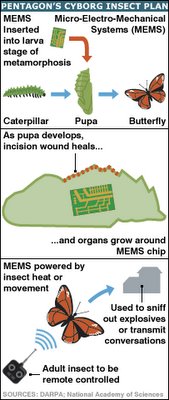
DARPA, the advanced concepts research group voted most likely to destroy the Earth, has come up with a bizarre futuristic idea for the Pentagon.

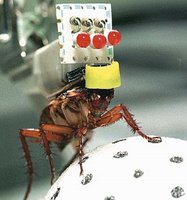
They want to create an army of cyber-insects that can be remotely controlled to check out explosives and send transmissions. The organisms would truly be cybernetic; the idea is to insert microelectromechanical systems (MEMS) at the pupa stage, when the insects can integrate them into their body, so they can be remotely controlled later.

A number of experts are skeptical, but it sounds fairly plausible to me. Most criticisms of the plan have to do with the supposed implausibility of creating such small MEMS. Indeed, today it is quite impossible, but the miniaturization revolution is in full swing, and it's likely that MEMS will eventually be manufactured that are small enough to fit inside the insect at the pupa stage.

Moreover, scientists have already created cyborg roaches that have had their nervous systems tapped into. A research team at Tokyo University is making 'cyber-roaches' by lopping off the antennae of regular cockroaches and replacing them with pulse-emitting electrodes. The researchers then send signals with a remote control to a backpack worn by the roach that powers the electrodes. The roaches can be told to go left, right, forward and back.

This is starting to become something of a trend. It was rumored at one time that either China or the United States was developing nano-ants for the purpose of destroying the enemy's infrastructure. While somewhat outlandish, it does bring to mind the evil potential for robotic locusts and other man-made blights.

Indeed, these are dangerous precursors to nanoweaponry and other forms of advanced bioweapons.

Süddeutsche Zeitung Online recently featured an article about the potential for nanotech-equipped soldiers -- namely smart dust, self-healing body armor and self-reproducing nanobots.

Some analysts, including Jürgen Altmann, are starting to think that arms control needs to be extended to miniature weaponry. In his book, Military Nanotechnology: Potential Applications and Preventive Arms Control, Altmann takes a look at the prospect of future weapons and considers international security, the new dangers for arms control and the international law of warfare, the dangers for stability through potential new arms races and proliferation, and of course, the dangers to humans and human civilization altogether.

The specific technologies that Altmann considers include extremely small computers, robots, missiles, satellites, launchers and sensors, lighter and more agile vehicles and weapons, implants in soldiers’ bodies, metal-free firearms, autonomous fighting systems, and new types of chemical and biological weapons.

Thinking it through, Altmann concludes that international treaties need to be installed, existing non-proliferation agreements need to be extended, and that a general ban on autonomous robots smaller than 20 centimeters needs to be put into force.

But as the actions of the United States has recently shown, it is a country that is not very interested in these types of constraints. Back in 2000 George W. Bush pulled out of the Biological Weapons Convention, and in 2003 he withdrew the US from the 1972 Anti-Ballistic Missile treaty with Russia. And as the illegal (civil)war in Iraq continues, and as DARPA looks to litter the battlefield with cyber-insects, the chances of attaining global consensus on the regulation of miniaturized weapons looks slim indeed.

Tags: , , , , , , , .

post to del.icio.us

Rushkoff, Kurzweil to be on CNN special

IEET fellow Douglas Rushkoff was recently recorded for a CNN special called Welcome to the Future, along with Jeff Greenfield, Ray Kurzweil, Mirka De Arellano, and Margaret Cho. The program will air on CNN Saturday March 25 at 7pm EST, and will be repeated Sunday at the same time.

Rushkoff has an account of the experience on his blog. Here's an excerpt:

It was a strange and long journey into various utopian and dystopian high-tech scenarios concerning everything from nano-bots implanted in two-year-olds so they can compete for places at increasingly selective nursery schools to why we never got to ride go carts on Mars even though Lost in Space was set in 1997.

I found Kurzweil brilliant but a little creepy. I'm usually on the gung-ho pro-technology side of discussions, so it was fun to be voicing some of the more cautionary concerns for a change. Of course, I've never really been pro-tech or anti-tech - just pro "life" (in the living things sense) and pro consciousness. While Mirka would argue against, say, genetic selection techniques on religious grounds (we should raise the children as God gave them to us), I was in the interesting position of suggesting how a balance could be struck between human agency and new technology. Do we *want* to choose our child's talents? If so, what does that say about why we want to have a child in the first place? Is it to have the opportunity to care for another human being, or simply to extend our own obsessions to another generation?

It all came down to "human nature" for Jeff Greenfield; you know, the idea that we can develop all sorts of technologies but human nature will stay the same, and use them for the same good and bad reasons. And that's when, for me, it became about the opposite: yes, human beings may have their biases, but so do the technologies we develop and implement. And we don't always know those biases when we set out to invent this stuff in the first place.
Tags: , , , , , .

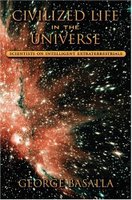
Civilized Life in the Universe

Civilized Life in the Universe: Scientists on Intelligent Extraterrestrials
by George Basalla

Book Description:

This book is a selective and fascinating history of scientific speculation about intelligent extraterrestrial life. From Plutarch to Stephen Hawking, some of the most prominent western scientists have had quite detailed perceptions and misperceptions about alien civilizations: Johannes Kepler, fresh from transforming astronomy with his work on the shape of planetary orbits, was quite sure alien engineers on the moon were excavating circular pits to provide shelter; Christiaan Huygens, the most prominent physical scientist between Galileo and Newton, dismissed Kepler's speculations, but used the laws of probability to prove that "planetarians" on other worlds are much like humans, and had developed a sense of the visual arts; Carl Sagan sees clearly that Huygens is a biological chauvinist, but doesn't see as clearly that he, Sagan, may be a cultural/technological chauvinist when he assumes aliens have highly developed technology like ours, but better.

Basalla traces the influence of one speculation on the next, showing an unbroken but twisting chain of ideas passed from one scientist to the next, and from science to popular culture. He even traces the influence of popular culture on science--Sagan always admitted how much E. R. Burroughs' Martian novels influenced his speculations about Mars. Throughout, Basalla weaves his theme that scientific belief in and search for extraterrestrial civilizations is a complex impulse, part secularized-religious, and part anthropomorphic. He questions the common modern scientific reasoning that life converges on intelligence, and intelligence converges on one science valid everywhere. He ends the book by agreeing with Stephen Hawking (usually a safe bet) that intelligence is overrated for survival in the universe, and that we are most likely alone.

Tags: , , , , , , .

March 19, 2006

New podcast available [19-Mar-06]


The latest Sentient Developments podcast is now available.

Feed: http://feeds.feedburner.com/PodcastSentDev

Tags: , , , , , , .

Neat sociohack: make a career playing contests

Carolyn Wilman has got a neat racket going on: play as many contests as possible. Wilman, who lost her job five years ago after the dot-com bust, now devotes her working hours to finding and entering various contests.

Last year she won more than 150 contests, bring in about $34,000 in cash and prizes. In 2004, she won 125 of them worth much the same. She plays everything from 99-cent music downloads to $10,000 Greek Island getaways.

"I actually think I'm on the cusp of where I want to be," Wilman says. "I'm with my family a lot. I've parlayed a passion into a career. For me this hobby is more than a hobby — it's now my life."

Entire article.

Whiny kids grow up to be conservatives

This was too good to pass up:

How to spot a baby conservative
Whiny children, claims a new study, tend to grow up rigid and traditional. Future liberals, on the other hand ...

By Kurt Kleiner

Remember the whiny, insecure kid in nursery school, the one who always thought everyone was out to get him, and was always running to the teacher with complaints? Chances are he grew up to be a conservative.

At least, he did if he was one of 95 kids from the Berkeley area that social scientists have been tracking for the last 20 years. The confident, resilient, self-reliant kids mostly grew up to be liberals.
Entire article.

The future of science

Stewart Brand of the Long Now Foundation has organized a series of seminars which he hopes will build a "coherent, compelling body of ideas about long-term thinking, to help nudge civilization toward Long Now's goal of making long-term thinking automatic and common instead of difficult and rare."

One such seminar has recently been published on Edge.org by Kevin Kelly. Titled, "Speculations on the Future of Science," Kelly tries to predict how science and the scientific method will change over the next 50 years.

As a starting point, he looks at how recursion is at the heart of science; Kelly compiled a list of new recursive devices in the history science:

2000 BC — First text indexes
200 BC — Cataloged library (at Alexandria)
1000 AD — Collaborative encyclopedia
1590 — Controlled experiment (Roger Bacon)
1600 — Laboratory
1609 — Telescopes and microscopes
1650 — Society of experts
1665 — Repeatability (Robert Boyle)
1665 — Scholarly journals
1675 — Peer review
1687 — Hypothesis/prediction (Isaac Newton)
1920 — Falsifiability (Karl Popper)
1926 — Randomized design (Ronald Fisher)
1937 — Controlled placebo
1946 — Computer simulation
1950 — Double blind experiment
1962 — Study of scientific method (Thomas Kuhn)

Looking to the future, Kelly makes some predictions (details can be found in the article):

1) There will be more change in the next 50 years of science than in the last 400 years
2) This will be a century of biology
3) Computers will keep leading to new ways of science
4) New ways of knowing will emerge
5) Science will create new levels of meaning

More specifically, Kelly comes up with possible breakthroughs in how science is done:

Compiled Negative Results - Negative results are saved, shared, compiled and analyzed, instead of being dumped.

Triple Blind Experiments - In a double blind experiment neither researcher nor subject are aware of the controls, but both are aware of the experiment. In a triple blind experiment all participants are blind to the controls and to the very fact of the experiment itself.

Combinatorial Sweep Exploration - Much of the unknown can be explored by systematically creating random varieties of it at a large scale.

Evolutionary Search - If new libraries of variations can be derived from the best of a previous generation of good results, it is possible to evolve solutions.

Multiple Hypothesis Matrix - nstead of proposing a series of single hypothesis, in which each hypothesis is falsified and discarded until one theory finally passes and is verified, a matrix of many hypothesis scenarios are proposed and managed simultaneously.

Pattern Augmentation - Pattern-seeking software which recognizes a pattern in noisy results.

Adaptive Real Time Experiments - Results evaluated, and large-scale experiments modified in real time.

AI Proofs - Artificial intelligence will derive and check the logic of an experiment.

Wiki-Science - The average number of authors per paper continues to rise.

Defined Benefit Funding - The use of prize money for particular scientific achievements will play greater roles.

Zillionics - Ubiquitous always-on sensors in bodies and environment will transform medical, environmental, and space sciences.

Deep Simulations – As our knowledge of complex systems advances, we can construct more complex simulations of them.

Hyper-analysis Mapping – Just as meta-analysis gathered diverse experiments on one subject and integrated their (sometimes contradictory) results into a large meta-view, hyper-analysis creates an extremely large-scale view by pulling together meta-analysis.

Return of the Subjective - Existence seems to be a paradox of self-causality, and any science exploring the origins of existence will eventually have to embrace the subjective, without become irrational.

Tags: , , , , , , .

The Posthuman Condition: Consciousness beyond the Brain, by Robert Pepperell (2003)

This highly readable update to a 1998 release unites the postmodern and the posthuman in a provocative but limited piece of speculation

By George Dvorsky, November 3, 2003

The philosophical struggle to grab hold of and understand what is real and what is not is as old as civilization itself. Today, in light of the potential for radical human redesign and the reimagining of the human organism and condition, perspectives as to what constitutes the self, the body and the environment are becoming increasingly vague and inadequate.

Author Robert Pepperell, in this revised version to his 1998 book The Post-Human Condition, explores these particular themes while challenging the traditional assumptions of human uniqueness and superiority in consideration of 21st century technologies. As Pepperell notes, "the possibilities suggested by synthetic intelligence, organic computers and genetic modification are deeply challenging to that sense of human predominance."

Moreover, through the application of a discernibly postmodernist bias to futurist issues, The Posthuman Condition reads like a critique of rigid scientific methodologies and traditional humanism. Questions of machine consciousness and sentience are difficult to answer, writes Pepperell, "given the redundant concepts of human existence that we have inherited from the humanist era, since many widely accepted humanist ideas about consciousness can no longer be sustained." New theories about nature and the operation of the Universe, he argues, are "starting to demonstrate the profound interconnections of all things in nature where previously we had seen separations."

Considering that most futurists and transhumanists adhere to the legacy of rational humanism and Enlightenment notions of perpetual progress, Pepperell takes his life into his own hands by co-opting the posthuman and claiming it as his own. He even includes his own posthuman manifesto.

Consequently, The Posthuman Condition, while it reads lucidly and vibrantly, is a book that infuriates as much as it titillates. Pepperell offers an interesting but problematic fusion of skeptical epistemology with the latest thinking in the sciences, including cybernetics, artificial intelligence and chaos and complexity theories. Ultimately, while he offers provocative insight into the nature of knowledge and consciousness, he offers very little in terms of practical futurology, while completely misunderstanding and ignoring the valid humanistic roots of today's practical posthumanism.

The real and the artificial

The founder of the Hex multimedia collective and the coauthor of The Postdigital Membrane, Pepperell recognized the inexorable collision of postmodernist thinking with futurism back in 1998 when he wrote the initial version of The Posthuman Condition.

For Pepperell, posthumanism is more than just the attainment of a post-biological state of being, it also marks the end of the humanist period of social development, because of "the fact that our traditional view of what constitutes a human being is now undergoing a profound transformation."

The profound transformation that he speaks of is the fusion of humans and machines and the rise of artificial intelligence. Pepperell exposes the lines that are about to blur and wonders how thinkers will distinguish between the real and the artificial, the original and the simulated, the organic and the mechanical. He suggests that very soon these will become little more than semantic distinctions.

To bring his readers up to speed on the technologies that will bring these changes, Pepperell devotes the introduction of his book to a concise summary of the pending technologies, including quick notes on robotics, communications, prosthetics, intelligent machines, nanotechnology, genetic manipulation and artificial life. Once he gets this formality out of the way, Pepperell gets down to the nitty-gritty, and tackles one of the hardest problems in modern science, that of consciousness. And true to his scientific skepticism, he takes a philosophical approach to the problem of mind.

The fuzzy human

In spite of his avoidance of any substantive discussion of the mechanics behind human consciousness, Pepperell offers a fascinating account of how consciousness should be understood, defined and circumscribed. In Stelarc-like fashion, he declares that there are no boundaries that divorce humans from their environment. Pepperell advocates a form of "embedded" or "embodied" intelligence, arguing that consciousness cannot be understood—let alone exist—without placing it in the sensorial and perceptual context of the conscious being's environment.

"[A]n integrated continuum exists throughout human consciousness, body and environment," writes Pepperell, "such that any distinction in that continuum...is contingent and arbitrary." The general implication, he argues, is that we can never determine the absolute boundary of the human, either physically or mentally. "In this sense, nothing can be external to a human because the extent of a human can't be fixed," he writes. The implication is anything but trivial, suggesting that "human beings do not exist in the sense in which we ordinarily think of them, that is as separate entities in perpetual antagonism with a nature that is external to them."

Indeed, there is undoubtedly much truth to embodied intelligence theory. It is impossible to deny that the mind cannot exist without a body and an environment, whether real or simulated. The mind feeds and reacts off the information that is fed to it by its body and surroundings.

So powerful is this conception that, as Pepperell concedes, it is quite possibly the most dominant paradigm in artificial intelligence research today. The human, the mind and the environment are indistinguishable, says Pepperell, leading him to conclude that posthuman intellects will continue to migrate and blend into their surroundings.

Attacking scientific reductionism

Continuing with this line of inquiry, Pepperell declares that there are no determinate origins, ends, complete answers or final reasons for the existence of anything. "It's not that we can't find them," he writes. "But that they're just not there."

Along the lines of fuzzy knowledge, Pepperell notes that recent scientific ideas have upset conceptions of order and disorder, continuity and discontinuity—namely chaos, catastrophe and complexity theories. It is because of these insights, argues Pepperell, that humanist notions of mechanism, reductionism and determinism have become dated.

However, Pepperell's disapproval of scientific reductionism should be taken with a grain of salt, and not just because he replaces it with its bipolar cousins, expansionism and extensionism. These types of deconstructionist and postmodernist lines of inquiries often venture far too close to radical skepticism for my liking. Accusing scientists of reductio ad absurdum can come perilously close to denying the measured, calculated and predictable observations of the Universe. As evolutionary biologists Richard Dawkins once said, "reductionism is explanation."

On humanism and posthumanism

Pepperell's take on the humanist legacy isn't entirely fair or accurate. He declares posthumanism to be the philosophical and methodological successor to humanism, but fails to acknowledge how humanist thinking has in many ways contributed to progressive posthumanist thought; in many respects, posthumanism is the transitional successor to humanism, and not postmodernism as Pepperell insinuates. In fact, while most of those who call themselves posthumanist tend to be critical of the humanist movement, more and more humanists have, with relative ease, shifted their thinking in favor of progressive or transhuman thinking.

In one example, Pepperell characterizes humanism as a philosophy that places humans in a combative relationship with nature. Posthumanism, says Pepperell, suggests that people are not in opposition to nature, but an intrinsic part of it. While this is interesting from a philosophical perspective, particularly as it pertains to human consciousness, it does very little to explain how we are to deal with such things as disease, asteroid impacts and gamma ray bursts.

For centuries now, humanists have insisted that it is through the comprehension of our surroundings that we can better deal with the dangers of nature. Thinkers such as Marquis de Condorcet, David Hume, Denis Diderot, Claude Adrien Helvétius and Benjamin Franklin insisted that nature was not necessarily something to be fought or resisted, but something to be understood in order for humanity to better survive and prosper.

In some respects, this is an issue of semantics. Pepperell considers the post-biological or transhumanist element to be one facet of his brand of posthumanism, the other parts being the end of humanism and the beginning of a new (or is that old?) form of epistemological skepticism. It is because of Pepperell's proprietary definition of posthumanism that a number of futurists and transhumanists will have serious problems with his analysis.

Future persons

To bolster his argument, Pepperell includes a very interesting chapter on art, aesthetics and creativity. His analysis of Einsteinian relativity and cubism reveals that perceptual relativity can cross mediums, and is a developmental trend that has now entered into our cultural artifacts.

Pepperell, an artist himself, aptly observes that art forms exist outside of speculative fiction that contributes to our sense of our present and future selves. That being said, his subsequent chapter on automating the creative process felt somewhat out of place and forced. If Pepperell was trying to argue that creativity is a requisite for consciousness, he did so in an unconvincing and incomplete way.

Still, as do many futurist and transhumanist thinkers, Pepperell predicts a time when synthetic and cybernetic creatures will walk the earth. Where he and other futurist thinkers diverge, however, is in how these intellects and posthumans will conduct their affairs.

Aside from saying that it will act creatively and artistically, Pepperell is surprisingly vague on future life, except for such statements as, "Science will never achieve its aim of comprehending the ultimate nature of reality. It is a futile quest...[t]he posthuman abandons the search for the ultimate nature of the Universe and its origin (thus saving a lot of money in the process)."

Pepperell is less concerned with pragmatics than he is in formulating the philosophical rudiments of what he believes will be the next era in the social development of intelligent life. Essentially, Pepperell takes a science studies approach to futures issues while also taking the opportunity to slam scientific reductionism, including conventional notions of what is meant by consciousness and humanity, all the while touting postmodernist notions that proclaim the limitations to what can realistically be known.

What makes this work so interesting and perplexing is that Pepperell uses the latest science to reveal the limitations of science. It would seem that the more we know, the less we know—or, as Pepperell would claim, the more we know, the more we realize what we can't know.

Copyright © 2003 George Dvorsky

This column originally appeared on Betterhumans, November 3, 2003.

Tags: , , , , , , .

post to del.icio.us

Better Living through Transhumanism

More than just a philosophy and social movement, transhumanism is for many a way of life

By George Dvorsky, November 10, 2003

Some experts believe that all genetic-based diseases will be eliminated by 2030. The widespread application of genetic and other technologies, it is thought, may also result in significant increases to human intelligence, memory, physical health and strength. Some expect the achievement of indefinite lifespans this century and believe that immortals already walk among us.

Researchers suspect that the development of strong nanotechnology in the coming decades will result in molecular assemblers that effectively function like Star Trek replicators. A number of experts are hopeful that medical nanotechnology will be used to revive those who are preserved in cryonic stasis. It is also suspected that advances in both nanotechnology and robotics will greatly alter the current socioeconomic infrastructure, potentially resulting in such things as massive unemployment, the need for a basic guaranteed income, and the general rethinking of how people should coordinate their activities and leisure time.

Steady advances in computing processing power are leading many experts to conclude that human-equivalent artificial intelligence may be attainable by the year 2040, if not sooner. After that, as intelligent machines continue to redesign themselves and recursively improve, they will likely develop into superintelligences, with cognitive capacities thousands of times greater than that of humans. No one knows what this will mean to humanity, causing futurists to dub the hypothesized event the "technological singularity," or simply the Singularity.

These predictions are nontrivial to say the least. Of course, they are just predictions, and most casual observers maintain that these things will never come—or at least not within their lifetime. Futurists such as myself tend to be less skeptical, recognizing the remarkable upward trends in technological research and development; things are set to change quite dramatically and quite quickly.

In consideration of these predictions, a growing number of people are turning to transhumanism, which aims to promote and encourage human enhancement through the application of science and technology. They maintain that this is a good thing, and that we should encourage and work towards the attainment of a posthuman condition.

While many—including me—have written often about transhumanism, few have elaborated on how the transhumanist mindset has an impact on how people live their life in the present. Not ones to dwell on the future while passively waiting for it to happen, transhumanists engage in foresight, activist and promotional activities.

Just as significantly, the day-to-day lifestyle choices of transhumanists such as me reflect anticipated change. I am in my early 30s, which means that barring some unfortunate accident (with no cryonic or other backup plan) I'll be around to witness, participate and take advantage of future radical developments. Consequently, everything from my ethical and moral foundations to my eating and exercising habits are in some way influenced by how I think the next 50 years will go.

And I am hardly alone. Transhumanism is in many respects a burgeoning lifestyle choice and cultural phenomenon.

Transhuman spirituality and ethics

Without unforeseen conceptual or political impediments to scientific and technological progress, or some kind of manmade or natural catastrophe, some if not all of the predictions I listed above are likely to come to fruition this century, possibly even during the next 50 years.

For society in general, this will represent a mixed blessing at best. People who cling to dated, comforting and static worldviews, including those who suffer from scientific illiteracy, are heading for serious bouts of future shock. Cyborgs, transgenic human-animal hybrids, sentient machines and uploaded consciousnesses can do that.

To be fair, some of the more radical notions and predictions even make me squirm in my seat. To help me deal with future shock, and to objectively assess the changes that humanity is about to undergo, I often rely on some good ol' fashioned Buddhism to help me through.

I was a Buddhist before I became a transhumanist, but the two idea-sets proved to be surprisingly compatible. In fact, many transhumanists describe their "spiritual" or moral beliefs as having Eastern and Buddhist influences. Personally, Buddhism works for me on a number of levels, including its humanism, compassionate tenets, and its denial of God and the soul, or the self.

I am also partial to how Buddhists encourage progress and the cultural harmonization of the observations of Western science. Like the humanists of the Enlightenment, Buddhists tend to see science and progress as a way to better comprehend reality and as a means to reduce suffering. Buddhists see no hubris with scientific research. The Universe and all that is in it is not something to be fought and resisted, nor should its components be divided into the sacred and profane, the natural and the unnatural. Einstein, who may have been a Buddhist himself, once asserted that Buddhism is the future of religion, and acknowledged that, "The most incomprehensible thing about the Universe is that it is comprehensible."

The Dalai Lama himself has openly stated that Buddhist goals are "the same as those of Western science," to "serve humanity and to make better human beings." The Dalai Lama has also gone on record as saying that he believes an artificial consciousness is attainable and should be treated and respected as a person. Buddhism, unlike many other religions or philosophies, reject "yuck factor" ethics, abstractions and romantic divinations in favor of rational, pragmatic and empathetic considerations. It's no coincidence, therefore, that so many Buddhists subscribe to personhood ethics.

Transhumanists can certainly relate. Most have put their trust in science, and have no trouble imagining themselves as nonbiological or transgenic posthuman organisms. Moreover, transhumanists tend to recognize the medical potential for future technologies and how it can and should be applied to reduce diseases and disabilities and to create "better humans."

And more radically, transhumanists such as me look to science and technology as a possible means for the creation of a Nirvana-esque and quasi-utopian future—or at the very least, as a means for perpetual progress.

Live long and prosper

I became a vegetarian last year and, once again, as a transhumanist I am by no means unique in this respect. I was a very unlikely candidate for this type of change, as I used to eat meat at nearly every meal. But a number of factors conspired to lead me to this change.

Obviously, the Buddhist respect for sentient life played a significant part. Combined with recent advances in the cognitive sciences, it became obvious to me that many of the nonhuman animals that landed with great regularity on my dinner plate were once intelligent and conscious creatures. Moreover, I realized that it was unnecessary for my survival or health that animals should continue to die for my benefit.

I also became a vegetarian for health and longevity reasons. Even conservative predictions suggest that the goal of negligible senescence will be achieved at the turn of the next century, meaning that I would have to live to 130 years of age—not outrageous if you consider the advancements that are sure to come in genetics, biogerontology, cybernetics and nanotechnology. Thus, being in my 30s, I realized that if I were to reap the benefits of future life extension technologies, including the radical possibility of attaining an indefinite lifespan, I was putting those possibilities at risk by clogging my arteries with animal fat and filling my brain with Creutzfeldt-Jakob disease, and not reaping the benefits of antioxidants and raw foods.

And true to transhumanist and Extropian principles, the conversion to vegetarianism (or any other life change) can be interpreted as an expression of ongoing personal evolution and the continual challenge to improve one's moral, intellectual and physical condition. Complacency is not a word in the transhumanist vocabulary.

When it comes to life-extending eating habits, however, there are some transhumanists who make me look like a kid after Halloween. Many immortalists practice caloric restriction, for example, which experiments have shown retards the aging process in every animal tested so far. Some immortalists carefully manage their diet, including vitamins and supplements, and even test their blood to help guide their dietary and pharmaceutical choices. Many transhumanists believe that such short-term pains will be surely outweighed by long-term gains.

Applying unconventional technologies and techniques

The idea of fooling the body's natural processes, through such things as caloric restriction, is referred to in some circles as "biohacking." Transhumanists recognize that their bodies are a kind of machine—one that can be studied, understood and subjected to hacks. A recent article by Katharine Mieszkowski on Salon, "Hackers on Atkins," showed how a number of dieters are "cheating" by going on the low carbohydrate, high protein and unintuitive Atkins diet. As Mieszkowski says, the Atkins diet is a "a sneaky algorithm for getting the body to do what you want it to do, a way of reprogramming yourself. Programmers, who are used to making their computers serve their will, are now finding that low-carb diets enable the same kind of control over their bodies."

Similarly, although not considered technology by most, I consider yoga and meditation to be types of "software enhancements" that, when applied, strengthen both the body and mind. Yoga, aside from being extremely enjoyable, offers numerous physiological and psychological benefits, including increases to strength, endurance, balance and somatic and kinesthetic awareness. Yoga, of which I practice Hatha, also improves mood, reduces feelings of hostility, depression and anxiety, and increases feelings of self-acceptance and self-actualization.

Meditation is another powerful technique, one that not only calms the body and mind, but also improves mood and clarity of thought. It also contributes to greater cognitive awareness and happiness. Meditation helps me to better regulate my thoughts and emotions and to better understand how it is that certain ideas, feelings and motives enter into my conscious thoughts and how I can better process and act on that information. I often think of my meditation, which is derived from the Theravadan Vipassana tradition, as memetic Vipassana meditation, as it helps me better manage the competing memes that often cloud and influence my thoughts and perception.

Applying hi-tech to daily living

Needless to say, transhumanists also apply the latest technologies to their daily lives to both overcome biological limitations and to enhance individual performance and efficiency. I tend to take a Zen transhumanist approach to computer use, and I am never satisfied with my work processes. I am constantly striving to improve and refine my work habits to come up with quicker and more effective ways of working.

For example, I memorize patterns of keyboard shortcuts to increase my efficiency when working on mundane or repetitive tasks. I don't go anywhere without my handheld PDA, which acts as my memory and math skills prosthesis, an on-demand dictionary and thesaurus, and as a task scheduler. I use group collaboration tools to help me with my work and I visit personal networking sites to help me meet and communicate with people with similar interests. I know of some transhumanists who carry around small recording devices to supplement their memories, constantly recording conversations and other audible events.

As a contributor to the transhumanist blogosphere, I have to find lots of information fast, and because of my busy schedule, time is often of the essence. To help me find news items, I use the Mozilla Web browser's multiple tabs and group bookmarks functionality; when scouring the Web for information, I refer to about six different sets of preconfigured and specialized bookmark groups that contain as many as 15 Websites each. I also use the Google News Alerts feature so that the news comes to me.

Speaking of Mozilla, like many transhumanists, I am also interested in the open source movement, as it not only represents a new and innovative way of developing new technologies from a bottom-up and user-perspective, but it may come to represent an important change in the development, economy and dissemination of new technologies.

At the same time, I consciously avoid certain technologies, namely television and video games. While I recognize the entertainment and (sometimes) educational value of these mediums, they are the soma of our times, representing drug-like distractions from my goals, contributing to passivity rather and activity.

Better at assessing change and progress

Transhumanists tend to look at the world through linear-colored glasses. News items are almost exclusively evaluated based upon their short and long-term impact on the human condition. As a result, most transhumanists consider the daily headlines put out by the major media outlets to be trivial and disinteresting at best.

For example, a new item about the latest efforts to expand the lifespan of a nematode worm to the equivalent of 500 human years will reach the back pages of most news publications, but it's the kind of news that tops the lists in transhuman circles. The same goes for debates about research on stem cells, human cloning, genetics, bodily autonomy issues, the state of health care and artificial intelligence. This is the stuff, transhumanists maintain, that really matters.

Consequently, transhumanists, through their worldviews and lifestyle choices, and through their ability to deal with and better understand the changes on the horizon, are putting themselves in a better position than most to anticipate and apply the coming technologies to their lives and their bodies; they are inoculating themselves against future shock.

Transhumanists hope that future advancements will work to the benefit of humanity, and that missing out on this potential, either because of sweeping bans or preventable catastrophes, would be a travesty. Thus, a significant part of the transhumanist agenda involves getting the word out.

The more people are brought into these discussions the better. It is vital that the high degree of knee-jerk and reactionary opinion that dominates discussions of posthumanity be reduced as much in possible in favor of rational, informed and realistic discussions. By having these issues and debates enter into the popular zeitgeist, we collectively stand a better chance of avoiding the stresses and confusions sure to be posed by coming waves of radical change.

Copyright © 2003 George Dvorsky

This column originally appeared on Betterhumans, November 10, 2003.

Tags: , , , , .

post to del.icio.us

March 17, 2006

New podcast available


The latest Sentient Developments podcast is now available.

Feed: http://feeds.feedburner.com/PodcastSentDev

Tags: , , , , , , , , , , , , .

March 16, 2006

Joining the Lifeboat Foundation advisory board

I have recently joined the scientific advisory board for the Lifeboat Foundation, a group devoted to "ensuring that humanity adopts the powerful technologies of genetics, nanotechnology, and robotics safely as we move towards the Singularity."

The Lifeboat Foundation is pursuing a number of option to meet it goals, including the promotion of technological relinquishment and helping accelerate the development of defensive technologies including anti-biological virus technology, active nanotechnological shields, and self-sustaining space colonies in case the other defensive strategies fail.

My bio can be found here. I'm in good company as I join the likes of Ray Kurzweil, Michael Anissimov, Eliezer Yudkowsky, Robert A. Freitas Jr., Aubrey de Grey, James Hughes, David Pearce, Seth Shostak, Mike Treder, among many others.

It was the Lifeboat foundation who recently awarded Freitas and Bill Joy the 2006 Guardian Award.

The Matrix: Devolutions

What began as promising and profound ended in disappointing and formulaic, highlighting Hollywood's reluctance to explore the cutting-edge in speculative fiction

By George Dvorsky, November 24, 2003

I was coming down with what turned out to be strep throat and was utterly exhausted from a long and trying day at work. But it was opening night for The Matrix: Revolutions, which I had planned to see that evening.

I considered postponing but my resolve proved weak. For some inexplicable reason I found my way into a packed movie theater at 10:30 PM to see the final installment of the trilogy. Two hours later I left still sick and exhausted, and to my list of ailments I could now add mild depression and disgust.

Yup, they blew it.

The Wachowski brothers, who four years earlier climbed into the genius category faster than Neo can dodge bullets, turned a visually spectacular and philosophically engaging piece of speculative fiction and fantasy into a conventional and ultimately meaningless action thriller.

Consequently, the significance of The Matrix series as both groundbreaking and entertaining silver-screened speculative cyberpunk was squandered. Instead of expressing something important about humanity's place in the Universe, the Wachowskis resorted to clichés, formulaic plot devices, stock characters and stunningly conservative approaches to the science fiction genre. The brothers that we came to know and admire from the original Matrix seemed to be replaced by Hollywood hacks.

It didn't have to be this way. Hollywood can't seem to get its head around the fact that there are many good stories and unconventional concepts worthy of consideration. What's more, as witnessed by the reaction to the first Matrix, there's an audience that's very thirsty for this type of speculative fiction.

Welcome to the real world

The original Matrix, in its exploration of the nature of reality, existence, perception and knowledge, spawned nothing less than a cultural revolution. Its effect on pop culture, visual aesthetics and the zeitgeist has been nothing less than extraordinary. In the four short years since its initial release, The Matrix had as large an impact as Star Wars did in the late 1970s. But unlike George Lucas's swashbuckling space fantasy film, The Matrix contributed as much to philosophical discourse as it did to special effects wizardry.

University professors are constructing lesson plans based around the film. Graduate students are writing theses about it. Philosophy and religion sections in bookstores are littered with Matrix books. The cosmological suggestion that we may in fact be living in a simulation was suddenly given added credibility. And recently, in his book Matrix Warrior, author Jake Horsley argues that we are in fact living in nothing less than the Matrix as portrayed in the film.

It was against this backdrop that the The Matrix sequels were released, with much anticipation. Considering how cutting edge and provocative the original film was, most fans, me included, were desperate to know just how far the Wachowski brothers would take the franchise.

Squandered potential

Unfortunately, they didn't take it very far at all. The second installment, Reloaded, wasn't great, but it was memorable. But where Reloaded was entertaining and interesting, Revolutions was predictable and thin. It was like a retread action movie, with tired themes of faith, Christian mythology and sacrificial messianism thrown in. How boring. How banal.

Hence the reviews have been anything but flattering, reflecting near universal disappointment. Curiously, however, a number of reviewers commented on how nicely everything was resolved.

This is strange to me because I felt that virtually nothing of import was resolved, and that's part of the problem. At the conclusion of Revolutions, the Matrix construct remains intact, same as it ever was. An uneasy peace has been established for a completely inexplicable reason, and the machines still clearly hold the cards. Then there are Neo's superpowers outside of the Matrix, which are never adequately explained. The movie forces viewers to suspend disbelief to the point of psychosis. It's as if we're supposed to feel stupid in not getting it—scriptwriter laziness passed off as inaccessibly deep thought.

And I'd say that the ending was designed to leave the door open for further sequels. The nothing-has-really-changed finale is evidence that the Matrix world will forever remain a static one, a franchise that can be easily marketed across different media. Consequently, compelling speculative science and philosophy has been sacrificed for the sake of the almighty dollar. The Boys, as the Wachowskis are called, sold out.

Counterrevolutionary

Admittedly, much of my disappointment in Revolutions stemmed from the fact that it didn't even come close to matching my predictions and expectations. The first two films had enough concepts in them to suggest something profound and, well, revolutionary, was going to happen in the finale.

There were a number of questions that I hoped to see answered in the conclusion. Could the inhabitants of Zion find a way to overthrow or merge with the machines and, if so, could they leave their squalid underworld and create a new virtual home for themselves in a Matrix of their own design? In this new world of cyber-Hegelian resynthesis, could humans continue to reprogram reality and morph it at will, marking the next stage in the evolution of intelligent life?

Or, as implied by the Architect in Reloaded, could there be other, deeper realms of existence unknown to humanity? Does the Creator have a Creator? Would Neo find a way to transcend his humanity and his surroundings and become a superhuman who can explore alternate realities and dimensions? Just how far would the hacker motif be developed?

And how far would the Buddhist and Eastern philosophical themes be taken? Would Neo finally realize that Agent Smith was the physical manifestation of his own ego? Would he figure out that to end the suffering caused by his ego attachment he would have to seek a reconciliatory union with his splintering psychologies? Could Neo and the others jacked into the Matrix free themselves from the illusion that imprisons and misleads them? Could Neo break the endless cycle of death and rebirth? Would such a perceptual and epistemological breakthrough allow the inhabitants of the Matrix to achieve a state of enlightenment? Nirvana?

It can be done

Frustratingly, the failure of Revolutions was a deliberate failure of imagination. Innovative ideas such as these exist in today's science fiction; the genre is as strong and compelling as it has ever been. These themes have in fact been explored across different media, including film.

Back in 1968, Arthur C. Clarke and Stanley Kubrick collaborated on the now classic science fiction film 2001: A Space Odyssey. At the time of its release, sci-fi movies typically meant four-eyed monsters chasing scantily clad women across the screen. Inspired by what Gene Roddenberry did for the genre on television through his Star Trek series, Clarke and Kubrick showed through 2001 that concept can in fact be conveyed on the silver screen in both an entertaining and thoughtful manner.

2001 chronicles no less than four million years of human history, exploring humanity's relationship with its technology, its lack of psychological development over the course of that time and its place in the Universe and ongoing evolution. The movie concludes with David Bowman's transcendent (or is that trippy?) journey as he is transformed from man into posthuman Star Child.

And like any great science fiction movie—the original Matrix included—great visuals need not be compromised. 2001 featured cutting edge special effects that have stood the test of time, revealing a universe of awe, danger and magnitude.

As for current science fiction, however, the written word is clearly where it's at. Authors such as Vernor Vinge, Greg Bear and John C. Wright continue to explore the realms of science and the future.

Perhaps the most talented science fiction writer of today is Greg Egan, who is both the H. G. Wells and Isaac Asimov of our time. Egan, who displays an uncanny grasp of science and technology, has an almost preternatural gift for speculative fiction. Reading Egan, your mind is blown with each turn of the page.

Egan has grasped the future's potential unlike any current author. In his 1997 novel Diaspora, he envisions humanity speciating out in different directions, including uploaded humans who live in supercomputer-run simulated realties that are buried deep underground. Other posthuman forms include cyborgs, robots and genetically modified biological humans. And Egan doesn't stop there, as the heroes of the novel journey to the jaw-dropping limits of the Universe and beyond.

Unfortunately, Hollywood tends to be about 20 years behind written science fiction at any given time. Excluding 1982's Blade Runner (which was ahead of its time and largely ignored as a science fiction classic until the 1990s), The Matrix marks Hollywood's first successful foray into cyberpunk, a reimagining of William Gibson's 1984 classic, Neuromancer.

So, the good news is that we'll eventually see the visions of Vinge, Bear and Egan hit the big screen. The bad news is that we're going to have to wait a while. And in the meantime, we'll just have to suffer through more boring and unimaginative Hollywood films. Science fiction movies such as the original Matrix, it would seem, come about once every 20 years.

Copyright © 2003 George Dvorsky

This column originally appeared on Betterhumans, November 24, 2003.

Tags: , , , .

post to del.icio.us

Beating Beijing's Big Brother

As authorities fortify the Great Firewall of China, information technology is allowing increasingly modern, high-tech and culturally sophisticated Chinese to slip the grip of totalitarianism

By George Dvorsky, December 8, 2003

During the late 1990s, as the Internet wave swept virtually every part of the world, the Chinese government reacted by establishing its own internal and highly regulated Internet. Dubbed the "Great Firewall of China" by cynical outsiders, the move marked a dangerous and disappointing precedent for Chinese information technology policy.

Since that time, Beijing has continued to make life difficult for those desiring specific types of information. Citizens are prevented from visiting some Websites and engaging in some online activities. Those who dare defy the system put themselves at risk of arrest—or worse.

This fusion of information technology with a totalitarian agenda bears a startling resemblance to the Orwellian nightmare in which information flow is tightly managed and deviously engineered by those in power. The Chinese may be making great strides in such fields as space exploration and biotechnology, and are certainly moving forward in information technology and modern capitalism, but old-school Marxist impositions remain.

The question we must ask now, as we inexorably head deeper into the digital age, is this: To what extent can the communist Chinese authorities continue to control and use information technology for their own political and ideological ends? Will they be capable of implementing a Big Brother style Internet and society, or is this a project doomed to failure as the Chinese move further into the information age?

Given recent events in China, it's still hard to say. But I'm inclined to think that controlling a country of more than one billion people who have access to an ever-growing assortment of savvy communication technologies will be no easy task, demanding a massive police effort that would be hugely impractical and untenable to maintain. Instead, through the application of novel technologies, democratization may be forced upon Chinese authorities whether they like it or not.

Building information armor

There are now more Internet users in China than any country in the world apart from the US. With numbers steadily increasing, the country now boasts an estimated 68 million users online.

At the same time there are tens of thousands of Websites blocked from Chinese eyes. The Chinese government is doing its best to isolate its citizens from sites that it deems offensive or politically incompatible. Citizens are prevented from accessing sites that express dissenting political opinions, religion, sexually suggestive material and gambling.

"Obviously there is some harmful information on the Internet," says Chinese Foreign Ministry spokesman Kong Quan. "Not everyone should have access to this harmful information," he says, "the whole world now is exploring a way to manage the Internet and China is also working on this."

In part, Beijing has been able to control much Internet access by eliminating search engines such as Google and AltaVista altogether. Google was banned for a time in 2002, accompanied by a loud chorus of outrage. It has since been returned.

Yahoo!, unlike Google and AltaVisa, agreed (or is that caved?) to voluntarily block access to certain Websites in accordance with Chinese Internet laws. Some of the sites that have been blocked by Yahoo's China-based affiliate include the US Courts, Playboy, MIT, CNN, Voice of America and even, apparently, this very publication, Betterhumans.com.

To ensure stronger government control, and in a move that smacks of economic protectionism, Chinese authorities have recently urged China's IT industry to develop and implement its own encryption standards for wireless networks. It's been speculated that the Chinese government is concerned about having its own network hacked. More likely it's an attempt to prevent the free flow of information from person to person that wireless technology allows. This move is a continuation of like-minded policies, including Beijing's 1999 order to importers to provide extensive information about Web servers and other computers with encryption technology, and to replace with Chinese products any software rejected by the government.

The Chinese authorities are also training "Internet police," who will be used to trace and arrest political dissidents who are using the Internet to evade state censorship. Recently, exiled Chinese dissident Xu Wenli spoke out on the matter, noting that the government "used to sentence people because they spoke to a newspaper abroad or spoke to VOA." He claims that Chinese communist authorities are jailing dissidents simply because they are using the Internet to disseminate or read political views. "Lately people who have gotten online have been arrested and sentenced," says Xu. "A lot of students are training as Internet police online to censor articles. This is a very dangerous signal for us."

Xu's disclosure is consistent with a report put out by Amnesty International in late 2002. It was shown that through these types of policies Beijing has effectively created a new type of "prisoner of conscience." At the time that the report was issued, at least 33 people had been detained for Internet subversion and two prisoners had subsequently died after apparent torture or ill treatment. "Internet users are increasingly caught up in a tight web of rules restricting their fundamental human rights," reads the report. "Anyone surfing the Internet could potentially be at risk of arbitrary detention and imprisonment." Amnesty International has been critical of China's efforts to block foreign websites, create Internet police and close off sites with articles on corruption or criticism of the government.

Where there's a wall there's a way

Despite Beijing's efforts to control the Internet, however, it hasn't been all smooth sailing. The very essence of information technology makes it difficult to control, and this is what Beijing is now coping with. Every action has a reaction, and in the information age every measure has a countermeasure.

While Yahoo! has acquiesced to China's terms, for example, AltaVista has been anything but happy about censorship. James Barnett, AltaVista's CEO, has made his displeasure with the Chinese government very clear. He plans to make the search engine available through other avenues that are accessible to Chinese citizens, including the no-frills search engine Raging.com. Even though less than five percent of AltaVista's audience originates in China, it's the principle that matters to Barnett. "This is very unfortunate," he says. "We believe free and open access to information is critical to the global community."

And for the brief period in which Google was off limits, an innovative—if not tongue-in-cheek—workaround was devised: A mirror site called Elgoog (Google spelled backwards). Elgoog allows users to type in search queries backwards and access the genuine Google database, with results returned backwards. While the mirror site was intended as a spoof, a number of Chinese citizens asked that it be un-mirrored and made completely functional.

Indeed, as much of the world is finding, there will always be cracks in the Internet armor. And according to Guo Liang, deputy director of the Research Center for Social Development at the Chinese Academy of Social Sciences, Beijing is quickly losing control of Internet usage. "You cannot control [the] Internet," he says, "People can receive all sorts of information." Guo's observation is on the mark. It's difficult, for example, for filters to scan a graphic with text on it. Moreover, with access to encryption technologies, including 128-bit encryption, it is already near impossible for messages to be deciphered en route from source to destination.

The kind of information that is seeping into China is reminiscent of what transpired during the Cold War between the US and the Soviet Union. As an example, the news and propaganda wing behind the US government's VOA broadcasts has developed a type of virtual private network that lets Chinese running Microsoft Windows operating systems breach the Chinese firewall. Known as a circumvention Web server, it allows users to effectively tunnel under the firewall to access VOA broadcasts. Ken Berman, program manager for Internet anticensorship at the International Broadcasting Bureau, which puts out the VOA radio and Internet transmissions, is concerned about how highly censored news is in China. "The Chinese government jams all of our radio broadcasts and blocks access by their people to our Website," he says. "We want to allow the people there to have the tools to be able to have a look at it."

Disenchanted by what Beijing is doing, and as a means to protest what they consider to be the illegitimate detainment of Chinese citizens, a number of hackers have taken to a new form of political agitation known as hacktivism. These hackers have penetrated and disabled a number of Chinese firewalls and defaced Websites, including the Tianjin City Network of Information of Science & Technology site, which explains what the people of China are entitled to access legally over the Internet.

Tearing it down

Of course, information and communication technologies are more than just a means to transfer and access data, they are also an effective vehicle for novel means of expression, be they artistic or political. The West has witnessed the rise of personal sites and blogs and China, it would appear, is not immune. Needless to say, the Chinese authorities are increasingly concerned with the way that the Internet contributes to the individuation of its citizens and allows them to spread what it considers to be deviant ideas and behaviors. The democratization of China is happening, and it's happening at the grassroots level.

One example is the excellent Living in China blog at which contributors frequently add what they consider to be newsworthy items. The tagline for the blog is explicitly democratic: "One Country, Many Voices." The blog aims to showcase the growing variety of opinions and experiences of those living in and writing about China.

Recently, a racy Chinese blog caught the attention of Chinese authorities: The personal site of 25-year-old sex columnist, Mu Zimei. Writing about the intimate details of her personal life and sexual experiences, Mu has attracted millions of followers to her site. Needless to say, Beijing, after ignoring the site for some time, eventually reacted in a predictable manner; the state-run Beijing Evening News severely criticized Mu and accused Sina.com, the popular Chinese portal site that bought the rights to Mu's blog, of wrongly promoting her to attract more visitors. "The blind pursuit after this kind of phenomenon," the newspaper stated, "will mislead people into thinking that the government authorities over news are turning blind to this." Bowing under this pressure, Sina.com quickly pulled back in its promotion of the blog, but did not remove it. However, in an effort to diffuse the controversy, Mu has quit her columnist job and voluntarily shut down her Website.

It's safe to say, though, that despite the regrettable resolution to this story, it's certainly not going to be the last of its kind. Freedom of expression is about to become a big issue in China, one that is being fueled by the introduction of new technologies.

Indeed, technological developments, contrary to the dystopic images conjured up by George Orwell and Aldous Huxley, are extremely effective at promoting and propagating democratic values and institutions. China is in many respects a third world country that is unconsciously modernizing itself in an awful hurry. What Beijing is currently doing to control this wave is as reactionary and short-sighted as it foolish. With 68 million Chinese citizens already online, it will soon become impossible for authorities to control China's ongoing democratization.

Copyright © 2003 George Dvorsky

This column originally appeared on Betterhumans, December 8, 2003.

Tags: , , .

post to del.icio.us

March 15, 2006

Challenging SENS

Remember back in January 2005 when Technology Review editor-in-chief Jason Pontin slammed anti-aging expert Aubrey de Grey? Well, looks like Pontin is at it again, and this time he's putting his money where his mouth is.

Last July Pontin offered a challenge to anyone who could successfully discredit de Grey's theory of SENS (Strategies for Engineered Negligible Senescence). The contest winner would demonstrate that SENS "is so wrong that it is unworthy of learned debate."

Soon thereafter, de Grey's Methuselah Foundation pledged an additional $10,000 to anyone who could meet the requirements of the challenge.

Today, nine months later, Pontin has finally announced the five judges: Rodney Brooks, Anita Goel, Vikram Kumar, Nathan Myhrvold and J. Craig Venter. None of them are bonafide gerontologists, but Pontin did try to get more specialized biologists on board, including Cynthia Kenyon. For whatever reason (perhaps they didn't want to challenge a colleague, or their heart wasn't in it), it's not clear why Pontin couldn't get a more credible panel.

Regardless, I say bring it on.

This is what science is all about. Pontin's motives may be mean spirited, but if de Grey is right, he's going to have to hold up to this kind of scrutiny whatever the reasons.

Tags: , , , , , , .

post to del.icio.us

Scientific Ignorance Dooms Democracy

Increasingly hi-tech nations need informed citizens, making scientific literacy a human right and scientific illiteracy a disability

By George Dvorsky, December 22, 2003

I recently put a painting on my fridge door by my six-year old son, Lucas. In this particular composition, Lucas portrays a scientist diligently working in his "nanotechnology lab," operating what appears to be (to me anyway) a molecular assembler. When I asked Lucas if he knew what nanotechnology was, he replied, "Sure, Daddy, it's technology and robots that work at a microscopic size."

The kid's in grade one and has already picked sides in the Drexler-Smalley debate. He can also already describe the human digestive system in detail. And he knows that humans evolved from apes, that the fastest that anything can travel in the Universe is the speed of light and that hypotheses aren't set in stone—he acknowledges that the current theory of how the dinosaurs became extinct 65 million years ago is just that, a theory. So passionate is he for science that once, at an observatory open house, he overheard an astronomy professor teaching a class and felt compelled to correct him about how many moons orbit Saturn.

In addition to his insatiable appetite for all things scientific, Lucas has the advantage of a scientifically inclined father and exposure to excellent educational programs such as Bill Nye the Science Guy and The Magic Schoolbus, as well as Websites such as BrainPops.

With all this, I don't have to worry that Lucas will grow up scientifically illiterate. It's good to know that he'll be able to count off facts and figures, and even more comforting to know that he'll grow up with the broader, softer skills that science teaches, namely skepticism, empiricism and a dedication to formal methodologies. In other words, through learning about science, my son is becoming a critical thinker.

But he's probably in the minority. Ignorance of how science and technology works is rampant in our society, leading to a stunningly dependent, suggestible and ill-informed populace.

We all need to know about science. Without this knowledge we are powerless, forced to live in a fog about how things work. Without it, we are utterly dependent on others to form our opinion. Without it, we cannot properly participate in society as informed, critical and responsibly opinioned citizens. Moreover, in today's hi-tech information age world, democracy cannot work without a scientifically literate society.

On my way to work each day I pass a bus shelter ad that reads, "Literacy is a Right." Well, I'd take that further and declare that today scientific literacy is a basic human right. As with the inability to read, the inability to understand science and scientific methodology is nothing less than a disability.

Embarrassing ignorance

Most of those who live in the West, particularly North Americans, are guilty of an anti-intellectual bias. Scientists are supposed to be nerds, right? And who wants to be a nerd? This sentiment, combined with a general suspicion of science and the predominance of aggressive theological and pseudoscientific memes, has resulted in much of the scientific illiteracy that now pervades our society.

It doesn't help that the educational system is in shambles and without focus, and that fatuous postmodernism and its insistence that nothing can truly be known now dominates many disciplines at most universities. Consequently, too many people wear their ignorance like a badge of honor, as if being clueless about science is something to be proud of.

Well, there's nothing noble about ignorance, and if anything scientific illiteracy should be considered downright embarrassing. A 2001 poll conducted by the National Science Foundation in the US revealed the pervasiveness of the problem. Results showed that only 48% of Americans knew that the earliest humans did not live at the same time as the dinosaurs, and that only 22% could properly define a molecule. The survey also showed that only 45% knew what DNA was and that lasers don't work by focusing sound waves, and that 48% knew that electrons were smaller than atoms.

Just as significant, only 21% of those surveyed were able to explain what it means to study something scientifically. Slightly over half understood probability, and only a third knew how an experiment is conducted.

Cognitively disabled

The trouble with ignorance is not so much what people don't know but what this causes them to believe.

There is a direct correlation between scientific illiteracy and a propensity for belief in superstitions, religion, the paranormal and pseudoscience. Those unacquainted with science also tend to be more prone to scam artists, unwise investments, fiscal schemes and bogus health and medical practices. On this last note, a number of opportunistic hucksters are beginning to take advantage of the hype created by pending life extension technologies and stem cell research, making grand promises to hopeful people that can't possibly be fulfilled; the scientifically illiterate make for easy targets.

It's safe to suggest, therefore, that those with a deficiency in scientific comprehension have underdeveloped critical thought faculties. In other words, they might as well be suffering from some kind of cognitive disorder.

A consequence of this disability is that some will be left behind. As neuroscientist Steven Pinker has noted, "As our economy comes to depend increasingly on technology, and as modern media present us with unprecedented choices—in our lifestyles, our workplaces, and our political commitments—a child who cannot master an ever-increasing body of skills and knowledge will be left farther and farther behind."

Crippling society

The late Carl Sagan similarly worried about the effects of a scientifically illiterate society. "We live in a society exquisitely dependent on science and technology, in which hardly anyone knows anything about science and technology," he lamented. "We have also arranged things so that almost no one understands science and technology. This is a prescription for disaster. We might get away with it for a while, but sooner or later this combustible mixture of ignorance and power is going to blow up in our faces."

Indeed, scientific illiteracy cripples culture, justice, democracy and society in general. When you have misinformed individuals you get unhealthy societies.

The way the media works today, with its problematic approach to "balanced" reporting instead of accurate reporting and its propensity for sensationalism, it is guilty of much of the misinformation and frequent fear-mongering that imbues news and pop culture.

Similarly, the judicial system is not immune to the problems posed by a scientifically illiterate populace. Judges and jurors, with little background in the hard sciences, tend to be easily swayed by so-called expert witnesses who, despite taking sworn oaths, spew weak and bogus science to help lawyers defend their case.

Scientific illiteracy also has political implications, resulting in such things as the rise of the religious right in the Bush administration and the prominence of orthodox office holders at all levels of its government. A misappraisal of science has also resulted in backwards legislation in the US, Canada and Europe for stem cell research, cloning and genetically modified foods. A recent Eurobarometer poll revealed that 60% of Europeans believe that ordinary tomatoes do not contain genes while genetically engineered tomatoes do, while 50% believe that eating genetically modified fruit can cause a person's genes to become modified.

As early as the 1950s, scientist and novelist C.P. Snow was already sounding the alarm about increasingly ignorant electorates. Snow coined the term "two cultures" to refer to the growing divergence between those in society who understand science and technology sufficiently to make informed choices and those who do not.

Biologist and education critic Stephen Schneider recognizes the threat that a scientifically illiterate society poses to a functional democracy. "We all share a strong belief in democracy," he notes, "but it can only function well when the people understand the choices they need to make and are in a position to make trade-offs rationally." He believes that as issues get increasingly complex, "ignorance decouples the people from the knowledge they need to help guide policy choices that can shape our future."

Psychologist Barry L. Beyerstein agrees. He contends that it is essential for a well-functioning democracy that "we all be conversant with the basics of science so that we can cut through political rhetoric and the daily news when these issues arise."

Science fuels democracy

Like the right to vote, those living in a democracy should demand the right to scientific literacy so that they may become informed and discerning citizens. As Carl Sagan noted, "Our species needs, and deserves, a citizenry with minds wide awake and a basic understanding of how the world works." A central lesson of science, argued Sagan, is that to understand complex issues, people must try to free their minds of dogma and to guarantee the freedom to publish, contradict and experiment. He strongly believed that arguments from authority were unacceptable.

Skepticism is one of the greatest tools that a person can have, and science teaches this as a matter of course. But the business of skepticism can often be dangerous. As Sagan observed, skepticism challenges established institutions. "If we teach everybody, including, say, high school students, habits of skeptical thought, they will probably not restrict their skepticism to UFOs, aspirin commercials, and 35,000-year-old channelees," wrote Sagan, "Maybe they'll start asking awkward questions about economic, or social, or political, or religious institutions. Perhaps they'll challenge the opinions of those in power. Then where would we be?"

Science helps us to be free of gross superstition and gross injustice. "Often, superstition and injustice are imposed by the same ecclesiastical and secular authorities, working hand in glove," Sagan argued. "It is no surprise that political revolutions, skepticism about religion, and the rise of science might go together. Liberation from superstition is a necessary but not a sufficient condition for science."

Indeed, as Schneider has observed, science literacy is not just about the "facts"—knowledge of chemistry, physics, biology or economics per se. "More important for non-specialists," says Schneider, "is to understand the process of science, and how science interacts with public policy issues and gets communicated via the media."

What can be done?

All this begs the question: What can be done?

First and foremost there must to be a push for education reform. According to Pinker, most high school and college curricula have barely changed since medieval times mostly because "no one wants to be the philistine who seems to be saying that it is unimportant to learn a foreign language, or English literature, or trigonometry, or the classics." He worries about how classroom practices are set by "fads, romantic theories, slick packages, and political crusades." To alleviate the problem, Pinker believes that a scientific mindset needs to be applied to the educational process and a renewed commitment to the sciences, including the fields of economics, biology, probability and statistics.

Education reform also rests with the scientists themselves. Education critic Neal Lane, the former assistant to the US president for science and technology, has proposed the idea of the "civic scientist." "What we need," says Lane, "is the science community's leadership to educate the nation about the value of science and technology to our national well-being." Neal envisions a proactive and socially active scientific community.

We also need educational systems that are accountable—ones that respect the human right to a liberal education and high academic standards. It's preposterous that Creationism is still taught in some schools. This issue has nothing to do with freedom of religion and everything to do with one's right to be free from religion. Otherwise, schools might just as well teach that the Earth is flat and that the Moon is made out of cheese.

And finally, we all need to promote science as an attractive discipline and as a means to personal empowerment and social betterment. As science educator Nye has said to children across North America, science is cool.

And indeed it is—and more so than ever before. Today, scientists are busy discussing the possibility of infinite universes, microscopic robots that will operate in the body, cyborg and artificial citizens, plants that can clean toxic waste in the soil and a manned expedition to Mars.

While exciting, however, all these things are prone to misunderstanding and apprehension. Unless we have a populace that can fully understand and assess these and other pending issues, we risk squandering what should be wonderful opportunities for individuals and the species. We also risk creating the "two cultures" envisioned by Snow—the intellectual haves and have-nots.

The time to act is now, for those who fail to grasp the scientific issues of our time will find the future truly incomprehensible.

Copyright © 2003 George Dvorsky

This column originally appeared on Betterhumans, December 22, 2003.

Tags: , , .

post to del.icio.us

Thinking Outside the Gene

Only by eliminating genetic determinism from our thinking can we talk effectively and responsibly about genetic interventions

By George Dvorsky, January 5, 2004

It seems that every day a new gene is discovered that accounts for a certain ailment or behavioral tendency. These insights are a welcome and commonplace occurrence now. Following the mapping of the human genome, we live in the Genetic Age. The work of geneticists is helping us unravel our source code and discover what makes us tick. It will only be a matter of time before parents start using germline interventions to have healthier, stronger and smarter children.

But the way the media promotes these findings—this publication included—often gives readers an exaggerated sense of what the discoveries entail and how they can be practically applied to alter the human condition. Reading the news, we should be asking a number of questions. What does it really mean to discover the genes responsible for, say, schizophrenia, depression or vengefulness? To what extent can we really affect and impact human behavior at the genetic level? What do the discoveries mean to the nature versus nurture debate?

Now that the age of environmental determinism is coming to a close—a mass hallucination that fooled a large segment of society into buying the blank slate theory of human behavior while discounting biological propensities—the excitement over recent breakthroughs in genetics is causing another mass hallucination, this time at the other end of the spectrum: Genetic determinism.

Consequently, in these early days of human genomics and the pending accessibility of germinal choice technologies, two broad and disparate camps have emerged to battle it out: Those who support genetically modifying humans and those who are opposed. Interestingly, in each of these camps lurk genetic determinists, those individuals who—whether they know it or not—are drawing conclusions from the false belief that genes utterly dominate and dictate human morphology, psychology and behavior.

This is simply not the case. While genes represent the starting block for an organism, they are by no means the final say in how a person develops and navigates through life. This type of fetishizing needs to stop and be replaced by a more tempered appreciation of the complexity of human behavior, decision making and societal intricacies. Continual misunderstandings and exaggerations of the human genome's function will only result in ongoing hysteria emanating from bioconservatives on the one hand and unrealistic and utopian transhumanists on the other.

What you see isn't what you get

Listening to the genetic determinists talk, you get the distinct impression that we are large clumps of walking, talking DNA. Obviously, that's not the case. Rather, we are a phenotype, a morphological expression of a genome. It's vital that we don't equate genotypes and phenotypes.

A phenotype is a constantly changing and evolving entity. Genes, at any given time during a person's life, merely contribute to a person's physical and psychological makeup. As evolutionary biologist Richard Dawkins describes them, genes are "statistical contributors to a complex, causal web." The mistake that genetic determinists make is overestimating the role of genes and regarding them as the absolute and autonomous causes of all physical, behavioral and emotional traits.

While the genome acts as the blueprint for an organism, a phenotype's development is susceptible to a wide number of environmental factors. Certain genes express differently—or not all—based on the feedback the body gets from the environment, including particular living conditions at a particular stage in development.

Making babies

Because of genetic determinism, much of the popular disdain for so-called "designer babies" is misguided. Parents have had a significant say in how their children are raised and subsequently "designed" for some time now. They are always trying to manipulate their children's environment to enhance their mind and body—determinants that cannot be qualitatively differentiated from genetic factors.

As noted in the book From Chance to Choice: Genetics and Justice, "How the child is fed, for example, will affect height, strength, and resistance to illness. How the child exercises will affect body shape, muscle development, strength and physical capabilities and even neurological development. How the child is spoken to, read to, and interacted with will affect the development of cognitive and emotional capabilities. There is no preexisting ('essential') 'best' that is brought out by parental manipulation of environmental causes; such manipulation has enormous effects in shaping phenotype."

In other words, in conjunction with the genome, a phenotype is very much a product of its environment. Those who would dismiss nurture over nature (or vice-versa), or those who fail to recognize the synergistic collaboration between the two are completely leaving out the complexity of how a biological being comes to be and lives out its life.

Unrealistic concerns

On a related note, part of the widespread negative reaction to the prospect of human cloning stems from the popular belief in genetic determinism. It's commonly held, for example, that a clone of baseball legend Ted Williams would have the same success at baseball as his genetic forebear. While a clone of Ted Williams might exhibit similar physical traits and behavioral tendencies, his life experiences would be profoundly different than the original. The clone might just become jaded by the whole affair and give up sports in favor of the fascinating world of dentistry.

Much of the apprehension here is the feeling that control over the genome will result in a loss of freedom and individuality, that dabbling in genetics will compel future citizens of the Brave New World to live out determined lives. This is simply not the case, as we already have genetic duplicates living among us, namely identical twins, who don't feel that they are any less of an individual or that they're living biologically dictated lives.

Another popular misconception—one that's been perpetuated by many bioethicists and biologists—is the notion that through genetic manipulations we'll eliminate integral features of human nature. Biologist W. French Anderson, for example, worries that through germline interventions we may engineer out our capacity for the "contemplation of good and evil."

Not only does this smack of genetic determinism—the allusion that human decision making is performed by the genome—but it's devoid of realism. It's highly unlikely that we would deliberately cripple our capacity for morality. Moreover, it's dubious to claim that our sense of "good and evil" resides in the genome, especially since notions of good, evil and morality are normative cultural constructs. As bioethicist Allen Buchanan has stated, "It is extremely unlikely in the short term that the effects of genetic re-engineering will be felt by the mass of humanity." A side effect of this is that if we start to hammer a nail into our hand, we'll see and feel the damage, and we'll stop.

The correlation between the loss of human dignity and the advent of genetic engineering is another example of genetic determinism at work. Some of the worst culprits here include the bioethicist Leon Kass, the political scientist Francis Fukuyama and the social activist Bill McKibben, who all insist, as does Anderson, that germline interventions could eliminate those qualities that make us "human."

As social critic Kenneth Silber notes, "This argument sometimes comes with a religious emphasis, and sometimes with a secular one." Silber continues, "But the underlying assumption either way is that humans are more than just simple automatons driven by genes. If we were such automatons, after all, how could we have much dignity to begin with?" It is only if genetic determinism is true, says Silber, that the bioluddite nightmare scenarios of genetic manipulation and future dystopias promoted by Kass, Fukuyama, McKibben and others become plausible.

Changing our minds about changing our natures

At the other end of the genetic determinist spectrum are some transhumanists, specifically those who insist that society's ills can be remedied by tweaking human nature. One such transhumanist is Mark Walker, who in his essay "Genetic Virtue" argues that we should select for behavioral traits that give rise to virtuous citizens.

Makes sense though, doesn't it? We could eliminate the genes that cause the "criminal mind" and antisocial behavior. While we're at it, we could get rid of greed, competitiveness and aggressiveness. Then we should promote those genes that we like, namely those for altruism, cooperativeness and initiative. Utopia, here we come.

Of course, there are many problems with this line of thinking. First of all, there is no such thing as the "criminal mind" gene or the "caring" gene. It is very unlikely that these traits are determined by one gene or even by a complex set of genes. As stated earlier, much of human behavior is regulated by the complex interaction of environmental factors upon genes for certain tendencies. Factors such as socialization, cultural norms, laws and the punitive system all have an important say in human behavior and decision making.

As the authors of From Chance to Choice point out, it is also a mistake to assume that people could actually reach a consensus about preferred traits. We are talking about individual parental decisions, after all, and not state imposed eugenic directives. At least I certainly hope so, as any state-driven attempt to modify the cognitive makeup of its citizens is tantamount to totalitarianism.

At best, we could probably reach a sort of superficial agreement as to which traits are desirable, but serious differences of opinion would surely surface once people begin to think about the sorts of psychological dispositions we should foster. One person might consider "initiative" to be a good thing, while others would surely regard it as excessive forwardness or even aggression. Similarly, what one person might believe to be the right proportion of altruism, others will criticize as weakness or a failure to stand up for oneself. And so on down the long line of psychological and behavioral traits.

But at a deeper level, the idea that human nature is what has caused all the bloodshed in human history is fallacious. As historian Richard Webster has noted, "While incidental insights are plentiful, Darwinian theory cannot yet offer any adequate or comprehensive explanation of the development of human culture or the extraordinary complexity of human behaviour." The work of E. O Wilson, Jared Diamond and Robert Wright, while groundbreaking and revealing, is a great start to the exciting field of sociobiology, but is by no means hard science.

Tempered approaches

Human history is a maelstrom of complexity. It is influenced by inexorable and dissonant forces, many of which are beyond human control. Human decision makers may act on their emotions, urges and weaknesses, but they also act on their rationality, perpetually dealing with the constraints of their resources, the limitations of the memepool, game theory arrangements and perceived threats and risks. They also make decisions via committees and votes, and they make decisions on behalf of organizations and other self-interested but unconscious collectives. We'd like to think that history has been controlled by us, but in many respects it is history that is happening to us.

Indeed, as the Prisoner's Dilemma though experiment has shown us, even when we make rational decisions—and it can be argued that virtuous behavior is rational—we can still make wrong decisions. And as we well know, "wrong" decisions in history have all too often been falsely equated with individual human failings and our ingrained propensity for evil. The belief that we can create utopia by engineering a species of virtuous citizens is as false as it is dangerous.

Instead of fixating on biological cures to the problems of human society, we need to focus on the failings that stem from our social practices and institutions. And instead of worrying that germline interventions will turn us into immoral and undignified automatons, we should better understand the complexity of human behavior and how it comes about.

Once we do this and eliminate genetic determinism from our thinking, then we can start to talk responsibly and effectively about the potential for genetic interventions. Only after we have moved past unfounded fears of dystopia and the false promise of utopia can we effectively start to work on continuing progress and improving the human condition.

Copyright © 2004 George Dvorsky

This column originally appeared on Betterhumans, January 5, 2004.

Tags: , , , , , , .

post to del.icio.us

March 14, 2006

Seth Lloyd: Programming the Universe

Quantum physicist Seth Lloyd has just published his latest book, Programming the Universe : A Quantum Computer Scientist Takes On the Cosmos. There's a quick interview with him on Wired.

From the article:

Computers are our favorite metaphor at the moment, so maybe we see everything as com­puters. But this view is not that facile. Statistical mechanics, which underlies all chemistry, grew out of the realization that the world is information. The mathematical definition of a bit was first ­postulated not during the 1930s and '40s when Claude Shannon and Norbert Weiner started information theory but by James Clerk Maxwell and Ludwig Boltzmann during their 19th-­century explorations of the nature of the atom. They were working on thermo­dynamics, but they discovered that the world was made of information.
Editorial reviews of Programming the Universe:

From Publishers Weekly
Lloyd, a professor at MIT, works in the vanguard of research in quantum computing: using the quantum mechanical properties of atoms as a computer. He contends that the universe itself is one big quantum computer producing what we see around us, and ourselves, as it runs a cosmic program. According to Lloyd, once we understand the laws of physics completely, we will be able to use small-scale quantum computing to understand the universe completely as well. In his scenario, the universe is processing information. The second law of thermodynamics (disorder increases) is all about information, and Lloyd spends much of the book explaining how quantum processes convey information. The creation of the universe itself involved information processing: random fluctuations in the quantum foam, like a random number generator in a computer program, produced higher-density areas, then matter, stars, galaxies and life. Lloyd's hypothesis bears important implications for the red-hot evolution–versus–intelligent design debate, since he argues that divine intervention isn't necessary to produce complexity and life. Unfortunately, he rushes through what should be the climax of his argument. Nevertheless, Lloyd throws out many fascinating ideas.
From Booklist
Lloyd's specialty in physics is the hot topic of quantum information. And his book may do for quantum information what Brian Greene did for strings (The Elegant Universe, 1999) and Stephen Hawking did for spacetime (A Brief History of Time, 1988): popularize a far-out scientific frontier. Will Lloyd's listeners have the same head-scratching reactions as his MIT students do on their first encounter with the idea that information is a quantifiable physical value, as much as mass or motion? Or with the proposition that any physical system--a river, you, the universe--is a quantum mechanical computer? Not if they've read his book, which offers brilliantly clarifying explanations of the "bit," the smallest unit of information; how bits change their state; and how changes-of-state can be registered on atoms via quantum-mechanical qualities such as "spin" and "superposition." Putting readers in the know about quantum computation, Lloyd then informs them that it may well be the answer to physicists' search for a unified theory of everything. Exploring big questions in accessible, comprehensive fashion, Lloyd's work is of vital importance to the general-science audience.
Tags: , .

March 13, 2006

Extreme 'natural' brains

I have always been intrigued by superhuman feats of cognition. It's truly amazing what some people are capable of, be they math geniuses or musical prodigies. Moreover, from the perspective of neuroengineering, it's quite interesting to see how, given a minor tweak here or there, the brain is truly capable of extreme mental feats.

Take some autistic savants, for example. Most autistic savants have what are called 'splinter skills' that allow them to memorize facts, numbers, license plates, maps, and extensive lists of sports and weather statistics. Some can mentally note and then recall back perfectly a very long series of music, numbers, or speech.

Some, the so-called 'mental calculators', can do lightning-fast arithmetic calculations, including finding prime factorizations. Other skills include precisely estimating distances by sight, calculating the day of the week for any given date over the span of tens of thousands of years, and perfect perception of passing time without a clock.

One notable autistic savant is Kim Peek, who can recall about 9,600 books from memory.

It's amazing to think that Kim Peek's talent is likely the result of a minor genetic tweak or two in the brain (i.e. a mutation), and that the neurotypical brain, or the brain in its 'natural' or default state, is not too far removed from Peek's.

Consequently, it's quite likely that in the early stages of neuroengineeing these sorts of augmentations will not be too difficult to bring about. The trick will be to create cognitively gifted people without the side-effects, namely autism and other psychological disorders (and yes, I'm claiming that autism is a disability for all those in the autistic rights movement).

Strangely, however, why autistic savants are capable of these extraordinary feats is not quite clear. Some savants have obvious neurological abnormalities, but the brains of most such individuals appear anatomically and physiologically normal.

While not exclusive to autistic savants, extreme memory is one particular example of what the human brain is capable of. Individuals with an extreme ability for recall have what is called 'eidetic memory.' Just last year, for example, Akira Haraguchi managed to recite pi's first 83,431 decimal places from memory, and in 1994, Tom Groves memorized the order of cards in a randomly shuffled 52-card deck in 42.01 seconds.

It's believed, by the way, that polymath John von Neumann had eidetic memory.

Interestingly, and possibly of relevance to this topic, von Neumann's colleague, John Nash (who was portrayed in A Beautiful Mind), also has extraordinary math skills, but suffers from schizophrenia. Also, Kurt Gödel suffered terribly at the hands of paranoid schizophrenia. The linkage between brilliance and attendant mental illness is an important topic, particularly on the eve of cognitive enhancement.

For more on memory skills, check out this article on Wired about the recent memory championships.

Tags: , , , , , , , .

post to del.icio.us

Nano and bio death abound

Looks like the peril of nanotechnology and biotechnology is the topic de jour around ye ol' blogosphere these days.

Salon got the existential ball of doom rolling last week by publishing I, Nanobot (abstract: Scientists are on the verge of breaking the carbon barrier -- creating artificial life and changing forever what it means to be human. And we're not ready).

Today KurzweilAI is reporting on how Robert A. Freitas Jr. and Bill Joy are the recipients of this year's Lifeboat Foundation Guardian Award:

[Freitas] has pioneered nanomedicine and analysis of self-replicating nanotechnology. He advocates "an immediate international moratorium, if not outright ban, on all artificial life experiments implemented as nonbiological hardware. In this context, 'artificial life' is defined as autonomous foraging replicators, excluding purely biological implementations (already covered by NIH guidelines tacitly accepted worldwide) and also excluding software simulations which are essential preparatory work and should continue."

Bill Joy wrote "Why the future doesn't need us" in Wired in 2000 and with Guardian 2005 Award winner Ray Kurzweil, he wrote the editorial "Recipe for Destruction" in the New York Times in which they argued against publishing the recipe for the 1918 influenza virus. In 2006, he helped launch a $200 million fund directed at developing defenses against biological viruses.
Not to be outdone, Glenn Harlan Reynolds (who I like) of Tech Central Stupid (which I dislike) has just written Biowarfare and Bioterror: The Future Is Now. Reynolds is mostly reporting on a Technology Review article, Biowar for Dummies (abstract: How hard is it to build your own weapon of mass destruction? We take a crash course in supervirus engineering to find out) by Paul Boutin.

Chiming in on all of this danerous knowledge is Mike Treder of the Center for Responsible Nanotechnology.

Phew, okay, now I'm depressed.

Tags: , , , , .

Space: Not the Final Frontier

Our destiny isn't outer space but inner space—if we can avoid extinction

By George Dvorsky, January 20, 2004

So, it looks like the Americans are going to space again.

Since President Bush's recent announcement about the United State's renewed commitment to space exploration, it's been hard not to get caught up in all the excitement about proposed lunar colonies and manned expeditions to Mars. And I must admit, when I heard the news my arms filled with goose bumps and I was overwhelmed with a deep sense of history in the making.

Unsurprisingly, a significant number of commentators and futurists have declared this next stage of space exploration to be the starting block to something greater, namely humanity's expanding presence in the Galaxy. Adding fuel to this sentiment is the general consensus that an imperative exists to colonize space, lest we deny our natures and precariously leave all our eggs in one basket, risking the complete extinction of the species.

This assumption, that we are destined to become a star-hopping species, is nearly unanimous—one that's rarely, if ever, questioned. It is taken for granted that space is the next obvious realm for the advancement of human intelligence, the logical continuation of our individual and collective tendency to migrate, colonize and explore. It'll only be a matter of time, it is thought, before humanity finally hitches a ride on the wagon train to the stars, spreading its seed across the Galaxy and possibly even beyond.

The trouble with this thinking, however, is that it's likely wrong.

It is highly improbable that space exploration and colonization beyond our immediate surroundings is in our future. The evidence for this perspective is growing steadily, leading to some interesting and disturbing conclusions about the future and our place in it.

Simply put, our chance for survival this century is in serious doubt. The next 100 years will pit humanity against a series of apocalyptic threats unlike any encountered in our history.

And assuming we can avoid extinction and burst through to the other side of the technological "Singularity," it's more likely than not that the next stage of our evolution will see intelligence venturing into "inner space" rather than outer space.

Should this assumption prove true, our future will still be filled with remarkable explorations and experiences—they're just not going to happen where we thought.

Where the heck is everybody?

Anyone who suggests that interstellar exploration and colonization awaits us in the future must reconcile one rather glaring data point: We have yet to encounter signs of extraterrestrial intelligence when clearly we should have by now.

At first glance, this statement might sound odd, even presumptuous. But typical responses to this problem are almost always knee-jerk and often aloof, with people confidently proclaiming our cosmic uninterestingness or the incredible vastness of space as excuses for why we haven't shaken hands with ET.

But what such casual assumptions ignore is the mounting evidence suggesting that we really should have met someone by now, and that by consequence, we need to acknowledge that something very fishy is going on in the Universe.

This conundrum is known as the Fermi Paradox, named after the Italian physicist Enrico Fermi who first discovered the problem in 1950. Fermi calculated that any sufficiently advanced alien society should be able to colonize the entire Galaxy within 10 million years. While this length of time might seem extreme at first, it only represents 0.08% of the total age of the Galaxy, which is 12.6 billion years old. According to cosmologist Charles Lineweaver's estimates, planets started forming 9.1 billion years ago, so taking that into consideration the length of time to colonize the Galaxy is still a minuscule 0.1% of the total age of the Milky Way.

Thus, given our Galaxy's age, it could have been colonized many times by now—nine million to be exact. And as cosmologist Milan Cirkovic notes, "new complex-lifeform habitats cannot be expected to arise in a colonized Galaxy." Thus, we are forced to conclude that we live in an uncolonized Galaxy, bewildered as to why.

Whither the Von Neumann probes?

To add credence to Fermi's argument, mathematician John Von Neumann conceived of an efficient way for an advanced society to colonize the Galaxy. Dubbed the Von Neumann probe, it is a self-replicating machine that could travel from solar system to solar system replicating itself and spreading out at an exponential rate.

Thanks to Eric Drexler and his conception of molecular manufacturing, we now know that such a probe is theoretically possible. In fact, given the potential for strong nanotechnology, an intelligent probe could conceivably detect habitable planets and spawn any kind of complex molecular system, including intelligent biological life.

More to the point, the fact that we can already conceive of a way to colonize the Galaxy is telling; our descendants will undoubtedly look back at our naïve and primitive conceptions of Von Neumann relative to their more advanced colonization schemes. Simply put, galactic colonization should be a rather straightforward task. Variables such as distance, time and technological constraints must be rejected when trying to reconcile the Fermi Paradox. The question must be asked, then: Why isn't the Galaxy colonized? Why the Great Silence?

Possible explanations

There are many counterarguments that attempt to reconcile the paradox. It's possible, for example, that N in the Drake Equation is less than 1, meaning that we may be the only advanced civilization in the Galaxy. This is often referred to as the Rare Earth hypothesis.

Another credible idea is that the conditions required to foster the advancement of intelligent life have only recently been established in the Galaxy. Thus, we may be one of many civilizations currently working towards the capacity for interstellar exploration.

It's also conceivable that advanced intelligences quarantine themselves against threats such as digital viruses or, conversely, to prevent themselves from contaminating less advanced societies.

Also, idle Von Neumann probes may already be present in our solar system. Arthur C. Clarke's Von Neumann probe, as portrayed by a black monolith in 2001: A Space Odyssey, awaited humanity's progression to a specific stage of development before instigating the next phase of evolution for the species.

Such explanations, however, are in violation of Occam's Razor, which suggests that the simplest explanation is often the best. It's for this reason that a number of people point to the Rare Earth hypothesis as a reconciliation for the paradox.

Doom soon?

Another simple but disturbing explanation is the Great Filter argument. Some theorists, such as economist Robin Hanson, speculate that all intelligences reach a critical point in their development that is virtually insurmountable—a technological or evolutionary milestone that tends to result in extinction.

Evidence for this grim possibility is starting to emerge.

A number of philosophers who engage in thought experiments based around the anthropic principle (the general idea that laws governing the Universe are special in order for life and complexity to emerge) have posited the Doomsday Argument. Conceived by astrophysicist Brandon Carter and refined by Richard Gott and John Leslie, the argument suggests that we have grossly underestimated our location in the total roll call of all possible humans, including those to come in the future. According to the argument, we should use probabilistic reasoning to locate ourselves in the total roll call, an activity that leads us to conclude that we live in a non-special time in human history. In other words, it's more likely that we're closer to the end of all possible humans than the beginning.

What could possibly cause the mass extinction of all humanity in the near future? Unfortunately, lots of things.

Disturbed by the implications of the Doomsday Argument, and intent on doing something about it, transhumanist philosopher Nick Bostrom has compiled a list of possible human extinction scenarios. Similarly, Bill Joy published his now famous article "Why the Future Doesn't Need Us" in Wired magazine in 2000, and cosmologist Sir Martin Rees recently published his book Our Final Hour.

These thinkers tend to argue that the most significant risks involve 21st century technologies, including nanotechnology grey goo scenarios, deliberately or accidentally instigated bioengineered plagues, particle accelerator catastrophes, and the rise of artificial superintelligence .

SAI may be the gravest threat. The degree of scale between human and proposed greater-than-human intelligence is nontrivial. It could be as much as 5,000 times greater than human intelligence and endowed with the capacity for recursive self-improvement. The damage that could be inflicted by such an entity is nearly unfathomable, leading researchers such as artificial intelligence expert Eliezer Yudkowsky to devote his life's work to the problem.

The advent of SAI, in conjunction with the broader implications of rapidly accelerating technology, has been dubbed the "Singularity," the future point, or event horizon, in the human story that we cannot see beyond. The Singularity, it is thought, could either be a very bad thing for us, or a very good thing.

Space is in our "rear view mirror"

Developmental systems theorist John Smart is one thinker who believes that the Singularity may be a good thing. Arguing in favor of the transcension hypothesis, Smart has observed that, as intelligence develops, it increasingly organizes itself around smaller compressions of matter, energy, space and time. He believes this tendency points to directionality, and that intelligences, rather than venturing out into the "information desert" of space, seek out realms in the limitless richness of inner space. "I think all Universal intelligence follows a path of transcension," argues Smart, "not expansion."

Smart argues that there's a certain statistical inevitability to all this, that the Universe "organizes" intelligence in such a way that it is compelled to work towards a developmental Singularity, an evolutionary milestone representing an existential phase shift.

Post-Singularity intelligences, says Smart, will likely reside in digital ecologies, a realm akin to virtual reality, "a place where the technology stream flows so fast that new global rules emerge to describe the system's relation to the slower-moving elements in its vicinity, including our biological selves." Influenced by such thinkers as the Jesuit philosopher Pierre Teilard de Chardin, Smart considers the Internet to be the embryonic precursor to the "global brain" or noosphere—the next evolutionary paradigm shift in human communication and organization.

According to Smart, once intelligence saturates its local environment, it is constrained to leave local spacetime. He expects that event (a developmental singularity) to occur in a "cosmologically insignificant time" after the emergence of a technological singularity. "It learns how to enter hyperspace," argues Smart, "that suspected multidimensional environment hinted at in our string and supersymmetry theory, and within which cosmologists tell us new Universes may be born and other yet-uncertain events may happen."

I spoke to Smart about the Fermi problem, and he remarked that space will be in our "rear view mirror" as we move into our new stomping grounds. "There is so much space within even our own solar system that there seems to be no realistic possibility that we'll send intelligence even to the edge of it," says Smart. "No matter, we can simulate it to amazing levels already, with even the primitive eyes and brains we've developed locally."

To avoid the eggs-in-one-basket problem, and to prevent the extinction of Earth-based human and posthuman life, futurists such as Vernor Vinge have suggested that post-singularity intelligences will build local secondary systems. Supplementing this, redundancy could be achieved by placing a few Eganesque repositories of local knowledge off-Earth.

To counter natural disasters such as gamma ray bursts from nearby supernovas, posthumans could develop nanotechnology or femtotechnology shielding around repositories, while foreign objects such as asteroids could be easily detected and then redirected or destroyed.

Informed guesses

Of course, while intensely seductive and provocative, the Great Filter and Developmental Singularity hypotheses are just that, guesses. But given the existence of the Fermi problem, the Doomsday Argument, the dangerous technologies that are soon to be in our grasp and the observation that humanity is likely headed towards a radical phase shift, the idea that space is so incontrovertibly in our future is equally as speculative. The burden of proof is slowly starting to shift towards those who would suggest that we are headed for the stars.

As for the renewed interest in exploring our solar system, I'm generally in favor of it, and I eagerly await to see the extent to which we branch out. But while we engage in these explorations and advancements we must act responsibly and tackle high priority issues in an effort to avoid catastrophe this century. The existential risks we are facing will likely be upon us well before we develop the capacity to permanently sustain human life off-planet.

And assuming we can survive the next 100 years, it would appear that our destiny is likely not in the stars, but in ourselves, as we increase the depth of our capabilities and experiences rather than the span of our physical presence.

Copyright © 2004 George Dvorsky

This column originally appeared on Betterhumans, January 20, 2004.

Tags: , , , , , , , , .

post to del.icio.us

Trickle-down Genomics

The wealthy will benefit first from enhancement biotechnologies, but eventually we'll all be better off

By George Dvorsky, February 10, 2004

I've never been very good at math, but I always wished that I could be.

When I was in grade 10, I had the pleasure of sitting beside a math whiz. The ease with which this guy juggled numbers was both awe-inspiring and humiliating. The teacher struggled to give him challenging math problems. Eventually, he was bumped to a class that matched his abilities.

Talk about feelings of inadequacy. It didn't help that I was struggling just to pass the course. Even more frustrating was seeing just how hard I had to work at math, while to the math whiz crunching numbers seemed exquisitely effortless.

It just didn't seem fair. Why couldn't I have been born with such an aptitude?

As I look around today, I see many other examples of this genetic lottery at work; different people can do certain things better than other people simply because they're wired that way. It's an absolute truism about the human condition. And because we can't really do anything about it, we have accepted it as a fact of life, and even celebrated it as "diversity."

But these so-called facts of life are set to change as we become better at manipulating our biological constitutions. Germinal choice technologies will offer people control over their physical and psychological characteristics, as well as control of their offspring's genetic makeup. Consequently, there will come a day when people can augment biological "resources," no longer having to endure the misfortune of losing in the genetic lottery.

As we well know, and as bioconservatives are apt to point out, initial access to these technologies will not be universal. Undoubtedly, as with all new technologies, they will initially be expensive and available only to the wealthy. This will likely give rise to the genetic haves and have-nots, further stratifying people based on their physical and cognitive capabilities.

But in the long term, accessible germinal choice and other biotechnologies will be better for everyone. Once public access is affordable and ubiquitous—and as previous technologies have shown, this will happen—the minimum acceptable standard of health for all people will increase.

Mind the gap

A common misconception among leftists is that in order for equality to exist, everyone must be held down at a low level of subsistence. This conclusion is in part derived from the Luddite tendency to ignore progress and the benefits of new technologies. It's also derived from the rationalization that if everyone can't be rich, then no one should be rich.

But as bioethicist Peter Singer has noted, "What matters is people's welfare, not the size of the gap between rich and poor." Society has always had rich and poor, healthy and unhealthy, weak and strong. Today, we are rightly concerned that such discrepancies still exist. But we shouldn't forget that the middle class in developed nations live like the kings of yesteryear, and that even the poor have unimaginable wealth compared to those living just a few hundred years ago.

And by wealth I don't necessarily mean a healthy bank account. Modern amenities such as phones, refrigerators and increased access to medicine and clean water are all signs of improved living.

This increase in "wealth" is reflected in how we have begun measuring people's well-being. Whereas traditional standard of living indexes, including the Quality of Life index, primarily measure the quality and quantity of goods and services available to people, newer indexes have expanded to account for health and wellness. The Physical Quality of Life index, the Basic Well-Being index and the World Quality of Life index are some examples of these. No longer are we satisfied merely with material success. While the gap between the rich and poor remains, on the whole society is wealthy enough to be concerned about wellness.

There's no reason why this trend would stop. Given enough time, minimum health standards will transcend what we currently consider normal human functioning. Thanks to enhancement biotechnologies, citizens and health professionals will eventually consider such things as low intelligence, poor memory, predispositions to physical and psychological ailments and possibly, ahem, poor math skills to be under the minimum threshold of what's considered to be a healthy human. The indexes will be adjusted accordingly, and humanity's wellness as a whole will have advanced.

The new normal

Of course, some might say that during this "renormalization" many people will suffer. They might also argue that new biotechnologies will allow the wealthy to become even wealthier, widening the gap between rich and poor to an unprecedented degree. Many of us have seen this future dystopia portrayed in such films as Gattaca and assimilated the vision as gospel, a static fixture of what lies ahead.

There is no evidence, however, to suggest that this would happen, or that if it happened it would be permanent. Certainly, as biotechnologies become available to make us healthier and stronger, the wealthy will have greater access to them, just as they have with previous technologies. But just as with other technologies, the benefits will trickle down, and probably faster than most people think.

One of the most remarkable things about new technology is that it eventually becomes widely accessible. While expensive at first, the cost of developing and manufacturing technology drops as more people buy it. Market forces such as competition and supply and demand further drive prices down and make technology widely available.

This process appears to be accelerating. Your personal computer is more powerful than million-dollar machines available just a few years ago, for example, and DVD players can be purchased at extremely low prices compared to early VCRs.

What's flabbergasting is that many people, particularly reactionary and anti-technology leftists, fail to see these trends.

Yet when considering a potential "biological divide," we need not look far for an analogy. The information technology industry and the Internet exploded out of the starting blocks in the mid 1990s. At the time, a number of activists spoke out against the growing "digital divide" that threatened to stratify nations along the technological spectrum. Today, barely a decade later, a number of developing nations, including India and China, have not only caught on to new information technologies, but thanks to them are threatening the economic and technological dominance of the developed world.

Access to health-related technologies will get an added kick from economic globalization, the free market and the activities of health-oriented organizations such as UNICEF, WHO and Médecins Sans Frontières. Thanks to such organizations, the price of pharmaceuticals is dropping and accessibility is steadily improving, particularly in developing nations. Consequently, 30 million people have been saved from river blindness since 1987, while the polio vaccine has nearly eliminated the polio virus altogether. Similar initiatives are underway to tackle the AIDS pandemic, and there's no reason to believe that there won't be efforts to increase access for future biotechnologies.

What might change in the future, however, is where most of the world's bio-poor are located. As countries such as China move vigorously to develop their biotech sectors, I'm forced to wonder who, exactly, the future have-nots are going to be. Thanks to strict regulations and undue public apprehension in the West, I may just be one of them. So it may be some time yet before I can enhance my math abilities.

I'm counting the days.

Copyright © 2004 George Dvorsky

This column originally appeared on Betterhumans, February 10, 2004.

Tags: , , , .

post to del.icio.us

March 11, 2006

Howard Lovy is blogging again

Good news: Howard Lovy is blogging again at NanoBot. Check it.

Odds and ends [11-Mar-06]

"Medical advances proposed by transhumanists would only shine light on inequalities that already exist." -- Josh Macdonald, Daily Bruin

"A suspicion, aversion or dislike of technology is not irrational. It doesn’t mean one wants to live the life of the Amish." -- Daniel Dinello

263 doctors from around the world recently urged the US military to stop force-feeding detainees on hunger strikes at the Guantanamo Bay prison camp, calling the procedure "degrading and unethical." The doctors wrote a letter that was published in The Lancet medical journal.

In Search of Memory: The Emergence of a New Science of Mind

In Search of Memory: The Emergence of a New Science of Mind
by Eric R. Kandel

Reviews:


From Publishers Weekly

When, as a medical student in the 1950s, Kandel said he wanted to locate the ego and id in the brain, his mentor told him he was overreaching, that the brain had to be studied "cell by cell." After his initial dismay, Kandel took on the challenge and in 2000 was awarded a Nobel Prize for his groundbreaking research showing how memory is encoded in the brain's neuronal circuits. Kandel's journey into the brain spans five decades, beginning in the era of early research into the role of electrical currents flowing through neurons and ending in the age of genetic engineering. It took him from early studies of reflexes in the lowly squid to the founding of a bioengineering firm whose work could some day develop treatments for Alzheimer's and on to a rudimentary understanding of the cellular mechanisms underlying mental illness. Kandel's life also took him on another journey: from Vienna, which his Jewish family fled after the Anschluss, to New York City and, decades later, on visits back to Vienna, where he boldly confronted Austria's unwillingness to look at its collusion in the Final Solution. For anyone considering a career in science, the early part of this intellectual autobiography presents a fascinating portrait of a scientist's formation: learning to trust his instincts on what research to pursue and how to pose a researchable question and formulate an experiment. Much of the science discussion is too dense for the average reader. But for anyone interested in the relationship between the mind and the brain, this is an important account of a creative and highly fruitful career. 50 b&w illus.

From Booklist
While most memoirs merely give the reader the contents of memory, this remarkable account by a pioneering neurobiologist actually opens up the cellular and biochemical structure of memory and details the epoch-making science that has uncovered that structure. Through the doors of his own memory, Kandel revisits the Vienna of his childhood, a city recalled with appreciation for its intellectual and artistic life and with antipathy for the anti-Semitism that swept through the region in the thirties, forcing the Kandel family to flee to New York. Kandel carried a career-shaping interest in Freud with him to Brooklyn, but he soon realized that the biology of the brain could explain more about mental processes than could Freud's theorizing. Kandel recounts his own revolutionary research in establishing the molecular chemistry of short-term memory and the cellular dynamics of long-term memory, highlighting particularly the potential of his findings for the treatment of Alzheimer's and other mental disorders. But even as he outlines the biomechanics of memory, Kandel shares his personal reminiscences of the years during which he unraveled those mysteries--a daughter's whimsical fascination with laboratory snails, for instance, and his wife's difficult search for a gown for the Nobel Prize ceremony recognizing his breakthroughs. In a provocative conclusion, Kandel contemplates the broad cultural meaning of memory as he chronicles his visit to a twenty-first-century Vienna still determined to forget its complicity in Nazi atrocities. An autobiography of exceptional substance.

Tags: , , .

March 10, 2006

Cascio's Reversibility Principle

Unsatisfied with both the Precautionary Principle and its bipolar cousin, the Proactionary Principle, World Changing's Jamais Cascio has come up with what he considers a reasonable compromise: the Reversibility Principle:

"When considering the development or deployment of beneficial technologies with uncertain, but potentially significant, negative results, any decision should be made with a strong bias towards the ability to step back and reverse the decision should harmful outcomes become more likely. The determination of possible harmful results must be grounded in science but recognize the potential for people to use the technology in unintended ways, must include a consideration of benefits lost by choosing not to move forward with the technology, and must address the possibility of serious problems coming from the interaction of the new technology with existing systems and conditions. This consideration of reversibility should not cease upon the initial decision to go forward to hold back, but should be revisited as additional relevant information emerges."
One obvious candidate for reversibility analysis, says Cascio, is biotechnology. Cascio finds reasonableness in both the Precautionary and Proactionary stances, and comes up with a third way.

"GMOs should be engineered in a way to make it possible to remove them from the environment if unexpected or low-probability problems emerge," writes Cascio, "Issues of human consumption of GMOs would be handled on a case-by-case basis, with a bias towards holding off on products that demonstrate a possibility of serious or irreversible problems."

But even Cascio admits that there are two major issues in regards to the Reversibility Principle: is "reversibility" even possible, and can we predict the various possible outcomes, both good and bad?

Ultimately, says Cascio, the Reversibility Principle should be a heuristic, "a prism through which we look at the world and make our decisions." We may not always choose the path with the simplest way back, says Cascio, it may not always be the right choice, "but it would encourage us to consider the issue for all of our options." Reversibility will force people to think in terms of more than immediate gratification, and to consider how the choice connects to other choices we and the people around us have made and will make. "In the end," writes Cascio, "it may even be a good first-order approximation of wisdom."

While laudable, and even potentially practical, there's a certain idealism to Cascio's Reversibility Principle that I question.

First, Cascio makes the assumption that there are rational decision-makers at play who will willingly pull back on those projects that are proving to be harmful. Much of the world today is de facto corporatist, and corporations have proven to be insane. Yes, human civilization narrowly dodged the bullet on the depleting ozone layer issue, but it doesn't appear even remotely close to dealing with the global warming catastrophe. It may be naive to believe that enough co-operation can happen globally to stem the tide of burgeoning but harmful technological trends--particularly if those trends are proving profitable.

Second, controlling the development of technologies and how they will be used will not be easy, if not impossible. Technological contraband will result in the creation of basement labs and the rise of black markets. Where there's demand, there's a way.

And finally, while the Reversibility Principle might work for the environment and biotechnology, it most certainly will not work for the military. There is no precedent yet in human history where the pursuit of certain weapons technologies have been abandoned due to their potential risks. It is the nature of the military to be in a perpetual search for the most sophisticated technologies.

Worse, once a military force gains possession of a weapon, it will never relinquish it. Global nuclear disarmament is a pipe dream. As the U2 album cover sarcastically asks, "How to Dismantle an Atomic Bomb?" -- the answer is you can't. Some things just can't be un-invented. Because of the devastating potential for biotech, cybernetics, robotics, nano-weapons and AI on the battlefield, you can bet that these technologies will be developed. And like many things that are developed by the military, the technologies will eventually trickle down to society.

Today, during the Information Age, the risk of proliferation has heightened dramatically. The world is dealing with this right now as Iran threatens to become nuclear capable. And with non-state actors increasingly threatening to acquire dangerous weapons, societies are increasingly become more police-like in their approach to surveillance and control. Our social and legal infrastructure is being moulded by technological and geopolitical pressures -- something that is clearly beyond reversibility.

Hopefully Cascio is right, and the Reversibility Principle can be applied to such realms as biotechnology and the environment. Change management is clearly an important issue, one that might even help us avoid preventable disasters. But pulling back on the reigns during this time of globalization, powerful corporations, and accelerating change will be a truly difficult task indeed.

Tags: , , , , , , .

post to del.icio.us

March 9, 2006

Olshansky wants you live an astounding 7 years longer!

Direct from the 'lack of vision' department comes S. Jay Olshanksky's latest offering to the great life extension debate. In collaboration with Daniel Perry, Richard A. Miller and Robert N. Butler, Olshansky has published a piece for The Scientist in which he comes out in favour of life extending interventions.

But typical of Olshansky, his limited vision for the potentials of life extension is at the point of laughability. He once told me that it is his expectation to see life expectancy decrease this century rather than increase, citing such things as the spread of diseases.

Olshansky, professor of epidemiology and biostatistics at the University of Illinois, and go-to boy for the press when they need an anti-life extension sound-bite, argues that it is in society's best interest to work at alleviating the effects of aging. To this end he suggests that US congress invest $3 billion annually to life extension with the hopes of prolonging lives by a factor of -- drum roll please -- an astounding 7 years.

Yep, 7 years.

In the words of the article’s authors, "What we have in mind is not the unrealistic pursuit of dramatic increases in life expectancy, let alone the kind of biological immortality best left to science fiction novels. Rather, we envision a goal that is realistically achievable: a modest deceleration in the rate of aging sufficient to delay all aging-related diseases and disorders by about seven years."

This target was chosen, say the authors, because the risk of death and most other negative attributes of aging tends to rise exponentially throughout the adult lifespan with a doubling time of approximately seven years. "Such a delay would yield health and longevity benefits greater than what would be achieved with the elimination of cancer or heart disease," they write, "And we believe it can be achieved for generations now alive."

Thankfully, Olshansky and the other authors are in agreement that life extension is possible. "The belief that aging is an immutable process, programmed by evolution, is now known to be wrong," they write, "In recent decades, our knowledge of how, why, and when aging processes take place has progressed so much that many scientists now believe that this line of research, if sufficiently promoted, could benefit people alive today."

In terms of benefits, they consider the aging baby boomers and hope that life extension will help alleviate the fiscal and social pressures of having a large elderly population. And simply put, health and longevity create wealth.

Olshansky et al are clearly trying to appear as reasonable and mainstream as possible to curry favour with US congress. It's conceivable that they may have more daring personal predictions for life extension, some of which may even come in line with biogerontologist Aubrey de Grey who is working to eliminate aging altogether (but that's just speculation on my part).

Yet, as the authors of this article note, life extension is real and we need to work collectively to help bring it about in the most expedient manner possible.

Tags: , , .

post to del.icio.us

Pandora: The Music Genome Project

Although I rarely purchase anything on Amazon.com, I maintain an account there to take advantage of the site's ability to make music recommendations based on my browsing habits. By doing this, I've come across artists that I would have likely missed.

Now there's a remarkable new online radio station called Pandora that takes this idea further and generates a 'best guess' playlist for listeners. Users enter their preferred artist or song and Pandora takes it from there.

Using data from the Music Genome Project, Pandora performs a quick analysis of the user's entry and generates an entire playlist. Users can enter as much or as little information as they like to help establish the playlist parameters.

According to the Pandora website, the Music Genome Project has been in development for the past six years. A team of 'musician-analysts' have been listening to music, one song at a time, studying and collecting literally hundreds of musical details on every song. They say it takes 20 to 30 minutes per song to capture all of the details that give each recording its specific quality, including melody, harmony, instrumentation, rhythm, vocals, lyrics and more -- apparently nearly 400 different attributes.

I gave the service a try today to check it out. I created a 'Boards of Canada' radio station and added other artists like Aphex Twin, Marumari and Freescha. I have to admit, the playlist was spot on. Pandora threw in some Plaid and Lamb (which I also like), along with some artists I have never heard of before but which were right up my electronic alley.

Turning to a different genre, I plugged in the song 'Schism' by the prog-metal band Tool. Given that limited information, the results were limited at best. Some of the tracks in the playlist were right on, while others weren't even close. Obviously, since the output is highly subjective, some listeners will be happy with its recommendations, while not with others. The key, I think, is to feed the engine as much data as possible to help refine the playlist.

Also, after listening to several songs, the Pandora service stopped and made me register (for free) or I wouldn't have been able to continue. It also gave me the option of a paid subscription so that I wouldn't have to suffer through banner ads. I didn’t feel that was necessary as the site is quite clean and minimal anyway.

The user interface is quite good and very flexible. Users can have multiple radio stations and they can edit them at will and on the fly. You can even email your radio stations to your friends.

The only flaw I see with this idea is a philosophical one. Yes, the service can expose listeners to artists that they're unfamiliar with, but because it's preference driven, it won't expose users to other genres and other types of music that listeners wouldn't normally listen to, but what they may like nonetheless. In other words, it won’t take listeners outside their own music box.

Perhaps in the future Pandora can add a 'genre strength' feature that would govern the strength of the playlist to stay within prescribed parameters.

Regardless, give it a try and see what you think.

Welcome to the Unreal World

We're more likely living in a simulation than not, philosophers say, adding a new twist to the age-old question: How are we to live?

By George Dvorsky, March 1, 2004

Without a doubt some of my favorite video games of all time have been those that involve simulations, including SimCity and The Sims.

When I play these simulations I fancy myself a demigod, managing and manipulating a wide array of variables that impact on the game, including the environment and the simulated inhabitants themselves. With each passing year these games become evermore realistic and their degree of sophistication is becoming nothing short of profound.

Recently, for example, a plug-in was developed for The Sims allowing the virtual inhabitants to entertain themselves by playing none other than SimCity itself. When I first heard about this I was struck with the vision of Russian Matrioshka nesting dolls, but instead of dolls I saw simulations within simulations within simulations.

And then I remembered good old Copernicus and his principle of mediocrity: We should never assume that our own particular place in space and time is somehow special or unique. Thinking of the simulation Matrioshka, I had to acknowledge the possibility that we might be Sims ourselves. Considering the radical potential for computing power in the decades to come, we may be residing somewhere in the Matrioshka.

Consequently, I'm faced with a myriad of existential, philosophical and ethical questions. If we are merely simulants, what does it mean to be alive? Are our lives somehow lessened and devoid of meaning? Should we interact with the world and our fellow simulants differently than before we knew we were living in a simulation? How are we to live given such existential doubt? How are we to devise moral and ethical codes of conduct? In other words, how are we to live?

Believe it or not, we should live virtually the same way as if we were living in the "real" world.

Malicious demons

A little over 350 years ago, philosopher René Descartes was struck by a rather disturbing thought. Is it possible, he wondered, that what we think of as reality is nothing more than an elaborate hoax?

Descartes, who was writing in his Meditations on First Philosophy, conceived of this possibility while formulating his principle of methodological skepticism. He was trying to find a fundamental set of principles that he believed could be known without a modicum of doubt. According to his methodology, any idea that can be doubted should be doubted.

Consequently, Descartes doubted a lot, including the efficacy of our senses to convey reality as it truly is. He used the example of dreaming to illuminate the point. When dreaming, our senses perceive things that seem real, but do not actually exist. "Thus what I thought I had seen with my eyes," he wrote, "I actually grasped solely with the faculty of judgment, which is in my mind." From this observation Descartes concluded that we cannot rely solely on our senses, as they may not be telling us what is necessarily true.

Taking this line of inquiry further and applying it to the "real" world, Descartes thought it conceivable that the reality we take for granted may actually be a complex hallucination orchestrated by some kind of powerful intelligence, what he referred to as a "malicious demon."

"It is at least possible that there is an all-powerful evil demon who is deceiving me, such that he causes me to have false beliefs, including the belief that there is a table in front of me and the belief that two plus three equals five," wrote Descartes. The all-powerful evil demon, he argued, could feed us whatever experiences he chooses. "I shall think that the sky, the air, the earth, colors, shapes, sounds and all external things are merely the delusions of dreams which he has devised to ensnare my judgment."

Undeniably, Descartes was on to something, but because of his place in time and history, he was unable to formulate sound technical explanations to describe how such a hoax could come about, save reference to supernatural intervention.

More recently, however, philosophers and scientists have come up with novel theoretical scenarios describing how such a hoax could in fact be perpetuated. Thirty years ago philosophers envisioned vats with floating brains that were fed sensory experiences. Today they envision powerful haptic and neural interfaces, virtual realities and sophisticated supercomputers running elaborate simulations.

Indeed, given the radical potential for supercomputers and our growing understanding of mental state functionalism and cognitive computationalism, we are coming to realize that even consciousness is subject to analog-to-digital conversion. And while we no longer speak of demons, we now consider the work of superintelligences running simulations of mind-boggling complexity and power.

The simulation argument

No longer relegated to the domain of science fiction or the ravings of street corner lunatics, this "simulation argument" has increasingly become a serious theory amongst academics, one that has been best articulated by philosopher Nick Bostrom.

In his seminal paper "Are You Living in a Computer Simulation?" Bostrom applies the assumption of substrate-independence, the idea that mental states can reside on multiple types of physical substrates, including the digital realm. As he notes, "a computer running a suitable program would be conscious."

Similar to futurists Ray Kurzweil and Vernor Vinge, Bostrom believes that enormous amounts of computing power will be available in the future. Moore's Law, which describes an eerily regular exponential increase in processing power, is showing no signs of waning, nor is it obvious that it ever will.

"Let us suppose for a moment that these predictions are correct," writes Bostrom. "One thing that later generations might do with their super-powerful computers is run detailed simulations of their forebears or of people like their forebears." And because their computers would be so powerful, notes Bostrom, they could run many such simulations.

This observation, that there could be many simulations, led Bostrom to a fascinating conclusion. It's conceivable, he argues, that the vast majority of minds like ours do not belong to the original species but rather to people simulated by the advanced descendants of the original species. If this were the case, "we would be rational to think that we are likely among the simulated minds rather than among the original biological ones."

Essentially, Bostrom's argument is this: If humanity survives to the point where it's possible to run simulations of forebears, and our descendents desire to do so, then there would be vastly more simulations than realities and a greater likelihood that that we ourselves are living in a simulation.

Ending substrate chauvinism

As shocking as the simulation argument is, it's a revelation that's no less shocking than previous existential paradigm shifts. While undoubtedly disturbing to the people alive at the time, previous civilizations have come to grips with the knowledge that they do not live on a flat Earth nor at the center of the Universe.

Like the simulation argument, these previous scientific epiphanies assaulted humanity's sense of itself and its cosmic importance within the Universe. But just as it no longer troubles us to know that we don't live at the center of the Universe, it shouldn't bother us to know that we don't reside in the deepest reality. While it's tempting to diminish the "realness" or the validity of a virtual world, so long as certain attributes of existence exist, there's no good reason to value one realm over another.

This being said, there are a number of unanswered questions about the type of simulation we could be living in—answers to which could have a profound impact on our self-conception.

We do not have the means yet to determine whether or not we live in a simulation, let alone the means to determine its potential type and nature. But this hasn't prevented serious speculation.

Philosopher Barry Dainton, for example, in his remarkable essay "Innocence Lost: Simulation Scenarios: Prospects and Consequences," attempts to describe and categorize possible simulation types and varieties of virtual life.

Dainton differentiates hard and soft simulations. Hard simulations result from directly tampering with the neural hardware ordinarily responsible for producing experience whereas people running in a soft simulation have no corporeal source—they are exclusive streams of consciousness generated by computers running the appropriate software.

The inhabitants of The Matrix had bodies that existed outside of the simulation, thus qualifying it as a hard simulation. Sensory experience could be directly machine-controlled through the stimulation of the appropriate areas of the sensory cortex and the movements of the simulated body would be under the control of the source mind, but there would be no need for the source body to actually move. As Morpheus noted, "What is real? How do you define real? If you're talking about what you can feel, what you can smell, what you can taste and see...then real is simply...electrical signals interpreted by your brain."

Dainton also describes active and passive simulants. Actives are completely immersed in virtual environments, but they are in all other respects free agents—or, as Dainton concedes, free as any agent can be. Their actions are not dictated by the program, but instead flow from their own psychologies, even if these are machine-implemented. Passive subjects, however, have a completely preprogrammed course of experiences. "The subjects may have the impression that they are autonomous individuals making free choices," writes Dainton, "but they are deluded." All their conscious decisions are determined by the program. They have apparent psychologies, and are conscious, feeling agents, notes Dainton, but their real psychologies are entirely suppressed or nonexistent.

Other varieties of simulated life include subjects who have either retained their original psychologies or are given entirely new ones. Simulation experiences could also be communal or individual. Communal simulations have a virtual environment that is shared by a number of different subjects, each with individual and autonomous psychological systems. In an individual simulation, however, there is only one real subject with an autonomous psychology; the other "inhabitants" of the simulation are merely automatons, parts of the machine-generated virtual environment.

These simulation and virtual life types can be combined in various ways. For example, a simulant could be in a hard communal simulation with an active but alternate psychology (for all you know, while you may think that you are you, you might actually be somebody else who is experiencing your life). Or, an individual could be in a soft simulation with a passive psychology. There are many other permutations, including iterations involving communal simulations with combinations of virtual life types.

If powerful simulation technology were to be commonplace, claims Dainton, it is by no means inconceivable that these simulations, particularly those of the hard variety, would be generated in sufficient numbers. "People might take virtual reality 'trips' to the past quite frequently," he argues. "They would certainly be used on an occasional basis during history lessons, and more intensively by historians, amateur and professional, with a particular interest in what it was like to live during certain periods of the past. But such trips might also be taken—far more frequently—for entertainment purposes." The soap operas of the future, predicts Dainton, might well have an immersive and interactive character that present-day shows lack.

How are we to live?

Given these numerous simulation scenarios, it's quite obvious, at least to me, that we don't know enough about our situation to alter our behaviors or moral sense. Until we have more empirical evidence, we should assume that we're not living in a simulation. Moreover, if we come to find it increasingly likely that we are living in a simulation, we should play it safe and assume that we are living in a communal simulation with active participants with original psychologies.

Unfortunately, not all philosophers agree with this strategy. Economist Robin Hanson, in his presumptuous essay "How to Live in a Simulation," makes some rather drastic suggestions about how we should act given the simulation possibility.

"If you might be living in a simulation then all else equal you should care less about others," declares Hanson. "Live more for today, make your world look more likely to become rich, expect to and try more to participate in pivotal events, be more entertaining and praiseworthy, and keep the famous people around you happier and more interested in you."

The reason for this, he argues, is that it's likely that the decisions we make in the simulation will have a direct bearing on the "real" world. Consequently, Hanson believes that we should tailor our actions to maximize their impact on the real world. It's conceivable, for example, that should the simulation not go according to the designers' plan they will simply hit the reboot button. "The only decision implications are for those who care about influencing 'real' history, or care about being thought of well by 'real' people," says Hanson. "After all, if this is a simulation, the only way to influence the real world is to somehow influence whoever is observing this simulation."

The trouble with Hanson's argument, however, is that he assumes we are in a specific type of simulation. In this case, he assumes that the simulation is an exact faithful reproduction of all of human history—a soft and communal simulation running active simulants.

While Hanson's argument makes some sense given the particular scenario he describes, I don't believe that he is justified in making such a grand assumption. It is the ethicist's duty to ensure that actions produce as little harm as possible to the self and others. Taking Hanson's course, you would immediately alienate yourself from friends and peers and quite possibly harm yourself and others.

Rather, despite the seemingly radical implications of our discovery that we might be living in a simulation, we really don't need to change much about ourselves and how we act at all. Harkening back to Descartes, because we still do not know the true nature of reality and ourselves, our existential skepticism must lead us to err on the side of caution. In other words, we should continue to honor our established and enlightened moral sense.

And despite where we might exist in space and time, our lives still have merit, purpose and meaning. We need to stay the course and continue to uphold our values and respect for life regardless of the substrate.

Now if you'll excuse me I think I'm going to play some SimCity.

Copyright © 2004 George Dvorsky

This column originally appeared on Betterhumans, March 1, 2004.

Tags: , , , .

post to del.icio.us

The Separation of Church and Bioethics

Our physical bodies should be as free from religious interference as our political bodies

By George Dvorsky, March 31, 2004

Earlier this month, around the same time that many Americans were howling with outrage over President Bush's shameless stacking of his bioethics council, Bill C-6 quietly slipped into law here in Canada.

With the ironic title of "An Act Respecting Assisted Human Reproduction," hot potato Bill C-6 finally wheezed into the books after several iterations, name changes and bill numbers. And like most things that arise from the debris of prolonged political battling, it emerged a wounded victim of compromise. Its wishy-washy, dubiously principled and middle-of-the-road character has made virtually no one happy, regardless of which side of the biopolitical fence they sit on.

This said, research scientists, the medical community and social liberals have a lot to be steamed about. It is now a criminal offense in Canada to engage in therapeutic cloning, to create an in vitro embryo for any purpose other than creating a human being (or for improving assisted human reproductive procedures), to maintain an embryo outside a woman's body for more than 14 days, to genetically manipulate embryos, to choose the gender of one's offspring, to sell human eggs and sperm and to engage in commercial surrogacy.

While I'm loath to admit it, and despite the merciful sanctioning of stem cell research (albeit under strict conditions), Canadian bioconservatives have clearly won a major battle here—and in this sense it's a de facto victory for religious interests. While not stated explicitly in the bill, it's quite obvious that C-6 upholds religious interpretations of personhood (namely the belief that life starts at conception) and theological injunctions against meddling in human biology and reproduction.

As the bio-Luddite camp continues to exert its influence in the US, as evidenced by Bush's recent maneuvering, I'm inclined to think that it's influencing and tainting Canadian sensibilities. For a country that's about to legalize same-sex marriage and decriminalize marijuana, reactive legislation such as C-6 is puzzling. Instead of looking to progressive countries such as Sweden (which recently allowed therapeutic cloning), Canadians tend to look to the US for precedent, and Proselytizer Bush and the high-profile fundie Kassites are setting a disturbing example for bioethicists everywhere.

This blind acceptance of mixing ethics and medical science with religion is unacceptable, and it has got to stop. For centuries, societies have known better than to let religious influences interfere with democracy, due process, reason and scientific inquiry. The inalienable domains of human biology and procreation should be regarded no differently than the social and political arenas. Religious bioethics is full of inherent problems and inconsistencies. It's time to dismiss it and acknowledge the efficacy and validity of real and accountable secular bioethics. In biology as in politics, citizens have the right to be free from the pressures of organized religion.

The roots of repugnance

Leon Kass, who is fully aware of the negative implications of chairing a religiously biased President's Council on Bioethics, has adamantly declared his brand of ethics to be untainted by theology. On closer inspection, however, his claim is as disingenuous as it is false.

Kass has vigorously studied the Torah and has written extensively about the Bible, including his book on Genesis, The Beginning of Wisdom. He adheres to a conservative form of Judaism, attends synagogue and fasts on Yom Kippur. As Kass himself half-jokingly concedes, "I suffer from a late-onset, probably lethal, rabbinic gene which has gradually expressed itself, and it has taken me over." Further, says Kass, "I've come to treasure the biblical strand of our Western tradition more than the strand that flows from Athens."

So it's no surprise that his particular approach to bioethics betrays an adherence to longstanding Abrahamic injunctions against meddling with the human body and reproductive processes. Kass's "wisdom of repugnance" ethics asks us to evaluate issues simply based on how we feel about them. "In crucial cases," says Kass, "repugnance is the emotional expression of deep wisdom, beyond reason's power fully to articulate it." According to Kass, those things we find offensive, grotesque, revolting and repulsive are illegitimate and immoral for inexpressible reasons and regardless of what our logic tells us.

This so-called "yuck factor" ethics betrays its religious roots, what sociologist Emile Durkheim described as the religious fixation on the profane and sacred. "All known religious beliefs," wrote Durkheim, "whether simple or complex, present one common characteristic: they presuppose a classification of all the things, real and ideal, of which men think, into two classes or opposed groups, generally designated by two distinct terms which are translated well enough by words profane and sacred."

Dividing the world into two domains is a tendency that runs rampant in the Abrahamic religious traditions. It is a tradition that insists on the presence of good and evil, simplistic black and white arguments, good guys and bad guys, piety and sin, the natural and the unnatural and, of course, moral meaning in the delineation of those things we find appealing and those things we find yucky.

Elizabeth Blackburn, one of two bioethicists recently removed from the President's Council, has some harsh words for Kass and his yuck factor ethics. "[Kass has] questioned modern medical and biomedical science and taken the stance of a 'moral philosopher,' often invoking a 'wisdom of repugnance'—in other words, rejecting science, such as research involving embryonic stem cells, because it feels wrong to him. I remain convinced that this type of visceral reaction should launch, rather than end, debate."

Blackburn is right. But we can trace the "wisdom of repugnance" beyond a single person. At the heart of his argument, and in true arrogant ultraconservative fashion, what Kass is really proclaiming is that the current cultural norm, or more specifically, the norm that has been established by longstanding religious traditions in the West, is the only true gauge to help us determine what is moral or immoral. And because scientists have a nasty habit of undermining antiquated religious beliefs, and by implication cultural norms, it is most certainly in the best interest of religious conservatives to interfere with scientific advancement to keep the veils of ignorance high and the taboos firmly rooted.

Absolutely inadequate

Uninterested in reevaluating ethics and morality in the face of scientific progress, religious conservatives tend to defer to scripture for moral and existential authority. The Bible is treated as a portal into everything we need to know about anything—end of discussion.

Thus, ethical guidelines that arise from scripture tend to take on the form of absolutism. Since God has supposedly endowed us with the ultimate moral rulebook, religious adherents argue that a fixed and unassailable universal ethics can and should be applied to all people and at all times. In my mind, there is very little that separates this type of reasoning—this moral absolutism—from ideology.

Some might find it comforting to think that we have the answers to everything—especially the answers to deep and complex moral questions—but we don't. By necessity, therefore, what we require is a more sensible approach to formulating our ethics. This is where a relativistic or normative methodology comes in, leading to what is known as situational ethics, as formulated by such thinkers as Joseph Fletcher. Religious followers tend to have fits over this notion, incredulous to the idea that moral values are editable over time or specific to a situation.

However, since the extent of our knowledge at any given point in history is partial at best, we have to continually take stock of what we know about the human condition and add to an evolving and improving set of ethical standards. And while the religious are unwilling to accept this, different social environments—whether those differences arise from social or technological differences—will require different ethics.

Take life support systems for example. The prolongation of life by technological means is leading to some interesting dilemmas in how we treat and define death. We currently declare someone to be dead when their heart stops. But what if someone is completely brain dead and on life support? They are alive in the sense that their body is functioning, but for all intents and purposes, there's nobody home.

Technologies are forcing us to redefine and rethink previously established conventions and practices. Is it right to leave someone who is clearly dead—and permanently so—hooked up to a machine? Christians in particular have no difficultly answering this one, defaulting to scripture and speaking of the "sanctity" of life. Yet the prescientific, vitalistic authors of the Bible (assuming, of course, that God didn't write it) were never in a position where they had to distinguish between a fully conscious individual and a carcass with a beating heart. Consequently, Christian adherents are following an antiquated version of personhood. And while once reasonable and even helpful, many such religious beliefs are of little value today.

Harmful and contradictory

Indeed, as our insight expands due to scientific progress, so too do our ethical sensibilities. What we considered harmful yesterday does not necessarily appear so today; what we consider harmful today, may not seem so tomorrow.

Interracial marriages, for example, were not too long ago considered a repugnant and dangerous social experiment, but very few today would argue today that they are immoral or risky. It's a non-issue.

Similarly, today we are coping with the prospect of same-sex marriages. I predict that in a few decades from now—if not sooner—we will have the same kind of nonchalant attitude to gay and lesbian couples that we currently have to interracial couples.

And I don't use this analogy lightly. Apropos of this discussion, a strong argument can be made that much of our racial and sexual inhibitions were induced by religious mores. Deep Christian values, often mutating into secularized offshoots, permeate our society to this very day. In the past, Christianity in particular has played no small part in the perpetuation of not just racism and anti-homosexual bigotry (including heterocentrism and the insistence on monogamy), but has also contributed to misogyny, sexual repression and the ongoing struggle against biotechnology in general and reproductive freedoms in particular.

Religious interference with reproductive practices is particularly problematic, often leading to considerable harm. Last year the Catholic Church, in a move that I can only describe as pure evil (if I may be allowed to use such a term), declared that condoms do not halt the spread of AIDs because they have tiny holes in them through which HIV can pass. The statement put literally millions of followers at risk.

And in another example of religious meddling, in the US, thanks to the efforts of President Bush and his fourth century stance on reproductive rights, some women who are about to undergo abortions are being terrorized by clinicians who force them to watch gruesome videos depicting bloody fetuses.

In addition to being flawed, prejudicial and harmful, the Abrahamic ethic also tends to be contradictory, inconsistent and sometimes just plain nonsensical.

As an example, while supposedly upholding the principle of the sanctity of life at all costs, a number of bioconservatives—Kass included—have contradictorily railed against the prospect of life extension technologies. Apparently all life is equal, but some life is less equal than others.

And because religious ethicists believe that personhood begins at conception, it has been argued that work in embryonic stem cells and therapeutic cloning is unethical. But as Reason's Ronald Bailey has pointed out, this line of reasoning can lead to some rather bizarre conclusions, including the notion that every cell in the human body should be considered inviolable because, given the right circumstances, every cell could conceivably become a full grown human being.

It's this kind of alternate reality that religiously influenced bioconservatives tend to operate in, one in which a blastocyst—a microscopic clump of 150 cells—is actually considered not just a person, but a person with equal rights to someone who is fully sentient.

Atheism is a civil rights issue

And thus, liberals and social progressives in both Canada and the US march onward in their attempt to derail those who insist on using unfair, dangerous and illogical methodologies. In fact, many of today's reformers and activists—those people who tend to reject absolutist religious ethics—are busy cleaning up the mess of the Christian legacy in the West.

At the same time, however, the ongoing struggle to achieve the Ultimate Divorce, that between the church and state, slowly crawls forward. Today, as the highly organized and motivated forces of the Religious Right and the political God Squads overwhelm popular sentiment with their influence and sheer numbers, those who promote secular values get shunted to the sidelines.

Part of the problem, says humanist Eddie Tabash, is that atheists are a persecuted minority who have utterly failed to recognize this and do something about it. "The gay community, women, African Americans, and other minority groups have learned the importance of civil rights activism, and of electing their own to political office," argues Tabash. "Since the mood of the country is so antagonistic toward atheists, our own quest to secure and preserve equality before the law is clearly a civil rights issue. As such, just like any other unjustly despised minority, we must learn how to elect a number of our own to the halls of power."

Fortunately, despite recent events in Canada and the US, the political situation is not as glum as it might appear, for no other reason than that we live in liberal democracies. The Bush administration in particular, while it has certainly taken on the character of a theocracy, is most likely one election away from the history books, and along with it will go Kass and his disciples. One can only hope that he will be replaced by a real bioethicist, someone like Arthur Kaplan.

And despite the religious roadblocks, we shouldn't get too worried about scientific stagnation. Scientific progress and biotechnological advancements will continue to march onward. Our challenge is to guide these changes with reason, compassion and an ethics grounded in reality, fighting to keep religious ideology from seeping out and affecting those who don't subscribe to its ethical dogma.

Copyright © 2004 George Dvorsky

This column originally appeared on Betterhumans, March 31, 2004.

Tags: , , , .

post to del.icio.us

Visionary Biologist Foresaw Transhuman Future

Dead at 84, John Maynard Smith married game theory to evolutionary biology while advocating human redesign

By George Dvorsky, April 26, 2004

Following his death at 84, English scientist John Maynard Smith is once again making headlines for his provocative propositions and wide-ranging legacy.

Smith, emeritus professor of biology at the University of Sussex, died on April 19 at the age of 84.

Born in London and known as "JMS" to his friends, Maynard Smith will most notably be remembered for his work in biology, and most particularly for his work introducing game theory to evolutionary biology.

He will also be remembered for openly advocating the reengineering of humans, particularly making alterations to the genome, and for speculating about the future of intelligent life on Earth.

Seminal and influential work

Maynard Smith will go down in scientific history as the first biologist to introduce mathematical models from game theory into the study of behavior. He was greatly influenced by John von Neumann and John Nash, and in turn introduced the Nash Equilibrium to biology.

In his book Evolution and the Theory of Games, he showed that that the success of an organism's actions often depends on what other organisms do. In a field dominated by evolutionary biologists who tend to look exclusively for competitive relationships in Darwinian processes, his ideas were a breath of fresh air, inspiring such biologists and thinkers as Richard Dawkins and Robert Wright and offering methodologies that are still making their way into research labs around the world.

Maynard Smith was also concerned with the predominance of sexual reproduction. According to his models, he surmised that asexual reproduction should be more advantageous from a selectional perspective.

In his 1978 book The Evolution of Sex, Maynard Smith pointed out "the twofold cost of sex." Sexually reproducing organisms, he argued, must produce both female and male offspring, whereas asexual organisms only need to produce females. In most sexual populations, half of the offspring are male, but in asexual populations there are twice as many females.

This advantage, claimed Maynard Smith, should provide a huge evolutionary advantage to asexual reproduction. The problem, he asked, is why we see so much sex in the world. We still don't have a satisfactory answer.

Forward thinker

Maynard Smith was greatly influenced by another important scientist, JBS Haldane, the controversial transhumanist biologist and philosopher.

While a student at Eton College, Maynard Smith became alienated by what he felt was an anti-intellectual, snobbish and arrogant atmosphere. His professors hated Haldane, and frequently complained about his socialist, Marxist and atheist leanings, as well as the fact that he was divorced.

Maynard Smith remembered thinking, "Anybody they hate so much can't be all bad. I must go and find out about him." He read Haldane's Possible Worlds and in turn sought him out. Haldane went on to become his primary mentor, claiming afterwards that he taught him everything he knew. "I wept when he died," said Maynard Smith.

Like Haldane, Maynard Smith had a progressive leftist political worldview and looked to technology and the medical sciences as a means for improving the human condition. He was for a time a member of the communist party but disgustedly left in 1956...

Copyright © 2004 George Dvorsky

This column originally appeared on Betterhumans, April 26, 2004.

Tags: , , , .

post to del.icio.us

March 8, 2006

Spreading the meme of God

I was shocked to find out recently that Pentecostalism is the world's fastest growing religion.

What started off in 1901 as a small bible college in Topeka, Kansas, is now a religion that has as many as 500 million followers worldwide. There are more than 140,000 American missionaries around the world and American-style mega-churches are beginning to appear in Europe.

Missions expert David Barrett estimated in a Christianity Today article that the Pentecostal and charismatic church is growing by 19 million per year. About 25% of the world's Christians are Pentecostal or charismatic, according to historian Vinson Synan.

The Pentecostal movement within Protestant Christianity places special emphasis on the gifts of the Holy Spirit, as shown in the Biblical account of the Day of Pentecost. It is similar to the Charismatic Movement, but developed earlier and separated from the mainstream church. The Charismatic Movement began with the adoption of certain Pentecostal beliefs, specifically what are known as the bibilical charisms of Christianity (ie speaking in tongues, prophesying, etc.) within mainstream Protestant and Catholic churches. Over time, many Charismatic Christians formed their own churches and denominations.

Why the sudden surge in Pentecostalism and religion in general?

Globalization and the so-called "clash of civilizations" has in part caused the recent global religious resurgence. Also, the dissolution of the Soviet Union and the disappearance of the bipolar geopolitical structure has unleashed an explosion of the long oppressed ethnic, religious, and social movements. And as Majid Tehranian argues, modernization has been mobilizing and fragmenting traditional societies to such a degrees that identity insecurities and anxieties have become a permanent feature of the modern world. "Mass nationalist, ethnic, and religious movements have emerged to provide a cultural and political home to the teeming millions of uprooted individuals stranded in the congested cities and countryside," writes Tehranian.

But these explanations seem suspiciously focused around the spread of Islam, and not that good ol' time religion comin' out of the USA. It seems to me that the spread of Pentecostalism is only partly explained by these suggestions.

Yes, human psychologies ripe for religion are in abundance today. But the memes require a vector, and in the case of Pentecostalism, its missionaries are its greatest asset. It's an aggressive religion that's excellent at perpetuating itself. And it doesn't help that Americans, and now Europeans, are fixated on mega-churches, or what I like to call factory churches (there's a brand new one just down the road from me).

What I'm having a hard time getting over, however, is why Asians and Africans are eating it up. I can only suppose that the human psyche is particularly prone to Christian memes and that the evangelizing Pentecostals are doing one heck of a job spreading the meme of God.

Too bad there's no such thing as evangelical atheists.

Tags: , , , , , .

post to del.icio.us

Evolving Towards Telepathy

Demand for increasingly powerful communications technology points to our future as a "techlepathic" species

By George Dvorsky, May 12, 2004

I recently read with great interest of researcher Chuck Jorgensen's work at NASA's Ames Research Center. It was the kind of news item that made the rounds among the cognoscenti that day, only to be forgotten the next. But it stuck with me for days afterwards.

Jorgensen and his team developed a system that captures and converts nerve signals in the vocal chords into computerized speech. It is hoped that the technology will help those who have lost the ability to speak, as well as improve interface communications for people working in spacesuits and noisy environments.

The work is similar in principle to how cochlear implants work. These implants capture acoustic information for the hearing impaired. In Jorgensen's experiment the neural signals that tell the vocal chords how to move are intercepted and rerouted. Cochlear implants do it the other way round, by converting acoustic information into neural signals that the brain can process. Both methods capitalize on the fact that neural signals provide a link to the analog environment in which we live.

As I thought further about this similarity it occurred to me that the technology required to create a technologically endowed form of telepathy is all but upon us. By combining Jorgensen's device and a cochlear implant with a radio transmitter and a fancy neural data conversion device, we could create a form of communication that bypasses the acoustic realm altogether.

I decided to contact Jorgensen and other researchers about the prospect of such "techlepathy." While I have always entertained the idea that we'll eventually develop telepathy-enabling technologies, the optimistic responses I received from these researchers startled me nonetheless. And as I suspected, the technologies and scientific insight required for such an achievement are rapidly coming into focus—an exciting prospect to be sure.

The dream of mind-to-mind communication and the desire to transcend one's own consciousness is as old as language itself. You could make a strong case that there's a near pathological craving for it, a tendency that manifests through the widespread belief in paranormal telepathy.

ESP aside, it seems that this craving will soon be satisfied. Several advances in communications technology and neuroscience are giving pause about the possibility of endowing us with techlepathy. As we continue to ride the wave of the communications revolution, and as the public demand for more sophisticated communications tools continues, it seems a veritable certainty that we are destined to become a species capable of mind-to-mind communication.

This prospect is as profound as it is exciting. Such a change to the species would signify a prominent development in the evolution of humanity—a change that would irrevocably alter the nature of virtually all human relations and interactions.

The shrinking planet

Our civilization's current postindustrial phase has often been referred to, quite rightly, as the Information Age. Moreover, the speed at which information is processed and exchanged is only getting faster. There's no question that humanity's collective clock-speed is steadily increasing. Indeed, as is Moore's Law, the communications revolution is still in effect and showing no signs of abating.

Thanks to the rapid-fire nature provided by such things as email correspondence and instant messaging, conversations that used to take weeks or days now only take hours or minutes.

In fact, as I recently read an archived exchange between Charles Darwin and his rival Louis Agassiz from the 19th Century, I realized that the entire exchange must have taken months if not years since their letters had to cross the Atlantic by boat. (Darwin lived in England while Agassiz was in the US.) Today when scientists converse, they debate, critique and collaborate at breakneck speed.

What's interesting isn't just the types of communication tools that now exist. It's also the way in which people use them—ways that hint at a desire for more intimate and open forms of communication.

Sitting at a red light the other day, I noticed a herd of pedestrians crossing the street—each and every one of them with a cell phone held tightly against their ear. These days, information transfer between people is nearly instantaneous, regardless of what they're doing and where they are.

Many people are also tapping into the power of instant messaging. Programs such as Messenger, ICQ and GAIM are immensely popular, changing the way in which people interact altogether. Family members converse with each other while in the same house (calling the kids down for dinner will never be the same again). Parents chat with their kids while at work. Coworkers, whether they're in the same building or offsite, can quickly exchange information and work in collaborative ways.

Social networking programs, such as Friendster, Tribe and Orkut, are also contributing to novel forms of communication. These programs are undoubtedly making the world a smaller place by steadily decreasing the number of so-called degrees of separation that exist between people. I'm continually stunned at the efficiency of how this works. I have only 19 immediate friends in my Friendster network, but it explodes out from there to 1,010 second-degree friends and 50,611 third-degree friends. I'm pretty much convinced that if you're on the Internet there's no less than four degrees of separation between you and anyone else on the Web, which is two complete degrees below the conventional six degrees of separation that is thought to exist for all people.

One of the most exciting and innovative ways to use the Web is found in the blogging ("Web logging") phenomenon. While bloggers chronicle the news, they also chronicle their own lives. Some bloggers use their sites to post personal journals and diaries. The difference with blogs, of course, is their public nature. What's fascinating is how many people want to make the most personal and private details of their life public. The largest segment of the population currently engaging in this are adolescents who use it to communicate with their friends, as an outlet to express their frustrations, anxieties and experiences and to provide each other with support. I'm both awestruck by and jealous of today's teens.

Bridging minds and machines

Needless to say, the communications revolution and the driving tendencies therein are not going to stop at cell phones, instant messaging and blogs. The work of research labs and universities around the world reveals that some of the most profound developments are still yet to come. It appears that the public's demand for ever more sophisticated communications devices will soon be met by supply.

We live in a day where neural interfacing technologies are enabling monkeys to move cursors across a computer screen with sheer thought alone and where paraplegics are able to type letters on a computer screen just by thinking about it. Recently, the FDA granted approval to Cyberkinetics in the US to implant chips in the brains of disabled people—chips that will map neural activity when they think about moving a limb. These signals will then be translated into computer code that could one day be fed into robotic limbs or applied to computer interfacing devices.

These advances in neural interfacing technology are now expanding from motor functioning to communications, an area that NASA's Chuck Jorgensen is actively exploring.

As I mentioned earlier, I contacted Jorgensen and asked him if he'd given any consideration to the issue of techlepathy. His answer was positive, noting that his next goal is to determine whether he can directly correlate auditory speech signals and subvocal signals recorded at the same time by learning nonlinear mapping equations to relate one to the other. Ideally, Jorgensen's team would like to develop a completely noninvasive process, starting initially with understanding highly intertwined surface measured signals. Such efforts would be in contrast to work focusing on embedded neural probes or surgical intrusions such as those used for highly disabled persons.

I also spoke with graduate student researcher Peter Passaro, a scientist pushing the envelope of human communications in the neural engineering lab at Georgia Tech. As is Jorgensen, Passaro and his team are trying to correlate mappings within a system, but in their case it's an in vitro system with no native structures. They are trying to determine general rules for how systems set up in response to sensory input and what the state space of their output will be. Once these rules are determined, says Passaro, it will become much easier to produce such things as cortical implants.

Passaro is fairly certain that all that's required to acquire sufficient neural information is an array of listening electrodes rather than interfacing with numerous single neurons. That being said, he believes incoming neural information is going to be a more difficult case because no one is sure how to use extracellular field stimulation to get information into cortical neural networks except in the simplest of cases. "Luckily," says Passaro, "cochlear information is the simplest of cases."

Passaro asserts that the technology required to create an implantable cell phone already exists—it's just a matter of someone getting around to doing it. He believes that such a device has the potential to be one of the first widely used nonmedical implants, what he dubs the world's first "killer app" implant.

The next progressive step as far as techlepathy goes, says Pasarro, is to tap into the brain's language centers, specifically the part of the motor cortex responsible for output for the region of the throat and mouth. With such a system in place muscular movement wouldn't be required at all to generate a neural signal. Instead, sheer thought alone will produce the desired language output.

Our telepathic future

Cybernetics pioneer Kevin Warwick also believes in the future of techlepathy. In fact, he's actively trying to communicate in such a manner with his wife by creating an implant that connects his nervous system with hers. "If I have to have a long-term goal for my career," says Warwick, "it would be creating thought communication between humans." Of significance, he sees this as a realistic goal within his lifetime.

But Warwick believes that signals other than thoughts or language are transferable as well. Humans will eventually be able to communicate all sorts of signals, he argues, such as "whether you are feeling bad, as well as where you are." He believes that the body produces an array of information that can be picked out and made to use in a variety of ways.

Indeed, humanity appears to be on the cusp of a rather remarkable development: We are, for all intents and purposes, about to become a telepathic species. Such a development will occur this century and it will likely happen in three major phases.

The first generation of telepathic devices will likely be of the subvocal variety in which communication travels one way, much like a normal conversation. The second phase will also involve unidirectional transmission, but consciousness (i.e. language center output) will be output instead of subvocalized speech. And the third phase will likely involve the seamless bidirectional transference of consciousness and emotions to one or more receiving persons—in other words, telepathy in the truest sense. It's highly probable that the medium of exchange for such communication will be the Internet, or its future form, the global mind or Noosophere.

Given such an endowment, human cooperation and performance, particularly in team environments, will be greatly enhanced—whether it be a search and rescue team or a prog rock band. Indeed, artists will undoubtedly exploit such advancements by creating unimaginably powerful expressions that involve the transference of conscious and emotive experiences.

Come together

While some might be perturbed by the ethical and practical ramifications of techlepathy, I am overwhelmingly in favor. Changes in communication and language have largely captured the human story, giving rise to not only technology and civilization, but also to our enhanced moral capacity and our ability to empathize. Undoubtedly, it is through communication that we learn to relate and understand one another.

As Robert Wright points out in Nonzero and Jared Diamond in Guns, Germs and Steel, effective communications have historically been the crucial key for humanity's ongoing survival and progress. In fact, Wright meticulously chronicles how improving communication technologies steadily result in more and more positive sum games and enhanced cooperative social and interpersonal frameworks. This holds true, argues Wright, whether it be a freshly carved path that connects two tribes in the jungle or the Internet.

There's no reason to believe that techlepathy won't have a similar impact on individuals, social groups and society as a whole. Moreover, imagine how it will further strengthen the bonds of interpersonal communication and intimacy. As we all live alone in our own minds—forced to live near-solipsistic existences—I cannot think of anything more powerful than the prospect of sharing someone else's thoughts and experiences. It's been said that such unions will signify the next phase of not just human communications and social interactions, but of personal and sexual intimacy as well.

Many people complain about the dehumanizing and depersonalizing effects of technology. Personally, my usage of communications technology has only resulted in increased interactivity with the rest of the world.

Further, this tendency seems to be the driving force in the history of the development of communications technology. On the surface humanity appears to be spreading outward, venturing across continents and into space. Yet in actuality we are journeying towards one another. Our globe has never appeared smaller and our proximity to each other has never been closer.

This trend shows no signs of slowing down, pointing the way to a remarkable interconnected future.

Copyright © 2004 George Dvorsky

This column originally appeared on Betterhumans, May 12, 2004.

Tags: , , , , , , .

post to del.icio.us

Shedding Light on Genetic Justice

With arguments about human enhancement producing mostly heat, four bioethicists look at it from a legal perspective and reach some surprising conclusions

By George Dvorsky, May 12, 2004

In all the heated and passionate discussions surrounding the ethics of human enhancement, it's rare to hear anyone argue from the perspective of justice and the protections of law. Rather, we're fed our daily bread of eloquent and well-articulated arguments based on abstractions, admonitions and abominations.

Mercifully, most of our legal traditions are informed by reason and sound argumentation. Much of the fairness and non-arbitrariness found in modern legal systems, including the civil liberties we all take for granted, cannot be appreciated outside the context of our jurisprudence, the so-called "science of law."

I tend to be frustrated, therefore, with those who ignore the realms of law and justice when arguing against such things as human enhancement. I often wonder how many legislators or lawyers would actually have the nerve to stand before a panel of judges and complain that something should be outlawed because it feels yucky.

I am, of course, being overly simplistic. At any given time, a myriad of factors contribute to a given body of law, including historical legacies. Today, nearly all discussions about reengineering the human species are met with comparisons to eugenics, and legislators are listening.

Thankfully, there are some bioethicists who, in their discussions of human enhancement, recognize the need to address issues of social justice while also acknowledging the need to reevaluate perceived skeletons in humanity's collective closet.

In 2000, four such ethicists—Allen Buchanan, Norman Daniels, Daniel Wikler and Dan Brock—penned a very important book that specifically addressed the ethics of genetic enhancements in consideration of upholding principles of justice and fairness to the highest and safest degree. The book, From Chance to Choice: Genetics and Justice, takes a thorough, methodological and pragmatic approach to the issues surrounding germinal choice, resulting in some extremely surprising, challenging and important conclusions.

Dissecting eugenics

After laying down some groundwork in the first chapter, Buchanan et al embark on the commendable task of dissecting the eugenics phenomenon. The second chapter, "Eugenics and its Shadow," contains an excellent overview of eugenics—its origins, history, political and cultural manifestations, and the varying interpretations of the term.

The authors also discuss the social tendency towards eugenics and draw direct analogies to historical and contemporary conceptions and agendas surrounding issues of human enhancement. Ultimately, five different theses are proposed in an attempt to answer the crucial question, "Why is eugenics wrong?"

Unsatisfied with virtually all the arguments, the authors argue that eugenics can only be considered wrong in the context of state control and the imposition of social injustice upon citizenry.

As the authors correctly point out, the term "eugenics" is bantered about so often these days it has entered into the rhetorical, a pejorative stripped of its meaning. Indeed, at its very core, and from the context of social justice, eugenics only exists as a problem when practiced by the state to control the reproductive processes of its citizens. As the authors note, "We can reject the eugenicists' notions of what is just without disavowing the possibility of using genetics to achieve greater justice." Bioethicists, consequently, have the significant responsibility of detecting where harm is imparted by a particular reproductive procedure.

The authors make it very clear from the outset that reproductive freedoms are a critical component of civil liberties and human rights. Much of their thinking was influenced by ethicist John Robertson, author of Children of Choice: Freedom and the New Reproductive Technologies, who put forth the argument that reproductive freedoms—so-called "procreative liberties"—are a vital civil rights issue.

The establishment of this theme—the importance of social justice—effectively sets the tone for From Chance to Choice, allowing the authors to critically examine the morality and validity of genetic interventions and human enhancement. The authors go on to discuss such topics as positive and negative genetic interventions, reproductive freedoms and the prevention of harm, and conclude with sensical policy recommendations.

Distributive justice for the posthuman future

Like the good ethicists that they are, Buchanan and company explore the broader themes of distributive justice that are necessarily a part of altering genetic constitutions. Novel germinal choice technologies, they argue, have thrust the human genome alongside other resources at our disposal.

Consequently, they address issues of Rawlsian distributive justice and conclude that resource egalitarians, in order to remain consistent, must include genetic interventions in the resource pool. "Resource egalitarians," they write, "appear committed to the thesis that justice requires direct interventions in the natural lottery, and not just to prevent or cure diseases, whenever doing so is the best way to achieve an overall equality of resources."

In other words, because of our pending control over our genetic constitutions, and because our biological characteristics play a significant role in how we are able to both function and actualize ourselves in society (not unlike the way our access to wealth and education works), we must be concerned about ensuring that as many people as possible have a right and access to germinal choice technologies in the name of justice and fairness.

Overall, From Chance to Choice is a historically important work that all thinking bioethicists should read. It will be a particularly interesting read for transhumanists—those who embrace human-enhancing technologies. While the authors never explicitly advocate a "transhuman" future, they come awfully close at times. Consequently, most transhumanist ethicists should have very few qualms with this work.

For example, say the authors, "We may either underestimate or overestimate our eventual powers to change ourselves." They continue, "If we underestimate, then once the limitations of our imagination are revealed, we may come to revise our conception of human nature." In turn, they argue, if we come to regard the constraints of our "nature" as rather negligible, as our ability to change ourselves increases "we may then focus directly on what sorts of characteristics we want our lives and the lives of our offspring to have, whether they are human lives or not."

In some respects, argue the authors, this would be all to the good "since there was never very much to be said for the view that what is important about us, morally speaking, is that we are human beings as opposed, say, to sentient beings or to beings who combine sentience with rationality." They argue that, "Appreciation for the fungibility of DNA, the consequent malleability of life, and the permeability of so-called species barriers thus may add impetus to the efforts of animal rights activists to rid our moral theorizing of parochialism."

And eventually, given enough changes and varying routes of human speciation, "Perhaps future members in the United Nations will become increasingly uncomfortable with the phrase 'Universal Declaration of Human Rights.'"

Minor irritations

While realistic and forward-looking in most respects, however, the book does have some minor irritations.

One if its primary shortcomings is a fixation and singular focus on genetic technologies. Yes, in the era of human redesign, genetics will be a major player, but hardly the only one. It's easy to get caught up in the excitement following the successful mapping of the human genome, but other technologies that could have been addressed include neuropharmaceuticals, cybernetic implants and medical nanotechnology.

In all fairness, however, because germinal choice technologies are all but upon us, we must start formulating public policy in regards to them now. Moreover, the methodology used to decide the ethics of genetic modifications is transferable to other enhancement technologies.

From Chance to Choice is also a challenging read; those with a post-secondary education would certainly get the most out of it. (In fact, I recently learned that it is required reading for students enrolled at the University of Toronto's Joint Center for Bioethics.)

And of course, the book will also be challenging to most traditional and conservative bioethicists in that the authors advocate a soft form of eugenics and favor human enhancement. They cogently argue that it is implausible for public policy to draw a line that allows people to use genetic technology for treatments but prohibits them from undertaking enhancements.

"Through its democratic processes, a liberal society could decide to devote resources to the continual enhancement of desirable human characteristics—to embark on a process of genetic perfectionism—so long as in doing so it did not compromise its commitment to justice and the prevention of serious harm," they argue. Such a policy, they say, need not infringe on anyone's reproductive freedom if, for example, "it only encourages rather than coerces or unduly pressures prospective parents to use enhancement technologies."

In other words, the authors conclude, a just society in which where there are substantial enhancement biotechnologies can have a public policy of eugenics—in the broadest sense of the term—while maintaining social justice and improving human beings.

Conclusions such as this will keep From Chance to Choice on the lips of bioethicists for years to come.

Copyright © 2005 George Dvorsky

This column originally appeared on Betterhumans, May 12, 2004.

Tags: , , , , , .

post to del.icio.us

Customizing the flesh

Quinn Norton has published an article in Wired called Body Artists Customize Your Flesh in which he describes one of the more radical trends in body modification, namely subdermal implants.

The article features an interview with body modification expert Shannon Larratt. A self-described transhumanist, Larratt runs BMEzine, a webzine devoted to the body modification community.

Bodymodders like Larratt tend to have an ear to the ground when it comes to new medical technologies. Always on the lookout for novel forms of morphological manipulation, the body mod community has been traditionally sympathetic to transhumanism, envisioning the day when such things as transgenics, cybernetics, and glow-in-the-dark skin are technically feasible.

Consequently, it came as little surprise to me when, during TransVision 2004 (the World Transhumanist Association's annual conference), a good size continigent of bodymodders were present at the event.

Today, in addition to tattoos, piercings, and scarification, body modifiers can now go about getting subdermal implants, which is essentially a raised area on the skin in a shape of the artist's choosing. As Norton notes in his Wired article, implants can be any form you can think of, from Star Trek ridges and small horns, to little stars and hearts sprayed across the chest. "Many people with body modifications have combined their implants with tattoos to create often beautiful or terrible effects," writes Norton.

Larratt estimates that at least 50,000 people worldwide have artistic implants. But with this high number comes considerable concern, as the procedure is, for all intents and purposes, surgery. There are far too many unqualified individuals performing the work, claims Norton, heighening the risk of infection and damage to the nerve and lymphatic system. In some cases, the implants cannot be removed. And needless to say, malpractice insurance doesn't cover these types of procedures.

As a result, there is a call for artists to get a higher education before they pull out their cutting implements. But as Norton notes, the procedure is unlikely to be adopted by the most qualified people to do it anytime soon, namely plastic surgeons.

Most medical professionals reject it on ethical grounds. They claim that it is nothing more than ritualistic scarification and self-mutilation. They argue that it is no place for a doctor that has "taken the Hippocratic Oath and wants to serve mankind."

Undaunted, the body modification community continues to move forward and innovate despite the lack of acceptance and the risks.

Some bodymodders are currently working with optical-grade silicone, trying to create implants that literally glow underneath the skin. Larratt says the next step is to make implants functional in some way. "There's crossover with people doing RFID work," he says, "there's a large number of people that want to build active implants." And with cybernetics, genomics and transgenics on the horizon, bodymodders will undoubtedly exploit those possibilities to the fullest.

Given their penchant for experimentation, and given the extreme potential for body modification technologies, it's likely that ain't seen nothin' yet.

Tags: , , ,

post to del.icio.us

Deathist Nation

Critics of life extension fear the risks of longer lives but don't acknowledge the danger and difficulty of enforcing death

By George Dvorsky, June 10, 2004

The late Freddy Mercury of Queen once asked, "Who wants to live forever?" Pose the question to the growing community of transhumanists, immortalists, cryonicists and various life extension aficionados around the world, and most would surely raise a hand and proclaim, "Uh, that would be me, thank you very much."

Predictably, ever since the mainstream have caught on to such seemingly outlandish desires, life extension advocates have been met with much scorn, ridicule and rolled eyes.

But not for the reasons you might think. The bio-Luddites certainly don't think these people are crazy—at least, not about the prospect of lifespan augmentation and thwarting aging altogether. No, the bio-Luddites are very concerned that this wish might actually come true. And the transformation of humans into a deathless species, they argue, could be disastrous on many levels.

So as the prospect of radical life extension becomes more real with each passing year, prominent bio-Luddites have gone on the offensive to convince immortal wannabes that death is where it's at. They speak in a flowery and comforting tone, proclaiming that death defines our species and endows our lives with meaning, purpose and social stability.

The most outspoken of these thanatophiles are, of course, Leon Kass and Francis Fukuyama, both of whom sit on the President's Council on Bioethics in the US. They're not alone, however, and can count a number of bioconservatives—including Charles Krauthammer and Bill McKibbin—on their side.

I consider myself open to ideas and alternative perspectives, but as I consider the arguments of the bio-Luddites and look deeper into their meaning, I have come to realize that the death-promoting propaganda campaign is more than just a battle for hearts and minds. I get the impression that—should radical life extension technologies become readily available—these detractors, some of whom have the ear of the President, would go much further than fighting a war of words in their attempt to ensure that we never gain mastery over our mortality.

And while their direct concern is for the people of the US, their encroaching cross-border influences, including the pressure they've put on the UN to impose their vision of international standards, should cause concern for people the world over. So I'm forced to consider what it would take to stop the coming antiaging revolution, and in doing so to fear the kind of future the bio-Luddites have in mind.

Big Brother wants you dead

At times the bio-Luddites sound parochial and authoritarian, and at their worst they sound downright ideological and even totalitarian.

Indeed, as Kass has repeatedly stated, "the finitude of human life is a blessing for every individual, whether he knows it or not." And frighteningly, when asked by Brian Alexander, the author of Rapture: How Biotechnology Became the New Religion, if the government has a right to tell its citizens that they have to die, Fukuyama answered, "Yes, absolutely."

Just what, exactly, does this dynamic duo have in mind for the citizens of the US, and by virtue, the rest of the world? I am completely bewildered as to how, at the dawn of the biotech century, such a policy of death could actually be put into place in an ethical, safe and legal manner.

Actually, it can't. It would take an authoritarian iron fist to stop antiaging efforts, creating a Brave New World far scarier than the one the bio-Luddites think the transhumanists and life extensionists would introduce.

Shame on you for living

How might this play out? Before the bio-Luddites do anything drastic, they'll likely ramp up the deathist rhetoric to convince people they should abstain from both developing and utilizing life extension technologies. I can already imagine the guilt-tripping psychological warfare. "Die or your children won't be able to find a job," one ad might go.

Realistically, this will have very little impact on people's opinions. As demonstrated by the Viagra phenomenon, hormone therapy and a host of other successful "antiaging" products, the demand for a longer, healthier lifespan is powerful and widespread. Moreover, believing that people should see death as a "blessing" is rather unintuitive at best—especially if those people are still physically and psychologically vibrant.

Indeed, as Herald Tribune columnist Rich Brooks recently pointed out, "It is death, Kass might say, that gives urgency to life. It drives us to discovery, to cross oceans and reach into the emptiness of space; it is the reason we squeeze pleasure and meaning from every moment and see beauty in every sunset." But if death is such a blessing, asks Brooks, "then why don't we embrace it? Why is life such a desperate enterprise?" Ultimately, says Brooks, "it's because each of us has only one life—a prospect that leads us to live out our lives with meaning and purpose."

And yes, the slope is always slippery. "When disease or hardship strikes, we decide as individuals whether to seek life-extending treatment," says Brooks. "Taken collectively, these decisions set the course for humanity. Our collective will to live drives the quest for cures and life-saving technology. Thus taking advantage of medical breakthroughs affirms our humanity rather than diminishing it."

Thus, given the inevitable failure of a pro-death propaganda campaign, the bio-Luddites will have to take their fight to the next level.

Declaring War on Life

Thanks to the efforts of pioneering biogerontologists such as Aubrey de Grey, Leonard Hayflick and Cynthia Kenyon, aging is increasingly coming to be regarded as a disease—and one that can be defeated. Coming from a computer science background, de Grey in particular has shown how aging is nothing more than a solvable engineering problem.

It'll only be a matter of time before these researchers make greater and greater strides in their work, resulting in a steady flow of life extension interventions destined for the market. The human lifespan will become increasingly longer and longer, and every year of extra life will bring people closer to the next antiaging intervention.

Unless, of course, drastic measures are put in place to prevent this from happening. Similar to the current War on Drugs, it's conceivable that a bioconservative government could impose a War on Life, fighting against life extension research and related technologies. Scientific research would be closely monitored and regulated, with scientists being forced to work within state-sanctioned guidelines.

This is not as farfetched as it might sound. Current governments in both the US and Canada, for example, have enacted extremely stringent policies in regards to stem cell and cloning research. The US in particular currently boasts one of the most anti-science regimes in all of its history. Given the prominence of religious and Luddite forces, combined with a mostly scientifically illiterate and politically challenged populace, the US government may continue this regressive policy as human enhancement technologies increasingly come info focus and into practical use.

Impossible to enforce

And like the useless War on Drugs, this war would also have its share of problems and victims. Quelling scientific research into life extension would be exceedingly difficult, creating a giant black market for both researchers and clinicians, and forcing an exodus of scientists to countries with less stringent regulations.

Conservative nations could petition the UN to impose global bans on such research—much as they're trying to do now with human cloning—but again, imposing and enforcing such a policy for developing a technology that would have such exceptionally high demand would be insanely costly and tragic.

Not to mention what a travesty this would be to the nature of scientific inquiry in general.

And finally, such a blanket fight against antiaging would be impossible to define and circumscribe. Most diseases are caused by aging and the steady deterioration of the body. How would we decide what constitutes a life extension intervention? How could we possibly delineate between a therapeutic medical practice and a life extension practice?

Logan's Run

Well, one way around this dilemma for the bio-Luddites would be to enforce a maximum lifespan. In such a scenario, after passing a certain age the elderly would be denied life-extending treatments. Since it would be impossible to distinguish between any kind of health intervention and life extension, the elderly would simply be allowed to die.

This reminds me of the campy 1976 sci-fi film Logan's Run. The movie takes place in a post-apocalyptic hedonistic world where no one is allowed to live beyond the age of 30. The Orwellian culture is laden with deathist rhetoric and citizens are made to feel shamed for even thinking about living beyond 30. When their time is up, they're forced to attend a death ritual called "renewal" for the illusory chance of a continued life called "rebirth." If anyone dares to avoid this state-imposed euthanasia, a crime referred to as "running," the offenders are tracked down and mercilessly killed on the spot by "sandmen," a specialty corps put into place for just such purposes.

Quite suddenly, given the position of the bio-Luddites, the horror of Logan's Run seems a disturbingly real possibility. If, as Fukuyma asserts, the state has the right to tell its citizens that they have to die, and assuming that such a policy would be put in place when life extension technologies arrive—which they will, regardless of propaganda campaigns and draconian anti-science measures—this would seem the only possible recourse to guarantee population turnover.

Which begs the question: What should the maximum allowable lifespan be? How old do people have to be before they start to negatively impact society, families, the sense of the human life cycle and their perception of a fulfilling and meaningful life? Any decision about a maximum lifespan would be utterly arbitrary. No figure could ever possibly make sense to everyone or be agreed upon.

Further, a policy of enforced euthanasia would be ageist to the extreme and a gross violation of human rights. The elderly would have all the justification in the world to fight against the implementation of gericide. And they will continue to have every right for equal access to the best and most effective health interventions that medical science has to offer. In fact, the elderly are already starting to organize and agitate, as recently demonstrated by a group of elderly New Yorkers who openly smuggled drugs from Canada to protest what they see as overly strict and unjust trade regulations.

Worse than useless ethics

When our species was pre-societal, humans could expect to live just a few years past 30. As recent as last century, life expectancy was not much more than 40. Today, the average lifespan is well into the 70s and creeping into the 80s. And people are not just living longer, they're living vibrantly into their elder years. Today's 70 and 80 year olds are completely unlike the elderly I remember seeing when I was child growing up in the 1970s.

And no one seems to be complaining. In fact, they're celebrating—and rightfully so. Society has coped very well with these changes by steadily adapting to the realities of having longer-lived citizens. There's no reason to believe that culture, society and its institutions won't continue to change and adapt to future issues, including any potential overpopulation problems.

And as for the bio-Luddite deathists, they're offering Americans the worst and most useless kind of ethics. It is an ethics without foundation in reality and devoid of pragmatic guidance and practical solutions. It simply doesn't do for the coming realities of 21st century life.

Consequently, the pro-death rhetoric is only resulting in a confused and scared populace, backwards and stifling legislation and a depraved indifference to the 50 million lives lost each year. And since the members of the US President's Council on Bioethics recognize the scientific plausibility of negligible senescence, their systematic curtailment and prevention of life extension research could be construed someday as a crime against humanity.

Don't believe their hype. Fight for your right to live.

Copyright © 2004 George Dvorsky

This column originally appeared on Betterhumans, June 10, 2004.

Tags: , , , , , , .

post to del.icio.us

Cutting Edge Science as a Candle in the Dark

The New Humanists brings together leading scientists to show how their work contributes to the humanities

By George Dvorsky, June 24, 2004

In today's age of overwhelming superstition, irrationalism and conspiracy theories, it's easy to forget that, while science may be a de facto second-class citizen, intellectuals throughout history have largely succeeded at reconciling it with the humanities.

At the dawn of European humanism, for example, Florentines believed that reading Dante while ignoring science was ridiculous. Leonardo da Vinci and Michelangelo both recognized the great importance of understanding science, technology and engineering.

This tradition has carried over to this very day, as showcased by John Brockman's Edge, an intellectual forum that showcases the work of prominent scientists and philosophers. As Brockman says, "the idea of embracing humanism while remaining ignorant of the latest scientific and technological achievements is incomprehensible."

To reinforce the idea that the humanities and science need to continue having a constructive dialogue, Brockman, whose books include The Next Fifty Years: Science in the First Half of the Twenty-first Century, has published his latest work, The New Humanists: Science at the Edge, a compilation of excellent and thoughtful articles produced by his Edge contributors.

By bringing together some of the best scientific minds of the 21st century, and by keeping a firm eye on the future, the book puts Brockman's ideas on the evolution of modern thought to the test.

Stimulating roster

For those who enjoy following the works of today's leading scientists, The New Humanists boasts an impressive roster of thinkers, including Martin Rees, Lee Smolin, Steven Pinker, Daniel Dennett, Marvin Minsky, David Deutsch and Jared Diamond. For those interested in futures issues, there are articles by Ray Kurzweil, Hans Moravec, Jaron Lanier and Rodney Brooks.

The thinkers bring their specialties to the table and individually discuss their unique contribution to the development of science and modern thought, touching upon such topics as evolutionary biology, cosmology, cognition and computer science.

The book itself is divided into three major sections: "Homo sapiens," "Machina sapiens?" and "Evolving Universes..."

As far as the futurists go, Ray's Kurzweil's "The Singularity" is by far the most pertinent and provocative. Conversely, Jaron Lanier's tired refutation of cognitive computationalism is an annoying blip in an otherwise solid book.

Those who follow biology and anthropology will find Richard Wrangham's "The Evolution of Cooking" to be a wonderful gem. Among other things, Wrangham postulates that humans may in fact be a pedamorphic species—a species that has been domesticating itself and selecting for culturally advantageous traits such as cooperativeness.

And after reading the "Evolving Universes..." section, you'll truly be left with the feeling that we are, as Alan Guth asserts, in the midst of a golden age in cosmology. Indeed, as recent insights into such things as the accelerating Universe and string theory show, our conceptions of the cosmos are changing on a nearly yearly basis.

The Third Culture

The final section of the book is an open discussion of Brockman's "Third Culture" theory of modern thought. The arguments and discussions that ensue are particularly engaging and certainly an unexpected high point of the book. The scientists discuss everything from the limitations of science to the problems of reductionism to issues of political correctness and the need to separate science from politics. It's particularly absorbing to follow them as they argue amongst themselves.

The New Humanists is a satisfying, stimulating and quick read. The section on cosmology may be on the challenging side for some readers not versed in its related complexities, but all in all it's an accessible and nontechnical read.

Ultimately, as Brockman asserts, the work of humanistic scientists affects "the lives of everybody on the planet." As the world we live in increases in complexity with each passing year, and as fewer and fewer people seem interested in understanding how it all works, Brockman's conclusion is as much a keen observation as a plea for greater acceptance of the work done by today's scientists.

Copyright © 2005 George Dvorsky

This column originally appeared on Betterhumans, June 24, 2004.

Tags: , , , .

post to del.icio.us

March 7, 2006

Cyberhand

Cyberhand, a brain-controlled robotoic hand with fingers that can actually feel.

Do You Believe in Science?

In Rapture, Brian Alexander describes how biotechnology and boosterism have made transhumanism the next big thing

By George Dvorsky, July 6, 2004

Throughout history, humans have been obsessed with transcending the body and living forever. Until very recently, this primarily manifested as one religion or another. But over the past several decades, and especially the past several years, the promise of science in general and biotechnology in particular has given rise to a new cultural phenomenon, one now widely referred to as transhumanism.

While self-described transhumanists were long hard to find, confined to such fringe hotbeds as California, this is no longer the case. Such topics as extreme longevity, human cloning and human genetic engineering, once freely discussed only at sci-fi conventions, are rapidly entering the domain of academic discussion and receiving serious scientific attention.

This is the essence of Brian Alexander's latest book, Rapture: How Biotech Became the New Religion, a brilliantly researched and wonderfully written work about transhumanism's journey from marginal to mainstream. Alexander, a former contributing editor for biotechnology at Wired magazine, chronicles the cultural and scientific roots of transhumanism and their remarkable intersection in the late 20th century.

At times supportive, and at others critical, Rapture is a revealing and entertaining look into the culture of unhindered techno-optimism that showcases transhumanists as important pilgrims for our times.

Accurate and compelling

As someone who has written about the biotech industry for years, Alexander is well-positioned to cover both the science and sentiment behind the transhumanist revolution. He created a stir several years ago, for example, when a Wired cover article of his on human cloning spawned congressional investigations and created the impetus for a challenge among would-be cloners. He knows of what he speaks.

And despite describing himself as a scientific layman, Alexander shows a firm grasp of the science, technologies and issues in question. Importantly, he writes with an informed and tempered perspective, not from the cynical cheap seats from where others pooh-pooh seemingly eccentric Extropians and immortalists, or brand scientists as "mad" when they create glow-in-the-dark transgenic monkeys with jellyfish DNA.

The result is an accurate and compelling look into a subculture that's gaining credibility and respect with each passing scientific breakthrough. Conferences, conventions and cultural groups now feature a healthy mix of scientists and cultural facilitators, argues Alexander, who are spurred on by "heroes" such as biotech CEO William Haseltine and cloning activist Randolfe H. Wicker.

Technological convergence

But as Alexander points out, it wasn't always this way. Scientists in particular have been reticent for decades to speak openly about such things as "negligible senescence" or human genetic engineering for various reasons—some for fear of losing funding and credibility, others the victims of limited imaginations or myopic hyper-specializiation.

One scientist who wasn't afraid to put his views forward, a man who Alexander calls "The Prophet," was the biologist JBS Haldane. It was Haldane who, in his remarkable 1923 speech Daedalus or Science and the Future, set the tone for speculative biotech in the 20th century. "Haldane is a hero not only because of his prescience, his uncanny predictions of in vitro fertilization, gene therapy, and hormone therapy, but because he gave biology power." Daedalus, says Alexander, challenged young biologists to throw off old assumptions and aim high.

In the post-Haldane era, it was not just the scientists who were inspired, but hopeful and forward-looking people in general—people such as FM 2030, Robert Ettinger, Max More and Natasha Vita-More. While the scientists were busy working on breakthroughs, these cultural facilitators were actively figuring out how to use and promote the coming technologies. Cultural posthumanism was born.

And eventually, the enthusiasm from these two independent camps converged. Over the past several years—thanks in no small part to the successful mapping of the human genome and improved insight into aging—today's emerging techno-optimistic climate began to take shape.

Minor bugs

While good, however, Rapture does have some bugs. While remarkably thorough, for example, there are glaring omissions. One is that there should have been an entire chapter on pre-20th century transhumanist influences rather than the book's several hurried pages. Addressing the European Humanists and the Enlightenment is absolutely necessary in any historical discussion of transhumanism, including the influence of such thinkers as Condorcet and Hooke on modern thought.

Alexander also ignores the remarkable work of the Jesuit mystic Pierre Teilhard de Chardin, who melded religious ideals with materialism earlier this century. Many transhumanists today first came into contact with the whole outlook through his writing.

And even though it's fairly young, the World Transhumanist Association should have received mention, especially for its efforts to promote transhumanism in the context of progressive democracy. Fringe or not, human enhancement is poised to create some of the most controversial and hotly contested political battlegrounds of the coming decades.

Required reading

All in all, Rapture is an important book for transhumanists, transhumanist sympathizers and those interested in how fringe ideas enter the mainstream. And with all its colorful characters, it also makes for a great story of personal courage and conviction in the face of opposition.

The book should be read by anyone interested in the biotech revolution, whether they support it or condemn it. At the very least, readers will have an increased appreciation of the people, science and culture behind transhumanism, radical life extension and issues of human enhancement, all of which are poised to shape tomorrow's world at least as much as religions shaped today's.

Copyright © 2005 George Dvorsky

This column originally appeared on Betterhumans, July 6, 2004.

Tags: , , ,, .

post to del.icio.us

Transhumanism Evolves in Silence

TransVision 2004 highlighted both the transhumanist movement's progress and the difficulty of getting people to notice

By George Dvorsky, August 18, 2004

Sitting in the back row, I couldn't decide if I should focus my attention on the man on stage or the smiles of people in the audience. "We fear what we have always been and what we are becoming," proclaimed the speaker in a lush Australian accent. "We are both cyborgs and zombies."

Speaking while silhouetted ahead of a gigantic screen stood world-renowned performance artist Stelarc. The audience sat completely absorbed, offering their rapt attention. Projected onto the screen was a massive computer-generated prosthetic head—Stelarc's head, given smarts by the ALICE AI software. Audience members eagerly asked the head a number of questions to which it responded in a loud and booming voice—something like Stephen Hawking's speech generator on steroids.

It all seemed larger than life, and after a year of preparations, I could scarcely believe that it was finally happening. The dramatic image of Stelarc standing in front of his prosthetic head while it answered questions on his behalf is one indelibly etched into my mind.

As the organizer of TransVision 2004, the World Transhumanist Association's annual conference held this year at the University of Toronto, I was as much interested in the presentations as I was in making sure that people were having a good time. And if their expressions were any indication, the event was a big success.

But looking at an audience of about only 150, I became deeply discouraged. I had been hoping for so many more. Here was an international conference in the heart of Toronto with some of the most important transhumanist thinkers on the planet talking about the future of our species—including Stelarc, cyborg Steve Mann, biogerontologist Aubrey de Grey, Extropian Max More, philosopher Nick Bostrom, computational neuroscientist Anders Sandberg, democratic transhumanism promoter and Betterhumans columnist James Hughes and many, many more—yet the event was unable to attract more than a handful of enthusiasts.

So as I sat there in awe of Stelarc, I muttered cynically to myself about how so many people just don't get it. For each empty seat I imagined someone who opted to stay at home to watch the latest reality television absurdity. It's their loss, I thought to myself.

As I look back at the conference, I can only conclude that while transhumanism is steadily maturing, and as the annual TransVision conferences continue to progress in sophistication and scope, getting the word out and tapping the popular mindset continues to be one of the movement's primary struggles.

You've come a long way, baby

Those who didn't attend TransVision 2004 certainly missed out. "George, you've really taken TransVision quite far this year," Sandberg told me. "These conferences are growing by leaps and bounds with each passing year."

Sandberg should know, as he has organized previous TransVisions and attended all of them since 1998. "I remember when a TransVision was nothing more than a bunch of us getting together to chat in a hotel lobby," he said. "This year's event is quite obviously a far cry from that."

I thought about last year's TransVision 2003 at Yale University and had to agree that the event is progressing. There, organizers brought in a number of key academics and bioethicists to discuss and debate transhumanism, including Gregory Stock and George Annas, and forced the issue onto wary academics. Since TV03, transhumanism has been regularly discussed and addressed in bioethics circles around the world—a tribute to the success of last year's conference.

This year, with the conference focusing on art and life, we reached out to other segments of society, with both Mann and Stelarc delivering high-voltage presentations (literally, as the audiovisual teams can attest).

I remember, after Mann's event from the night before, Sandberg, a brilliant Swedish transhumanist polymath in his own right, proclaiming with excitement, "I cannot even begin to imagine the technical complexity and intricacies involved in pulling that presentation off. I mean, the number of potential points of failure were incredible. I can't imagine myself ever trying to pull something like that off, no way."

Indeed, Mann pulled off an impressive show. Attendees were abuzz the following day. Exploiting the large screen at the University of Toronto's JJR McLeod auditorium to the fullest, Mann had no less than three video projections working simultaneously at any given time. His first-person view was also captured and projected onto a screen by his wearable video camera, giving the audience a glimpse of what it would like to be Mann on stage giving the keynote address.

Mann captivated the audience with a discussion of how future technologies will be applied to further liberate ourselves from intrusive surveillance devices and the ubiquitous corporate blanket that pervades our sensory environment. By using sophisticated video capture technologies we can fight back, says Mann, and by developing powerful mediated reality technologies, people can decide what they want their environment to look like, free from billboards and neon signs.

Echoing the words of Marshal McLuhan, another important Canadian futurist and techno-philosopher, Mann noted how the ongoing progression of communication technologies will continue to let us project and extend ourselves—including our conscious selves—further and deeper into the human community.

Looking at the screen, and literally seeing myself reflected back through Mann's eyes, I had to acknowledge the strength of his claims.

A sense of history

Thinking about Sandberg's comments and reminiscing about Mann's keynote address, I had to agree that the WTA's annual event was maturing and that the transhumanist dialog is continuing to expand.

The theme of TV04 was "Art and Life in the Posthuman Era," and we were hoping to show the cultural and sociological side of transhumanism. To this end, it made sense to have the University of Toronto's McLuhan Program in Culture and Technology sponsor the event. Prior to Mann's keynote, Robert Logan from the McLuhan program, author of The Sixth Language and a colleague of McLuhan's, introduced Mann to the audience. As he talked about McLuhan and the ties between his thinking and transhumanism, I was struck with a sense of history. Here, right before my eyes, two schools of independent futurist thought were intersecting. For me it was a remarkable moment.

Another remarkable TV04 moment for me was flashbulbs erupting when de Grey accepted the H. G. Wells Award for most significant transhumanist contributions during the past year. De Grey admitted to feeling a bit odd accepting the award, since he has been leery of identifying himself with the transhumanist movement because he's not a fan of leaving everything about humans behind. Having realized that transhumanism isn't about eliminating human pleasures, de Grey said he could accept the award without feeling hypocritical, which makes sense: This is the man, after all, who just might cure aging. As Betterhumans columnist Dale Carrico said to me, "He's a transhumanist superstar."

Having Stelarc at the conference was no small deal either. As Hughes aptly noted, "In the arts right now there are probably only a couple people repeatedly associated with transhumanism." Stelarc is one of those people. "He is listed in every review of contemporary art as one of the top couple dozen artistic innovators of our time," Hughes said, noting Mark Dery's Escape Velocity as an example.

Indeed, having Mann and Stelarc at a transhumanist event was no small matter for many conference attendees, who follow and admire their work. During the conference, neurotherapist Carmine Franzese, who drove in from New York City, told me that if he could have picked any two speakers for the event, it would have been Mann and Stelarc. Seeing both presenters mobbed by eager attendees after their presentations was a visual reaffirmation of Franzese's sentiments.

Transhumanist memes, however, are moving far beyond academic settings and avant garde artists. I was immensely pleased to see the radical body modification community come out and join us at TV04. Most notably, Shannon Larratt of BMEzine attended the event. Transhumanists and body modifiers have a major shared interest: Maintaining morphological liberties.

Larratt, as an important figure in the body modification community, has done incredible work to bridge the gap between the two camps, using and promoting technologies that allow people to morph their bodies into desired forms. "Ultimately," Larratt writes in part one of his report on the conference," if we're going to leap forward from these dirty ape fleshbag bodies of ours, we have to embrace the right of every individual to transform themselves in any way they see fit, be it a split tongue or be it a robotic tongue. "

Thinking about the body modifiers who came to TV04, I couldn't help but wonder what this community will look like in coming years. At future TransVisions, we're apt to see full-out cyborgs, transgenic creatures and glow-in-the-dark skin.

Meet the press

But while transhumanism continues to make inroads into various communities and disciplines, getting people to actually come out to transhumanist events has been exceedingly difficult. And it's not for lack of trying.

Betterhumans editor-in-chief Simon Smith, who helped me organize the conference, took extra steps to promote TV04. But while word got out, the public failed to respond. In addition to being on a number of event calendars, including one in Wired, and local listings prior to the event, we had an article in the widely read Toronto Star, and an interview with Mann broadcast on local radio a day before the conference.

Certainly, we had excellent media exposure—about 20 journalists attended the conference, including a CBC camera crew filming a documentary of the event. And since the close of the conference, there have been a number of write-ups, including one in NOW Magazine and one in Reason. Since the close of TV04, I've also been contacted by several journalists looking to do post-conference interviews.

Yet with all the conference's successes, attendance was disappointing. There were about 125 registrants, including journalists, and about 50 more people who came to see Mann and Stelarc. For a conference featuring such interesting and important figures, addressing such interesting and important topics and situated in the heart of a major metropolis, this was quite disheartening.

I hope that media coverage before and after the conference will help improve attendance at future TransVisions, getting people interested in transhumanist issues whether they agree or disagree with the transhumanist position. "Don't underestimate the value of getting to meet world class thinkers—even the ones you disagree with—in person," Larratt exhorts his readership, echoing my sentiments. "Don't underestimate the value of introducing yourself into dialogs you might otherwise not be able to have. As much as I didn't think much of a few of the presenters, the ones I disagreed with the most are also the ones that got me thinking aggressively about where humanity is going and how we should take it there."

Exactly: What's vital is that people start to think and discuss issues surrounding how technologies are going to change our species in the coming decades—and because it concerns everybody, it's a dialog in which as many people as possible need to engage.

They'll get a chance at TransVision 2005, to be held in Caracas, Venezuela with the theme "Transhuman Technologies for the Developing World." As with TV04, the conference organizers aim to introduce new communities and individuals to important transhumanist issues and get them thinking about how technologies can improve the quality of human lives.

Hopefully, next year's TransVision attendees will also witness another stage in transhumanism's evolution: Getting the attention it deserves.


This column originally appeared on Betterhumans, October 13, 2004.

Tags: , , .

post to del.icio.us

Blade Runner Brilliance

As 60 leading scientists attest, the movie is more relevant and important today than ever

By George Dvorsky, September 10, 2004

I'm a bit of a science fiction movie junky, so it was with great interest that I recently came across the results of a poll conducted by the Guardian about the best science fiction movies of all time. Sixty leading scientists were asked to rank their favorite science fiction films, a group that included such thinkers as evolutionary biologist Richard Dawkins, quantum physicist David Deutsch, psychologist Steven Pinker and Seth Shostak, a senior astronomer with SETI.

As a futurist and transhumanist, I looked at their results with great anticipation and seriousness. The science fiction genre, sometimes referred to as speculative fiction, is a particularly valuable medium for engaging in prediction and foresight. It's an effective and entertaining way in which to portray plausible futures.

In fact, I often assess the successfulness of a science fiction film based on its ability to do exactly this. Movies such as Star Wars are fine from an entertainment perspective, but offer little in their exploration of the human condition. In my mind, the most important science fiction films are the ones that speak to humanity's relationship with its science and technology, and the risks and benefits they hold for the future. Really, it's future-realism that I'm after rather than fantasy.

Thus, given the prominence of the scientists asked, it was with great delight that I discovered my own personal favorite ranked at number one: Ridley Scott's 1982 classic, Blade Runner. Today, given the potential for radically redesigned humans, cloning and artificial intelligence, Blade Runner has never been more relevant nor more important.

Realistic vision

Based loosely on the novel Do Androids Dream of Electric Sheep? by Philip K. Dick, and set in 2019 Los Angeles, the narrative focuses around artificially manufactured androids called replicants who are used for dangerous and degrading work in Earth's "offworld colonies." Replicants are considered dangerous and are illegal on Earth, and blade runners are bounty hunters who track down and kill those that trespass. Blade runner Rick Deckard, portrayed by Harrison Ford, is called out of his own retirement to "retire" several advanced "Nexus-6" replicants who are illegally present in LA.

At first glance one could easily dismiss Blade Runner as just another run-of-the-mill science fiction action movie. It's got all the classic staples, including futuristic cityscapes, bad guy androids on the loose, heroic gun-wielding cops and flying cars, all set to an otherworldly and majestic musical score.

But for those who really paid attention, and for those who have picked up on all its nuance and detail over the past 22 years, Blade Runner emerges as a philosophically complex and challenging film that speaks to the nature and future of man, while touching upon such themes as the perils of technological progress, tampering with nature, religion, mortality, the bounds of personhood and the very nature of individual identity and experience itself.

In doing so, Blade Runner avoided the trap that much of Hollywood speculative fiction tends to fall into, that of conveying an overly simplistic moral fable. Instead, the movie presents the viewer with a scientifically potent and realistic vision of a future filled with sober doses of philosophical and existential introspection.

More human than human

There are many shades of gray in Blade Runner, including ambiguity as to who the "good guys" and "bad guys" actually are.

Take the replicants, for example. While initially painted as the villains, viewers tend to become increasingly squeamish over the course of the movie as they watch them being hunted down like animals and shot in cold blood. But as the replicants' story unfolds, and as the viewers familiarize themselves with the characters and the issues, the problem of just what exactly a replicant is, and why they lack any fundamental rights, is forced to the surface.

Replicants are highly advanced androids manufactured from genetic and biological components. They have greater-than-human strength and intelligence, but have been created by the Tyrell Corporation to serve humans and be nothing more than slaves. To make matters worse, they only have a four-year lifespan. In Blade Runner, a group of replicants illegally return to Earth in search of the fountain of youth.

To complicate things, the differences between humans and replicants are so minute that a sophisticated procedure called the Voight-Kampf test is required to flesh out the latter. In this test, suspects are hooked up to a device that resembles a kind of lie-detector machine and asked a series of questions meant to elicit an emotional response. It is through subtle responses, particularly blush responses and the contraction of the iris, that a replicant can be identified. And even then the test is not perfect. When asked if he has ever retired a human by mistake, Deckard offers a very unconvincing, "No."

The justification for the replicants' status as noncitizens, or more accurately as nonpersons, is never clearly elucidated. It's just taken for granted that replicants have been created to serve humans. As Deckard himself admits, "Replicants are like any other machine, they're either a benefit or a hazard. If they're a benefit it's not my problem." Eldon Tyrell, the genius behind Tyrell Corporation, says of them, "[They are] an experiment, nothing more."

Later on in the movie, taking exception to these types of attitudes, replicant leader Roy Batty says to genetic designer J.F. Sebastian, "We're not computers, Sebastian. We're physical." And earlier, as replicant Leon Kowalski chases down Deckard, he remarks, "Quite an experience to live in fear, isn't it? That's what it is to be a slave!"

Today, as human genetic engineering, cloning and AI come closer into focus, these themes have an added sense of realism and urgency. As advances in human reproductive and cybernetic technologies allow us to modify our offspring and ourselves, and as these technologies increasingly enable us to create humans of a different sort, we need to pay close attention to, and work to prevent, human rights violations, prejudices and inhibitions such as those portrayed in Blade Runner.

I think, Sebastian. Therefore I am

In addition to these personhood issues, Blade Runner also offers commentary on the nature of individual identity, experience and even the soul. The film does so by exploring the role that memories play in the construction of the self and personal identity.

In order to better control the replicants, the designers decided to try something new. Speaking with Deckard, Tyrell explains, "We began to recognize in them a strange obsession. After all, they are emotionally inexperienced, with only a few years in which to store up the experiences which you and I take for granted. If we gift them with a past, we create a cushion or a pillow for their emotions, and consequently, we can control them better."

"Memories!" responds Deckard, "You're talking about memories!" Specifically, Tyrell was referring to Rachael, a replicant who was endowed with his niece's memories. In this particular case, however, Rachael has no idea that her memories are implanted, and thus, has no idea that she is a replicant fresh off the assembly line. To her, she had lived an entire lifetime of experiences as Tyrell's niece.

Needless to say, once Rachael was made aware of this, she was thrown into existential shock. Confused and angry, she had difficulty trying to locate and define her true self. After playing a piece on the piano, she remarked, "I didn't know if I could play. I remember lessons. I don't know if it's me or Tyrell's niece." Recognizing Rachael as a person unto herself, Deckard responds, "You play wonderfully," quickly returning to Rachael some of her dignity and self-worth.

Further complicating this issue is the question of whether or not Deckard himself is a replicant. This issue is given further grist in the director's cut in which the famous unicorn dream sequence appears. Deckard himself is most likely a replicant with false memories who, like Rachael, has been fed a set of experiences and a preconceived identity that causes the kind of Cartesian skepticism explored later in such films as Ghost in the Shell, The Matrix and Vanilla Sky. In fact, the name Deckard itself is play on the name Descartes.

The issue of implanted memories and engineered experiences raises not only troubling ethical questions, but the age-old question of whether or not the self even exists. What are we but the steady accumulation of memories over time? If we lacked the capacity for both short- and long-term memory, would we cease to be self-referential persons? Is memory therefore a requisite for sentience? Such questions throw the whole idea of the self and the immutable soul into complete turmoil.

It's not an easy thing to meet your maker

Over the course of the next few decades, as humans become progressively more "manufactured" and "engineered," the bubble of creationhood will expand outward from mother and father. In our future form, our very components and essence will be the product not just of our parents, but also of various scientists, engineers and corporations.

The replicants of Blade Runner face this on a daily basis. When genetic designer J.F. Sebastian meets with two of them, he tells them in a fatherly way, "There's some of me in you." And when the replicants come across Dr. Chew, the geneticist who created their eyes, he proudly proclaims, "You Nexus, huh? I design your eyes." Batty reacts to Chew by countering, "If only you could see what I've seen with your eyes," suggesting that, while Chew may have designed the eyes, it's Batty who has lived with them and endowed them with life.

One can certainly sympathize with Batty and the plight of the replicants. Indeed, their story is not too far removed from that of humanity's; we can certainly interpret the replicants as a metaphor for man. As we are, they are unsure and confused about existence and driven to seek answers to the big questions. They struggle to live in an indifferent world while trying to come to grips with their limitations and mortality. And, like (some of) us, they are actively trying to overcome their limitations and mortality.

Hoping to expand on his short four-year lifespan, Batty searches for Tyrell, the man who designed his brain. When Batty and Tyrell finally meet, the exchange is reflective of what the modern humanist or transhumanist might say if he were to finally meet God himself.

Once together, Batty admits to Tyrell, "It's not an easy thing to meet your maker." But Batty quickly gets down to business and asks, "Can the maker repair what he makes?" To which Tyrell responds, "You were made as well as we could make you." Filled with near pathological desperation and rage, Batty stares at Tyrell and irreverently demands, "I want more life, fucker."

Sounding eerily reminiscent of conservative bioethicst and thanatophile Leon Kass, Tyrell tries to console Batty by telling him, "The light that burns twice as bright, burns half as long. And you have burned so very, very brightly, Roy. Revel in your time!"

No longer in awe of the creator who endowed him with awareness and life, and frustrated with the imperfectness and absurdity of his existence, Batty brutally kills Tyrell. Man has killed God and must now face his fate alone.

Faced with his inevitable death, Batty regresses into an animalistic predator, howling out as he tries to hunt down Deckard. But with the tables turned on the blade runner, and with just moments to go before his own death, Batty spares Deckard's life in a final gesture that both restores and reaffirms his humanity.

Conceded to his fate, Batty never accepts his mortality. Looking back on his life and noting the wastefulness of death, Batty breathes his final words, "I've seen things you people wouldn't believe. Attack ships on fire off the shoulder of Orion. I watched C-beams glitter in the dark near the Tannhauser gate. All those moments will be lost in time, like tears in rain. Time to die."

Okay, okay. Clearly I could go on and on like this. Blade Runner is, after all, among my favorite movies. It also had a profound impact on me, bringing to my attention many of the issues I contend with today as a concerned humanist and transhumanist. Blade Runner was and is a breath of fresh air, forcing issues into discussion rather than denying them, while avoiding the all-too-frequent Hollywood tendency of painting a simplistic portrait of what we'll have to contend with in the future.

I tip my hat to the 60 scientists who voted Blade Runner number one. Good call.

Copyright © 2004 George Dvorsky

This column originally appeared on Betterhumans, September 10, 2004.

Tags: , , , , , , , .

post to del.icio.us

March 6, 2006

Latest SentDev Podcast posted [06-Mar-06]


The latest Sentient Developments podcast is now available.

Feed: http://feeds.feedburner.com/PodcastSentDev

Tags: , , , , , , , , , , , , .

Blurring distinctions between the real and virtual worlds


There's an excellent blog entry on 3quarksdaily about how virtual worlds are increasingly coming to resemble reality.

MMORPG, or massive multiplayer online role-playing games, are starting to become extremely popular, and by consequence, extremely sophisticated. Virtual worlds can boast of having such things as retailers, thieves, prostitutes, married couples, and even genocidal war criminals. With some MMORPG's having as many as 6 million subscribers [wow!], academics are starting to study the economics and psychology of virtual worlds, while the IRS is even thinking about eventual taxation.

Not surprisingly, computer addiction is starting to become a real problem; last fall, a Chinese girl died after playing for several days straight and neglecting her health. Others are staying home from work, or devoting far too much of their time to their adventures.

Clearly MMORPG's are here to stay, and one can only marvel at how an entirely new realm of existence has emerged as a result of computer technology. In a sense, computers have spawned an alternate dimension of being.

Thinking into the future, I wonder how far virtual worlds will go and what role virtual reality will play in all this. I can imagine future MMORPG's that are fully immersive and involve both active and passive personalities (ie characters with real people controlling them and those that are completely computer generated). I also have to think that the line dividing simulations and MMORPG will eventually start to blur.

Given the potential of man-machine interfaces and the future of computing, perhaps future existence will be entirely entailed by persons living multiple existences across many different virtual worlds. Given that the virtual world will eventually meet the real world in terms of realism and intricacy, it's possible that what we regard as individuality today will become a thing of the past. There won't be one you so much as there will be multiple you's -- and all of them legitimate existences in their own right.

This has me thinking of Barry Dainton's essay, "Innocence Lost: Simulation Scenarios: Prospects and Consequences," where he describes potential simulation types. You may also want to check out my column, Welcome to the Unreal World.

Tags: , , , , .

post to del.icio.us

Ripley's macromutations

Robert Ripley, the creator of Ripley's Believe it or Not!, had a thing for documenting macromutations, both in humans and in animals.

Most biologists believe that adaptation occurs through the accumulation of small mutations. However, some argue that macromutations (ie large-scale mutations) are responsible. This theory has generally been disregarded as the major explanation for adaptation, since a mutation on this scale is regarded as more likely to be detrimental than beneficial (eg. a frog with eyes on the inside of its mouth).

I visited Ripley's museum in Niagara Falls recently, and I got to see firsthand some of these oddities. I took some photos as I ventured through the facility (which, from the outside, resembles a fallen Empire State Building, including a defiant King Kong up top):

Two pupils in each eye.


Man with a horn sticking out the back of his skull.


Two-headed goat.


Two-headed magpie.


Two-headed boar.


An eight-legged frog.


This is most likely a fused twin rather than a macromutation.


Another fused twin.


One-eyed pig. Probably a fake.


And here are a couple of fakes:

Fur bearing trout.


The (in)famous mermaid hoax.


I love this one.


Tags: , , , .

post to del.icio.us

Death Vs. Hope

The pace of medical progress should give patients and doctors pause when considering assisted suicide

By George Dvorsky, October 13, 2004

Late last month, Canadians were once again thrust into the assisted suicide debate.

On September 26, former nursing assistant Marielle Houle helped her 36-year-old playwright son, Charles Fariala, commit suicide. Fariala had been diagnosed with multiple sclerosis last year and was starting to exhibit signs of the disease taking hold, including difficultly walking. He made no secret of the fact that he was seriously contemplating suicide.

Two days after his death, Fariala's mother was formally charged with aiding a suicide, an offense that carries a maximum sentence of 14 years in Canada with no minimum term.

In the days following, conversations across the nation focused nearly exclusively around the incident. For Canadians in particular, the issue of assisted suicide is a sensitive one—and one that's hardly new. A series of related cases still reverberate strongly in the Canadian consciousness.

Twelve years ago, Nancy B won a hard-fought battle to ensure her the unprecedented right to refuse medical treatment. A year later, in 1993, Sue Rodriguez went to court to fight for her right to assisted suicide. Rodriguez, who was dying of Lou Gehrig's disease, lost her case but committed suicide anyway in 1994 with the help of an anonymous physician. And a few days after Rodriguez lost her court case, Robert Latimer asphyxiated his 12-year-old daughter, who had been suffering from severe cerebral palsy. According to Latimer, he could no longer bear to see his daughter live in perpetual pain.

Today, in addition to the Houle-Fariala incident, there is yet another assisted suicide case before the courts in Canada. In Vancouver, a 74-year-old woman faces two charges of assisting two women to commit suicide.

Clearly, there is an issue here in desperate need of attention. The Canadian government, with its blanket refusal to allow and monitor assisted suicide, has forced desperate people to take desperate measures. Furthermore, the idea that our government can force us to stay alive—regardless of the particulars of our unique situation—is quite frightening and repugnant, especially when we consider how grossly underfunded health care is for the elderly and for palliative care units across the country.

But just because I defend the right to assisted suicide doesn't mean I have to like it. Given the primitiveness of today's technologies relative to what's on the horizon, I have to concede that in some cases it's a necessary evil. But there is the prospect of significantly advanced medical interventions arriving in the near future—interventions that may impact directly on people living with diseases or irreparable injuries today, and particularly those contemplating suicide. So for healthcare practitioners in countries where voluntary euthanasia is legal, and for those considering its legalization, it's time to act accordingly, including full disclosure to patients. Failing to inform patients of all their options is not only irresponsible, it could also mean the difference between someone choosing to live or die.

Primitive technologies

Some days I marvel at the advanced level of current medical technologies, while at others I bury my face in my hands frustrated at its sheer medieval character. Take the "treatment" of psychological conditions such as clinical depression or schizophrenia, for example, for which doctors prescribe hyper-generalized pills in the hope that the voodoo contained within will correct the imbalanced humors in the mind. We're basically just a step removed from exorcisms.

While I exaggerate for effect, the reality is that we're not too far off from this. We still don't know nearly enough about the brain to effectively treat these conditions. Moreover, managing the suffering human consciousness and all its characteristics—including anxiety, depression, paranoia, pain, nausea and so on—is still very much in its primitive stages.

And of course, we still live in the age of the terminal illness, where people are forced to endure the slow and agonizing decent into death, with each day worse than the previous. It's in these situations that allowing a preemptive death seems the most humane and merciful thing to do. We don't let our pets suffer in this way, yet we force ourselves to stay alive until the extremely bitter end, even when the outcome is all but assured.

Ultimately, because pain-relief technologies are still largely ineffective, and because of the devastating effects of terminal illnesses, the state is in my opinion morally obligated to allow patients the option of ending their own lives. This is a right that the state must properly manage instead of deflecting the issue to an impersonal piece of criminal law.

But this doesn't mean we can't have somebody looking out for us even when the situation looks hopeless.

Quackery or accountability?

Rarely does a day go by now where some remarkable medical insight or breakthrough doesn't appear in the press. Some of the most profound work is being done in the fields of genetic expression and gene therapy, stem cell therapy, cellular biology, therapeutic cloning, pharmacology, neurology, cybernetics and neural interfacing.

Within a few years people will have drugs tailored to their specific genome, and the first true antiaging drug will hit the market. Within a few decades doctors will be correcting genetic deficiencies in full-grown adults through gene therapy. They'll also be repairing and regenerating tissue with cloning technologies and stem cell therapies. It'll be an age where entire organs are grown for transplant, spinal cord damage is repaired and neurological diseases are prevented altogether. By the mid-point of this century we will likely succeed at severely retarding aging along with its attendant diseases. And eventually, through the advent of molecular assembling nanotechnologies and cybernetics, we will truly enter into the era of the cyborg.

Now, the timescales I've described here are not extreme by any means. There are many people alive today suffering from various diseases and injuries who will have their problems corrected during their lifetimes. For those suffering from a disease that causes steady debilitation or even death, these prospects represent one very important thing: hope.

Hope is an intervention unto itself

Oftentimes the critical factor for someone contemplating suicide is the complete absence of hope. In fact, I can think of few things more hopeless than being told that you've got an incurable terminal illness and little time to live.

With so many health breakthroughs on the radar, just the knowledge that a potential cure exists could make the difference between life and death. It may offer suicidal patients all they need to make it through to the next day. Consequently, I believe that doctors are obligated to learn as much about pending medical technologies as possible and to pass this information on to their patients. Like a democratic government accountable to its voters, doctors are there to serve their patients.

Some strongly object to this type of counseling. In these cases they worry that hype has replaced sanity. One such person is First Lady Laura Bush, who warns against giving patients a false sense of hope. In fact, the president's wife believes this so strongly she even argues that "preliminary" medical research with results that are not "very close" or "around the corner" should be banned altogether, including stem cell research.

This type of thinking boggles the mind. The idea that projects should be aborted and banned altogether because their potential benefits are not immediate or immediately obvious is absurd. And as bioethicist Arthur Caplan notes, "if you are Laura Bush, you must certainly know that your husband's policy of banning federal funding for stem cell research is the cruelest thing you can do to patients with incurable diseases."

But Caplan does go on to address an important point about hype in the biotech sector. "This is partly true," writes Caplan, "but every form of scientific research in 21st-century America gets overhyped. If the president's wife wants to bemoan hype in biomedicine, there are a lot of ad campaigns by pharmaceutical companies that she should add to her condemnation list."

Indeed, doctors who counsel their patients about upcoming technologies need to very carefully parse the hype from the truth—admittedly not an easy task. But one point needs to be made very clear: there is a considerable amount of truth to the claims that novel health technologies are set to arrive in the near future, and people need to know this.

There are a lot of heads in the sand these days about the power and imminence of these technologies. Most of these interventions are in fact going to arrive and they are going to have a profound effect on how the ill are treated. Someone who chooses to stay alive and tough it out in the hopes of eventually being cured may in fact be rewarded.

The second worst thing that can happen to you

In addition to responsibly informing suicidal patients, doctors should also inform them of one very important option: cryonics.

While still considered by many to be scientific quackery and worthy of snide jokes, the time is coming for the medical profession to acknowledge the possibility that future science will be sophisticated enough to revive those who undergo cryonic stasis. A quick read of K. Eric Drexler's Engines of Creation will show that we already have a good idea of how future technologies could assist in this regard.

While still very fringe, the cryonics option should increasingly come to be seen as a sensible choice. Such a shift in public opinion will not be easy, nor will it be quick, but we have to start somewhere. As with other health interventions on the horizon, health practitioners should know about cryonics and communicate the possibilities to their patients.

While cryonics may seem extreme to some, it would likely be a welcome choice to sick people considering suicide. Let's not forget that the term "voluntary euthanasia" is an oxymoron. When someone is suffering from extreme pain, continual loss of function and hopelessness, there is an overwhelming compulsion to want to end it all. Certainly, governments should give citizens the right to choose death. But doctors should also inform patients to give them hope. We should work towards a day when death can be truly voluntary for those who choose it, without disease and decrepitude forcing their hand.

Copyright © 2004 George Dvorsky

This column originally appeared on Betterhumans, October 13, 2004.

Tags: , , , , , .

post to del.icio.us

Working the Conscious Canvas

The ability to directly alter subjective and emotional experience will make mental manipulation an art form

By George Dvorsky, December 13, 2004


Last year in Toronto, as an outgrowth of their PhD research into biofeedback, cyborgs James Fung and Corey Manders used EEG (brainwave) technology to give a concert in which audience members collectively and unconsciously created music with their minds. Called "DECONcert: Regenerative Music in the Key of EEG," the result was an experimental and jazz-like form of music that placed human beings into the feedback loop of a computational artistic process.

To some, such work might seem fringe, the sort of science-meets-art that excites hackers, nerds and nobody else. But to me, DECONcert was a sign of just how close we are to a new era of art, one in which developing brain technologies open the door for new forms of artistic expression in which human consciousness and subjective experience become a canvas unto themselves.

In his 1968 sci-fi classic, Do Androids Dream of Electric Sheep, Philip K. Dick envisioned a machine called the "mood organ" that allowed users to dial-in their desired emotional states and, through some sort of techno-voodoo, achieve it. Around the same time, Isaac Asimov, in his Foundation series, envisioned a device he called the "Visi-Sonor" that could also stimulate emotions directly. And in 1970, writing in Ringworld, Larry Niven described the "tasp," a device that could induce a current in the pleasure center of the brain from a distance.

As with all great science fiction, these works made prescient predictions. Recent insight into the workings of the brain and the development of promising neurotechnologies are showing that mood organs and similar devices are theoretically feasible. Given the pace of scientific development this century, I believe that these types of devices should soon be within our grasp, and along with them new modes of artistic expression and experience.

From fiction to fact

Of course, what I'm talking about is in some ways nothing new. People have tried to manipulate their brain and emotional state for thousands of years—witness the recent discovery of ancient brew in China. These include indirect techniques such as taking drugs and alcohol and direct techniques such as psychosurgery—there is evidence of trephining from Neolithic times. Psychiatric shock therapy, which is still used to treat undesirable psychologies and mental illness, falls somewhere in between.

These, however, are crude attempts at cognitive control, with patients often not surviving procedures, or suffering adverse changes to personality. So are mood organs and their ilk actually possible, or will they forever be relegated to science fiction?

Theoretically, they are possible, and evidence suggests that they are also technically feasible.

At the physical level, emotions appear to be regulated through the amygdala, located deep inside the brain in the medial temporal lobe. The amygdala comprises several separately functioning nuclei, which are essentially electrical signal transit points. These components are necessary for fear conditioning, emotional arousal, smell and pheromone processing. It is the amygdala that induces changes in neuromodulator levels. In other words, if you can regulate the amygdala and its associated components, you can control emotions.

Easier said than done, of course, but there are a number of ways in which this could be accomplished.

So-called "brain jacks" would be the most direct route. External stimulation would be exceedingly challenging because the amygdala is fairly deep in the brain. As depicted in cyberpunk novels and films—perhaps most famously in The Matrix—a brain jack seamlessly int