September 6, 2010

Human stem cells restore motor function in mice with spinal cord injuries

A recent study at UC Irvine has demonstrated that human neural stem cells can restore mobility in cases of chronic spinal cord injury, suggesting that a human-specific application may be around the corner. About 1.3 million people in the United States live with chronic spinal cord injury; this latest study indicates that human neural stem cells may be a viable treatment in the near future.

Previous studies have focused on the early stages of spinal cord injury when drug treatments are still effective in helping restore some functional recovery. But the UC Irvine study, led by Aileen Anderson and Brian Cummings of the Sue & Bill Gross Stem Cell Research Center, is important because the therapy has restored mobility during the later chronic phase—the period after spinal cord injury in which inflammation has stabilized and recovery has plateaued. As is stands, there are no drug treatments to help restore function in such cases.

The team transplanted human neural stem cells into mice 30 days after a spinal cord injury caused hind-limb paralysis. The cells then differentiated into neural tissue cells and migrated to spinal cord injury sites. After three months of this treatment, the mice demonstrated "significant and persistent recovery of walking ability" in two separate tests of motor function when compared to control groups.

"Human neural stem cells are a novel therapeutic approach that holds much promise for spinal cord injury," said Anderson, associate professor of physical medicine & rehabilitation and anatomy & neurobiology at UC Irvine. "This study builds on the extensive work we previously published in the acute phase of injury and offers additional hope to those who are paralyzed or have impaired motor function."

According to Dr. Stephen Huhn, vice-president and head of the central nervous system program at StemCells Inc., the strong preclinical data that has been accumulated to date will enable the transition to a clinical trial, which they plan to initiate in 2011.

Source.

September 5, 2010

The future of space telescopes

With the Hubble Telescope project slowly winding down, it's time to look ahead to the next generation of space-based telescopes. There are two projects currently in the works that will undoubtedly revolutionize space telescopy and yield extraordinary results once put into use: The James Webb Space Telescope and the Advanced Technology Large-Aperture Space Telescope.

The James Webb Space Telescope

The James Webb Space Telescope (JWST) will be an infrared space observatory with the main scientific goal of observing the most distant objects in the universe beyond the reach of either ground based instruments or the Hubble. The JWST is a NASA project with international collaboration from the European Space Agency and the Canadian Space Agency, including contributions from fifteen nations.

Current plans call for the telescope to be launched on an Ariane 5 rocket in June 2014 (or mid 2015) and put on a five-year mission. The JWST will orbit the Sun in Earth's partial shadow, approximately 1,500,000 km on the far side of Earth at the L2 Lagrange point. Objects at the L2 point orbit the Sun in synchrony with the Earth, which will allow JWST to use one radiation shield, positioned between the telescope and the Earth, to protect it from both the Sun's and the Earth's heat and light. It's also possible for the same shield to block moonlight as the telescope is much further from Earth than the Moon.

The JWST's primary scientific mission has four main components:
  1. Search for light from the first stars and galaxies which formed in the Universe after the Big Bang
  2. Study the formation and evolution of galaxies
  3. Understand the formation of stars and planetary systems
  4. Study planetary systems and the origins of life
All of these tasks are more effectively done in the near-infrared than the visible. For this reason the JWST will not have the Hubble Telescope's visible light and ultraviolet capability but will be able to see much further into the infrared. Because of this, JWST will be able to see many more and much older stars than Hubble.

In addition, visible spectrum views cannot peer through much of the gas and dust that may obscure an image like infrared views can. Almost all of the gas and dust obscuring images in visible spectrum views may entirely disappear if viewed in the infrared, so that the stars lying behind the gas and dust will become easier to see. Infrared astronomy can penetrate dusty regions of space (such as molecular clouds), detect objects such as planets, and also view highly red-shifted objects from the early days of the universe.

The most distant stars in view are also the "youngest," that is, they were formed during a time period closer in time to that of the Big Bang than those stars less distant to us, such as our Sun. Because the universe is expanding, the light reaching us from those younger stars becomes red-shifted and are therefore easier to see if viewed in the infrared. Infrared light is also useful for observing the cores of active galaxies which are often cloaked in gas and dust.

The Advanced Technology Large-Aperture Space Telescope

The Advanced Technology Large-Aperture Space Telescope (ATLAST) is still in the design and approval stage. If constructed, it will be a 8 to 16.8-meter (320 to 660-inch) UV-optical-NIR space telescope with the ability to obtain spectroscopic and imaging observations of astronomical objects in the ultraviolet, optical, and Infrared wavelengths. It will have substantially better resolution than either HST or the JWST. And like JWST, ATLAST will be launched to the Sun-Earth L2 Lagrange point.

ATLAST is envisioned as a flagship mission of the 2025 to 2035 period and will be designed to address the question of whether or not life exists elsewhere in the Galaxy. It will work to accomplish this by detecting biosignatures like molecular oxygen, ozone, water, and methane in the spectra of terrestrial exoplanets.

In addition to this, ATLAST will assist in uncovering the underlying physics that drives star formation and the complex interactions between dark matter, galaxies, and the intergalactic medium. Because of the large leap in observing capabilities that ATLAST will provide, it is not fully known which types of investigations will dominate its use—just as the creators of HST did not foresee its pioneering roles in characterizing the atmospheres of Jupiter-mass exoplanets or measuring the acceleration of cosmic expansion using distant supernovae. ATLAST will likely have the versatility to outlast the scientific vision of current-day astronomers.

Implications

Technological advances have worked to drive science forward for centuries. There's no reason to believe that JWST and ATLAST won't do the same. Given the insights gleaned from Hubble, we may discover completely new things about the Universe, our Galaxy, and other solar systems.

We should also probably brace ourselves for what we may find. Our place in the Universe will undoubtedly get smaller and increasingly insignificant—that has been the trend for quite some time now as we continually gaze deeper into space.

In addition, I suspect that we'll start to find solar systems that more closely resemble our own. To date, we have only been able to find systems in which gas giants reside in the inner solar system. As it stands, our solar system, with its outer gas giants, is atypical—but that may be the result of an observation selection effect caused by limited telescopic technology.

Lastly, we should be on the lookout out for signatures that may reveal the presence of extraterrestrial intelligence. Specifically, we should look for signs of megascale engineering (Dysonian structures and megascale computers) and so-called calling-card objects.

UFO≠ET

Looks like I created a bit of a fuss yesterday when I put Michio Kaku to task for suggesting that extraterrestrials may account for UFOs. I realize that he didn't explicitly say that ETIs were definitely behind unexplained flying phenomenon; he was obviously choosing his words very carefully. But it is my opinion that Kaku exercised poor judgement (and not courage as others have pointed out) by appearing on a ridiculous TV segment that was clearly geared toward linking UFOs with aliens. His claim that "we don't have the smoking gun...but this is as close as you can get to the smoking gun," was a bit alarming to me.

I recognize that there are still a number of unsolved mysteries out there. As Kaku pointed out, we cannot account for 5% of these sightings. Okay, cool, I get it.

But it's the leaping to conclusions I don't get. Why the immediate linkage to extraterrestrial intelligence? Why not ghosts, superheros, or the Flying Spaghetti Monster? The tendency to do so has become a reflex action, a legacy of 1950s era futurism and its fixation on flying saucers.

I'm guessing that a lot of people, including Kaku, didn't get the memo: spaceships are dead. The whole starship concept makes for great science fiction, but as a potential method for galactic travel and colonization, it's an idea that's increasingly growing into disfavor among the futurist cognoscenti. And that's if colonization even happens at all. Kaku should stick to physics and leave the theorizing to those who know what they're talking about.

As for me, correlating UFOs with aliens seems very... unintuitive. It's not immediately obvious to me that an extraterrestrial intelligence has anything to do with with appears to be atmospheric phenomenon. If we're going to start throwing baseless Wild Assed Guesses out there, I'd put collective psi phenomenon or a simulation glitch ahead of alien visitations.

But Wild Assed Guessing like this is a bit of a cop-out. It's a kind of desperatism that people resort to when science can't provide the immediate answers. And this is another thing that disturbed me about Kaku's recent television appearance. Sure, it's very likely that he was using the segment to pedal his unique take on physics—extra dimensions and all—but it was frustrating to see him give up so easily on established science. For Kaku to tread forth and make assumptions about UFO phenomenon falling outside of the known laws of physics was surprising.

Am I suggesting that we know everything there is to know about physics? Not by a long shot. I'm just suggesting that we exhaust all scientific avenues of inquiry before we start making extraordinary and sensationalistic claims like these.

September 4, 2010

Apples in Stereo member creates mind-controlled Theremin


Okay, Robert Schneider of Apples in Stereo is my new hero. In one fell swoop he has combined two of my favorite things, namely vintage electronic instruments and a neural interface device. Scheider has invented a new instrument he calls the Teletron, which allows him to play an analog synth completely through brain activity.

The Teletron combines a vintage Moog with a Mattel toy called the Mindflex. "Experimental composers like Alvin Lucier and Pierre Henry used EEG sensors to make brain-controlled music as early as the 1950's. What is cool about the Teletron is that you can go out and buy this toy and make this simple mod, and mentally control your own synthesizer at home," he says.

Anissimov: Beware botulinum and EMP attacks

Michael Anissimov of Accelerating Future is feeling a bit doomy these days—and for good reason. He argues that we're collectively understating and underreporting non-conventional but thoroughly viable catastrophic risks, including the deliberate spread of botulinum toxin and an EMP attack.

On the latter risk, Anissimov writes:
If an EMP attack came, cars and trucks would just stop. Factories, controlled by computers, would stop. Molten steel on the assembly line would cool and solidify in place due to failure of the heating elements. The vast majority of tractors, combines, and other heavy machinery would become useless. Transformers and other electrical elements, large and small, would be fried. The largest transformers have to be ordered from China and are generally ordered with a year of lead time.

An effective EMP attack on the US would cause tens of trillions of dollars of damage. Cities would run out of food in a few days. The US grain stockpile only has about a million bushels of wheat. Wheat is the only common grain with enough nutrients to sustain someone on an all-grain diet. A bushel is only 60 pounds, and someone needs about a pound of wheat a day to avoid hunger pangs. Ideally two pounds if you are doing manual labor. 60 million man-days of food is not a lot. The population of the United States is 300 million. That means our grain stockpiles are enough food for everyone to eat a fifth of a pound and then they’re gone.
By the way, if you're particularly paranoid about this, you can always convert your house into a Faraday Cage. I'm just not sure how useful all your electronics will be given that everyone else's will be fried.

And in regards to the botulinum risk, he writes, "99.9% of the population will dismiss [it] as not a big deal, due to wishful thinking. It’s all just words on the page, until people start dying."

Hanson: Who should exist? And who pays?

Economist Robin Hanson of Overcoming Bias is wondering who should exist? and the ways in which our future creations can pay to exist. He writes,
[C]onsider the question, “Which creatures should be created?” in a future where factories can make a wide range of creatures. This situation might arise with whole brain emulation, or advanced genetic engineering. Imagine a supply-and-demand world where many similar competing profit-seeking factories can each make many possible creatures with great precision, endowing them with any preferred debts or rights, but aren’t overly limited by intellectual property rights. When creating creatures is such a competitive industry, supply and demand has strong implications.
Hanson eventually devises a principle of existence:
Creature X should exist if it wants to exist [i.e., would want to exist if they existed] and it can pay for itself. … Most new creatures would have designs near the peak of factory profitability, and own little surplus relative to their cost. Residual control rights (e.g., “are they slaves?”) would rest in the hands of whomever could squeeze the most market value from them.
Given that a 'creature producing factory' will have to foot the initial cost [his terminology, not mine], he comes up with a list of ways for the factory to recoup:
  • Slavery
  • Debt
  • Stock
  • Contract
  • Gratitude
  • Shared goals
  • Reproduction
Hanson admits that these approaches can be mixed, and concludes by saying, "While today’s creation practices include elements of all these approaches, we clearly lean most heavily on reproduction, and many of us are horrified at the prospect that future folk might not act similarly. For example, some libertarians tell me it is a basic ethical fact that no person should be born with debt, stock, or physical restraints. But I fear this is merely arrogant presumption that our ways must be best."

Nobody thinks like Robin Hanson. Nobody.

Seven ages of the body [video]


Archaeologist John Robb of Cambridge University provides a quick overview of how humans have interpreted and represented our bodies throughout the ages. Robb covers over 10,000 years in six minutes, taking us from the “Animal Body” and “Sexualized Body” of the Mesolithic and Neolithic Ages, to the “Politicized Body” of the Classical Age, “God’s Body” of the Middle Ages, and finally “The Body as Machine,” the metaphor we have been living with since 1500. Robb concludes with the “Body Digital,” the body of the future, and “Multiple Bodies.”

H/T @blazingbetta

Artificial hand of the 19th Century


From the Science Museum:
Made from steel and brass, this unusual prosthetic arm articulates in a number of ways. The elbow joint can be moved by releasing a spring, whereas the top joint of the wrist allows a degree of rotation and an up-and-down motion. The fingers can also curl up and straighten out. The leather upper arm piece is used to fix the prosthesis to the remaining upper arm. The rather sinister appearance of the hand suggests the wearer may have disguised it with a glove. Among the most common causes of amputation throughout the 1800s were injuries received as a result of warfare.
Disguise it with a glove?! Bah, it looks seriously badass.

How to reduce social anxiety and expand your social circle

As noted in a recent post, an inadequate social life may be as detrimental to your health as smoking, alcoholism and obesity. This is serious stuff. For those of us who are conscious of healthy living and extending our healthy lifespans, social disconnection needs to be taken as seriously as any other risk factor.

And this may hold particularly true for our community, that of the futurist sci-tech crowd, many of whom are too buried in their work and/or socially awkward (yes, Aspies, I'm talking to you). So, if you're finding it hard to get out and meet people, there are things you can do to remedy the situation.

Dealing with social anxiety

Now, before I get into it, I realize that for many people expanding a social circle is easier said than done. Social anxiety, severe introversion and shyness are serious things. If you suffer from these problems, I suggest the following:
  • Role playing: As silly as it may sound, you may wish to start roll playing all by yourself. Or recruit a friend or family member and practice various social scenarios with them. You'll be amazed at how this kind of pre-visualization helps.
  • Work within your skill-set: There's no need to completely reinvent yourself. Just remember your strengths and good qualities and work with them. Be sure to operate in social contexts that are familiar and nonthreatening to you.
  • Make good eye contact: Practice good eye contact. And that doesn't mean staring. As a rule of thumb, a natural range of eye contact is between 30% to 60% of the time during a conversation. As for you Aspies and Autistics, I know this is physically painful, but practice and regularity will ease the discomfort.
  • Have topics ready to discuss: If you're particularly anxious about the conversation itself, be prepared to have a dialogue ready. Make sure your topics are contextually appropriate and interesting, and that you deliver them in a seamless way (i.e. not as non-sequitors).
  • Introduce yourself to a stranger: Again, if you're going to approach a stranger, be sure that it's contextually appropriate and that you don't come off as being creepy. Put a smile on your face, introduce yourself, and inject a topic that is consistent with the setting (e.g. "Wow, it's taking forever for the bus to show up today"). The more you do it, the easier it will get.
  • Learn social skills: If you're feeling particular helpless, you can sign-up for an assertiveness training class. Community colleges, centers and adult learning facilities often offer free and low-cost classes. Alternatively, you can join an improv class.
  • Join a local or online support group: Find forums or classes where other social phobics can get together and share in their struggles and breakthroughs.
Failing this, you may wish to seek professional help; counselors and mental health professionals can help you with your social phobia with talk therapy, medication, and other techniques.

Expanding your social circle

Many of us take our friends and family for granted. We also take our social skills for granted, rarely thinking about the processes required to create and maintain our social circles. Assuming you're starting from scratch (e.g. you've moved to a new city, or you're overcoming social anxiety), there are some things you can do to start your very own social group:
  • Work with what you have: Do you have family that lives nearby? If so, you may want to increase your contact with them, especially if you're having trouble meeting and making new friends. This includes not just immediate family, but grandparents, aunts, uncles, nephews, nieces and cousins. And if you already have a friend or two, be sure to treasure and foster those relationships. You may even want to get to know friends of your friends, and even their family members. Lastly, if you have online friends who live in the area (e.g. through Facebook, Twitter or chat sites), be sure to organize a meet-up. If this is too much too soon, set-up a video chat as an intermediary step to meeting in person.
  • Pursue your passions in a social setting: You will stand a far better chance of meeting new friends when (1) you're in a setting that you're passionate about and comfortable in, (2) you're seen as someone who clearly has a specific interest and skill, and (3) you're surrounded with like-minded individuals. At the very least, you'll have fun doing what you love doing. Ideas include sports, public speaking, politics, games, crafts and so on.
  • Organize!: Why wait for someone else to organize something when you can? Create a meetup online. Help a friend set-up a party. Create a new group and schedule get-togethers. There's lots you can do, here.
  • Be the fun guy/gal: This might take you a bit out of your comfort zone, but it's important that you come across as being a genuinely fun, happy, and interesting person. Ultimately, you want to make people feel good when they're around you. If you project positive qualities, those around you will suck it up like a sponge and continue to want to hang out with you.
  • Make an effort: All of this advice will be for naught if you don't actively pursue friendships. Go into these settings with the mindset that you will meet new people. Approach strangers and introduce yourself. Build on familiarity and take it to the next stage by inviting your new acquaintances to alternative venues, like a bar or sporting event. Failing that, learn to enjoy the company of others in these settings. Remember, the goal here is to reduce the ill effects of social isolation.
As a last piece of advice, realize that there are a lot of people out there who would be happy to know you. Borrowing an axiom from the dating world, just remember that there are plenty of fish in the sea. Moreover, people are, for the most part, genuinely nice and well intentioned. Creating or increasing a social circle takes time, patience and persistence, but the payoffs are certainly well worth it. Your efforts will undoubtedly translate to positive and formative experiences.

Thousand-Hand Guan Yin


This performance is as spectacular as it is beautiful. The human capacity for creativity never ceases to amaze me. The choreography and precision required to pull this off boggles the mind.

Michio Kaku credibility FAIL: "UFOs are real"


Look, I'm a true believer in the right for academic freedom, but to see a prominent public intellectual and science popularizer go on like this about UFOs is too much for me to take.

To denote extraterrestrial intelligence as a viable reason behind 5% of all unexplained atmospheric phenomenon is the same tendency creationists have when then claim that God is responsible for all unknown aspects of Darwinian processes. It's the facile fill-in-the-gaps with God/UFOs routine, where neither solution has any basis in empirical reality.

Further reading:

Via Daily Galaxy.

God's response to Stephen Hawking [humor]


Courtesy MacLeod Cartoons.

September 3, 2010

Diane Benscoter on how cults rewire the brain


In this TED talk from 2009, cognitive deprogrammer Diane Benscoter talks about her efforts to help people leave cults.

At the age of 17, Benscoter joined The Unification Church—the religious cult whose members are commonly known as “Moonies.” After five long years, her distressed family arranged to have her deprogrammed. Benscoter then left The Unification Church, and was so affected by her experience that she became a deprogrammer herself. She devoted her time to extracting others from cults, until she was arrested for kidnapping— but the shock of her arrest caused her to abandon her efforts for nearly 20 years.

Now, after decades of research and study, Benscoter is once again talking about her experiences. She recently completed a memoir describing her years as a member of The Unification Church and as a deprogrammer.

In addition to this, she has embarked on a new project to define “extremist viral memetic infections”. She believes that defining extremism as a memetic infection, from a cognitive neurological perspective, might allow us to develop better memes that would inoculate against the memes of extremist thought. These inoculating memes could prevent the spread of extremist viral memetic infections and their inherent dangers.

Social isolation just as bad as smoking

Turns out that your friends and family are more important to you than you may realize. In fact, they might actually be extending your healthy lifespan.

A recent scientific review of 148 previous studies involving more than 300,000 people has revealed that social disconnection is a risk factor equivalent to smoking 15 cigarettes per day. The study showed that those with adequate social relationships were 50% more likely to be alive after an average follow-up period of nearly eight years, compared to more socially isolated people. Put another way, social isolation is as unhealthy as being an alcoholic or never exercising—and twice as dangerous as obesity.

Previous studies have shown that strong social networks boost mental health, but links to physical health have proved harder to establish across the age span. Social isolation as a health problem is usually attributed to the elderly, but this is not the case. While previous research has demonstrated survival benefits on this scale for elderly people, the new study finds that it holds true across all age groups.

"This effect is not isolated to older adults," said Timothy Smith, of Brigham Young University in Utah, who led the research. "Relationships provide a level of protection across all ages."

Reporting their findings in the journal Public Library of Science Medicine, the researchers noted that people with adequate social relationships have a 50% greater likelihood of survival compared to those with poor or insufficient social relationships. Consequently, the authors declared that physicians, health professionals, educators and the public media need to start taking social disconnection seriously. Specifically, medical professionals should routinely evaluate patients' social networks, and recommend more connections with other people.

The researchers said there were two mechanisms by which a thriving social network of friends and family could contribute to good health: (1) the support of other people may reduce the harmful effects of stress, and (2) the influence of others may also encourage behaviour that contributes to good health. They also speculated that isolation may reduce immune function.

"When someone is connected to a group and feels responsibility for other people, that sense of purpose and meaning translates to taking better care of themselves and taking fewer risks," Julianne Holt-Lunstad, one of Dr Smith's colleagues.

Public health expert Bruce Armstrong noted that the findings were "persuasive", but it was not clear whether social isolation itself directly affected health outcomes, or simply led to other unhealthy habits such as a poorer diet and exercise routine. He admitted, however, that this might not matter because even if this was the case, it was plausible to suppose these unhealthy habits would improve if the individual could be given more social connectedness and interaction.

So get out of your caves, people.

Source.

September 2, 2010

It's a control thing: Religion and human reproduction

Christianity is, like many other religions, a reproduction control system.

Its various sects take great pains to enforce a sexual code of conduct—and for very good reason. There's no better way for churches to control group behavior and ensure the growth of their flock than through the control of human reproduction. This explains why many Christians find it so important to get involved in biotechnological and bioethical discourse; it's crucial for Christian leaders to show their followers that they have authority over these areas, as authority imbues a sense of ownership.

Catholicism is a prime example. The Vatican's uncompromising stance on virtually all facets of reproduction shows how integral it is to the faith. Birth control, abortion, homosexuality and recreational sex (including sexual acts and positions that cannot lead to procreation) are considered taboos as each of these things represent a kind of subversion. And as far as health science is concerned, procedures like in vitro fertilization (IVF) are shunned upon as such practices wrest control away from the Church and towards individual couples and doctors. The injunction to 'not play God' is a memetic trick which convinces the faithful to avoid certain areas of inquiry traditionally reserved for the Church.

At the same time, Christians work to uphold so-called family values, knowing full well that the family unit is unquestioningly the most important vector for the entrenchment and spread of religious values.

Religious leaders and ideologues may argue that the reasons for their interest in human biology extend beyond mere reproduction. Instead, they argue that their domain extends into the realm of morality and spirituality, and that 'reproductive control' is a trite interpretation of their motives.

Now, I'm sure many of them are sincere when they make this case. That's how memes work, with hosts convinced that they're acting rationally and in the collective best interest. Memetics is, at its core, a study of the tendencies and vulnerabilities in human psychology.

In the case of human reproduction, Christians make the case for such things as embryonic personhood (or ensoulment) and espouse a strong interpretation of naturalism (i.e. humans were created in God's image). The problem with these arguments, however, is that they are rooted in fictions. The subsequent rationalizations and injunctions that emerge from these premises are thus intrinsically flawed.

Ultimately, once the arguments are stripped down and exposed for what they are, it's painfully obvious that the Christian memeplex is merely working to control human reproduction and the makeup of family units for the purpose of producing more willing hosts. One merely needs to stand back and look at the world's most successful religions as proof; those faiths that work to control human reproduction, namely Christianity, Islam and Hinduism (though Islam and Hinduism less so than Christianity) are undeniably the ones who have fared the best over the ages. It's the killer memetic adaptation.

As an example of the opposite effect, take the Shaker movement. It's a 250 year old Christian sect that acquired a rather disadvantageous characteristic—call it a maladaptive trait. According to Shaker law, all members of the faith are forbidden to engage in sexual activity. Reproduction is completely prohibited. The only way for Shakers to have children is through adoption, but even that was rejected in 1960. The only way new members could be acquired was from outside the community, which happened with great infrequency.

Today, the Shakers are all but finished. Their communities started to dwindle in the late 1800s. Although there were 6,000 believers at the peak of the Shaker movement, there were only twelve Shaker communities left by 1920. As of today, they are down to their last three members.

While most Christian sects have avoided this particular problem, they're not immune to changing social patterns and mores. The Vatican is having fits over the whole birth control thing. When it comes to family planning and recreational sex, Catholics and Christians alike are increasingly turning a blind eye to scripture. Couples want to continue engaging in sexual activity without having to have eight children. Additionally, infertile couples are choosing to have babies through IVF despite the Church's admonition against it.

The decline of Christian influence in much of the developed world (especially in Europe, but except, quite perplexingly, the USA) can be attributed to higher living standards and improved education—factors that lead couples to want smaller families and less to do with organized religion. Meanwhile, Christianity and Islam continues to spread in developing nations whose populations are still primed for religious memes.

But given the speed with which the developing world is catching up to the rest, it will only be a matter of time before they too start to shun religious laws that govern sexual activities and reproduction. Mark this as yet another reason to bring everyone up to first world standards.

September 1, 2010

Hunger improves mental clarity

For all you living on a calorically restricted diet, it turns out that you may be doing more than extending your lifespan—you may also be improving your mental clarity and wakefulness.

This revelation isn't a huge surprise to me. Several years ago I used to fast on a regular basis. The first couple of days were awful, but I remember feeling uncharacteristically alert and energetic as the fast went on. I could never account for this increase in brain power, but scientists at Washington University in St. Louis may have finally uncovered the mechanism behind this phenomenon.

New research in fruit flies suggests that hunger may provide a way to stay awake without feeling groggy or mentally challenged. It turns out that the need for nourishment pushes aside the need for sleep. While experimenting on fruit flies, the researchers discovered that starvation nearly tripled the amount of time they could survive without sleep.

What they found was that the ability to resist the effects of sleep loss was linked to a protein that helps the fruit fly brain manage its storage and use of lipids, a class of molecules that includes fats such as cholesterol and fat-soluble vitamins such as vitamins A and D.

"The major drugs we have to either put people to sleep or keep them awake are all targeted to a small number of pathways in the brain, all of them having to do with neurotransmission," says Paul Shaw, PhD, assistant professor of neurobiology and anatomy. "Modifying lipid processing with drugs may provide us with a new way of tackling sleep problems that is more effective or has fewer side effects."

Scientists have long known that there is a complex relationship between sleep and dietary metabolism. Inadequate sleep results in obesity and contributes to the development of diabetes and coronary disease. But until now, no one had connected genes linked to lipids with regulation of the need for sleep; the results fit into a growing awareness that organisms use lipids for much more than energy storage.

"It's becoming apparent that fats serve as signaling molecules in a number of contexts. If you identify the appropriate lipids involved in sleep regulation and figure out how to control them, you may be able to decrease suffering associated with loss of sleep or the need to stay awake," says Clay Semenkovich, MD, a Washington University lipid expert not directly involved in the study.

Shaw uses fruit flies as models for sleep's effects in higher organisms. He has proven that flies enter a state comparable to sleep, showing that they have periods of inactivity where greater stimulation is required to rouse them. Like humans, flies deprived of sleep one day will try to make up for it by sleeping more the next day—what's called sleep debt. Sleep-deprived flies also perform poorly on a simple test of learning ability.

Scientists tested the starving, sleepless flies for two markers of sleep debt: an enzyme in saliva and the flies' ability to learn to associate a light with an unpleasant stimulus. Both tests showed that the starving flies were not getting sleepy.

Studies in other labs have shown that starvation or, in the case of human volunteers, fasting leads to less sleep. More recent research has also shown that starvation can change the activity levels of genes that manage storage and use of lipids.

"From an evolutionary perspective, this makes sense," says Matt Thimgan, PhD, a postdoctoral research associate. "If you're starving, you want to make sure you're on the top of your game cognitively, to improve your chances of finding food rather than becoming food for someone else."

Source.

August 30, 2010

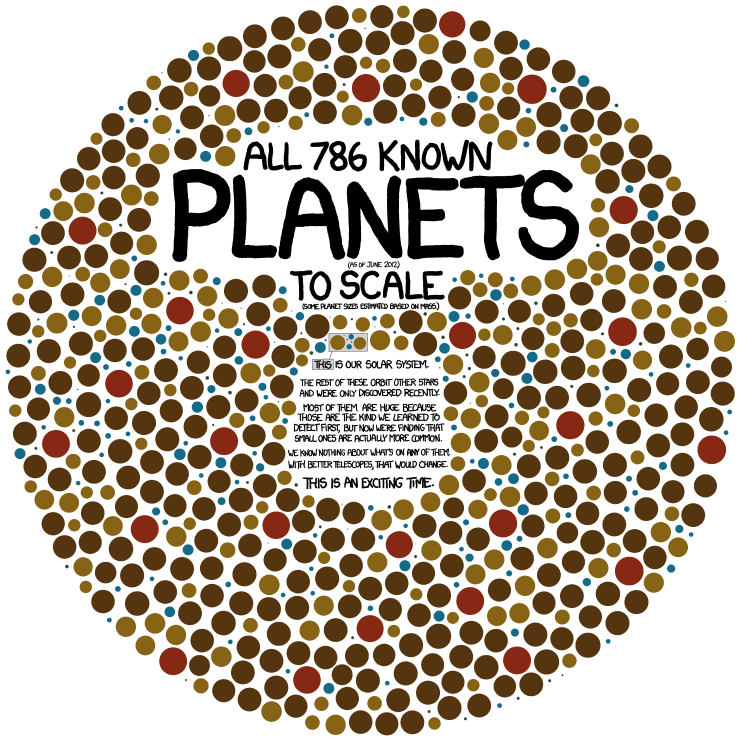
xkcd: Exoplanets

Yep, that's about right: Amazing discoveries that are now totally taken for granted.

Five ways to well-being [life extension]

There's no question that our sense of well-being is a significant contributor to our overall longevity. While it may or may not impact directly on aging, it most certainly influences the ways in which we engage in life and with others—and that most certainly impacts on our mental and physical health.

But the idea that we can actually choose to be happy is largely rejected in our society; much of Western culture is rooted in the idea that externalities control our mood and that we as individuals are merely reacting to either negative or positive stimuli. That's why the media constantly hammers us with the message that purchasing a next generation iGadget will unlock our happiness.

Fortunately, we have more control over our happiness than we think.

Back in 2008, the New Economics Foundation was commissioned by the UK Government’s Foresight Project on Mental Capital and Well-being to review the inter-disciplinary work of over 400 scientists from across the world. The aim was to identify a set of evidence-based actions to improve well-being, which individuals would be encouraged to build into their daily lives.

The NEF came up with five evidence-based ways to well-being:
  1. Connect: Make an effort to be social, whether it be with friends, colleagues or neighbors
  2. Be Active: Make an effort to be more physical, whether it be walking, running, cycling, dancing, whatever
  3. Take notice: Stop sleepwalking and start being curious, inquisitive, and mindful; savour the little things
  4. Keep learning: Learn a new skill, rediscover an old hobby, push past your comfort zones and what you think you know
  5. Give: Do something nice for a friend or stranger, volunteer your time; see yourself linked to the wider community
The NEF suggests that we try to engage in all five of these activities over the course of each day.

Seems simple, no? Go for it—choose to be happy. And live a longer, happier life.

Happy planet

It has been very encouraging to see the recent increase in attention given to happiness and well-being studies. It's about time we started measuring these things—and started making our governments more responsible and accountable in these areas. Studies are increasingly revealing that gains in GDP and overall wealth are not having an impact on our personal well-being. It would seem that the capitalist interpretation of the 'pursuit of happiness' is just that: a perpetual quest for an illusory goal that leaves us unsatisfied.

While seemingly counterintuitive, it seems that beyond at certain Maslovian point where our basic needs are met we hit a peak in our relative happiness. As behavioral economist Daniel Kahneman has revealed, once we hit $60,000 a year in salary we reach a kind of plateau with respect to the happiness of the experiencing self. It doesn't matter if you make $120,000 a year or $500,000 a year—according to his research you're going to be just as happy if you were making $60,000.

You should stop and think about that for a moment. That's a pretty amazing revelation.

Sure, you can convince yourself that you'd be happier in those higher salary ranges, but you'd be going against empirical data that suggests otherwise. What makes you think you'd be a special case?

Speaking of Kahneman, his TED Talk is one of the best out there:


Also along these lines is the Happy Planet Index (HPI), which measures human well-being and environmental impact. The HPI was introduced by the New Economics Foundation (NEF) in July 2006 and was designed to challenge well-established indices of countries’ development, such as Gross Domestic Product (GDP) and the Human Development Index (HDI), which are seen as not taking sustainability into account. According to the HFI, the five happiest countries in the world are Costa Rica, the Dominican Republic, Jamaica, Guatemala, and Vietnam—not exactly your G8 type of nations.

Statistician Nic Marks thinks he knows what's going on. Like so many others these days, he is starting to ask why we measure a nation's success by its productivity —instead of by the happiness and well-being of its people. This is why he introduced the HPI. Moreover, he believes that a happy life doesn't have to cost the earth.

Marks argues that quality of life is measurable, and that true contentment comes not from the accumulation of material wealth but from our connections with others, engagement with the world, and a sense of autonomy. To back his claims, Marks has created statistical methods to measure happiness, analyzing and interpreting the evidence so that it can be applied to such policy fields as education, sustainable development, healthcare, and economics.

You'll want to check out his recent TED talk:


The HPI is not perfect (it ignores issues like political freedom, human rights and labor rights, for example), but Marks is on the right track. It's about time we started shelving the Puritan Work Ethic in favor of those things that will truly improve the subjective quality of our lives.

August 28, 2010

Science to the rescue! Helping the Chilean miners survive their ordeal

Quite a story developing in Chile: the 33 miners who are trapped 700 meters underground will have to wait about four months before they are rescued. That's obviously not going to be easy on the men who have been trapped for over 18 days already. Keeping it together psychologically, physically and socially for that extent of time will undoubtedly prove challenging.

But this is where science can step in and help. While this incident is dreadful for all those involved, it'll be an extraordinary opportunity to apply our knowledge and help these guys cope with the extreme isolation — and at the same time learn from it. The whole experience will serve as an important case study across several scientific disciplines.

This is why NASA has been called in to help. The space agency obviously has tremendous experience and expertise managing extended bouts of isolation, both from physiological and psychological perspectives. While it's still early days, NASA has already recommended that the men keep exercising and adopt a routine where days are separated from nights.

As noted, the two primary areas of concern are the men's physical and psychological health. While food and supplies are now being routed through a six inch tunnel, there are still extreme limitations in terms of limited social contact and the problem of having so many men live in such close quarters. They are living without natural sunlight and the temperature is hovering around 29.5°C (81°F).

Compounding this is the stress the men must feel; avoiding an impending sense of doom and bouts of claustrophobia can't be easy. I myself suffer from mild claustrophobia and my stomach tightens at the very thought. As of today, at least five of the men are experiencing severe depression. Chilean officials have already sent down anti-depressants to help the miners cope — though the miners have reportedly asked for some beer. Advisors have made it clear that the men, in order to keep it together, must maintain a healthy sense of optimism. How this can be achieved is easier said than done, but regular contact with the surface and frequent updates about the rescue effort will go a long way.

From a social psychology standpoint, it's interesting to note that the men appear to be in good spirits. They've also put the Lord of the Flies myth to rest; soon after the ordeal started they began organizing themselves. They're holding daily meetings, assigning tasks, and portioning out rations (they actually made three days of rations last 17 days). Their ability to self-organize and maintain order given such extreme circumstances is proving to be as fascinating as it is praiseworthy.

NASA has suggested that the miners do regular exercises to prevent muscle atrophy as they await extraction. This will prove beneficial from not just a health standpoint, but from a psychological one as well; it's well documented that exercise tends to improve mood. There's also word that, in addition to food and medicine, other items such as flashlights and games are being sent down. It's also very likely that they will be given sun lamps to help simulate natural sunlight. Otherwise, it's very likely that Seasonal Affective Disorder (SAD) will kick in.

Scientists will undoubtedly learn from this episode and eventually apply the learnings to such things as a future expedition to Mars. The data will likely compliment that of the Mars isolation study currently underway in Russia. In this experiment, a crew of six volunteers are isolated from the outside world in a space measuring just 550 cubic meters.

Again, I hope that everything will turn out for the best and that this story has a happy ending.